G is for greenish blue

G for greenish blue. I am blogging A to Z about artists, particularly women artists and mostly about my mother, Helen Burling Ottaway.

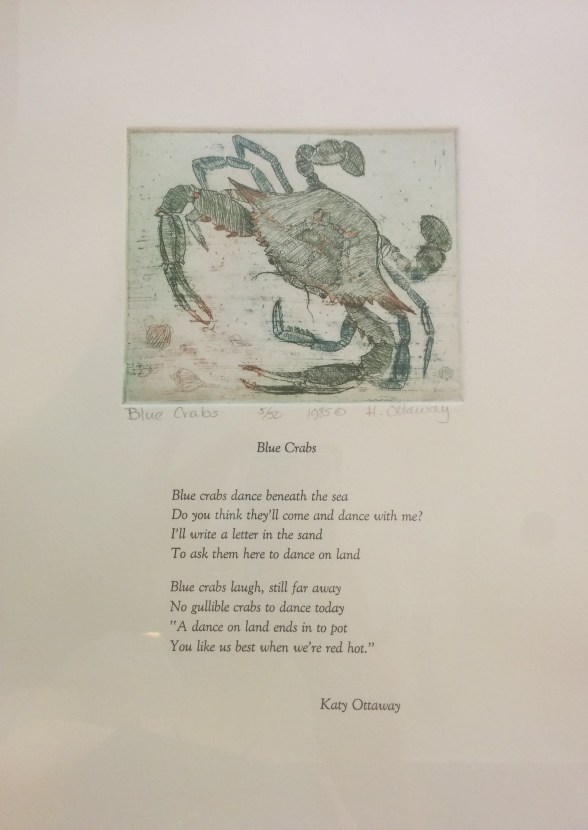
Greenish blue is a stretch, but this is a blue crab. They are greenish blue. I wrote the poem and my mother did the etching. I was thinking of a cooked crab, but H. Ottaway did a live crab. I went with her to the crab restaurant, where she explained that we wanted one live crab. “One live crab?” said the restaurateur. “Yes, one live crab.” The owner shook her head, but sold us one live crab.

At home, my mother got the crab out and put it on the floor. The cat was intrigued. The crab was NOT happy. I took photographs of her drawing the crab and making the etching. Apologies for the reflections but I am not at home, so I can’t retake these!

Three photographs: Helen Ottaway drawing a blue crab on the floor, the crab and Helen running an etching on the press.

You can see the crab and her drawing it, as well as the etching press. I took the photographs in the mid 1980s.

Our poem/etching collaboration was a delight! She said that she would illustrate poems as long as they rhymed. “No free verse,” she said. “I don’t like it.” So, the poems had to rhyme. We did ten different ones. I am so glad that we did, since we didn’t have nearly enough time together!

ATOZBLOGGINGCHALLENGE2022 #art #Women artists #Helen Burling Ottaway #ATOZCHALLENGE

within normal limits

I think doctoring makes one cynical. Or at least messes up the scale of normal.

Maybe there are Marcus Welby docs out there, but I don’t know any. Doctoring messes up one’s scale. A wound is compared to black horrifying gangrene to the knee, pain is compared to screaming delirium tremens or full thickness burns or heroin withdrawal, one in four adults can be diagnosed with a psychiatric disorder at some time in their life…. so then, what is normal?

What is normal for relationships? How many deeply happy marriages do you know? If half end in divorce, what are the odds?

Where is the line in love? Where is the line between loving the other person no matter what and wait, that is domestic violence. Where is the line for abuse? Do people agree on it?

No. They do not. What I think is behavior that is frightening may be normal behavior to my partner. Is it ok to drink until one is drunk? I don’t want to be around it. I saw enough of that shit at work. I deal with addiction daily. If someone wants to get drunk, they can choose to do that. But not around me. And no, I don’t want to date them. And if they are working themselves to death, is that ok? Well, I might be a tad hypersensitive to that, since I nearly managed that myself. So I don’t want to be around that either. That might be viewed as noble self-sacrifice. But at work, I see the caregiver die before the recipient of the care, all too often. Especially in older couples, where neither one wants to let anyone in the house to help….

….but then, some people do hear me. A woman thanked me last year for saying she should quit covering for her husband. She was afraid, but backed off. He is able to do more than she expected and he also is more respectful and kind to her. She thanked me and I got all shy and tongue-tied.

My definition of love is listening. Someone who listens and hears and lets me listen and hear. When each person can say what they are thinking and feeling and wanting and worried about…. because if only one person is speaking, if only one person is determining what the relationship is, it is not a relationship.

Take down

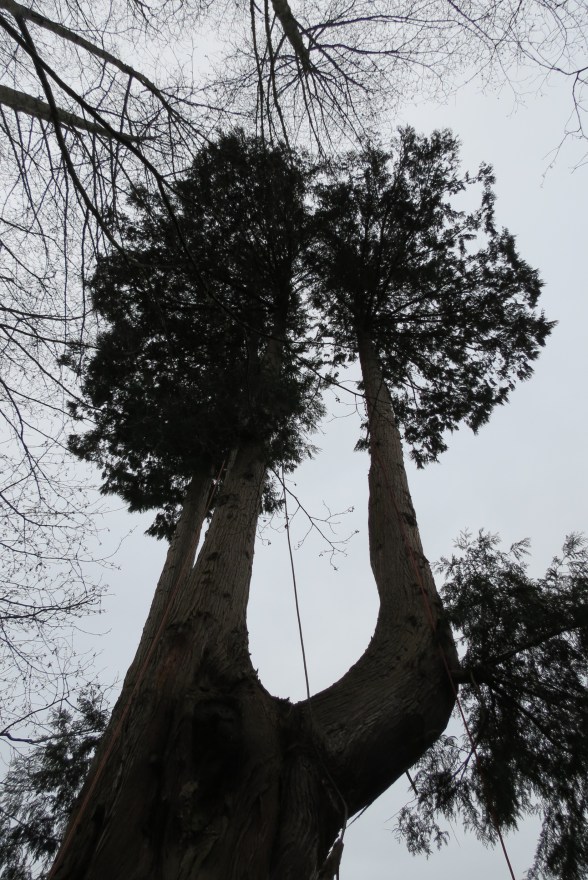
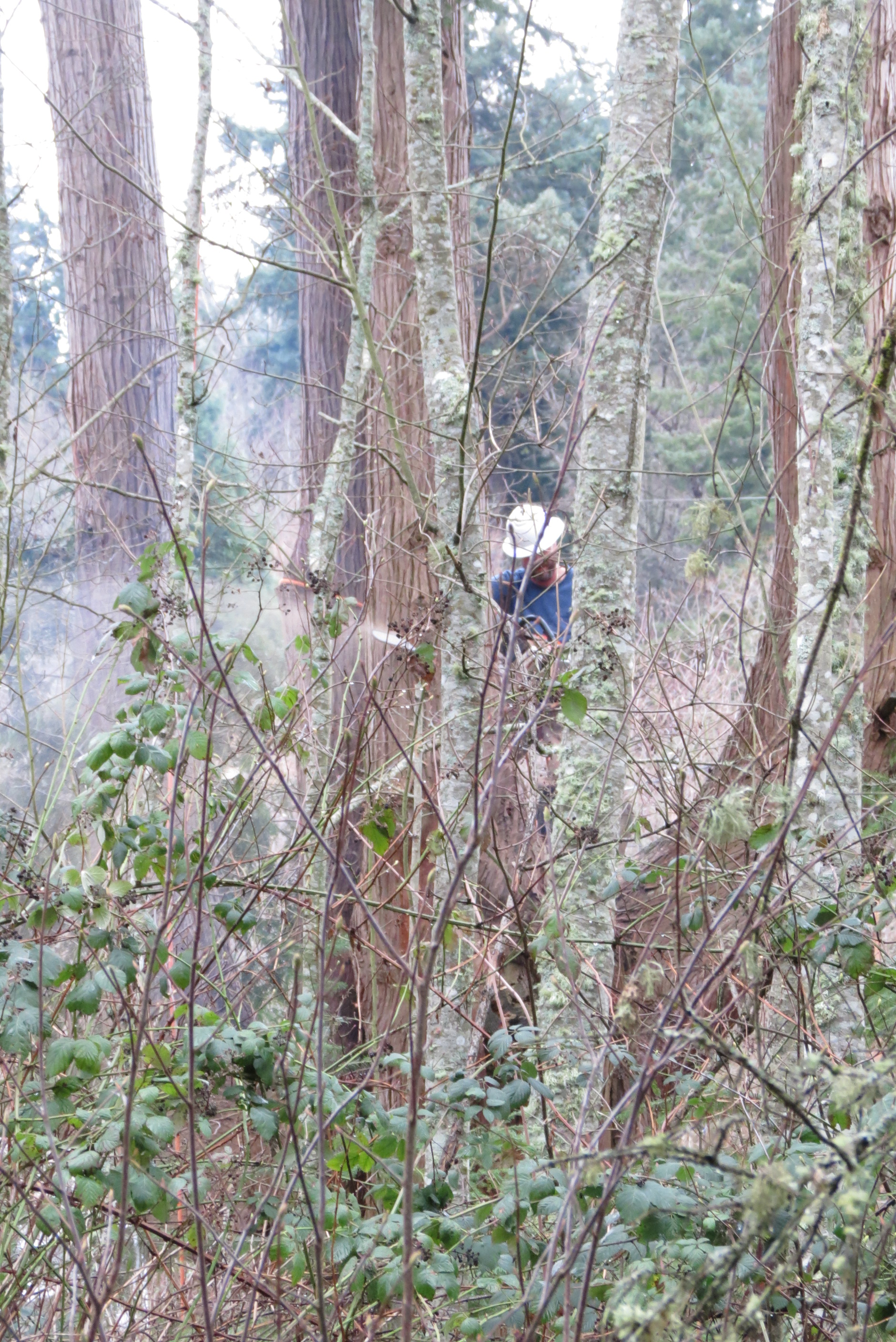
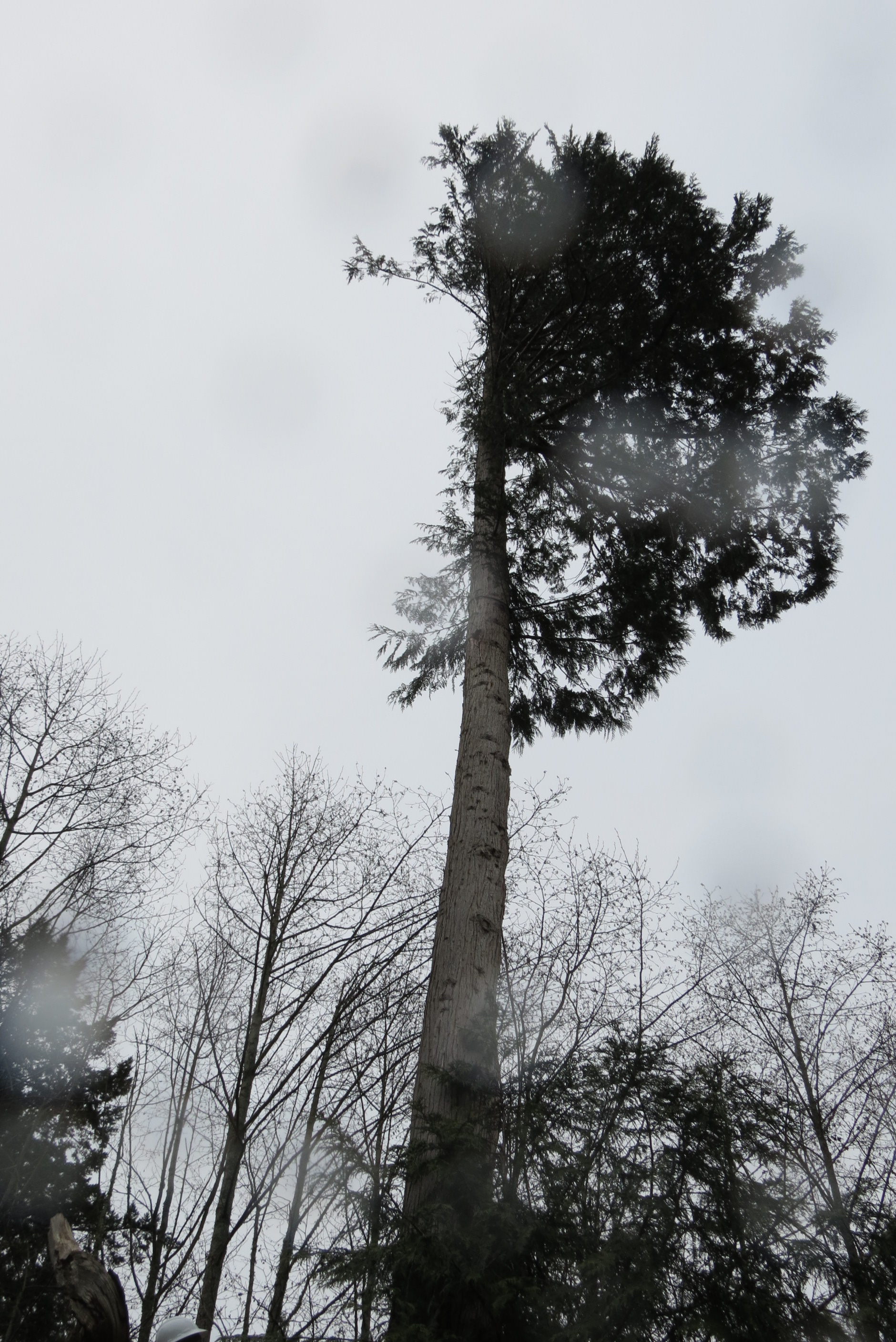
This is a beautiful living cedar.

Unfortunately, the trunk, twenty feet high, had split in half in high winds. So now it was a very dangerous very tall living cedar that is going to come down and is right next to a house.

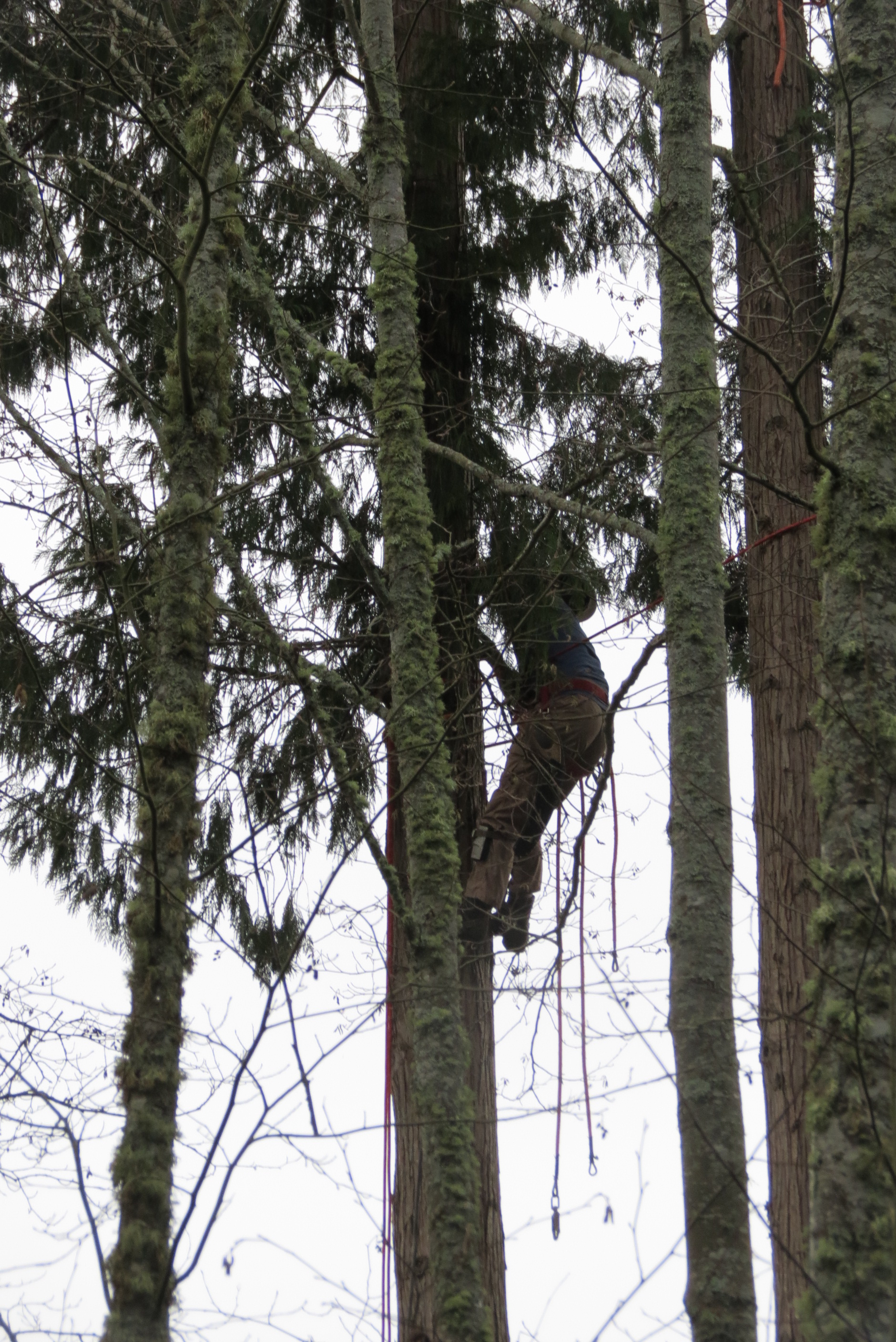
An expert was consulted. He said the tree could not be taken down intact. Each of the four tall trunks would have to come down individually. This is terribly dangerous, because felling trees is dangerous enough, but when you are up IN the tree, it is worse.

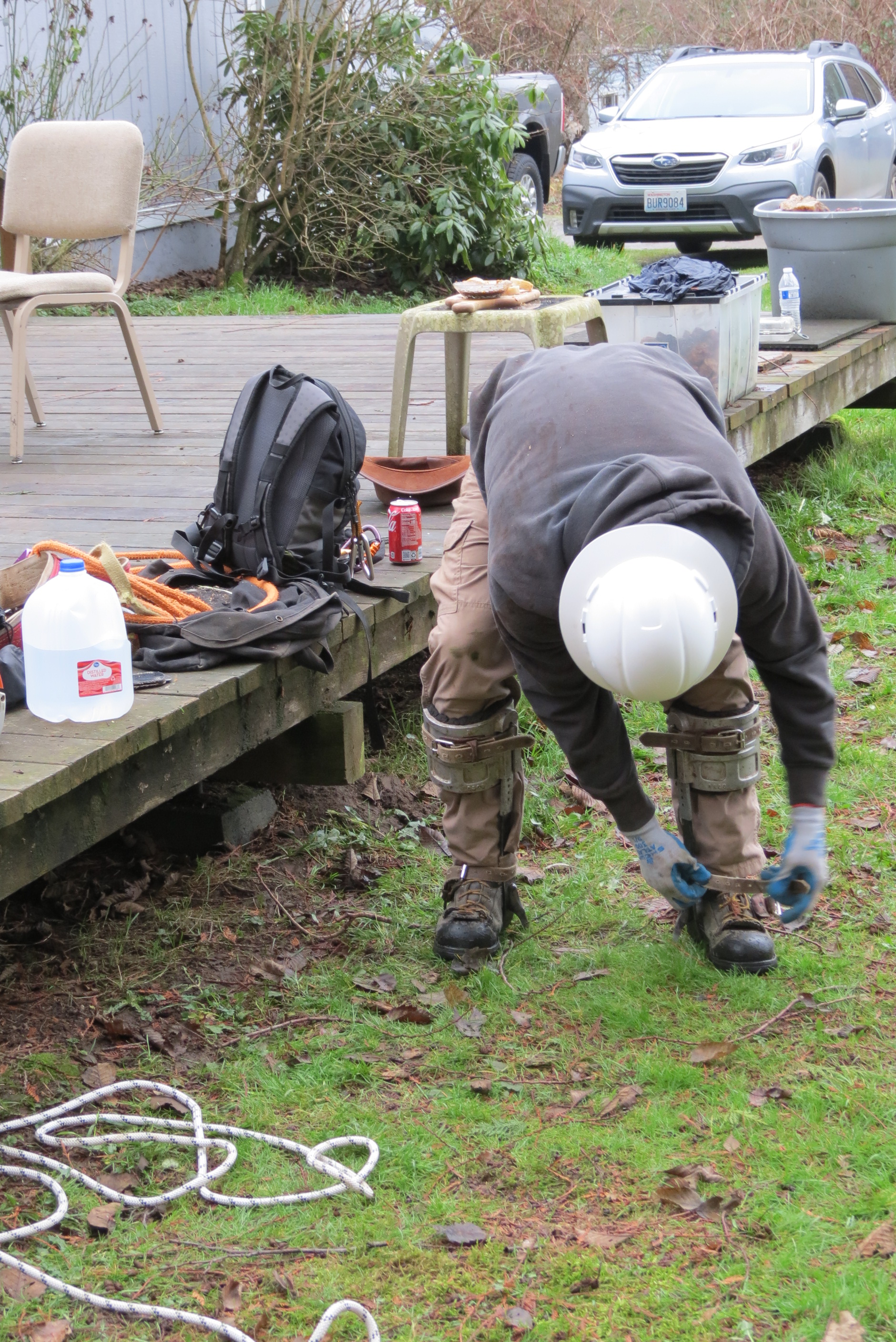
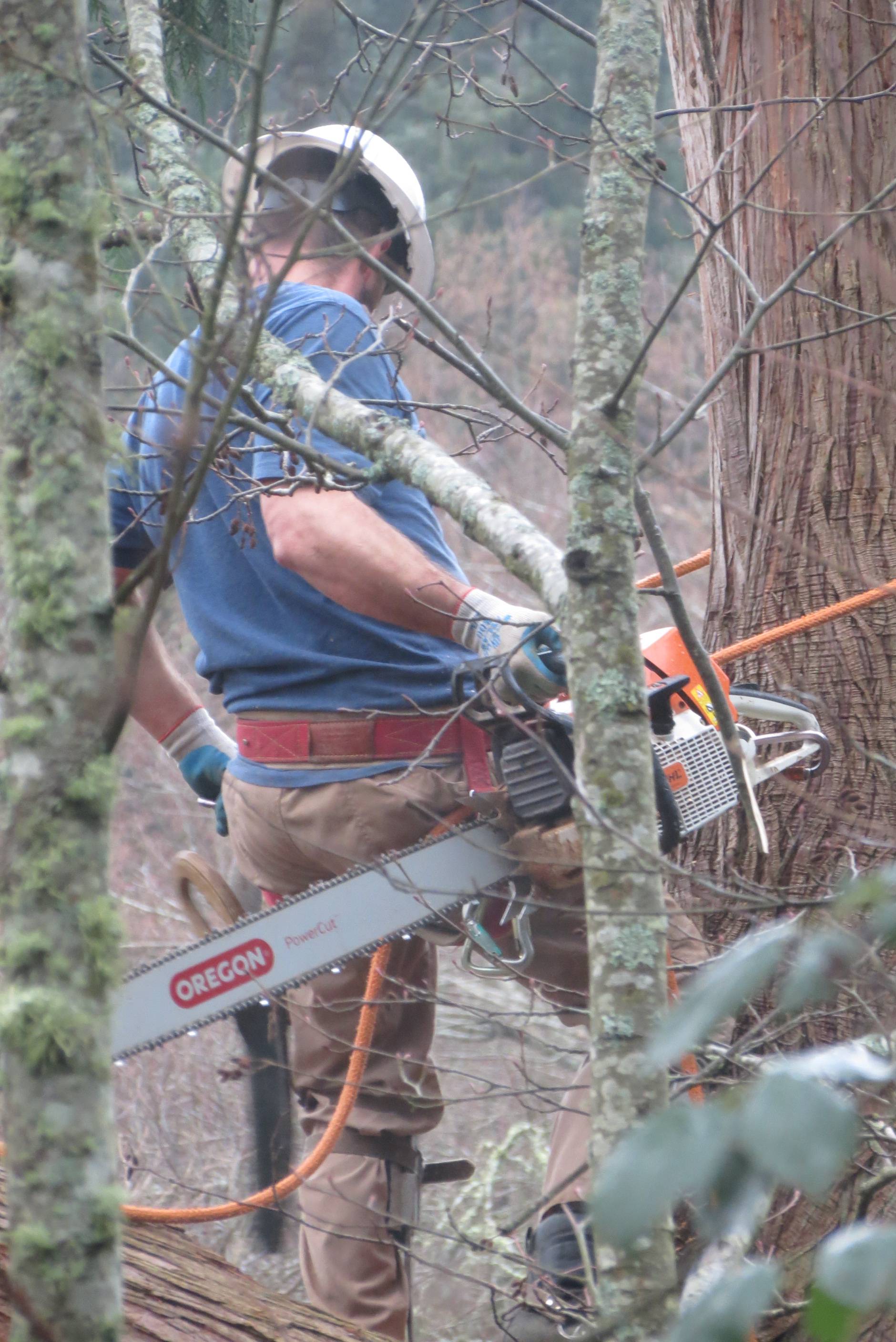
Gear for the take down.

There are four men and me. I am there with a camera. I do not help at all, I just try to stay well out of the way.

I am filming with a zoom lens from a nearby hill. They are trying to control the direction of the fall. Not on me or the house or any of them.
One down, three to go. When the top starts falling, it accelerates very quickly and crashes. He is trying to stay out of the way.
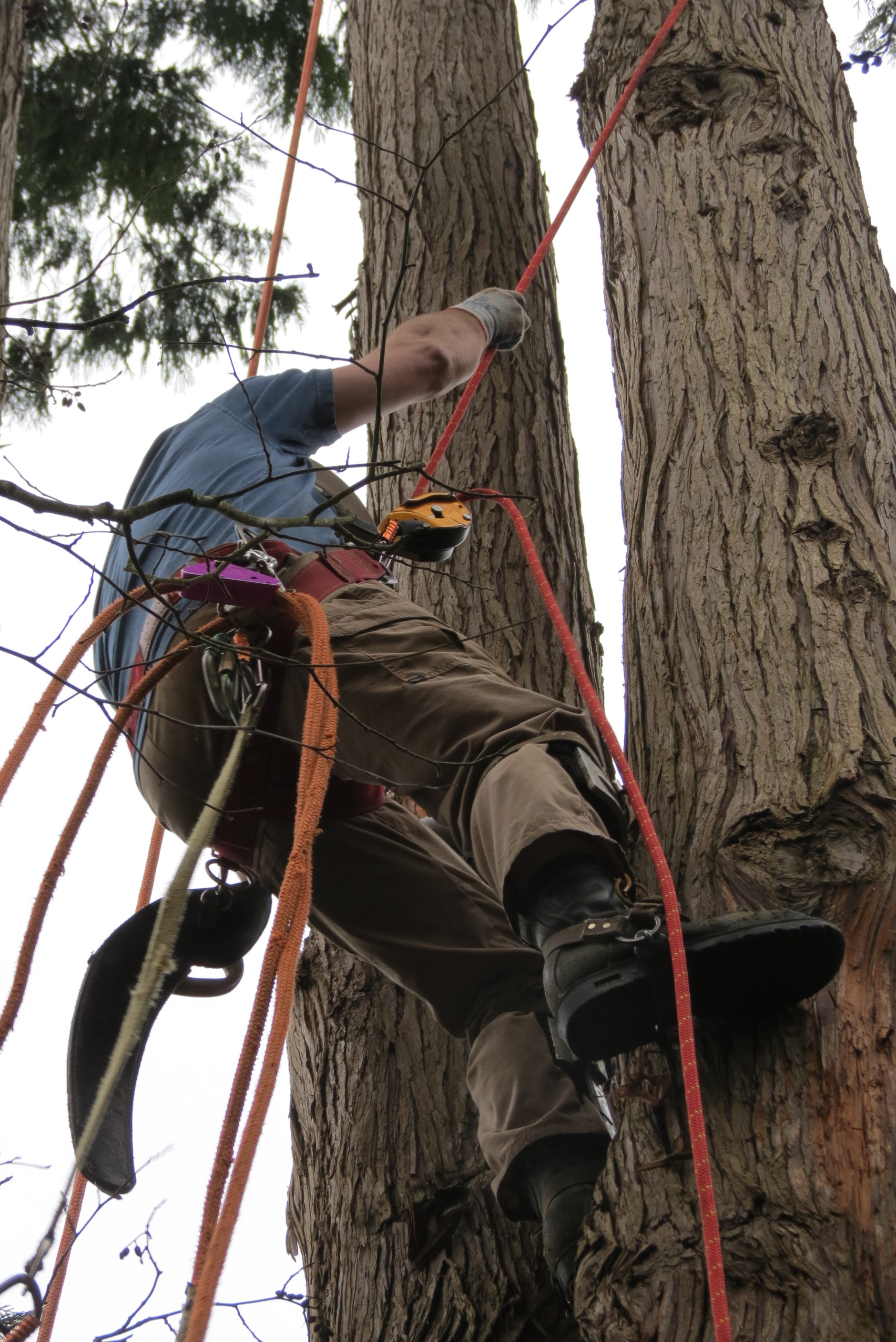
Going up to attach the cable high up to guide the fall direction.
Way up.
The falls take out smaller trees, but are controlled. It is raining.
Two trunks left.
Studying trunk three.
One left.
The last one is down. The trunk is still alive, with the split.
A closer view of the split trunk.

When the last trunk fell, it swung towards me and they shouted “Run!” It had slipped of the trunk and can’t be controlled as well even though there was a cable and a machine pulling in the desired direction. I ran and I am still here, thankfully.

Clean up on another day and the cedar goes to the sawmill.

For the Ragtag Daily Prompt: WAR. I wish we were all just working and there was no war.

No names or faces, because you know, those loggers are shy and wild, right?

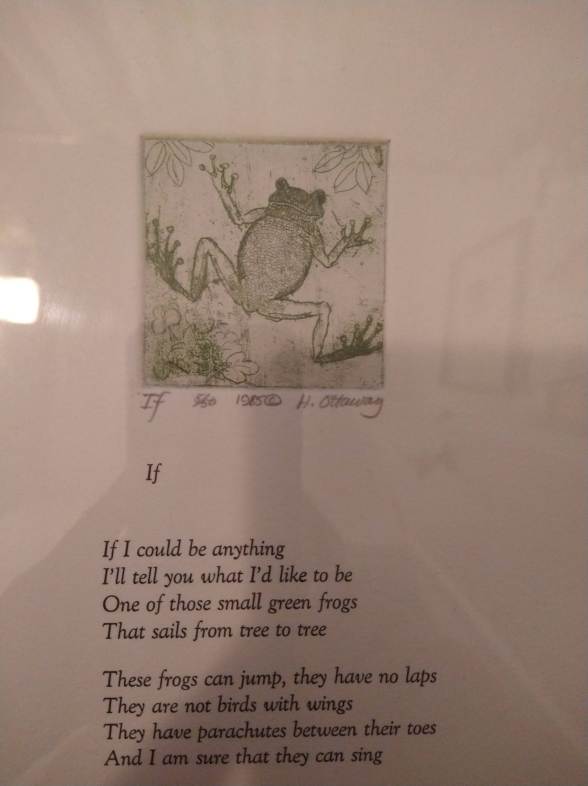
If

This is one of the ten poems that my mother made etchings for, the year I was just done with college. 1983-4. I wanted to write, but had no idea what to do with the poems that I was writing. My mother Helen Burling Ottaway had done a series of etchings with a family friend’s poems, so I asked if she would do the same with me. She said, “Yes, on one condition.” “What is that?” “They have to rhyme.” She did not like the free verse. Almost all of the poems were about animals, except for one about my sister. Another friend printed the poems on a lead type press and then my mother worked on editions numbered 1-50 of each, inking the plate separately for each one. This one is number 5/50. You can see the imprint of the plate on the paper in the photograph.

If I could be anything
I’ll tell you what I’d like to be
One of those small green frogs
That sails from tree to tree

These frogs can jump, they have no laps
They are not birds with wings
the have parachutes between their toes
And I am sure that they can sing

They spread their toes and jump so high
To float like snowflakes in the air
Frogs fall like rain from clear blue skies
It must be nice up there

Why they jump I do not know
Maybe escaping hungry eyes
Perhaps to catch a tender bug
Or they just like to fly

If I could be anything
I’ll tell you what I’d like to be
One of those small green frogs
That sails from tree to tree.

What I learned from my first doctor job

When I started my first job, I had a nurse and a receptionist within a bigger clinic, all primary care. Fresh out of residency. One month in I asked to meet with my nurse and the receptionist.

The receptionist brought the office manager. I was surprised, but ok.

I started the meeting. “I am having trouble keeping up with 18-20 patients with fat charts that I have never seen before, but I think I am getting a little better at it. What sort of complaints are you hearing and how can we make it smoother?”

The office manager and the receptionist exchanged a look. Then the office manager excused herself.

Weird, I thought.

The three of us talked about the patients and the flow and me trying to keep up. About one third were Spanish speaking only and I needed my nurse to translate. That tended to gum things up a bit, because she could not be rooming another patient or giving a child vaccinations.

I thanked them both and the meeting broke up.

Later I found that the office manager had been brought in because another doctor tended to manage by yelling and throwing things. And another doctor had tantrums. So the receptionist was afraid of me and had asked the office manager to stay. The moment they realized that it was collaborative and I was asking for feedback and help, the receptionist was fine without the office manager.

That was an interesting lesson on working with people. I had been very collaborative with the nurses and unit secretaries in residency. As a chief resident, I told my Family Practice residents to treat the nurses and unit secretaries and in fact everyone, like gold. “They know more than you do and if you take care of them, they will save your ass!” The unit secretaries would go out of their way to call me in residency. “Mr. Smith is not getting that ultrasound today.”

“Shit. Why not? What the hell?” I would go roaring off to radiology to see what the hold up was.

The unit secretaries did not help the arrogant residents who treated them like dirt.

I thought it takes a team. I can’t do my work without the nurse, the pharmacist, the unit secretary, the laundry, the cafeteria workers, the administration. It takes the whole team. I value all of them.

phoenix rising

Written in 2009.

Set a torch to me
Why don’t you?

It’s not the tearing sound of fabric
A small rip
And now a tear
That I feel

It’s the torch

I’ve been here before
A job where the idealistic came
As moths to the flame
Self-immolation
Because they had ideals

I watched and burned and rose

It’s the torch
The flames that rise
As the witch is burned
Tilts back her head
In ecstasy and knowledge
Eager to learn what she can
From these burning brands

In the burning we learn
In pain we learn
If we can remain open
Ashes fall to the ground
Buckets of water
Wash any remains to grey mud
Gone, punished
Relief for the frightened
An example has been set

No but what stirs at night
Moon or none
What rises from the mud
The ashes
Takes form
Takes flight
Laughing

Set a torch to me
Why don’t you?
And see what is created

Adverse Childhood Experiences 12: welcome to the dark

Welcome to the dark, everyone.

When you think about it, all the children in the world are adding at least one Adverse Childhood Experience score and possibly more, because of Covid-19. Some will add more than one: domestic violence is up with stress, addiction is up, behavioral health problems are up, some parents get sick and die, and then some children are starving.

From the CDC Ace website:

“Overview:Adverse Childhood Experiences (ACEs) are potentially traumatic events that occur in childhood. ACEs can include violence, abuse, and growing up in a family with mental health or substance use problems. Toxic stress from ACEs can change brain development and affect how the body responds to stress. ACEs are linked to chronic health problems, mental illness, and substance misuse in adulthood. However, ACEs can be prevented.”

Well, can they be prevented? Could Covid-19 be prevented? I question that one.

I have a slightly different viewpoint. I have an ACE Score of 5 and am not dead and don’t have heart disease. I spent quite a bit of time thinking about ACE scores and that it’s framed as kids’ brains are damaged.

I would argue that this is survival wiring. When I have a patient where I suspect a high ACE score, I bring it up, show them the CDC web site and say that I think of it as “crisis wiring” not “damaged”. I say, “You survived your childhood. Good job! The low ACE score people do not understand us and I may be able to help you let go of some of the automatic survival reactions and fit in with the people who had a nice childhood more easily.”

It doesn’t seem useful to me to say “We have to prevent ACE scores.” Um. Tsunamis, hurricanes, Covid-19, wars… it seems to me that the ACE score wiring is adaptive. If your country is at war and you are a kid and your family sets out to sea to escape, well, you need to survive. If that means you are guarded, untrusting, suspicious and wary of everyone, yeah, ok. You need to survive. One of my high ACE Score veterans said that the military loved him because he could go from zero to 60 in one minute. Yeah, me too. I’ve worked on my temper since I was a child. Now it appears that my initial ACE insult was my mother having tuberculosis, so in the womb. Attacked by antibodies, while the tuberculosis bacillus cannot cross the placenta, luckily for me. And luckily for me she coughed blood at 8 months pregnant and then thought she had lung cancer and was going to die at age 22. Hmmm, think of what those hormones did to my wiring.

So if we can’t prevent all ACE Scores, what do we do? We change the focus. We need to understand crisis wiring, support it and help people to let go of the hair trigger that got them through whatever horrid things they grew up with. 16% of Americans have a score of 4 or more BEFORE Covid-19. We now have a 20 or 25 year cohort that will have higher scores. Let’s not label them doomed or damaged. Let’s talk about it and help people to understand.

I read a definition of misery memoirs today. I don’t scorn them. I don’t like the fake ones. I don’t read them, though I did read Angela’s Ashes. What I thought was amazing about Angela’s Ashes is that for me he captures the child attitude of accepting what is happening: when his sibling is dying and they see a dog get killed and he associates the two. And when he writes about moving and how their father would not carry anything, because it was shameful for a man to do that. He takes it all for granted when he is little because that is what he knows. One book that I know of that makes a really difficult childhood quite amazing is Precious Bane, by Mary Webb. Here is a visible disability that marks her negatively and yet she thrives.

A friend met at a conference is working with traumatic brain injury folks. They were starting a study to measure ACE scores and watch them heal, because they were noticing the high ACE score people seem to recover faster. I can see that: I would just say, another miserable thing and how am I going to work through it. Meanwhile a friend tells me on the phone that it’s “not fair” that her son’s senior year of college is spoiled by Covid-19. I think to myself, uh, yes but he’s not in a war zone nor starving nor hit by a tsunami and everyone is affected by this and he’s been vaccinated. I think he is very lucky. What percentage of the world has gotten vaccinated? He isn’t on a ventilator. Right now, that falls under doing well and also lucky in my book. And maybe that is what the high ACE score people have to teach the low ACE score people: really, things could be a lot worse. No, I don’t trust easily and I am no longer feeling sorry about it. I have had a successful career in spite of my ACE score, I ran a clinic in the way that felt ethical to me, I have friends who stick with me even through PANDAS and my children are doing well. And I am not addicted to anything except I’d get a caffeine headache for a day if I had none.

For the people with the good childhood, the traumatic brain injury could be their first terrible experience. They go through the stages of grief. The high ACE score people do too, but we’ve done it before, we are familiar with it, it’s old territory, yeah ok jungle again, get the machete out and move on. As the world gets through Covid-19, with me still thinking that this winter looks pretty dark, maybe we can all learn about ACE scores and support each other and try to be kind, even to the scary looking veteran.

Take care.

Fuzzy Poet Doctor and the small child

I think I finally understand what I have been doing in clinic all these years. And not just in clinic. As a theory it explains both why patients, nurses, hospital staff and specialists really really like me and my fellow Family Practice doctors, particularly the males, and the administrators, really really do NOT like me.

I am on a plane flying to Michigan a few weeks ago. Double masked. N95 with another mask over it. Sigh.

A friend keeps saying that he can see into me. He can, but he can see thoughts. Not feelings. I am wondering if I see feelings. But I see the stuffed feelings particularly, the ones that people keep hidden. They are like clouds.

And then I think, oh.

I automatically scan any new person for their small child. The inner small child, who is often damaged and hidden. The small child is hidden under those stuffed feelings, which I think of as monsters. In Ride Forth, I am writing about pulling every monster feeling that I can find stuffed out and letting myself feel them. And that people do not like seeing me like that. Their monsters attack me!

Except that the monsters don’t attack. The monsters come to me and say, “Please, please, help me. I want out. The small child needs to heal.” The monsters lie their monstrous heads in my lap and weep.

Now WHY would I develop this skill? That is weird.

I develop it because my parents both drink. The myth in the family is that it was my father. But my mother’s diaries and also her stories make it clear that she drank heavily too. I think they were both alcoholics. And she told two stories about me trying to get someone to get out of bed to give me food as a toddler. As jokes. But it is not a joke. I have food insecurity. At every meal, I think of the next one and whether there is food available. My daughter has it too….. epigenetics.

I think that the only way I could love my parents was to have compassion for them. Once you see another person’s damaged small child, then how can you not feel compassion for them?

With patients I learned to be very very delicate and gentle about asking about the cloud. Just gently. Sometimes people open up on the first visit. Sometimes they shut tight like a clam and I back off. Sometimes they return the next visit or the 3rd or the 8th or after a couple years… and say, “You asked me about this.”

It’s nonverbal communication. The reason why I take the WHOLE history MYSELF at the first visit is for the nonverbal communication. When the person doesn’t want to answer a question, veers away from a topic, switches subjects: there is my cloud. That is where the hurt is. That is where the pain is.

The first cracks in the United States medical system collapse are appearing. Not doctors quitting, not nurses, but medical assistants. Here is an article about how clinics all over can’t hire medical assistants. Because there are tons of jobs, employers are offering more money, why would you do a job where you may well be exposed to covid-19 if you can do something else? And make as much money or more….

The cracks will widen. Ironically doctors are doing what I have done for the last ten years: “rooming” the patients themselves. Ha, ha, good may come out of it, after the disaster. Which is getting worse fast. If people don’t put their masks on and don’t social distance and don’t get vaccinated, I predict more deaths in the US this winter then last winter. Sigh. And in the US we will run out of medical assistants, doctors and nurses.

It is ok to gently ask a patient about that cloud. It is not polite to “see” it in a Family Medicine colleague or and administrator. I can’t “not see” it. I can’t turn it off. However, on the plane my behavior changed even before I could put all of this into words. The words are that I have to be as gentle with everyone as I am with patients.

And the trip felt so odd. I was putting this into effect before I had words. That is how my intuition works. But everyone, absolutely everyone, was kind to me on the trip. A Chicago policeman helped me in the train station and was super kind. It was weird, weird, weird, with bells on. It took me a few more days to be able to put it into words.

Problem intuited, after 60 years of study. Implementation of solution proceeds immediately. Logical brain struggling to catch up, but results satisfactory long before logical brain gets a handle on it.

Pretty weird, eh? I think so. My doctor said that an episode of Big Bang Theory could be written just by following me around for a day. I think it was both saying that I am smart AND that I have no social skills. But I have implemented the social skills program already. She’s just upset that I gave her justifiable hell two visits ago and also…. I do hide my brain. Because sometimes colleagues are jealous.

But maybe they should not be jealous. Maybe they can learn it too. Maybe I can teach. Maybe….
Mask refusal in the 1918-1919 influenza pandemic

This is from an article about the history of medicine, about people refusing to wear masks in the 1918-1919 influenza pandemic:

“Adherence is based on three concepts: individualism versus collectivism; trust versus fear; and willingness to obey social distance rules. Jay Van Bavel opines that some countries tend to be more individualistic,16 and therefore more likely to reject rules and ignore attempts by public health authorities to “nudge” behavior change with risk messages or appeals for altruism. In collectivist cultures, people are more likely to do what is deemed best for society. Trust and fear are also significant influences on human behavior.17 In countries with political division, people are less likely to trust advice from one side or the other and are more likely to form pro- and anti- camps. This may also undermine advice issued by public health professionals. The last and most difficult to attain is social distancing. Human beings are social animals with bodies and brains designed and wired for connection. A pandemic, in many ways, goes against our instinct to connect. Behavioral psychologist Michael Sanders argues that if everybody breaks the rules a little bit, the results are not dissimilar to many people not following the rules at all.18

From another article:

“It was the worst pandemic in modern history.

The 1918 influenza virus swept the globe, killing at least 50 million people worldwide.

In the US, the disease devastated cities, forcing law enforcement to ban public meetings, shut down schools, churches, and theaters, and even stop funerals.

In total, 675,000 Americans died from the Spanish flu, named after the disease’s early presence in Spain.”

I read a book on the 1918-1919 influenza. It started in the U.S. The photograph that haunts me is the bodies stacked five deep in the hallways of San Francisco Hospitals.

And in a third article:

“The scenes in Philadelphia appeared to be straight out of the plague-infested Middle Ages. Throughout the day and night, horse-drawn wagons kept a constant parade through the streets of Philadelphia as priests joined the police in collecting corpses draped in sackcloths and blood-stained sheets that were left on porches and sidewalks. The bodies were piled on top of each other in the wagons with limbs protruding from underneath the sheets. The parents of one small boy who succumbed to the flu begged the authorities to allow him the dignity of being buried in a wooden box that had been used to ship macaroni instead of wrapping him a sheet and having him taken away in a patrol wagon.”

A CDC article about the history of the 1918-1919 influenza says this:

“The fully reconstructed 1918 virus was striking in terms of its ability to quickly replicate, i.e., make copies of itself and spread infection in the lungs of infected mice. For example, four days after infection, the amount of 1918 virus found in the lung tissue of infected mice was 39,000 times higher than that produced by one of the comparison recombinant flu viruses.14

Furthermore, the 1918 virus was highly lethal in the mice. Some mice died within three days of infection with the 1918 virus, and the mice lost up to 13% of their body weight within two days of infection with the 1918 virus. The 1918 virus was at least 100 times more lethal than one of the other recombinant viruses tested.14 Experiments indicated that 1918 virus’ HA gene played a large role in its severity. When the HA gene of the 1918 virus was swapped with that of a contemporary human seasonal influenza A (H1N1) flu virus known as “A/Texas/36/91” or Tx/91 for short, and combined with the remaining seven genes of the 1918 virus, the resulting recombinant virus notably did not kill infected mice and did not result in significant weight loss.14

The 1918-1919 influenza virus was sequenced and studied in 2005. We did not have the tools before that. Frozen bodies were exhumed with the permission of Inuit tribes to find the virus.

Later, that same article talks about future pandemics:

“When considering the potential for a modern era high severity pandemic, it is important; however, to reflect on the considerable medical, scientific and societal advancements that have occurred since 1918, while recognizing that there are a number of ways that global preparations for the next pandemic still warrant improvement.”

Let us now travel back to a worse epidemic: the plague in the Middle Ages:

“Did you know? Between 1347 and 1350, a mysterious disease known as the “Black Death” (the bubonic plague) killed some 20 million people in Europe—30 percent of the continent’s population. It was especially deadly in cities, where it was impossible to prevent the transmission of the disease from one person to another.”

I am hoping that people will awaken, get their vaccines, wear their masks and stop Covid-19 in its’ tracks, so that our death rate resembles the 1918-1919 Influenza. Not the Middle Ages plague.