Show me

I have been flying under the radar
for a long time
I want to be visible
on screen
maybe
I want to teach
Residents
Medical students


I want them to love rural medicine
as I love it
I am a pterodactyl
wanting to rise
among the AI satellites
and say
Use the telephone to reach other doctors
Listen to your patient
Listen to what they don't say
Listen to the pieces that don't fit
Let the patient teach you
Why are they really here?
It's not always a pill
Sometimes it is just
So that someone will listen
to the feelings
that our culture
denigrates
ignores
vilifies
hates
Listen
You might turn in to a pterodactyl too
Or a cross
between a modern AI manipulator
and a pterodactyl
It is good to have more tools
than a hammer
Let me show you mine
And you
show me yours

________________________

The Ragtag Daily Prompt is timid.

Argh, the formating is wrong. And WordPress has updated enough that I don’t know how to single space the parts I want single spaced! Feedback welcome!

Hmmm, used the poetry block as per Sgeoil — do I put it all in one block?

Shim Sham Shimmy

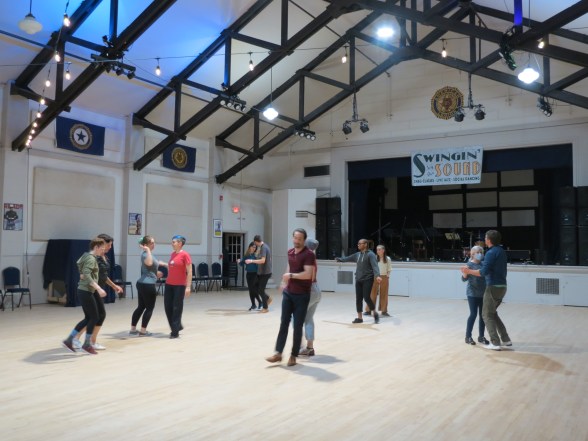
I had to choose shim as my Ragtag Daily Prompt today because I am relearning the Shim Sham!

I learned it years ago, but forgot it. Now the dance group that I hang out with on Fridays does the Shim Sham as the end of their dance evening. This is a line dance but it’s a line dance from Harlem in the 1920s and 30s. It started from tap dance. “At the end of many performances, all of the musicians, singers, and dancers would get together on stage and do one last routine: the Shim Sham Shimmy.” Here.

I am learning it from this teaching tape. The individual moves are not that hard, but it is fast and it’s the transitions that I really have to work on. It is fast enough that it has to be memorized and automatic, I can’t think about the next step.

Frankie Manning was an American dancer, instructor, and choreographer. Manning is considered one of the founders of Lindy Hop, an energetic form of the jazz dance style known as swing. I got to take lindy hop classes with him in the 1980s in the Washington, DC area, when swing and lindy hop were having a revival. It is still going on, and what better exercise is there than dance?

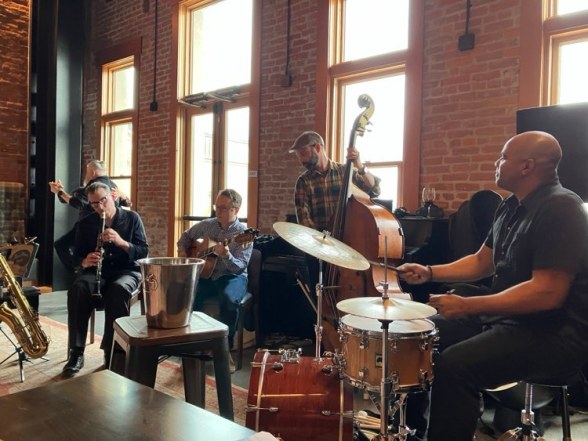
And the photograph is Jonathan Doyle and friends playing in late March 2023. I love dancing to live music!

Tongue twisters and counting rhymes

My mother taught us the tongue twisters that she learned growing up. My favorite is “the mistle thrush whistles in the thistle bush”. There are mistle thrushes in Europe but not in the United States. It is also found in temperate Asia and North Africa, here.

A counting rhyme that we learned is this:
“Intry mintry cutetry corn
Apple seed and apple thorn
Wire briar limber lock
Three geese in a flock
One flew east, one flew west
one flew over the cuckoo’s nest
Sit and sing, by the spring
One, two, three
Out goes he.”

Here is another version, from 1920: https://etc.usf.edu/lit2go/74/nursery-rhymes-and-traditional-poems/5204/intery-mintery-cutery-corn/.

We also learned some of my grandfather’s songs. A piece of this one:

Only we learned it as “chop, chop” not clap, clap. It’s like a 1960s line dance, isn’t it? Shirley Ellis, 1965.

For the Ragtag Daily Prompt: whistle.

And here is a version with the clapping:

I would bet that there are way more elaborate versions of the clapping.

Before that, a song called Little Rubber Dolly was recorded in 1930.

G6PD deficiency and diabetes

Today I follow an online trail to this article on diabetes from Nature Medicine here.

It is talking about a genetic variant that is found in people with African-American heritage called G6PDdef. This genetic pattern makes the HgbA1C test inaccurate. It will look low and “in control” even when blood sugars are high. Since the blood sugars are NOT in control, complications from diabetes can happen: damage to vision, to kidneys, to nerves in the hands and feet.

I have been reading articles about current and changing guidelines about diabetes. The current guidelines say that checking blood sugars at home doesn’t make a difference. I REALLY disagree with this and at the same time, I don’t think that physicians are approaching blood sugars in a practical manner.

I saw a man recently who is diagnosed with “insulin resistance”. His HgbA1C is in between 5.6 and 6.0. Normal is 4.5 to 5.6. Over 6.5 is diabetes. He has prediabetes. He has not checked blood sugars at all, but he is on metformin.

There is evidence that metformin is helpful, and still, I think it is putting the cart before the horse. I ask my people to go buy an over the counter glucometer. Ask for the one that has cheap strips, 6 for a dollar instead of a dollar apiece. Then we go over the normal and abnormal blood sugar ranges and I ask them to start checking blood sugars. If I give them a medicine right away, they don’t learn how to control their blood sugar with diet. ALL of my patients can figure out how to bring their blood sugars down with diet. If we can’t get to a good range, then we will add metformin. I do explain that the guidelines say use a medicine right away, but I ask, “Would you like to see if you can control your blood sugars with diet?” The answer is overwhelmingly “YES!” I have never had someone say no. If we do not give them the chance and explain the goals, why would they even try?

Also, I read the dietician handouts for diabetes yesterday and I am not satisfied. I do not think they explain carbohydrates well. Foods have fats, proteins, and carbohydrates, and anything that isn’t fat or protein has carbohydrates. I think of carbohydrates as a line, from ones with high fiber that do not send the blood sugar up fast, to ones that shoot it way high. At the low end is kale and lettuce and chard and celery. Then the green and yellow and red vegetables that are not sweet. Then beets and sweet peas. Next come the fruits, from blueberries up to much sweeter ones. Fruits overlap with grains: bread and pasta and potatoes and rice. The whole grains have more fiber and are slower to digest. Candy then sweet drinks (sodas are evil) and sugar.

Sugar has 15 grams of carbohydrate in a tablespoon. Kale has 7 grams of carbohydrate in a cup. That’s a pretty huge difference. A small apple has about 15 grams of carbohydrate and a large one 30 grams. Read labels for grains. There is a lot of carbohydrate in a small amount. The issue with fruit juice is that most of the fiber is gone, so the sugars are broken down and absorbed much faster. A 12 oz coke has 32 grams of carbohydrate and a Starbucks mocha has 62! I quit drinking the latter when I looked it up.

Most people with diabetes are supposed to stay at 30 grams of carbohydrate per meal, or 45 if it is a big person or if someone is doing heavy labor. Snacks are 15 grams.

Avocados are weird. They have about 17 grams of carbohydrate in a whole one, but they also have a lot of fat. They do have a lot of fiber, which surprises me.

Diet control takes a combination of paying attention to what is on the plate and serving amounts. Three servings of pasta is not going to work, unless you are out fighting forest fires or are on the swim team. Fire fighters are allotted 6000 calories a day, but most of us do not get that much exercise.

At the same time that articles are telling me that home blood sugars are not useful with a glucometer, everyone is pushing the continuous glucose monitors. I think we like technology. And other articles say that diabetes can be reversed with major lifestyle changes.

Articles: about not using home glucose checks, here. Starting metformin, here. Starting with one of the newer medicines, here.

I think people feel a lot more successful if they get a glucometer and can bring their blood sugar down by messing about with diet. I tell them to check after what they think is a “good” meal and after a “bad” one. How much difference is there? Contrast that with being handed a pill to control it, while someone talks about diet and says all the same stuff that we’ve heard for years. Nearly all of my people want to avoid more pills and are willing to try a glucometer to see if they can avoid a pill. People who have been on diabetes medicine for a while are less willing to try, but sometimes they do too. And sometimes they are surprised that some meals do not do good things for their blood sugar.

This is all type II diabetes. For type I, we have to have insulin. If type II has been out of control for a long time, sometimes those people have to have insulin too. Right now insurances will usually cover continuous glucose monitors for people with diabetes who are on insulin, both type I and II. I do hope that they really make a huge difference for those people!

The spectrum from the low carbohydrate vegetable, the green and yellow and orange ones, up to the really high simple sugar ones is also called the glycemic index. There are lists of low to high glycemic index foods. Perhaps some people with diabetes find that helpful, but I think it’s simpler to say, ok, the stuff that doesn’t taste sweet will send the blood sugar up less. Also, since we are all genetically different and then our gut bacteria and microbiome are all different, it is individualized care to say how does this person at this time respond to this food? We change over time!

There are other examples of the HgbA1C not working to track diabetes. A resident and I looked over a person with diabetes and spherocytosis. The HgbA1C was nearly normal but the blood sugars were in the 300 range. Spherocytosis is a genetic blood cell abnormality, and the red blood cells don’t live as long. People with a past bone marrow transplant also have red cells that live for a shorter time. The G6PD deficiency is thought to help people survive malaria, so persists in the population, like sickle cell anemia. Isn’t genetics fascinating?


The New Old Time Chautauqua

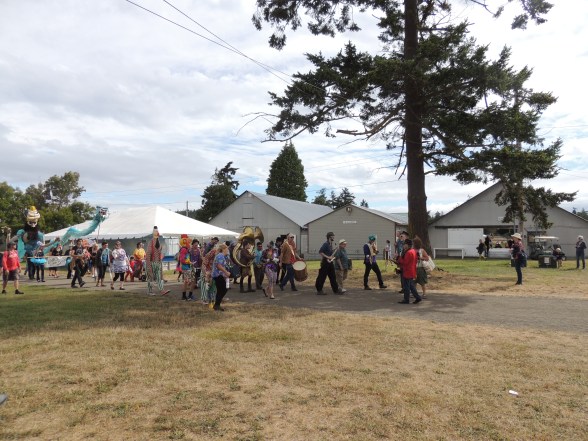
Funny how our brains work. I think of going to the other computer and then think I will look in this one for a moment. I have photographs from years past of the New Old Time Chautauqua. I open the file of Nikon photographs. There are 28 subfiles. I go to July 2018. At the end of the file, here is this motley parade. The New Old Time Chautauqua with our local Unexpected Brass Band and Other Friends.

I didn’t “know” that these photographs were even on this laptop. At least, not consciously. These are taken at the fairgrounds, August 11, 2018, in Port Townsend, Washington.

The New Old Time Chautauqua is the last one on the road. They are fundraising to go work and play with the Blackfoot Confederacy in Canada and the US. There are too many people dying from fentanyl, so the Chautauqua is part of the healing process. They are fundraising as they hit the road. I wish all of them the best.

And here is the Unexpected Brass Band at THING last year. You can hear them even if you can’t see them!

To donate to the New Old Time Chautauqua, go here. No, I mean back there. Right.

For the Ragtag Daily Prompt: Chautauqua.

Achievement

My first achievement for today’s Ragtag Daily Prompt is spelling achievement. And no, I did not spell it correctly on the first try.

My daughter has finished her first two years of teaching eighth grade, during Covid-19. She taught remotely until March of 2021 and then in person. She worked on her teaching certificate the first year and finished her Masters last month. She is SOOOO amazing!

Hooray for ALL of the teachers who continued to teach during Covid-19, remotely, in person, hugs and prayers and sending love.

Adverse Childhood Experiences 12: welcome to the dark

Welcome to the dark, everyone.

When you think about it, all the children in the world are adding at least one Adverse Childhood Experience score and possibly more, because of Covid-19. Some will add more than one: domestic violence is up with stress, addiction is up, behavioral health problems are up, some parents get sick and die, and then some children are starving.

From the CDC Ace website:

“Overview:Adverse Childhood Experiences (ACEs) are potentially traumatic events that occur in childhood. ACEs can include violence, abuse, and growing up in a family with mental health or substance use problems. Toxic stress from ACEs can change brain development and affect how the body responds to stress. ACEs are linked to chronic health problems, mental illness, and substance misuse in adulthood. However, ACEs can be prevented.”

Well, can they be prevented? Could Covid-19 be prevented? I question that one.

I have a slightly different viewpoint. I have an ACE Score of 5 and am not dead and don’t have heart disease. I spent quite a bit of time thinking about ACE scores and that it’s framed as kids’ brains are damaged.

I would argue that this is survival wiring. When I have a patient where I suspect a high ACE score, I bring it up, show them the CDC web site and say that I think of it as “crisis wiring” not “damaged”. I say, “You survived your childhood. Good job! The low ACE score people do not understand us and I may be able to help you let go of some of the automatic survival reactions and fit in with the people who had a nice childhood more easily.”

It doesn’t seem useful to me to say “We have to prevent ACE scores.” Um. Tsunamis, hurricanes, Covid-19, wars… it seems to me that the ACE score wiring is adaptive. If your country is at war and you are a kid and your family sets out to sea to escape, well, you need to survive. If that means you are guarded, untrusting, suspicious and wary of everyone, yeah, ok. You need to survive. One of my high ACE Score veterans said that the military loved him because he could go from zero to 60 in one minute. Yeah, me too. I’ve worked on my temper since I was a child. Now it appears that my initial ACE insult was my mother having tuberculosis, so in the womb. Attacked by antibodies, while the tuberculosis bacillus cannot cross the placenta, luckily for me. And luckily for me she coughed blood at 8 months pregnant and then thought she had lung cancer and was going to die at age 22. Hmmm, think of what those hormones did to my wiring.

So if we can’t prevent all ACE Scores, what do we do? We change the focus. We need to understand crisis wiring, support it and help people to let go of the hair trigger that got them through whatever horrid things they grew up with. 16% of Americans have a score of 4 or more BEFORE Covid-19. We now have a 20 or 25 year cohort that will have higher scores. Let’s not label them doomed or damaged. Let’s talk about it and help people to understand.

I read a definition of misery memoirs today. I don’t scorn them. I don’t like the fake ones. I don’t read them, though I did read Angela’s Ashes. What I thought was amazing about Angela’s Ashes is that for me he captures the child attitude of accepting what is happening: when his sibling is dying and they see a dog get killed and he associates the two. And when he writes about moving and how their father would not carry anything, because it was shameful for a man to do that. He takes it all for granted when he is little because that is what he knows. One book that I know of that makes a really difficult childhood quite amazing is Precious Bane, by Mary Webb. Here is a visible disability that marks her negatively and yet she thrives.

A friend met at a conference is working with traumatic brain injury folks. They were starting a study to measure ACE scores and watch them heal, because they were noticing the high ACE score people seem to recover faster. I can see that: I would just say, another miserable thing and how am I going to work through it. Meanwhile a friend tells me on the phone that it’s “not fair” that her son’s senior year of college is spoiled by Covid-19. I think to myself, uh, yes but he’s not in a war zone nor starving nor hit by a tsunami and everyone is affected by this and he’s been vaccinated. I think he is very lucky. What percentage of the world has gotten vaccinated? He isn’t on a ventilator. Right now, that falls under doing well and also lucky in my book. And maybe that is what the high ACE score people have to teach the low ACE score people: really, things could be a lot worse. No, I don’t trust easily and I am no longer feeling sorry about it. I have had a successful career in spite of my ACE score, I ran a clinic in the way that felt ethical to me, I have friends who stick with me even through PANDAS and my children are doing well. And I am not addicted to anything except I’d get a caffeine headache for a day if I had none.

For the people with the good childhood, the traumatic brain injury could be their first terrible experience. They go through the stages of grief. The high ACE score people do too, but we’ve done it before, we are familiar with it, it’s old territory, yeah ok jungle again, get the machete out and move on. As the world gets through Covid-19, with me still thinking that this winter looks pretty dark, maybe we can all learn about ACE scores and support each other and try to be kind, even to the scary looking veteran.

Take care.