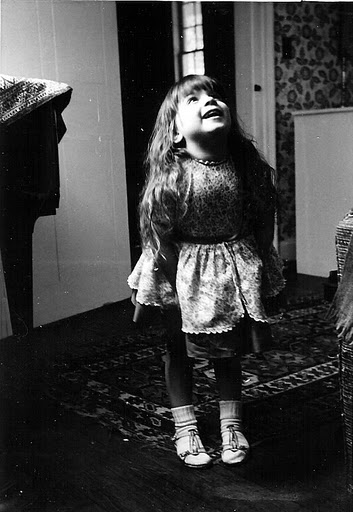
Adverse Childhood Experiences 12: welcome to the dark

Welcome to the dark, everyone.

When you think about it, all the children in the world are adding at least one Adverse Childhood Experience score and possibly more, because of Covid-19. Some will add more than one: domestic violence is up with stress, addiction is up, behavioral health problems are up, some parents get sick and die, and then some children are starving.

From the CDC Ace website:

“Overview:Adverse Childhood Experiences (ACEs) are potentially traumatic events that occur in childhood. ACEs can include violence, abuse, and growing up in a family with mental health or substance use problems. Toxic stress from ACEs can change brain development and affect how the body responds to stress. ACEs are linked to chronic health problems, mental illness, and substance misuse in adulthood. However, ACEs can be prevented.”

Well, can they be prevented? Could Covid-19 be prevented? I question that one.

I have a slightly different viewpoint. I have an ACE Score of 5 and am not dead and don’t have heart disease. I spent quite a bit of time thinking about ACE scores and that it’s framed as kids’ brains are damaged.

I would argue that this is survival wiring. When I have a patient where I suspect a high ACE score, I bring it up, show them the CDC web site and say that I think of it as “crisis wiring” not “damaged”. I say, “You survived your childhood. Good job! The low ACE score people do not understand us and I may be able to help you let go of some of the automatic survival reactions and fit in with the people who had a nice childhood more easily.”

It doesn’t seem useful to me to say “We have to prevent ACE scores.” Um. Tsunamis, hurricanes, Covid-19, wars… it seems to me that the ACE score wiring is adaptive. If your country is at war and you are a kid and your family sets out to sea to escape, well, you need to survive. If that means you are guarded, untrusting, suspicious and wary of everyone, yeah, ok. You need to survive. One of my high ACE Score veterans said that the military loved him because he could go from zero to 60 in one minute. Yeah, me too. I’ve worked on my temper since I was a child. Now it appears that my initial ACE insult was my mother having tuberculosis, so in the womb. Attacked by antibodies, while the tuberculosis bacillus cannot cross the placenta, luckily for me. And luckily for me she coughed blood at 8 months pregnant and then thought she had lung cancer and was going to die at age 22. Hmmm, think of what those hormones did to my wiring.

So if we can’t prevent all ACE Scores, what do we do? We change the focus. We need to understand crisis wiring, support it and help people to let go of the hair trigger that got them through whatever horrid things they grew up with. 16% of Americans have a score of 4 or more BEFORE Covid-19. We now have a 20 or 25 year cohort that will have higher scores. Let’s not label them doomed or damaged. Let’s talk about it and help people to understand.

I read a definition of misery memoirs today. I don’t scorn them. I don’t like the fake ones. I don’t read them, though I did read Angela’s Ashes. What I thought was amazing about Angela’s Ashes is that for me he captures the child attitude of accepting what is happening: when his sibling is dying and they see a dog get killed and he associates the two. And when he writes about moving and how their father would not carry anything, because it was shameful for a man to do that. He takes it all for granted when he is little because that is what he knows. One book that I know of that makes a really difficult childhood quite amazing is Precious Bane, by Mary Webb. Here is a visible disability that marks her negatively and yet she thrives.

A friend met at a conference is working with traumatic brain injury folks. They were starting a study to measure ACE scores and watch them heal, because they were noticing the high ACE score people seem to recover faster. I can see that: I would just say, another miserable thing and how am I going to work through it. Meanwhile a friend tells me on the phone that it’s “not fair” that her son’s senior year of college is spoiled by Covid-19. I think to myself, uh, yes but he’s not in a war zone nor starving nor hit by a tsunami and everyone is affected by this and he’s been vaccinated. I think he is very lucky. What percentage of the world has gotten vaccinated? He isn’t on a ventilator. Right now, that falls under doing well and also lucky in my book. And maybe that is what the high ACE score people have to teach the low ACE score people: really, things could be a lot worse. No, I don’t trust easily and I am no longer feeling sorry about it. I have had a successful career in spite of my ACE score, I ran a clinic in the way that felt ethical to me, I have friends who stick with me even through PANDAS and my children are doing well. And I am not addicted to anything except I’d get a caffeine headache for a day if I had none.

For the people with the good childhood, the traumatic brain injury could be their first terrible experience. They go through the stages of grief. The high ACE score people do too, but we’ve done it before, we are familiar with it, it’s old territory, yeah ok jungle again, get the machete out and move on. As the world gets through Covid-19, with me still thinking that this winter looks pretty dark, maybe we can all learn about ACE scores and support each other and try to be kind, even to the scary looking veteran.

Take care.

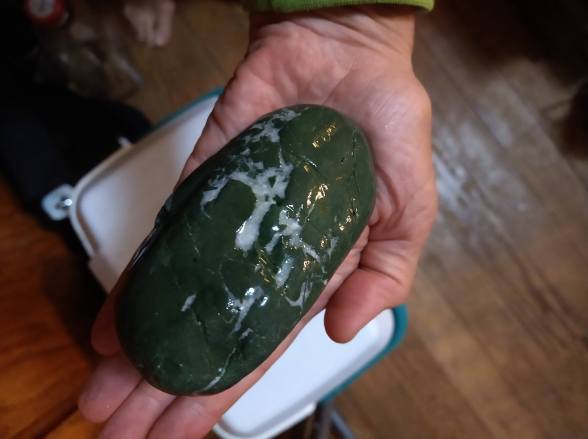
pebbles

This is for the RDP stone prompt, my prompt.

Small pebbles… except now we have to sing: “One of these things is not like the others, one of these things just doesn’t belong! Can you guess which thing is not like the others, by the time I finish my song!”

And here is a photo for scale.

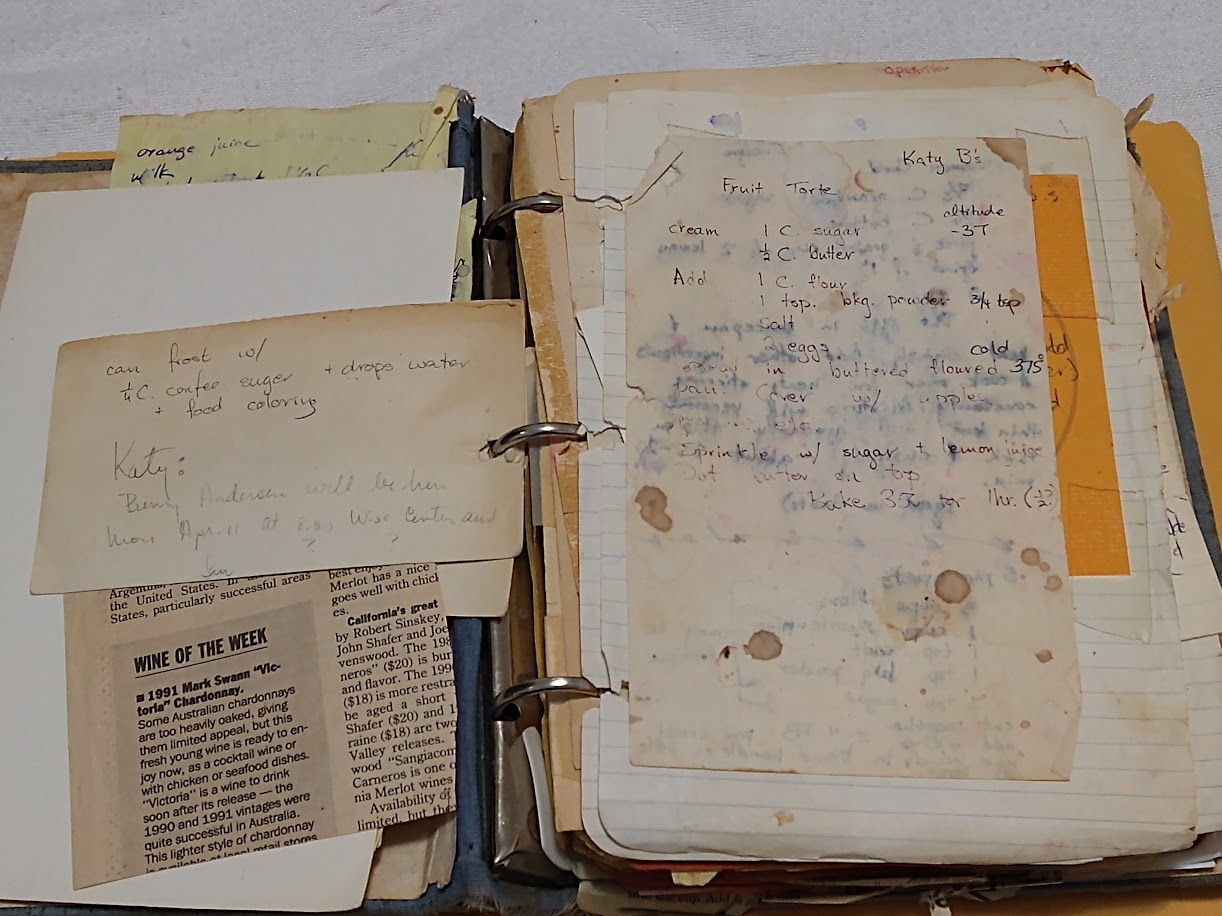
Katy B.’s fruit torte

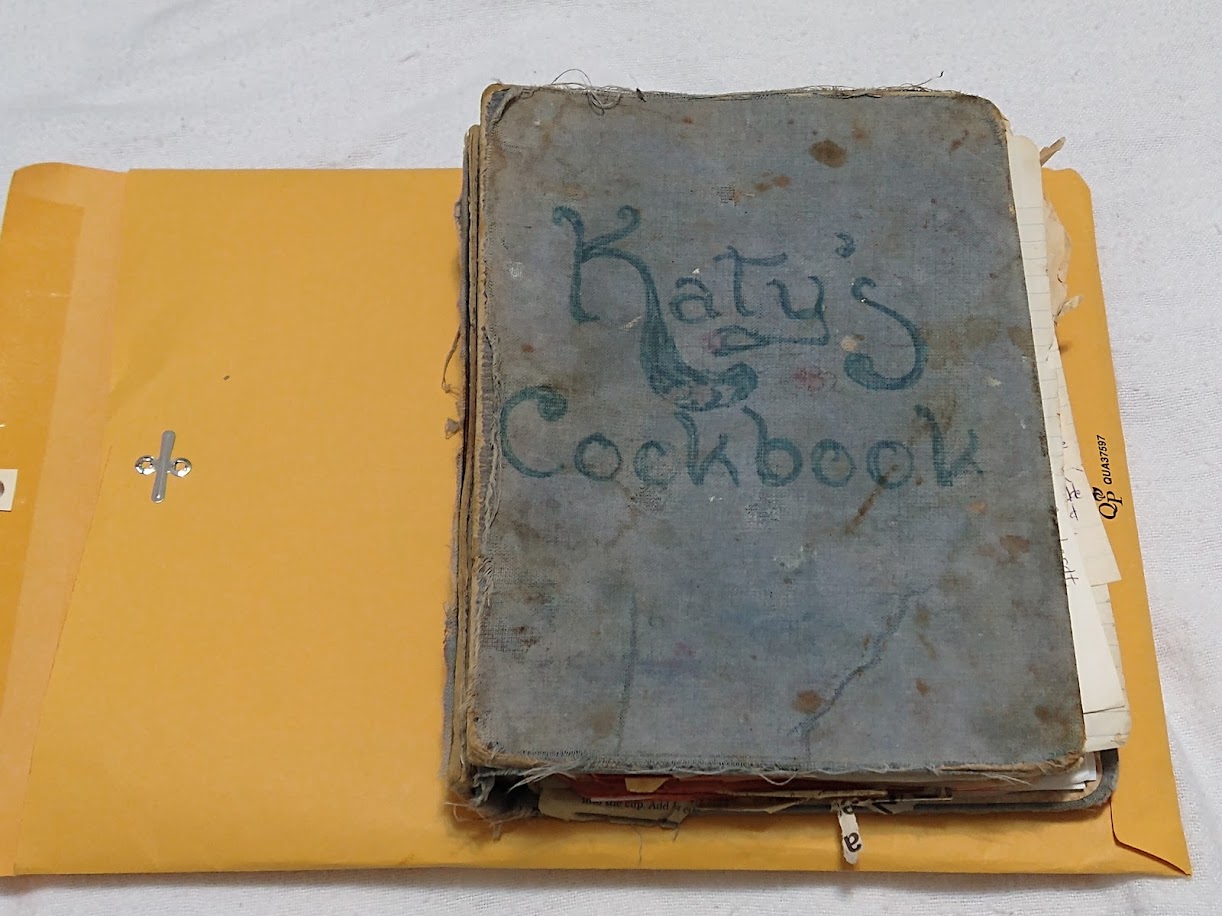
Katherine White Burling was my maternal grandmother, and this recipe is attributed to her. I still have the small three ring binder that my mother gave me when I was in high school, explaining that my sister and I had to do some of the cooking. We told her what we wanted to make and she would write the recipe in our book and help us. I wrote this recipe out in the 1970s.

preheat the oven to 350 F

cream: 1 C sugar
1/2 C butter

while the butter is softening enough to cream, cut up fruit: apples, pears, peaches, rhubarb, or use berries…

Add to the creamed butter:
1 C flour
1 tsp baking powder
salt
2 eggs

Spread in in a buttered, floured pan. Cover with chopped fruit: apples, pears, peaches. This one was local plums and blueberries.

Sprinkle with sugar and lemon juice
Dot with butter on top.
Bake for 30-40 minutes, depending on your oven.
Cook until browned a little in the part that rises around the fruit, and when a toothpick comes out clean.

I am submitting this to today’s Ragtag Daily Prompt: Kaleidoscope, because the torte reminds me of a kaleidoscope.

I have seen the frogs

I have seen the frogs
in the northwest

all you have to do is be quiet
near the puddles
or a pond

walk there very very quietly

in the spring they are singing
to each other
calling
a symphony of longing and joy
and they don’t hear me
when I walk very quietly
at the end of the world

as a child my father teaches me
to catch frogs

very quietly
approach the pond
or puddle

if the frog hears you
it will duck under water
you will only see a ripple
spreading out

or it will hop
into the woods
and hide

my father
would occasionally use frogs
as bait
to catch northern pike
a live frog on a hook
frogs scream
when you stick a hook through their back

I hope they go into shock then
and don’t feel much

one we’d seen this
my cousins and my sister and I
when my father got his fishing rod
we’d run through the woods
yelling “Hide the frogs, hide the frogs!”
and we would catch any frog
that was dumb enough not to hide
and quickly set it in the woods
to hide it from my father

we would check the puddles, too
feeling in the brownish muck
to make sure no frog was hidden
in the shallow puddle
come out, you must go in the woods
to survive

to catch the smart ones
normally
we would tiptoe to the puddle
hoping a frog was facing the other way
if they saw us, they were gone

slowly bend down, hand out
behind the frog
reach gently
grab just above the back legs
not too hard, don’t squish it

I was under ten
on a canoe trip
when I run to my father
“A frog! A frog! The biggest frog I’ve seen!
Papa, come help!”
My father comes.
An enormous frog is beside the canoe.
“Catch it.” says my father.
“Please! You catch it!” I beg.
My father creeps up on the frog.
His hand moves out slowly.
He grabs the frog, who tries to jump
and croaks, a bass, huge mouth.
“It’s a young bullfrog,” says my father.
“It will get even bigger.”
He hands it to me.
I take it carefully, shaking a little.
“We could eat it’s legs.”
“NO!” I say. I just want to hold it for a minute.
I turn it over and gently stroke it’s throat.
The frog goes limp, mesmerized.
I set it down gently, right side up,
near the water.
I squat by the frog and wait.
I am waiting for it to wake up.
The frog is so beautiful.
I wait until it wakes up
and returns home.

On vaccination: rock stubborn

A friend in his 30s was working on my car the other day. “Are you immunized?” I ask. “No.” he says. “I wish you’d get immunized,” I say, “Also, I can’t ride in the car with you because if I get the Delta variant, I’ll probably die.” He responds, “I hate doing what other people tell me to do.” “Oh,” I say, “Oppositional defiant, just like me. Fine. Don’t get the vaccine.”

Two days later I text. “Don’t get the vaccine today. Or tomorrow.”

I hear back. He got vaccinated the day I sent the text. I don’t know if it was me saying don’t do it, or me getting out of the car and staying a good ten feet away after that. Please don’t kill me, not today, ok?

Maybe we should try it nation wide. “DON’T GET VACCINATED. DON’T DO IT TODAY. OR TOMORROW.”

Unvaccinated thirty year olds are getting really sick and getting intubated and dying. One in five hospitals in the US now is 95% full, on divert. I used to heave a sigh of relief when I was in residency and we were on divert. That meant no admissions until beds opened back up. We are full. But one in five is really bad. Virginia Mason in Seattle is on divert. Our rural county has more covid infections than we’ve had the whole time, mostly unvaccinated. About 15% vaccinated. We are starting to see the breakthrough infections, around 8 months after the vaccine. Makes sense, because the vaccine riles up the immune system for 8 months and then quiets down. I am 8 months out, no immune system, high bleeping risk. The head of the heart lung bypass part of Virgina Mason was interviewed. “We have been full for ten months (?or a year) and have turned away over 150 patients.” So heart lung bypass could save lives in covid. But it takes round the clock two ICU nurses and the ICU nurses are burning out, quitting, dying. If they get too tired, their immune systems don’t work, they are more at risk for covid and they could die. The nurses and the doctors KNOW this. So…. how many unimmunized people are you willing to die for? Just curious.

Kids have been at home, quarantined, small groups. So then they started school or daycare or even a few more playdates and hello: when you get them together, they trade viruses. There is an outbreak of RSV and other viruses. RSV won’t kill most kids but some babies need the hospital and it can kill premies. And the beds, remember, are full.

Now the AAFP is calling for emergency authorization for kids age 2-11 to get the vaccine. Because they are dying too and there bloody won’t be room in the hospitals at this rate. Or well, you can build a tent, but if you don’t have any ICU nurses, the tent is not too helpful.

For the governors saying “No mask mandate at school,” yeah, well, I think they should refuse the vaccine and refuse treatment and refuse intubation and refuse oxygen.

Meanwhile, I am hiding under the bed. Roll up the sidewalks, lock the doors, I am sorry not to be useful but I am not useful dead. I could telemedicine if our area gets shorthanded enough. I suppose I should call the hospital and say that. They aren’t that desperate… yet. We have four ventilators last I checked. And 32,000 people in the county and we are the only hospital. Bummer.

I am in a physician mothers Facebook group. The stories are getting grimmer and grimmer. A physician put up the list of hospitals she called to try to transfer a patient: over 30. All no. Another is in North Carolina and got a call from Texas to transfer a patient. But… they were on divert. No.

Take care. Don’t get your immunization if you are against it. Whatever.

Ride forth

I wrote this poem more then ten years ago, but since I want to reference it in an essay, I am putting it up here now.

Ride Forth


My grandmother
Packed all her troubles in her saddlebags
And rode forth singing

My mother
Packed all her troubles in her saddlebags
And rode forth singing

My father
Was the only one
Who ever saw the contents
He tried to drown them

My mother was loved
For her charm

I ride forth
Sometimes I sing
Sometimes I weep

My saddlebags are empty

Prayer flags flutter
Slowly shred
In the wind

I write my troubles
And my joys
On cloth
And thank the Beloved
For each

My horse is white
When I sing
Black
When I cry
A rainbow of colors
In between
The whole spectrum
That the Beloved allows

After I emptied
My saddlebags
I tried to leave them
But the people I meet
Most, most, most
Are frightened

A naked woman
On a naked horse

I had to leave my village
When I learned to ride her
Made friends with her
Beloved
My village does not allow tears
When she turns black
Their saddlebags squirm and fight
The people try to throw them on my horse

In other places
The horses are all black
The white aspect of the Beloved
Frightens them
And they attack

I carry saddlebags
And Beloved is a gentle dapple gray
And the illusion of clothes surrounds me
When we meet new people
Until we know
It is safe to shine
Bright
And dark

I hope that others ride with the Beloved
In full rainbow

I ride forth
Sometimes I sing
Sometimes I weep

Even the color lonely
Is a part of the Beloved

Mask refusal in the 1918-1919 influenza pandemic

This is from an article about the history of medicine, about people refusing to wear masks in the 1918-1919 influenza pandemic:

“Adherence is based on three concepts: individualism versus collectivism; trust versus fear; and willingness to obey social distance rules. Jay Van Bavel opines that some countries tend to be more individualistic,16 and therefore more likely to reject rules and ignore attempts by public health authorities to β€œnudge” behavior change with risk messages or appeals for altruism. InΒ collectivist cultures, people are more likely to do what is deemed best for society. Trust and fear are also significant influences on human behavior.17 In countries with political division, people are less likely to trust advice from one side or the other and are more likely to form pro- and anti- camps. This may also undermine advice issued by public health professionals. The last and most difficult to attain is social distancing. Human beings are social animals with bodies and brains designed and wired for connection. A pandemic, in many ways, goes against our instinct to connect. Behavioral psychologist Michael Sanders argues that if everybody breaks the rules a little bit, the results are not dissimilar to many people not following the rules at all.18

From another article:

“It was the worst pandemic in modern history.

The 1918 influenza virus swept the globe, killing at least 50 million people worldwide.

In the US, the disease devastated cities, forcing law enforcement to ban public meetings, shut down schools, churches, and theaters, and even stop funerals.

In total,Β 675,000 Americans died from the Spanish flu, named after the disease’s early presence in Spain.”

I read a book on the 1918-1919 influenza. It started in the U.S. The photograph that haunts me is the bodies stacked five deep in the hallways of San Francisco Hospitals.

And in a third article:

“The scenes in Philadelphia appeared to be straight out of the plague-infested Middle Ages. Throughout the day and night, horse-drawn wagons kept a constant parade through the streets of Philadelphia as priests joined the police in collecting corpses draped in sackcloths and blood-stained sheets that were left on porches and sidewalks. The bodies were piled on top of each other in the wagons with limbs protruding from underneath the sheets. The parents of one small boy who succumbed to the flu begged the authorities to allow him the dignity of being buried in a wooden box that had been used to ship macaroni instead of wrapping him a sheet and having him taken away in a patrol wagon.”

A CDC article about the history of the 1918-1919 influenza says this:

“The fully reconstructed 1918 virus was striking in terms of its ability to quickly replicate, i.e., make copies of itself and spread infection in the lungs of infected mice. For example, four days after infection, the amount of 1918 virus found in the lung tissue of infected mice was 39,000 times higher than that produced by one of the comparison recombinant flu viruses.14

Furthermore, the 1918 virus was highly lethal in the mice. Some mice died within three days of infection with the 1918 virus, and the mice lost up to 13% of their body weight within two days of infection with the 1918 virus. The 1918 virus was at least 100 times more lethal than one of the other recombinant viruses tested.14 Experiments indicated that 1918 virus’ HA gene played a large role in its severity. When the HA gene of the 1918 virus was swapped with that of a contemporary human seasonal influenza A (H1N1) flu virus known as β€œA/Texas/36/91” or Tx/91 for short, and combined with the remaining seven genes of the 1918 virus, the resulting recombinant virus notably did not kill infected mice and did not result in significant weight loss.14

The 1918-1919 influenza virus was sequenced and studied in 2005. We did not have the tools before that. Frozen bodies were exhumed with the permission of Inuit tribes to find the virus.

Later, that same article talks about future pandemics:

“When considering the potential for a modern era high severity pandemic, it is important; however, to reflect on the considerable medical, scientific and societal advancements that have occurred since 1918, while recognizing that there are a number of ways that global preparations for the next pandemic still warrant improvement.”

Let us now travel back to a worse epidemic: the plague in the Middle Ages:

“Did you know? Between 1347 and 1350, a mysterious disease known as the “Black Death” (the bubonic plague) killed some 20 million people in Europeβ€”30 percent of the continent’s population. It was especially deadly in cities, where it was impossible to prevent the transmission of the disease from one person to another.”

I am hoping that people will awaken, get their vaccines, wear their masks and stop Covid-19 in its’ tracks, so that our death rate resembles the 1918-1919 Influenza. Not the Middle Ages plague.