Long Covid imaging

In the last Long Covid talk that I attended and wrote about (here: Pulmonary Manifestations of Long Covid), the pulmonologist and intensivist says that one problem with Long Covid is that we do not have imaging that can “see” it.

That is, the chest x-ray looks normal, the echocardiogram may look normal (heart ultrasound), the chest CT scan may look normal, a brain CT or MRI may look normal, but the patient may still be tachycardic, feel exhausted, feel brain fog and have multiple other symptoms.

That pulmonologist listed five of the top mechanisms that are prolonged in the immune system. Most of the scientists and physicians are framing this as “immune system dysfunction”. I am not. I am framing it as “you were really really sick and your immune system is still on high alert and trying to protect you so you can recover”. Now wait, you say, how could chronic fatigue like symptoms protect me? Well, if you are exhausted, you can’t go to work and you’ll stay quiet at home most of the time and less exposure chance. But what about brain fog? Again, this will slow your interaction with other people and force you to rest and heal. But, you say, I don’t like it. Well, yeah. Patience. We call grumpy patients that are recovering “convalescents”. It is a good sign when they are grumpy and over it and just want to be better. That doesn’t mean I can make myself or anyone else heal faster.

The pulmonologist says that the best test is the six minute walk test. This is usually done by a respiratory therapist. The person walks in a circle for six minutes wearing a pulse ox, with the respiratory therapist doing regular checks. This distinguishes between the people who have primarily a lung issue from all the other issues. If the person is tachycardic (fast heart rate) but not hypoxic (oxygen level dropping), then it’s not primarily lungs though blood clots to the lungs sometimes have to be ruled out. One of the mechanisms in the immune system is microclots and an increased risk of blood clots. That can mean heart attack, stroke, or pulmonary embolus, a clot in the lungs. The microclots are suspected of causing some of the muscle fatigue and exercise intolerance, by clogging capillaries and reducing oxygen flow to muscle cells. Muscle cells do not like this at all.

I have done my own quick walk test with patients since 2003, when I had terrible influenza. About a week after my influenza started, with the temperature of 104 and heart rate at 100 at rest and 135 walking, my temperature came down. However, the fast heart rate continued. Normal heart rate is 70-100 and 135 walking will make you feel exhausted. I lay on the couch and could barely make my kids dinner for two months. It resolved then. I read a book about influenza and thought that I had “influenza viral pneumonia” where there is lung tissue swelling, reducing the air spaces, after influenza.

My quick walk test in clinic is to check a sitting oxygen level and heart rate and then have the person walk. I would have them walk up and down a short hall three times then sit down. When they sat, I watched the pulse oximeter recovery. Some people would jump from a resting heart rate of 62 to a walking heart rate of over 100, say 120. Their oxygen level could stay normal or it could drop. If they dropped below 88, I would get home oxygen and forbid them to return to work. If their oxygen level held, then they needed to rest until their walking heart rate stayed under 100 and they were no longer exhausted by gentle or normal activity. If they return to work with a walking heart rate of 120, they will be exhausted and are more likely to get a secondary pneumonia or have other problems. The heart does not like to run at 120 all the time. You can see why a person who already has some coronary artery blockage would be more likely to have a heart attack if they get pneumonia from influenza or Covid-19.

The conferences I am attending are talking about “targets” in the immune system. That is, new drugs. I think the science is wonderful and amazing, but I also think we need to step back and say, this is a really really bad infection and some people need a lot of support and reassurance and time to heal. Reassure them that even though they have not yet returned to normal, the immune system is working hard to protect them from other infections and it is saying very very loudly that they need to rest. Rest, recuperate and trust the immune system. Some things need immediate treatment, especially blood clots, heart attacks and strokes, but once those are ruled out, we need to support people through their convalescence and healing.

______________

The photograph is from April 2021, a few days after I was put on oxygen. A selfie.

Oxygen testing

“If oxygen might help with chronic fatigue, as it has helped you,” a friend asks, “how do I get on oxygen?”

Complicated answer.

First of all, one of the things that is not clear, is what recovery looks like. I think I’ve had low grade chronic fatigue for the last 7 years compared to my “normal”. Now, will I get off oxygen? I don’t know. I am hoping for September but it may be that 7 years of low grade hypoxia means I have lung damage and no, I won’t get totally off oxygen.

They have apparently recently made the guidelines for oxygen more stringent. I sort of missed that update, even though I just recertified in Advanced Cardiac Life Support. You now have to have an oxygen saturation that goes to 87% or below. It used to be 88.

Now, you can test this at home with a pulse oximeter. In 2005 after the influenza, I held my saturations but my heart rate would go up to 135. Which means that I walked across the room very very slowly because a heart rate of 135 sustained does not feel good at all. Normal is 70-100 beats per minute. You can measure pulse with just a second hand, number of beats in a minute. For oxygen saturation, you need the pulse ox and it will measure both heart rate and oxygen saturation.

So: measure pulse and saturation at rest first. Write them down.
Then walk. I usually send patients up and down the hall three times then sit them down and watch the pulse ox. In some, the heart rate jumps up. If it’s over 100 and they are getting over pneumonia, I don’t want them back at work until it is staying under 100. Or if sitting they are at a pulse of 60 and then walking it’s 95, well, I think that person needs to convalesce for a while yet. They can test at home.

As the heart rate returns to the baseline, the oxygen level will often start to drop. Does it drop to 87? Describe the test to the doctor and make sure the respiratory technician does it that way and also they should do pulmonary function tests. Mine were not normal.

Now, what if the oxygen doesn’t drop to 87? We are not done yet. What does the person do for work or do they have a toddler? If they have a toddler do the same test carrying the toddler: they sit down, exhausted and grey and this time the oxygen level drops below 87. If they do not have a toddler, do the test with two bags of groceries. Or four bricks.

When I did the formal test, the respiratory therapist said, “Let’s have you put your things down so you don’t have to carry so much.”

“I’d rather not.” I said, “I want to be able to walk on the beach, so I need the two small oxygen tanks, my bird book, camera, binoculars and something to eat.”

“Oh, ok,” she said.

So I did the test with two full tanks of oxygen, small ones, and my bird book and etc. I dropped like a rock loaded. I think I would have dropped not loaded but perhaps not as definitively. Still hurts to carry anything, even one tank of oxygen.

We are making a mistake medically when we test people without having them carry the groceries, the toddler, the oxygen tank. My father’s concentrator is pre 2013. It weighs nearly 30 pounds. Now they make ones that weight 5 pounds. Huge massive difference.

Good luck.

beach walk

My daughter is home and we went on a beach walk yesterday! The stupid oxygen keeps me from going fast. She went for a bike ride afterwards. Hooray!

Yesterday evening she brought up social distancing and how careful she should be. She has about 5 friends who are home that she is going to walk with. I am still wearing a mask over my oxygen tubing most places. She will unmask if they are vaccinated and they don’t have a cold or anything else. Even a cold would make me worse at this point. It makes me grumpy to be vulnerable, but I appreciate the discussion.

outfits inappropriate for work 2

When pneumonia nearly takes me out, I want COLOR. I think I managed it with this. The skirt is not only silly, but a little short for me to wear to work….

stealthie in the grass

Stealthie in my yard, two days ago. I like the current crop of grass and weeds.

Music: Simon Lynge Hallelujah: https://www.youtube.com/watch?v=iIHpeaHJJ9s

His website is here: https://simonlyngemusic.com/. Hey Simon, when do we get another local concert? Concert in the grass? Hugs, ya’ll.

Last photo

From Bushboys world, a “last on the card” contest, with the last photo on the phone or card.

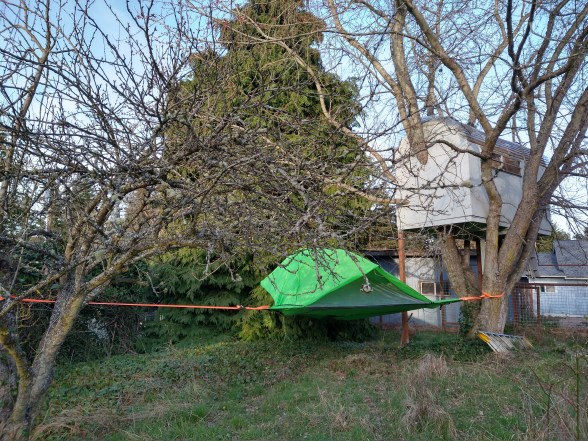
I knew exactly which photo was there. I took it last night after spending a couple hours trying to remember how to set up the tree tent. Got it, though should still mess with it a little. It’s tricky if the trees aren’t an equilateral triangle. Which is nearly always.

I lay on the platform in the sun for a while yesterday before the tent part was up. It’s supposed to rain today. I really got the wrong tent when I got this one, it’s not really suited to the Pacific Northwest. I still love it.