Mask refusal in the 1918-1919 influenza pandemic

This is from an article about the history of medicine, about people refusing to wear masks in the 1918-1919 influenza pandemic:

“Adherence is based on three concepts: individualism versus collectivism; trust versus fear; and willingness to obey social distance rules. Jay Van Bavel opines that some countries tend to be more individualistic,16 and therefore more likely to reject rules and ignore attempts by public health authorities to “nudge” behavior change with risk messages or appeals for altruism. In collectivist cultures, people are more likely to do what is deemed best for society. Trust and fear are also significant influences on human behavior.17 In countries with political division, people are less likely to trust advice from one side or the other and are more likely to form pro- and anti- camps. This may also undermine advice issued by public health professionals. The last and most difficult to attain is social distancing. Human beings are social animals with bodies and brains designed and wired for connection. A pandemic, in many ways, goes against our instinct to connect. Behavioral psychologist Michael Sanders argues that if everybody breaks the rules a little bit, the results are not dissimilar to many people not following the rules at all.18

From another article:

“It was the worst pandemic in modern history.

The 1918 influenza virus swept the globe, killing at least 50 million people worldwide.

In the US, the disease devastated cities, forcing law enforcement to ban public meetings, shut down schools, churches, and theaters, and even stop funerals.

In total, 675,000 Americans died from the Spanish flu, named after the disease’s early presence in Spain.”

I read a book on the 1918-1919 influenza. It started in the U.S. The photograph that haunts me is the bodies stacked five deep in the hallways of San Francisco Hospitals.

And in a third article:

“The scenes in Philadelphia appeared to be straight out of the plague-infested Middle Ages. Throughout the day and night, horse-drawn wagons kept a constant parade through the streets of Philadelphia as priests joined the police in collecting corpses draped in sackcloths and blood-stained sheets that were left on porches and sidewalks. The bodies were piled on top of each other in the wagons with limbs protruding from underneath the sheets. The parents of one small boy who succumbed to the flu begged the authorities to allow him the dignity of being buried in a wooden box that had been used to ship macaroni instead of wrapping him a sheet and having him taken away in a patrol wagon.”

A CDC article about the history of the 1918-1919 influenza says this:

“The fully reconstructed 1918 virus was striking in terms of its ability to quickly replicate, i.e., make copies of itself and spread infection in the lungs of infected mice. For example, four days after infection, the amount of 1918 virus found in the lung tissue of infected mice was 39,000 times higher than that produced by one of the comparison recombinant flu viruses.14

Furthermore, the 1918 virus was highly lethal in the mice. Some mice died within three days of infection with the 1918 virus, and the mice lost up to 13% of their body weight within two days of infection with the 1918 virus. The 1918 virus was at least 100 times more lethal than one of the other recombinant viruses tested.14 Experiments indicated that 1918 virus’ HA gene played a large role in its severity. When the HA gene of the 1918 virus was swapped with that of a contemporary human seasonal influenza A (H1N1) flu virus known as “A/Texas/36/91” or Tx/91 for short, and combined with the remaining seven genes of the 1918 virus, the resulting recombinant virus notably did not kill infected mice and did not result in significant weight loss.14

The 1918-1919 influenza virus was sequenced and studied in 2005. We did not have the tools before that. Frozen bodies were exhumed with the permission of Inuit tribes to find the virus.

Later, that same article talks about future pandemics:

“When considering the potential for a modern era high severity pandemic, it is important; however, to reflect on the considerable medical, scientific and societal advancements that have occurred since 1918, while recognizing that there are a number of ways that global preparations for the next pandemic still warrant improvement.”

Let us now travel back to a worse epidemic: the plague in the Middle Ages:

“Did you know? Between 1347 and 1350, a mysterious disease known as the “Black Death” (the bubonic plague) killed some 20 million people in Europe—30 percent of the continent’s population. It was especially deadly in cities, where it was impossible to prevent the transmission of the disease from one person to another.”

I am hoping that people will awaken, get their vaccines, wear their masks and stop Covid-19 in its’ tracks, so that our death rate resembles the 1918-1919 Influenza. Not the Middle Ages plague.

practicing grandmother

My sister sends me a t-shirt years ago.

It said, “I don’t know if I am the good witch or the bad witch.”

I burst into tears and put it in the trunk of my car. I never wear it. I am the designated bad witch for half my family. We won’t go into that.

She gets a shirt too. Hers is the green one. Mine is black.

She is dead, in 2012, breast cancer. It’s hard to describe the fallout. Toxic and radioactive. But… I have decided not to be a witch.

Instead, I am a practicing grandmother.

Really I’ve been one for a while. There was a young couple who lived down the street with two children. This was in 2014. I was a Facebutt friend, so sometimes noted what was happening. The father has to travel for his job. The mother is trying to care for two kids and work and so on… been there.

In 2014 I am recovering from my third round of pneumonia. This third round it takes six months before I can return to work. Short of breath and coughed if I talked. The state medical watch doctors went to disable me but I fight them tooth and nail. I win.

I wander down to the neighbor and offer my services. She already knows me. She is instantly grateful and two year old T is introduced to me, again. He doesn’t really remember me. She explains that he is coming to my house for a little while and then back home.

T and I walk towards my house.

A nuthatch calls.

I stop and reply. In college I took ornithology and the teaching assistant could do a barn owl call so well that the barn owls would do a territorial fly over at night to see who had the weird accent. Marvelous.

The nuthatch and I went “enh” back and forth. T is amazed. This woman talks to birds. Then we see the nuthatch! I point out how nuthatches come down a tree head first. “If you hear that call, it’s a nuthatch. Look for it.” The nuthatch is very cooperative. Magic.

We get to my house. T is clutching a book. “He’s taking it everywhere,” sighs his mother. “I’m not sure why.”

So first we read the book. It is a board book about a farm. Each page has a central picture and then there are pictures around the edges with the word under each picture. On one page T says, “Haaaaay.”

“Oh!” I say, delighted. “You can read HAY!”

His face lights up. An adult who gets it! Yes! He can read HAY!

On another page he says HAY. “Oh,” I say, “That is straw. Straw is a lot like hay but it’s not exactly the same.”

He is very serious absorbing that information.

I show him my closet. There is a stick horse. Only it isn’t a horse: it’s a unicorn dragon, with a forehead horn and wings. When you press a button it’s eyes flash and it roars.

Ok, that’s pretty scary. He wants the closet door closed and he does NOT want to play with the dragon.

Next is pouring. I get out a towel and put it on the kitchen floor. I get out a rather nice expresso set. Bright colors. Orange and green and yellow and blue. I fill the coffee pot with water and invite him to sit on the towel. “You can pour the tea.”

He looks at me with surprise. He picks up the coffee pot. He looks at me again. “Go ahead. It’s ok.” He starts pouring into a cup. He pours until the cup overflows and the saucer overflows and he keeps pouring. The coffee pot is empty. He looks at me a little warily. This is technically spilling and he knows it.

“Would you like more in the teapot?”

He nods.

I refill the coffee pot with water and he starts again, with a different cup.

When I return him to mom, after two hours, he’s damp. “Sorry, he got a little wet, but it’s just water,” I say cheerfully. Mom is too harried to do much more than look resigned at a change of clothes.

Next time he comes with a change of clothes and his large stroller, in case he goes down for a nap.

And first off, he goes to the closet. Time to hear that dragon roar again.

even if

even if

I never see you again
you never speak to me again
you never love your bearish parts
you never let yourself get angry
you never let yourself get sad
you never let yourself feel
you tell yourself you are happy
you tell yourself everything is the way it should be

even if

I never see you again

I still love you
I still forgive you

I still love you

I hope that you truly do

find happiness

Covid-19 Delta Variant

This article: The CDC warns that the delta variant is as contagious as chicken pox and can make people sicker than the original Covid-19

Chicken pox has up to 21 days before you break out after exposure. It is really really contagious. And it is infectious until every pustule has scabbed over. And it can kill people, especially adults. It can also cause some pretty awful birth defects, which is why we ask every patient who is pregnant if they have had chicken pox or the vaccine. If not, we check antibodies. If they have no antibodies and are exposed, they are to get VZIG within 48-72 hours, an antibody to the virus to try to stop the birth defect. In my small town, it’s flown in by the health department.

So as contagious as chickepox is really bad. Chickenpox is worse than influenza. Tuberculosis is a very small bacteria and can be airborne as well.

The delta variant kills people who are unvaccinated at a higher rate than the original Covid-19. The 30-50 year olds are dying.

The delta variant can infect vaccinated people though rarely. The vaccinated people are way less likely to be hospitalized and die. However, someone walking around with delta (vaccinated or unvaccinated) apparently sheds 1000 times more virus than the original Covid-19. This means that we all need to put our masks back on unless we are in our homes with the very small groups we should stick with. If we do not do that, we may have more deaths this winter than last winter.

I double masked on the plane, one flight from Chicago to Seattle, two days ago. I kept the mask on in the taxi and waiting for the ferry. I felt most exposed waiting for the ferry because fully half the people were ignoring all of the mask signs. Ah well. I was going to travel in late August again but the prediction is for a big Covid-19 wave starting to peak in 4-6 weeks. Seems like a bad time to go anywhere, much less on oxygen.

Gather up whatever you need to get through the winter and get ready. Enjoy the August sun, but store up things for this winter. I think it is still going to be a hard one.


There is lots of detail on the CDC website.
will the unvaccinated change their minds in time?

Pull saw work

I need to work on my tree house.

The tree has grown. The walls of the treehouse are digging in to the bark in places.

I looked for my pull saw, but haven’t found it yet. I did find three saws. I did some trimming last night, but I was pretty tired and up a tree and didn’t take my oxygen up. I would saw a little bit then get short of breath and stop. The pull saw would be a much better tool for the job than the crosscut.

I have a swiss army knife with a saw and one of those emergency kit saw wires, that probably would make me swear if I tried to use it.

Now, where did I put the pull saw?

Welcome home

Two friends texted welcome home and a third picked me up. I was in the east, visiting a friend who has known me since birth. I had a good trip. She is twenty years older than me.

It was very much an adventure traveling on oxygen, but it worked. It’s like having a cell phone that weighs ten pounds, plugs into your nose, the batteries are the size of my hand, my carry on weighs 50 pounds (batteries, oxygen concentrator, camera, flute, laptop and phone) (also a book, I’m retro) AND you still have your phone AND you can’t breathe if you leave part of it at home….. So why can’t I have ONE wire to charge all of these stupid electronics instead of a cord for the phone and a cord for the oxygen concentrators and a car charger and a cord for the laptop and a cord and charger for the camera. Hello Electronic Hell.

Anyhow, made it there and back, double masked on the plane and taxi and ferry and…. the number of people who were ignoring the “you must wear a mask” on the ferry was impressive. About half. Well, fifty percent of people are dumber than the other 49%, right? Right now I can pick them out in a crowd really easily. Hey, I am on oxygen, I really do not want covid-19 or strep A or flu or whatever else you are coughing into the air.

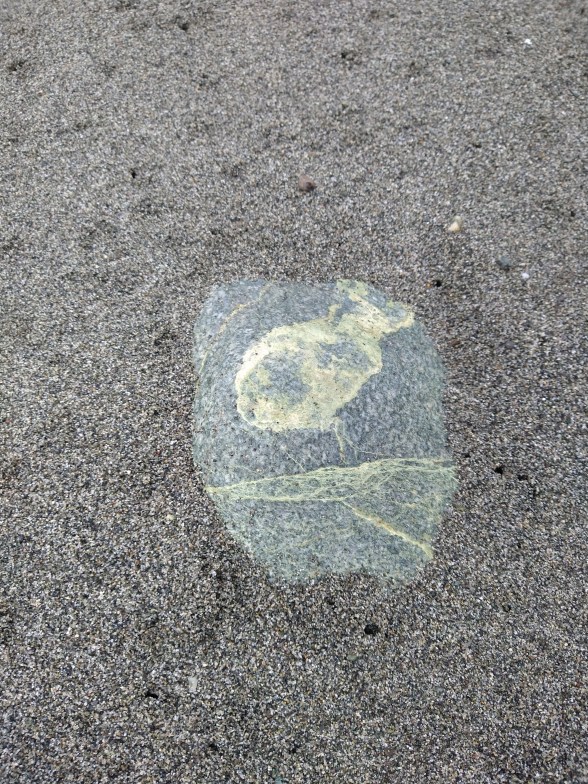
What do you see?

What do you see in this rock?

Broken rock

Water breaks rocks.

How? It does wear them down, but it can also break blocks off. Water goes into any tiny crack. When it freezes, it expands. Over time, the crack is widened, until the rock breaks. Rock cannot stand against water.