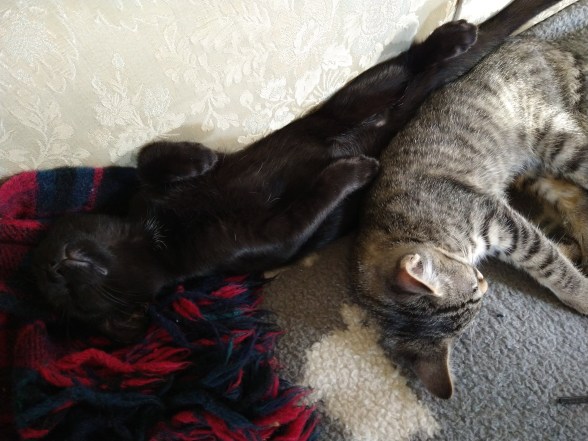
I want to nap like a kitten


When I started my first job, I had a nurse and a receptionist within a bigger clinic, all primary care. Fresh out of residency. One month in I asked to meet with my nurse and the receptionist.
The receptionist brought the office manager. I was surprised, but ok.
I started the meeting. “I am having trouble keeping up with 18-20 patients with fat charts that I have never seen before, but I think I am getting a little better at it. What sort of complaints are you hearing and how can we make it smoother?”
The office manager and the receptionist exchanged a look. Then the office manager excused herself.
Weird, I thought.
The three of us talked about the patients and the flow and me trying to keep up. About one third were Spanish speaking only and I needed my nurse to translate. That tended to gum things up a bit, because she could not be rooming another patient or giving a child vaccinations.
I thanked them both and the meeting broke up.
Later I found that the office manager had been brought in because another doctor tended to manage by yelling and throwing things. And another doctor had tantrums. So the receptionist was afraid of me and had asked the office manager to stay. The moment they realized that it was collaborative and I was asking for feedback and help, the receptionist was fine without the office manager.
That was an interesting lesson on working with people. I had been very collaborative with the nurses and unit secretaries in residency. As a chief resident, I told my Family Practice residents to treat the nurses and unit secretaries and in fact everyone, like gold. “They know more than you do and if you take care of them, they will save your ass!” The unit secretaries would go out of their way to call me in residency. “Mr. Smith is not getting that ultrasound today.”
“Shit. Why not? What the hell?” I would go roaring off to radiology to see what the hold up was.
The unit secretaries did not help the arrogant residents who treated them like dirt.
I thought it takes a team. I can’t do my work without the nurse, the pharmacist, the unit secretary, the laundry, the cafeteria workers, the administration. It takes the whole team. I value all of them.

You are sick as shit.
You go to the ER.
You finally feel safe, on a bed, they will save me, you think.
The nurse is on autopilot. He does not seem concerned. You are shaking a little as he arranges you on the bed. He puts the heart monitor stickers on and hooks you up. Blood pressure cuff, pulse ox. Blood pressure is fine, pulse is a bit fast, at 110.
You notice he is not making eye contact.
“I’m cold.” you whisper.
He doesn’t reply. He keeps messing with the wires. He puts the call button next to your hand. He leaves and returns with a warm blanket. It feels wonderful. He doesn’t say a word.
You feel better under the warmth.
The respiratory therapist wheels in the ECG machine. You smile at her but again, no eye contact. She puts more stickers on you. “Hold a deep breath.” The ECG spits out. She takes it and leaves.
The radiology tech wheels the portable xray machine in. You watch his face but don’t bother to smile. He looks everywhere but at you. It’s a bit creepy. Are they all robots? It’s 3 pm, not 3 am. “Lean forward,” says the tech, putting the radiology cartridge behind you. “Take a deep breath and hold it.” He takes the cartridge and leaves.
The nurse is back. Puts in the iv and draws 5 tubes of blood. You are shivering a little. He doesn’t seem to notice. You think about another warm blanket. The iv fluid starts and you can feel it running cold into your arm.
There is a child crying in the ER, in some other room. You start noticing the noises. Machines beeping. People typing on computer keyboards. No one is talking. The kid gives a howl of protest, rising and then is abruptly quiet.
Your hands and feet are tingling and burning. You writhe a little under the blanket. Sensation is returning to your hands and feet. It hurts but it is also good. You were at the point where all your feeling had shrunk to a tiny spark in the center of your chest. As the iv fluid runs, feeling slowly spreads out from that.
The doctor comes in. Grumpy, clearly. “Lean forward.” Listens to your chest. “Sounds clear.”
“It’s been hurting for 5 days. It hurts to breathe. Burns.” You are anxious as hell. BELIEVE ME.
The ER doc gives a little shrug. “Oxygen sats are fine.” He does a half-assed exam. He leaves.
You look at your feet, taking your socks off. Because he didn’t. There are two black spots, a couple millimeters across, old blood. Those are new.
You press the call button.
Time goes by. The nurse floats back in.
“Look. Tell the doctor to look. These are petechiae.” You point to the black spots.
If the nurse had laser vision, your feet would be burned. The nurse glares at your feet. He goes out.
The doc comes in and looks at your feet.
“They are petichiae. I have an infection.”
He gives a tiny shrug. “Your chest xray looks clear. Your labs are normal. You are not running a fever.”
“I am on azithromycin for walking pneumonia. I suddenly felt like all the fluid was running out of my arms and legs. I am worried that I am septic.”
“Blood pressure is fine. You are really really anxious.”
You are furious. It probably shows on your face. You are terrified.
“Could it be an antibiotic reaction?”
Shrug. “No rash.”
“Except the petechiae.” A sign of sepsis.
“I will change the antibiotics. Clindamycin.” He leaves.
You lie back, terrified. He doesn’t believe you. He is sending you home, septic. You will probably die.
The nurse comes in. Removes the iv and unhooks the monitor and the blood pressure cuff. You get dressed, numb and frightened and cold. The nurse goes out and returns. He recites the patient instructions in a bored voice and gives you the first dose of clindamycin.
You walk shakily to the door of the emergency room. To go home. While you are septic and they don’t believe you. You know what happens with sepsis: your blood pressure will drop and then organ damage and then IF you survive you could have heart damage or lung damage or brain damage and you might not anyhow.
You go home.

So, should healthcare workers be required to have Covid-19 vaccines?
Yes.
What is the precedent?
Take tuberculosis, for example. Airborne, very contagious. I was born in a Knoxville, Tennessee tuberculosis sanatorium, because my mother coughed blood a month before she was due and got quarantined for active tuberculosis. Yes, the state could quarantine my mother. I was removed immediately at birth because tuberculosis doesn’t cross the placenta. The antibodies do, but the infection doesn’t. However, newborns usually catch it and die very quickly. I was lucky. My father and grandparents took care of me for 5 months. Then my mother was allowed out (after 6 months total) but was not strong enough to take care of me. So I was taken to my maternal grandparents for the next four months, and did not touch my mother until I was 9 months old.
My mother was taking 36 pills a day at home, because you have to use multiple drugs to kill tuberculosis. It develops drug resistance very very quickly.
Well, so what, you say?
Healthcare workers in the United States are routinely checked with a ppd for tuberculosis. If it is positive, you cannot work until further testing. If you have latent tuberculosis, you are treated. If you have active tuberculosis, the treatment is longer and more complicated, here: https://www.cdc.gov/tb/topic/infectioncontrol/default.htm
My cousin then said, “Well, you don’t have to show the tuberculosis test to go in a restaurant!”
Well, not right NOW, because currently tuberculosis is under more or less reasonable control in the US. Remember that guy who came in to the US with active multi drug resistant tuberculosis and knowingly exposed everyone on that airplane? Great. I remember reading about that and thinking what a selfish jerk he was. And then the group of unimmunized people who went to India and all got measles. The US at that time did not bar anyone from returning, but asked them to finish a 3 week quarentine before returning to the US. One person did not do that. There was a measles outbreak in the midwest which cost the CDC (and therefore you and me because those is tax dollars) millions to trace, quarantine and clean up. So there was discussion at that time about whether the policy should be changed and we should not allow US citizens with known infectious diseases to come in on airplanes. We DON’T allow immigrants in with infectious diseases: they are tested for tuberculosis if coming from countries where it is endemic.
So, if we had a huge outbreak of tuberculosis, we WOULD have quarantines and shut downs.
I have tested a patient for tuberculosis, about two years ago. Her son had been diagnosed with active tuberculosis. We tested her with a blood test and then repeated it in three months. Negative, hooray. In residency I also saw a case of miliary tuberculosis. That is where the tuberculosis is growing so well in the lungs that it looks like little grains of rice in the lungs on imaging. Not a good thing.
My cousin: “You shouldn’t have to put something in your body to work.”
If you have tuberculosis, you do not get to work in healthcare, because you can kill your patients. I think that this is a good thing, to not kill our patients.
I am submitting this to the Ragtag Daily Prompt: starspangled. Keep America Healthy, how about that?

Survey shows 6 in 10 Americans will delay or skip flu shots this year.
Oh, dear. Not going to get your influenza shot? I am. Well, you say, YOU are on oxygen and have tricky lungs and keep yammering about imaginary Pandas.
Yes, and you should get your vaccine anyhow, even if you are healthy as a hoss.
If not for yourself, for everyone else. Because usually influenza kills 12,000 to 61,000 US citizens a year and gosh, guess what it will do to post-Covid long haulers. Um, kill, I would expect. And with a very low influenza winter last winter, because covid and masks and social distancing, immunity is down and the infectious disease folks are anticipating that it could be a worse than usual influenza year. How many people have long covid? This just in: More than half of covid survivors experience post acute sequelae to covid 19 (PASC) at 6 months after. ““The most common PASC involved functional mobility impairments, pulmonary abnormalities, and mental health disorders,” wrote Destin Groff, Penn State College of Medicine and Milton S Hershey Medical Center, Hershey, Pennsylvania, and colleagues. ”These long-term PASC effects occur on a scale that could overwhelm existing health care capacity, particularly in low- and middle-income countries.”
AND not only that, even if you or your friend or mother or grandmother don’t die of influenza, far more people clog up emergency rooms and doctor’s offices. The “CDC estimates that influenza has resulted in between 9 million – 45 million illnesses, between 140,000 – 810,000 hospitalizations and between 12,000 – 61,000 deaths annually since 2010.”* And the doctors and nurses and emergency people and nursing home employees and first responders are already short staffed and tired. So if you won’t get your flu vaccine for the general public, get it for the first responders.
AND before you tell me that “the vaccine gave me flu”, hello, it takes up to two weeks for the flu vaccine to confer immunity, and so if you got influenza two days later, you didn’t get it from the vaccine, you got it because you got the vaccine too late. Vaccine complications, well, I have seen one complication in my 30 years of Family Medicine, and it was someone I knew, not a patient. And half the people who tell me that “the vaccine gave me flu”, stomach flu with diarrhea and barfing is not influenza. It’s more likely to be a hangover than anything else. I see a lot more post alcohol “stomach flus” than true food poisoning. Quit drinking so much alcohol, ok?
And while you are at it, you’d better get the Covid-19 vaccine while it is still available free. And before you get on an airplane for Thanksgiving or go Trick or Treating with all those little germ spreaders or fly off to see family at Christmas/Kwanza/Winter break/whatever. Two weeks before, at least. Like, NOW. Or don’t, whatever, just don’t whine to ME about more deaths.
This public service message has been brought to you by a beneficent alien lizard. Feel free to send money.

I do not think of emotions as bad or good. None of them are bad or good. They are information, controlled by electrical impulses and hormones, evolved over millions of years (or endowed by our creator, for those who swing that way).
I don’t dismiss emotions. I listen to them.
I think of myself as an ocean. There is all sorts of stuff happening in the depths that I don’t understand. Probiotics, for example. I don’t take them. If not for penicillin, I’d be dead many times over, from strep A pneumonia twice and other infections. I don’t think we understand probiotics yet. We don’t understand the brain, either.
The emotions are the weather in my life. I don’t really control them but they don’t control my ocean, either. Some days are sunny and gorgeous and then a storm may blow up. I am afraid of hurricanes, one destroyed my grandparents’ house in North Carolina, on the outer banks. I think all the cousins still mourn that house. And I miss my grandparents too, all of them. And my parents and my one sister.
See? The weather got “bad” there for a moment, but it isn’t bad. Storms have their own beauty though we hope to batten the hatches and that not too much damage is done. Maybe there is rain, scattered showers, sun breaks, a lenticular cloud. In the Pacific Northwest on the coast, the weather can change very quickly and we have microclimates. My father lived 17 miles away, but inland from me and in a valley. It was warmer in the summer and colder in the winter.
My goal with my weather emotions is to pay attention to them, let the storms blow in and out, and try not to harm anyone else because of my weather. When my sister was in hospice, we had a sign up in my small clinic. It said that my sister was in hospice with cancer and that clinic would be cancelled at some point with little warning. Patients were kind and gentle with me. And then it was cancelled, when she died. I got cards from people. They were so kind, thank you, thank you, and I could barely take it in. My maternal family then dealt with grief by having lawsuits. I don’t think that is a good way to deal with grief, but we just see things differently. Maybe it’s the right way for them. I don’t know.
Whenever I was having internal emotional weather that stirred me up, I would tell my nurse or office manager. Because they will sense my weather and need to know what is up. I had enormous support from them during a divorce, while my partners treated me horribly. My nurses and office manager knew me and my partners didn’t. My partners distanced me as if a divorce were catching. Whatever. Their loss.
Sometimes patients sensed that I was upset. I could tell by their faces. If they didn’t ask, I would. Bring the emotions out. Reassure them that I AM grumpy but not at them. Stuff in my own life. No worries.
Sometimes clinic is about a patient’s weather. They ask if they can tell me something. Often it is prefaced by “Maybe I need an antidepressant.” or “I feel really bad.” When they tell the story, usually I would say, “I think it is perfectly reasonable and normal that you feel angry/hurt/shocked/horrified/grieved/upset.” And then I would ask about an antidepressant or a counselor and most of the time, the person would say, “Well, I don’t think I need it right now.” What they needed was to know that their weather was NORMAL and REASONABLE.
I am seeing things on Facebutt and on media saying that mental health problems and behavioral health problems are on the rise. Maybe we should reframe that. Maybe we could say, “The weather is really bad right now for everyone and it’s very frightening and it is NORMAL and REASONABLE to feel frightened/appalled/angry/in denial/horrified/confused/agitated/anxious or WHATEVER you feel.” This weather is unprecedented in my lifetime, but as a physician who had very bad influenza pneumonia in 2003 and then read about the 1918-19 influenza, I have been expecting this. Expecting a pandemic. Expecting bad weather. This will pass eventually, we will learn to cope, be gentle with yourself and be gentle with others. Everyone is frightened, grieving, angry, in denial or in acceptance. The stages of grief are normal.
Hugs and prayers for all of us to endure this rough weather and help each other and ourselves..
I took the photograph in color. My program made a black and white version. It looks like the back of a stegosaurus to me, a dinosaur now living as a mountain.
For the Ragtag Daily Prompt: rainbow. Because sometimes the rain and sun combine to make a rainbow.

Sometimes emotions are vast. I do not think our culture deals with grief very easily. Grief then becomes a vast pit, stuffed inside us. I sent the Falling Angels poems to friends and family. One older friend said that the poems were too sad and was I that sad all the time?
I replied, no, I am not sad all the time. The sadness is in the poems because there are very few people that I know that are comfortable with sadness and grief. So I put it in to poetry, because I do not want to stuff it. We need to let grief come out and let the tears flow and let it go.
For the Ragtag Daily Prompt: vast.

Welcome to the dark, everyone.
When you think about it, all the children in the world are adding at least one Adverse Childhood Experience score and possibly more, because of Covid-19. Some will add more than one: domestic violence is up with stress, addiction is up, behavioral health problems are up, some parents get sick and die, and then some children are starving.
From the CDC Ace website:
“Overview:Adverse Childhood Experiences (ACEs) are potentially traumatic events that occur in childhood. ACEs can include violence, abuse, and growing up in a family with mental health or substance use problems. Toxic stress from ACEs can change brain development and affect how the body responds to stress. ACEs are linked to chronic health problems, mental illness, and substance misuse in adulthood. However, ACEs can be prevented.”
Well, can they be prevented? Could Covid-19 be prevented? I question that one.
I have a slightly different viewpoint. I have an ACE Score of 5 and am not dead and don’t have heart disease. I spent quite a bit of time thinking about ACE scores and that it’s framed as kids’ brains are damaged.
I would argue that this is survival wiring. When I have a patient where I suspect a high ACE score, I bring it up, show them the CDC web site and say that I think of it as “crisis wiring” not “damaged”. I say, “You survived your childhood. Good job! The low ACE score people do not understand us and I may be able to help you let go of some of the automatic survival reactions and fit in with the people who had a nice childhood more easily.”
It doesn’t seem useful to me to say “We have to prevent ACE scores.” Um. Tsunamis, hurricanes, Covid-19, wars… it seems to me that the ACE score wiring is adaptive. If your country is at war and you are a kid and your family sets out to sea to escape, well, you need to survive. If that means you are guarded, untrusting, suspicious and wary of everyone, yeah, ok. You need to survive. One of my high ACE Score veterans said that the military loved him because he could go from zero to 60 in one minute. Yeah, me too. I’ve worked on my temper since I was a child. Now it appears that my initial ACE insult was my mother having tuberculosis, so in the womb. Attacked by antibodies, while the tuberculosis bacillus cannot cross the placenta, luckily for me. And luckily for me she coughed blood at 8 months pregnant and then thought she had lung cancer and was going to die at age 22. Hmmm, think of what those hormones did to my wiring.
So if we can’t prevent all ACE Scores, what do we do? We change the focus. We need to understand crisis wiring, support it and help people to let go of the hair trigger that got them through whatever horrid things they grew up with. 16% of Americans have a score of 4 or more BEFORE Covid-19. We now have a 20 or 25 year cohort that will have higher scores. Let’s not label them doomed or damaged. Let’s talk about it and help people to understand.
I read a definition of misery memoirs today. I don’t scorn them. I don’t like the fake ones. I don’t read them, though I did read Angela’s Ashes. What I thought was amazing about Angela’s Ashes is that for me he captures the child attitude of accepting what is happening: when his sibling is dying and they see a dog get killed and he associates the two. And when he writes about moving and how their father would not carry anything, because it was shameful for a man to do that. He takes it all for granted when he is little because that is what he knows. One book that I know of that makes a really difficult childhood quite amazing is Precious Bane, by Mary Webb. Here is a visible disability that marks her negatively and yet she thrives.
A friend met at a conference is working with traumatic brain injury folks. They were starting a study to measure ACE scores and watch them heal, because they were noticing the high ACE score people seem to recover faster. I can see that: I would just say, another miserable thing and how am I going to work through it. Meanwhile a friend tells me on the phone that it’s “not fair” that her son’s senior year of college is spoiled by Covid-19. I think to myself, uh, yes but he’s not in a war zone nor starving nor hit by a tsunami and everyone is affected by this and he’s been vaccinated. I think he is very lucky. What percentage of the world has gotten vaccinated? He isn’t on a ventilator. Right now, that falls under doing well and also lucky in my book. And maybe that is what the high ACE score people have to teach the low ACE score people: really, things could be a lot worse. No, I don’t trust easily and I am no longer feeling sorry about it. I have had a successful career in spite of my ACE score, I ran a clinic in the way that felt ethical to me, I have friends who stick with me even through PANDAS and my children are doing well. And I am not addicted to anything except I’d get a caffeine headache for a day if I had none.
For the people with the good childhood, the traumatic brain injury could be their first terrible experience. They go through the stages of grief. The high ACE score people do too, but we’ve done it before, we are familiar with it, it’s old territory, yeah ok jungle again, get the machete out and move on. As the world gets through Covid-19, with me still thinking that this winter looks pretty dark, maybe we can all learn about ACE scores and support each other and try to be kind, even to the scary looking veteran.
Take care.
This is from an article about the history of medicine, about people refusing to wear masks in the 1918-1919 influenza pandemic:
“Adherence is based on three concepts: individualism versus collectivism; trust versus fear; and willingness to obey social distance rules. Jay Van Bavel opines that some countries tend to be more individualistic,16 and therefore more likely to reject rules and ignore attempts by public health authorities to “nudge” behavior change with risk messages or appeals for altruism. In collectivist cultures, people are more likely to do what is deemed best for society. Trust and fear are also significant influences on human behavior.17 In countries with political division, people are less likely to trust advice from one side or the other and are more likely to form pro- and anti- camps. This may also undermine advice issued by public health professionals. The last and most difficult to attain is social distancing. Human beings are social animals with bodies and brains designed and wired for connection. A pandemic, in many ways, goes against our instinct to connect. Behavioral psychologist Michael Sanders argues that if everybody breaks the rules a little bit, the results are not dissimilar to many people not following the rules at all.18“
From another article:
“It was the worst pandemic in modern history.
The 1918 influenza virus swept the globe, killing at least 50 million people worldwide.
In the US, the disease devastated cities, forcing law enforcement to ban public meetings, shut down schools, churches, and theaters, and even stop funerals.
In total, 675,000 Americans died from the Spanish flu, named after the disease’s early presence in Spain.”
I read a book on the 1918-1919 influenza. It started in the U.S. The photograph that haunts me is the bodies stacked five deep in the hallways of San Francisco Hospitals.
And in a third article:
“The scenes in Philadelphia appeared to be straight out of the plague-infested Middle Ages. Throughout the day and night, horse-drawn wagons kept a constant parade through the streets of Philadelphia as priests joined the police in collecting corpses draped in sackcloths and blood-stained sheets that were left on porches and sidewalks. The bodies were piled on top of each other in the wagons with limbs protruding from underneath the sheets. The parents of one small boy who succumbed to the flu begged the authorities to allow him the dignity of being buried in a wooden box that had been used to ship macaroni instead of wrapping him a sheet and having him taken away in a patrol wagon.”
A CDC article about the history of the 1918-1919 influenza says this:
“The fully reconstructed 1918 virus was striking in terms of its ability to quickly replicate, i.e., make copies of itself and spread infection in the lungs of infected mice. For example, four days after infection, the amount of 1918 virus found in the lung tissue of infected mice was 39,000 times higher than that produced by one of the comparison recombinant flu viruses.14
Furthermore, the 1918 virus was highly lethal in the mice. Some mice died within three days of infection with the 1918 virus, and the mice lost up to 13% of their body weight within two days of infection with the 1918 virus. The 1918 virus was at least 100 times more lethal than one of the other recombinant viruses tested.14 Experiments indicated that 1918 virus’ HA gene played a large role in its severity. When the HA gene of the 1918 virus was swapped with that of a contemporary human seasonal influenza A (H1N1) flu virus known as “A/Texas/36/91” or Tx/91 for short, and combined with the remaining seven genes of the 1918 virus, the resulting recombinant virus notably did not kill infected mice and did not result in significant weight loss.14“
The 1918-1919 influenza virus was sequenced and studied in 2005. We did not have the tools before that. Frozen bodies were exhumed with the permission of Inuit tribes to find the virus.
Later, that same article talks about future pandemics:
“When considering the potential for a modern era high severity pandemic, it is important; however, to reflect on the considerable medical, scientific and societal advancements that have occurred since 1918, while recognizing that there are a number of ways that global preparations for the next pandemic still warrant improvement.”
Let us now travel back to a worse epidemic: the plague in the Middle Ages:
“Did you know? Between 1347 and 1350, a mysterious disease known as the “Black Death” (the bubonic plague) killed some 20 million people in Europe—30 percent of the continent’s population. It was especially deadly in cities, where it was impossible to prevent the transmission of the disease from one person to another.”
I am hoping that people will awaken, get their vaccines, wear their masks and stop Covid-19 in its’ tracks, so that our death rate resembles the 1918-1919 Influenza. Not the Middle Ages plague.
BLIND WILDERNESS
in front of the garden gate - JezzieG
Discover and re-discover Mexico’s cuisine, culture and history through the recipes, backyard stories and other interesting findings of an expatriate in Canada
Or not, depending on my mood
All those moments will be lost in time, like tears in rain!
An onion has many layers. So have I!
Exploring the great outdoors one step at a time
Some of the creative paths that escaped from my brain!
Books, reading and more ... with an Australian focus ... written on Ngunnawal Country
Engaging in some lyrical athletics whilst painting pictures with words and pounding the pavement. I run; blog; write poetry; chase after my kids & drink coffee.
Coast-to-coast US bike tour
Generative AI
Climbing, Outdoors, Life!
imperfect pictures
Refugees welcome - Flüchtlinge willkommen I am teaching German to refugees. Ich unterrichte geflüchtete Menschen in der deutschen Sprache. I am writing this blog in English and German because my friends speak English and German. Ich schreibe auf Deutsch und Englisch, weil meine Freunde Deutsch und Englisch sprechen.
En fotoblogg
Books by author Diana Coombes
NEW FLOWERY JOURNEYS
in search of a better us
Personal Blog
Raku pottery, vases, and gifts
𝖠𝗇𝗈𝗍𝗁𝖾𝗋 𝖶𝗈𝗋𝖽𝖯𝗋𝖾𝗌𝗌.𝖼𝗈𝗆 𝗌𝗂𝗍𝖾.
Taking the camera for a walk!!!
From the Existential to the Mundane - From Poetry to Prose
1 Man and His Bloody Dog
Homepage Engaging the World, Hearing the World and speaking for the World.
Anne M Bray's art blog, and then some.
My Personal Rants, Ravings, & Ruminations
 KO Rural Mad As Hell Blog
You must be logged in to post a comment.