Covid-19: Approach to Long Haul

Covid-19: Approach to Long Haul

This is written primarily for physicians, but is for anyone to read. This is a working theory.

I am very interested in Long Haul because I was diagnosed with PANS by an older psychiatrist who worked exclusively with physicians in 2012. That was during my third flare. The evidence is mounting that Long Haul is an autoimmune disorder like PANS. I am sharing my approach to Long Haul based on both my clinic and personal experience.

Step 1. Validate the patient. Patients are terrified, understandably, to have something “like” chronic fatigue, fibromyalgia, or are worrying that they are “crazy”. Evidence is appearing that Long Haul, chronic fatigue and fibromyalgia are all complex autoimmune disorders with multiple antibodies. We do not yet have vast antibody tests. So the first step is to say that we believe patients and also that we can help. This is a very new and evolving field. I tell patients that it will change fast over the next few years. What I tell them today may change within a year as we get new information. If this makes them anxious, remind them of the Women’s Health Initiative and how that changed hormone therapy, and that cancer treatments keep improving.

Step 2. Lower stress and antibody levels. When we are high stress, cortisol and adrenaline go up and impair the immune system. The immune system is fired up and looking for something to do. Bacteria like strep A have evolved with us and have surface proteins that “look like us”. Our bodies make antibodies to the Strep A or Covid-19 and sometimes those antibodies attack us too, because our own proteins look the same. One way of lowering the antibody level is sweating. Hot bath or shower, sauna, hot tub, exercise. Support these and explain. A second way to lower the antibody level is to quiet the sympathetic nervous system and activate the parasympathetic nervous system. The parasympathetic is the quiet, relaxed and laughing one. Where does the patient feel safe, relaxed, quiet? After my father died, leaving a complicated and messy estate with an out of date will, I did a Sudoku daily for a year. I realized that the Sudoku relaxed me because I could not solve the estate quickly, but I could nearly always solve the Sudoku. Stupid cat videos, rocking chairs, knitting, gentle walk in the neighborhood if it feels safe, a walk in a mall (without one’s purse if overspending is an issue) — how does this particular person relax? Teach the slow breathing: in for a slow count of five and out for a slow count of five. Or square breathing: in for five, hold five, out five, in five. Twenty minutes of slow breathing supposedly moves almost everyone from sympathetic to parasympathetic. It may take practice and feel unfamiliar: I have had a veteran say that it felt very very weird to relax and he was not used to it. He kept at it.

Step 3. Symptom picture. At present I am basing this on my own experience with PANS. This is my working theory. Antibodies can block receptors or “turn the key” and activate receptors. Buprenorphine does BOTH (though it is not an antibody): at lower levels it turns the key and at higher levels it blocks. I would ask specifically about five fields. You many well be able to come up with more.

a. Brain function. In my PANS, I have antibodies to dopamine that turn dopamine on very high. Other physicians assume that I am manic. I am not quite manic, but it certainly feels awful. I feel like I have been shot out of a cannon when I wake up, with the morning cortisol rise. For me, the caffeine in coffee calms me, and my assumption is that it displaces the anti-dopamine antibodies. Tea does not work. I quit coffee for seven years until the latest flare. Albuterol doesn’t work. Terbutaline does work. I don’t know about theophylline or adderall, I have not tried them. If someone has “brain fog”, I assume that they have blocker antibodies OR be sure to ask if they were different in the first 4-6 months of the illness. For me, the antibodies rise for about 2-3 months and then take 2-3 months to drop. I have a lot of fatigue when they finally leave and this time I could tell the day that the last antibodies “fell off” or dropped to my “normal” level.
For blocked people, does caffeine help? How about albuterol? Adderall, theophylline, SSRIs. Every person will have different antibodies. Treatment needs to be tailored.

b. Muscle function. My anti-tubulin antibody (I have PANS, remember?) shuts down my “fast twitch” but not my “slow twitch” muscles. Tubulin is what makes the lung cilia function, so presumably mine are paralyzed during a flare and that is why I get pneumonia. I am tachycardic, resting heart rate 100 and walking slowly or talking heart rate 135, so I get very short of breath. Both the lung dysfunction and antibodies that upregulate my dopamine receptors make me tachycardic. I think that the people who can barely get out of bed with chronic fatigue have both fast and slow twitch muscles blocked. They need validation and lower stress. With support, perhaps the antibody level can be lowered enough that they can function again. I also found that my muscles hurt when my blood sugar was up and that if I keep it low, I have minimal muscle pain. I do not know if this is true for other people.

c. Gut function. In PANS, there appears to be an antibody to lysoganglioside. I don’t understand it but when I am sick, I cut carbohydrates way back or I am horribly ill. I tolerate lactose but not fructose, sucrose or gluten. One year after getting my last flare, I can eat everything except gluten. With this round I figured out that rising blood sugar when I am sick makes me acidic. This in turn worsens lung function more, as my body automatically slows my breathing to balance the acidity. I found that taking bicarb before a meal helped tremendously. In the worst/highest antibody part of the flare, I eat fats, because anything else makes me ill. SO: what can the patient eat or not eat and support them. Food intolerances are on the rise. Ask if there are foods that they cannot eat and support them not eating them. They can go to a very restricted diet that works for them and wait three weeks. After three weeks, food antibody levels are supposed to drop. They can start adding foods back in, one every three days. I do not know if this will work in a bad flare, the antibodies may be too high.

d. Lungs: do a resting heart rate and oxygen saturation. Do a walking heart rate and sat. Then do a LOADED heart rate and sat, with the person carrying the equivalent of two bags of groceries or their toddler. If they are young, they may hold their sats, but if their heart rate jumps to 135, that is like running a continuous marathon. Try oxygen and see if the heart rate comes down. Sleep apnea testing is also highly recommended. If they are tachycardic with daily activities, of course they have fatigue! Rest. Patients can learn to check a pulse or have a pulse ox, but fingers and second hand are cheap.

d. Other. I am reading that the main complaints in Long Haul are fatigue, brain issues, tachycardia and shortness of breath. What else really bothers the person? Sound sensitivity, loss of the sense of smell. The first step in helping with this is to listen and validate.
Covid-19: aftermath

I am thinking about the roaring twenties a lot. I think people went a little nuts, not because of the war, but because they had difficulty being emotionally honest about the influenza pandemic. I think we humans will do it again to forget the deaths, to go into denial, to refuse to grieve.

Yes, that is my prediction.

Be very quiet, I am hunting wabbits.

Be careful in our future roaring twenties. Money will flow like honey and people will go nuts. Hold fast, hunker down, don’t go out without your macintosh, wear clean underwear. Remember what your mother told you, remember what your father tells you. Because that was followed by the Depression and that is one risk.

I don’t know if it will start this spring or next spring. Ok, I AM hoping that my son and future daughter-in-law can get married in early May, since they’ve put it off for two years. But. The 1918-19 influenza was really three years, not two. It tailed off. Half the people in the world got it. In Samoa, half the adults died, or was it 70%? They had little exposure to infection but a ship brought it. They KNEW they were high risk, but a sailor didn’t know he was sick yet.

Why a roaring twenties? Because we want to forget this pandemic, as the last one was forgotten. Our history books say that the Roaring Twenties was about the end of World War I. We teach lots about that. We barely mention the influenza world pandemic. I am reading a book about the 1918-19 influenza pandemic published in 2018. The author says that it is only now, 100 years later, that we are starting to really tell the stories of that pandemic. She gathers stories from all over the world, including stores of different infection control strategies in two cities. One guessed right and one guessed wrong, and in the wrong one, way more people died.

I read about that 1918-19 pandemic after influenza nearly killed me in 2003. I was 42, healthy, a physician, a mother, an athlete. I had NO risk factors except stress. Now it looks like it was a PANS reaction, but at the time, neither my doctor nor I could figure out why I was short of breath and tachycardic walking across a room for two months. Fatigue, chest pain, tachycardia, shortness of breath. Hmmm, what does that sound like? My partners thought I was faking and I was so sick that I could barely communicate. The stresses were my mother dying of ovarian cancer in May 2000 and my marriage being pretty on the rocks and me working way too hard. My psychiatrist said I should take time off. I said, I can’t. He said, you’d better. Then I got flu. “See?” he said. The body decides, not the conscious brain. He was correct, damn him.

The book I read in 2004 looked dry and medical from the outside. It had pages and pages of footnotes. It had photographs of Los Angeles. They knew the influenza was coming towards them like a wave and they tried to get ready. Bodies under sheets were stacked five deep in the hallways of the hospitals. It hit that fast. People, usually age 20-50, turned blue and fell over dead. WHY? It was the immune response. The 20-50 year olds had a better immune response than the 50 and older and their lungs would swell until there was no airspace left. Even then, that pandemic death rate was only 1-2 % in the US. But it was so fast and spread so quickly that everything was disrupted because it was the workers that were deathly ill and at home and there was no one to work.

People wore masks in public, except for the mask refusers, but not in their homes. So entire families would get ill. I don’t think they had figured out viral loads yet. If you are the last one standing, and you are trying to take care of a spouse and six children, you were high risk from viral load and exhaustion.

The Roaring Twenties WAS a way to grieve, it’s just a dysfunctional one. The stages of grief: denial, bargaining, anger, grief and acceptance. My sister said that acting out and revenge ought to be added as stages of grief. She died of breast cancer after fighting it for 8 years. Roaring is denial and bargaining and acting out and revenge, all at once. Everyone grieves differently, remember that. There is not an order to the stages of grief and you don’t do them once. You do them over and over and over.

I am a Cheerful Charlie, right?

War is one way to forget/deny/act out. Let’s not do that. Let’s not have a civil war of forgetfulness and denial.

Let us remember clearly and lean on each other.

Playing for change: lean on me

I think this fits the Ragtag Daily Prompt: inflammable.

My sister’s blog: https://e2grundoon.blogspot.com/2009/01/chemo-not-in-vain.html . She died on March 29, 2012. The start of the blog is here: https://e2grundoon.blogspot.com/2002/02/ .

Blessings.

______________

I got Cheerful Charlie from Pogo comics: read the Albert Alligator section. https://comicstrips.fandom.com/wiki/List_of_Pogo_characters
More recently, Downton Abby used Cheerful Charlie. https://downtonabbey.fandom.com/wiki/The_Cheerful_Charlies

Baby doctor

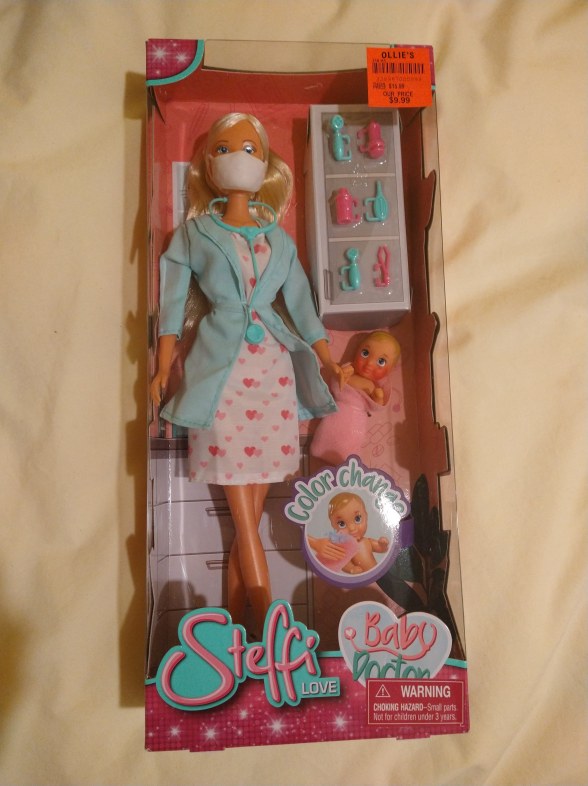
I pick up a Steffi-baby doctor while I am in Michigan.

For whom, you say?

For ME. I collect mother/baby images and statues. I have photographs, statues and toys, of mothers and babies and of pregnant women. Some family ones too. I am a Family Practice doctor, after all.

The Steffi is in with a bunch of Barbies. I am glad to see Barbie Princesses that are ethnically diverse. Next I hope the Disney will decide that adult women who are not virgins are human too, but judging by the way the second Frozen was received, I am not holding my breath. The only good Disney Queen is a dead one. The ones who survive, well, sex apparently turns them evil. It is pretty consistent in the Disney animated movies.

So, Steffi. I was thinking of Skipper, Barbie’s friend, but I realize that Steffi is not Skipper. Note that the baby has a facial rash. This apparently resolves if a cool washcloth is used on the baby’s face. I wish all babies were that easy to treat.

I look up Steffi on the internet and she is German. The packaging confirms this, with an instruction sheet in German and multiple other languages. I like Steffi a lot better than the Disney Princesses. She has tools: a stethoscope and a bottle and an otoscope and a thermometer and a rather mysterious looking caliper set. She has a green version of the white coat and a dress with hearts to reassure the babies. And LOOK! Steffi is wearing a MASK!

I love it. Up with Steffi, who can do things. I am not totally against princesses, I am just against the whole princesses are waiting for some prince to arrive and then their life will… well, they will die in childbirth if they remain nice and they will turn evil if they live. It seems like a poor choice of careers, honestly. My favorite princess is the Dealing with Dragons series, because that princess decides not to follow the usual princess path. The first thing she does is follow a frog’s advice and runs away. And the dragons are wonderful too.

For the Ragtag Daily Prompt: worry. I worry about the message of the Disney Princesses.

werewolf

Time out word warning, in this poem. This poem is about discrimination. Substitute practically anything for werewolf…. disabled, bipolar, depressed, autistic, substance abuser. I am sick of discrimination. For human, substitute “normal”.

You know I’ve been a werewolf my whole life

Started in the womb
triggered by antibodies
to tuberculosis

And I am tired

of people telling me

I’m a werewolf.

Ok? I fucking know that.
I have known it since Kindergarten
where I arrived full of joy
ready to sing

and was shunned

we didn’t have a television

but I knew that wasn’t really it
I was different
I am different

and fuck you humans
different is ok.

I am a werewolf
and I am fucking proud
of all I have accomplished
in the teeth of humans hating me
and trying to shut me down
and shunning me
and reporting me
and doing everything short of shooting me
with real guns

I’ve been told to sit down
shut up
stop arguing
be nice
be good
go away
die
don’t read my writeups
don’t C! my work
don’t talk to me
stop making waves
been fired
been reported
been shunned
been alone

and fuck you humans

get ready
because I am middle aged now
for a werewolf
and I am ready

to be one all the timee

damn the torpedoes
full speed ahead
fuck you humans
for how you’ve treated me

I’ve turned the other cheek
for sixty years

and now
I
will
fight

released like stars

I have had strep A sepsis and pneumonia twice. It was terrifying and I ended up having to take care of myself. I would be dead if I was not a physician.

Not to be named obscure website helped to sustain me, because it was a place I could go while I was alone, terrified and very very ill. The bout in 2014 took me out of clinic for six months and then I was barely able to work seeing half my usual number of patients. My local hospital refused to help me, but other people did. I am deeply deeply grateful to the people who did help me, including people on everything2.com that I have never met.

I wrote this in June 2014.

released like stars

________________

My sister used to tell me

β€œEverything2 is like a brain.

That’s what attracted me.

All the nodes, like neurons

Connected to each other more and more.”

Or something like that.


Isn’t it annoying?

Now that I’ve taken that memory out

Dusted it off

Embellished it

Who knows what she really said


Flashes of light now

And some where I blank out entirely

For just a moment

Only when I’ve eaten

I’m still avoiding carbs


Could be absence seizures

But she said seizures hurt

These do not hurt

And are accompanied by muscle twitches

Or muscles rolling gently across my frame


I am scared at first

Because I think they are neurons

Bursting into brain flame

And burning out

Brief candles


But I don’t think that’s right either

I think it is plaques

Deposits of antibody

Small pushpins in the wrong place

Being released like stars

hold me

poem: hold me

hold me, Beloved

hold me
I long for you
to be reunited with you, Beloved

to return to you

it is the children who hold me

here

the children
my children, grown
the hope of grandchildren
the damaged children
the new and young children
the old children in adults
who are so sad

it is the children who hold me

here

sometimes I am so sad, Beloved
I long for you

I do and I don’t
long for you
to call me home
and hold me

I know
that you hold me, Beloved
every moment

even when I cannot feel your touch

I know, Beloved
you will call me home

and hold me
now and forever
in your infinite embrace

DMV

I really did not want a tour of the DMV.

I arrive early, just as they open the doors, and there is already a line. We file in, each taking a paper number. The people in front go straight up to the desks. One window processes two people in only ten minutes each and then promptly puts up a closed sign. I guess it’s exhausting, working so fast.

Everyone waiting looks strained or sullen or stressed at the DMV. Shoulders hunched, heads down, the ones in power suits on their phones, but the phones keep cutting off in the DMV. Some sort of special shielding, I would bet.

I have number 17 and get to go to a window after 2 hours.

The clerk smiles at me. She is pale, pale, but has horns and pitch black wings, no feathers, like a bat.

“Unitarian!” she says, grinning.

“Um,” I say, eyeing the wings.

She looks wicked and then her wings are classic white feathered. She is browner and well, I’d guess Filipino. “Worried?” she says.

“No.” I say. “Tired. Sad. Curious.”

“What would you prefer to see?” she says and morphs. Now she has one bat wing that changes to black feathers then through rainbow feathers, to the snowy white feathers on the other side. Her skin tone is very dark on her right hand and then lighter across to pale with red freckles on her left hand.

“Nice.” I say.

“Which heaven would you like?”

“Unitarians do not believe in hell. Send me back.”

“You just got here. Violently and by surprise.” she wrinkles her nose. “Riots again. Sorry about that. We have opened a Unitarian space.”

“No. Send me back.”

She sighs and pulls down a heavy paper file. All the papers have gold edges, except for those with black. “You found your true love.”

“Yes. So what. We didn’t have time to make it work.”

“Don’t you want to wait until she dies so you can head down at the same time?”

“No. She’s only 32. And there is work to do.”

She is paging through the file. She snaps it shut. “Two week vacation. The minimum required. Go to the door on the right.”

I sigh. I want to argue but I’ve done that before. She will add on an extra week for every word I say.

My memories are intact here. Of all the lives. It’s always a bit overwhelming when I first arrive.

I go to the door on the right. A small page with grey tattered wings opens the door for me. I think it is a boy but he is wearing a Tinkerbell style tunic.

“I am your guide today.” No, it is a girl. I think. They may be able to morph that too.

We go in the door. My guide is shedding feathers, one every few steps. I pick one up. “Sorry.” she says. “Puberty. So, where do you want to spend your two weeks?” We are in a half circle shape hall, with hallways branching off. The hallways have no end that I can see and there are open doors all along them.

“I just want to go back.”

She pats my arm absently. “Oh, yes, they told me. You have to take breaks. You are wonderful, though, we love you.” She is leading me to one of the halls towards the left. We go past two doors and to the third. “See?” she says. “Unitarians. Of course, they can come in and out and go in all the others and argue with everyone. We wouldn’t want them to get bored.”

The room is empty at the moment. “And I guess they are all in other places!” The room across the hall seems to be a classic hell, with demons and pitchforks and a grim rocky landscape with pits of burning tar. I can see a dinosaur caught in tar, and a really huge crowd of people. There is a lot of screaming.

“Some people insist.” says my guide. “Where to next? Evangelical? Valhalla is rather fun for males and certain females, we’ve got fluffy clouds and harps, or are you more interested in touring Asian, African, Australian? We do have paleolithic sites and many people are interested in Egyptian themes. The cliff dwellers interest many as well. “

“Atheist.”

She frowns. “Of course, but that room shuts down consciousness and you have to have two weeks of consciousness before you can go back.” She is leading me back into the central half hall.

“Ok,” I say, giving in. “I am not trying to be difficult, you know.”

“Yes, and everyone told me correctly that you are difficult. All the ones that go back over and over are difficult. And there are more every year.”

“Take me somewhere new, ok?” I am looking now at the frieze over the door that will take me back. Two weeks. I can manage. I am resigned. The frieze is cupids and then male odalisques, then female, then leopards, and then they are cupid fauns with horns on their heads, morphing towards adulthood. Yet the carved letters stay the same:

Deus Machina Verum

and I follow my guide into another hallway to find a place for my two weeks.

_________________________

This poem inspires me to post today’s story: https://narble.blog/2021/08/17/if-there-are-no-dogs-in-heaven/

I think the hell in heaven also fits today’s Ragtag Daily Prompt: scorch.

No pandas

Today is PANS/PANDAS awareness day. I wrote this a couple weeks ago.

PANDAS PHYSICIANS NETWORK: PANS/PANDAS AWARENESS DAY

___________________________________

No pandas

I don’t have PANDAS because in the United States we barely believe in it in children and we don’t at all in adults.

I don’t have PANDAS because even though one psychiatrist said I did, he retired, and the next one says I don’t. Then not sure then no. They don’t agree.

I don’t have PANDAS because my primary care doctor won’t read the guidelines even after I have been her patient for seven years.

I don’t have PANDAS because my pulmonologist has never heard of it.

I don’t have PANDAS because it would be a lot easier to put me on a mood stabilizer to shut me up than listen to me.

I don’t have PANDAS because I am labelled difficult because I am afraid to take a mood stabilizer because I do not get a fever or a white count so my main symptom of infection is that other doctors think that I am manic though I am hypoxic and short of breath. They want to fix my mood while I want to not die of pneumonia, so our goals are at odds.

I don’t have PANDAS because I am a doctor and if I had PANDAS my fellow local doctors would feel guilty that they have told each other that I am bipolar and manic for the last 18 years and have shunned me at the county medical meetings and won’t even send me the invitations, except for the one that forwards them. He says he has given them my email and he doesn’t understand why they don’t send me the invitations.

I don’t have PANDAS because Seattle Children’s doesn’t allow the Cunningham Panel to be drawn and they say there is not enough evidence yet.

I don’t have PANDAS because I can’t afford to pay $925 on my own for the Cunningham Panel and anyhow my antibody level is back to whatever is my new baseline, higher than before no doubt.

I don’t have PANDAS because the other doctors are frightened: if I have PANDAS then who else does and if I have chronic fatigue caused by hypoxia and fibromyalgia and it’s related to PANDAS then who else would they have to test and neuropsychiatric is a whole different thing from psychiatric and we swear that we don’t know what causes chronic fatigue and fibromyalgia.

I don’t have PANDAS because I am an adult who lives in the US though if I was in Canada or Europe I could in fact have PANDAS.

I don’t have PANDAS because in the United States we barely believe in it in children and we don’t at all in adults.

Adverse Childhood Experiences 12: welcome to the dark

Welcome to the dark, everyone.

When you think about it, all the children in the world are adding at least one Adverse Childhood Experience score and possibly more, because of Covid-19. Some will add more than one: domestic violence is up with stress, addiction is up, behavioral health problems are up, some parents get sick and die, and then some children are starving.

From the CDC Ace website:

“Overview:Adverse Childhood Experiences (ACEs) are potentially traumatic events that occur in childhood. ACEs can include violence, abuse, and growing up in a family with mental health or substance use problems. Toxic stress from ACEs can change brain development and affect how the body responds to stress. ACEs are linked to chronic health problems, mental illness, and substance misuse in adulthood. However, ACEs can be prevented.”

Well, can they be prevented? Could Covid-19 be prevented? I question that one.

I have a slightly different viewpoint. I have an ACE Score of 5 and am not dead and don’t have heart disease. I spent quite a bit of time thinking about ACE scores and that it’s framed as kids’ brains are damaged.

I would argue that this is survival wiring. When I have a patient where I suspect a high ACE score, I bring it up, show them the CDC web site and say that I think of it as “crisis wiring” not “damaged”. I say, “You survived your childhood. Good job! The low ACE score people do not understand us and I may be able to help you let go of some of the automatic survival reactions and fit in with the people who had a nice childhood more easily.”

It doesn’t seem useful to me to say “We have to prevent ACE scores.” Um. Tsunamis, hurricanes, Covid-19, wars… it seems to me that the ACE score wiring is adaptive. If your country is at war and you are a kid and your family sets out to sea to escape, well, you need to survive. If that means you are guarded, untrusting, suspicious and wary of everyone, yeah, ok. You need to survive. One of my high ACE Score veterans said that the military loved him because he could go from zero to 60 in one minute. Yeah, me too. I’ve worked on my temper since I was a child. Now it appears that my initial ACE insult was my mother having tuberculosis, so in the womb. Attacked by antibodies, while the tuberculosis bacillus cannot cross the placenta, luckily for me. And luckily for me she coughed blood at 8 months pregnant and then thought she had lung cancer and was going to die at age 22. Hmmm, think of what those hormones did to my wiring.

So if we can’t prevent all ACE Scores, what do we do? We change the focus. We need to understand crisis wiring, support it and help people to let go of the hair trigger that got them through whatever horrid things they grew up with. 16% of Americans have a score of 4 or more BEFORE Covid-19. We now have a 20 or 25 year cohort that will have higher scores. Let’s not label them doomed or damaged. Let’s talk about it and help people to understand.

I read a definition of misery memoirs today. I don’t scorn them. I don’t like the fake ones. I don’t read them, though I did read Angela’s Ashes. What I thought was amazing about Angela’s Ashes is that for me he captures the child attitude of accepting what is happening: when his sibling is dying and they see a dog get killed and he associates the two. And when he writes about moving and how their father would not carry anything, because it was shameful for a man to do that. He takes it all for granted when he is little because that is what he knows. One book that I know of that makes a really difficult childhood quite amazing is Precious Bane, by Mary Webb. Here is a visible disability that marks her negatively and yet she thrives.

A friend met at a conference is working with traumatic brain injury folks. They were starting a study to measure ACE scores and watch them heal, because they were noticing the high ACE score people seem to recover faster. I can see that: I would just say, another miserable thing and how am I going to work through it. Meanwhile a friend tells me on the phone that it’s “not fair” that her son’s senior year of college is spoiled by Covid-19. I think to myself, uh, yes but he’s not in a war zone nor starving nor hit by a tsunami and everyone is affected by this and he’s been vaccinated. I think he is very lucky. What percentage of the world has gotten vaccinated? He isn’t on a ventilator. Right now, that falls under doing well and also lucky in my book. And maybe that is what the high ACE score people have to teach the low ACE score people: really, things could be a lot worse. No, I don’t trust easily and I am no longer feeling sorry about it. I have had a successful career in spite of my ACE score, I ran a clinic in the way that felt ethical to me, I have friends who stick with me even through PANDAS and my children are doing well. And I am not addicted to anything except I’d get a caffeine headache for a day if I had none.

For the people with the good childhood, the traumatic brain injury could be their first terrible experience. They go through the stages of grief. The high ACE score people do too, but we’ve done it before, we are familiar with it, it’s old territory, yeah ok jungle again, get the machete out and move on. As the world gets through Covid-19, with me still thinking that this winter looks pretty dark, maybe we can all learn about ACE scores and support each other and try to be kind, even to the scary looking veteran.

Take care.