Another Falling Angels poem.
quit


Another Falling Angels poem.

I wrote this in 2010, after I worked for three months at Madigan Army Hospital. I really enjoyed working there. It was the first time since residency that I had worked in a big hospital — 450 beds — and in a not rural setting. I kept asking to work with residents and eventually the Captain and I worked it out to both our satisfactions.
______________________________________
During my three months temp job at a nearby Army Hospital, I am asked to help the Family Medicine Inpatient Team (FMIT) whenever a faculty member is sick or out or deployed, which turns out to be fairly often. I enjoy this because I want to work with residents, Family Practice doctors in training. It is very interesting to be at a training program, watch the other faculty and work at a 400 bed hospital instead of my usual 25 bed one.
Two patients need to be admitted at the same time on our call day, so the second year resident takes one and I take the other. The report on mine is an 82 year old male veteran, coughing for three weeks, emergency room diagnosis is pneumonia.
The resident soon catches up with me because her person is too sick and gets diverted to the ICU. Mr. T, our gentleman, is a vague historian. He says that he has always coughed since he quit smoking 15 years ago and he can’t really describe his problem. He’d gotten up at 4:30 to walk around the assisted living; that is normal for him because he still does some o the maintenance. He had either felt bad then or after going back to sleep in a chair and waking at 10. “I didn’t feel good. I knew I shouldn’t drive.”
He’s had a heart attack in the past and heart bypass surgery. Records are vague. The radiologist reads the chest xrays essentially as, “Looks just like the one 3 months ago but we can’t guarantee that there isn’t a pneumonia or something in there.” He has a slightly elevated white blood cell count, no fever, and by then I do a Mini-mental status exam. He scores 22 out of 30. That could mean right on the edge of moderate dementia, or it could be delirium. I get his permission to call his wife.
“Oh, his memory has been bad since he spent a year in a chair telling them not to amputate his toes. And he was on antibiotics the whole time. He wasn’t the same after that. This morning he just said he didn’t feel right and that he shouldn’t drive.” So his wife called an ambulance.
The third year chief resident comes by and wants to know the admitting diagnosis. “Old guy, don’t know.” is my reply. “Either pneumonia or a urinary tract infection or a heart attack maybe with delirium or dementia or both.
The second year is helping me put in the computer orders, because I am terrible at it still. She could put them in upside down and asleep. “Why are we admitting him, anyhow? We can’t really find anything wrong, why not just send him home?”
“We can’t send him home because he can’t tell us what’s wrong. He might have an infection but he might not, and he has a really bad heart. If we send him home and he has a heart attack tonight, we would feel really bad. And he might die.”
I was getting a cold. I had planned to ask to work a half day but half the team was out sick so I just worked. But by morning I had no voice and felt awful. I call in sick.
At noon the phone rings. It is the second year. “You know Mr. T, who we admitted last night?”
“Yes,” I say.
“He had that heart attack during the night. Got taken to the cath lab. You made me look really good.” We had worked on the assumption that it could be early in a heart attack though the first labs and the ECG were negative. I had insisted on cardiac monitoring and repeating the enzymes. The resident had finished the note after I left and the night team had gotten the second and abnormal set of enzymes.
82 year olds are tricky. With some memory loss he couldn’t tell us much except that “I don’t feel right.” He was right not to drive and we were right to keep him in the hospital. And if it had all been normal in the morning, I still would not have felt bad about it. The residents are looking for a definitive diagnosis, but sometimes it’s “Old guy, don’t know,” until you do know.

Today is PANS/PANDAS awareness day. I wrote this a couple weeks ago.
___________________________________
No pandas
I don’t have PANDAS because in the United States we barely believe in it in children and we don’t at all in adults.
I don’t have PANDAS because even though one psychiatrist said I did, he retired, and the next one says I don’t. Then not sure then no. They don’t agree.
I don’t have PANDAS because my primary care doctor won’t read the guidelines even after I have been her patient for seven years.
I don’t have PANDAS because my pulmonologist has never heard of it.
I don’t have PANDAS because it would be a lot easier to put me on a mood stabilizer to shut me up than listen to me.
I don’t have PANDAS because I am labelled difficult because I am afraid to take a mood stabilizer because I do not get a fever or a white count so my main symptom of infection is that other doctors think that I am manic though I am hypoxic and short of breath. They want to fix my mood while I want to not die of pneumonia, so our goals are at odds.
I don’t have PANDAS because I am a doctor and if I had PANDAS my fellow local doctors would feel guilty that they have told each other that I am bipolar and manic for the last 18 years and have shunned me at the county medical meetings and won’t even send me the invitations, except for the one that forwards them. He says he has given them my email and he doesn’t understand why they don’t send me the invitations.
I don’t have PANDAS because Seattle Children’s doesn’t allow the Cunningham Panel to be drawn and they say there is not enough evidence yet.
I don’t have PANDAS because I can’t afford to pay $925 on my own for the Cunningham Panel and anyhow my antibody level is back to whatever is my new baseline, higher than before no doubt.
I don’t have PANDAS because the other doctors are frightened: if I have PANDAS then who else does and if I have chronic fatigue caused by hypoxia and fibromyalgia and it’s related to PANDAS then who else would they have to test and neuropsychiatric is a whole different thing from psychiatric and we swear that we don’t know what causes chronic fatigue and fibromyalgia.
I don’t have PANDAS because I am an adult who lives in the US though if I was in Canada or Europe I could in fact have PANDAS.
I don’t have PANDAS because in the United States we barely believe in it in children and we don’t at all in adults.

It is easy with you
All the places you’ve been offended
Where you haven’t been treated right
A bike shop
Food co-op
Coffee shops
Restaurants
It’s easy to hide my physical body
Where you can’t find me
But what of my mind and heart
You always feel it when I go
I go to the Beloved
I give up
I cast myself into the abyss
Grief, denial, loss, bargaining, abandonment, hopeless grief
I throw myself over the cliff
Over and over
I resist
And then let go
It’s not wings
Because the cliff is a waterfall
I don’t want wings
And the Beloved laughs
Wings form
I refuse to fly
I won’t I won’t I won’t
I fall towards the water
Each time I wonder
If this time the Beloved will not shift
I hit the water
Safe again
Scales and tail
And I can breathe
And swim free
To the sea

For the Ragtag Daily Prompt: vessel.

I took the photographs recently, from North Beach, second one zoomed all the way.
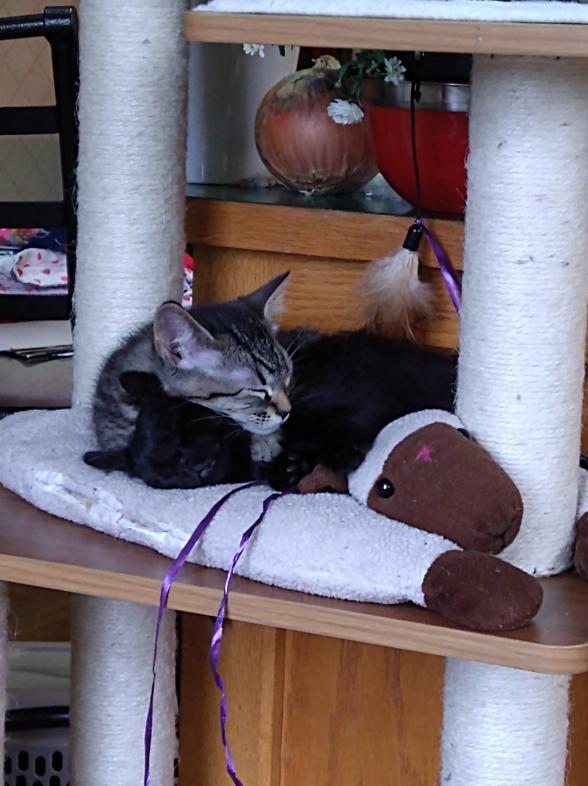
I have two new kittens, named after rivers. They have been here two weeks and two days.
They were only about 7 weeks when I got them, boy and girl, just fixed and groggy from anesthesia on the ride home. They had been fostered a little, and are well trained for catbox and for not using claws on hands.
The first favored toy is a cardboard box, the right size to hold one of them. They spend a lot of time with one inside the box and one outside. Sometimes with a toy mouse on the inside too.
This am before I got up, one of them went into a bag. However, it was a small gift bag with the handles. Apparently he got caught in the handles, panicked and tore around the room and then down the stairs. That was the tiger. I lay in bed laughing.
The black one just did the same thing. She got her neck through the handle and then tore through the kitchen and living room. She got out before I got to her so I couldn’t help laughing at her. Nine weeks or not, she stomped away with her ears in the embarrassed cat position.
Good that I didn’t leave the bag out the first week they were here. I was supposed to “keep them quiet” since they were post-operative. You can guess how well that went. One jumped over the back of the couch from the floor and landed on me when I was half asleep and then tore off the couch. They seem fine.
I am leaving the bag out to see if they investigate further.
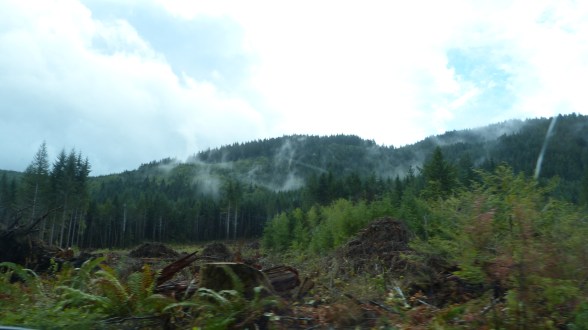
I was riding in the car last Monday and took this. We were headed out to hike. It was a pretty wet day but still really really fun.
For the Ragtag Daily Prompt: mist.

Poem: finally.

grief is an ox
that stands in the room with me
and overshadows
everything
no
grief
is a plow
pulled by an ox
I try to guide it
in the furrows
no
grief is the heavy ground
the plow turns it
the ox pulls
I guide it
in the furrows
no
I am grieving
I let it be close
I don’t push it
in to an ox
in to a plow
in to the earth
I let it in
I grieve

BLIND WILDERNESS
in front of the garden gate - JezzieG
Discover and re-discover Mexico’s cuisine, culture and history through the recipes, backyard stories and other interesting findings of an expatriate in Canada
Or not, depending on my mood
All those moments will be lost in time, like tears in rain!
An onion has many layers. So have I!
Exploring the great outdoors one step at a time
Some of the creative paths that escaped from my brain!
Books, reading and more ... with an Australian focus ... written on Ngunnawal Country
Engaging in some lyrical athletics whilst painting pictures with words and pounding the pavement. I run; blog; write poetry; chase after my kids & drink coffee.
Coast-to-coast US bike tour
Generative AI
Climbing, Outdoors, Life!
imperfect pictures
Refugees welcome - Flüchtlinge willkommen I am teaching German to refugees. Ich unterrichte geflüchtete Menschen in der deutschen Sprache. I am writing this blog in English and German because my friends speak English and German. Ich schreibe auf Deutsch und Englisch, weil meine Freunde Deutsch und Englisch sprechen.
En fotoblogg
Books by author Diana Coombes
NEW FLOWERY JOURNEYS
in search of a better us
Personal Blog
Raku pottery, vases, and gifts
𝖠𝗇𝗈𝗍𝗁𝖾𝗋 𝖶𝗈𝗋𝖽𝖯𝗋𝖾𝗌𝗌.𝖼𝗈𝗆 𝗌𝗂𝗍𝖾.
Taking the camera for a walk!!!
From the Existential to the Mundane - From Poetry to Prose
1 Man and His Bloody Dog
Homepage Engaging the World, Hearing the World and speaking for the World.
Anne M Bray's art blog, and then some.
My Personal Rants, Ravings, & Ruminations
 KO Rural Mad As Hell Blog
You must be logged in to post a comment.