A house for our lives

I wonder why we don’t design houses for our lives.

A family house could have everything on the first floor, with a bedroom, wheelchair accessible, and a full bath. The stairs could have an entryway that can be closed off. Upstairs, a sitting room, a full bath, two bedrooms or three and a pocket kitchen. Laundry facilities need to be on the main floor, but they could be in a mud room/entry that is part of the entry to the stairs.

The basement, if there is one, could be for storage or for another apartment.

A couple could buy the house, raise kids in the whole thing, then downsize to the main floor, rent the upstairs, perhaps rent the basement.

My daughter and son want less stuff. Neither has the packrat gene from me and they want to be mobile and have cleaning be very easy and moving be easy. I feel guilty that I have a big house alone, but it is full of stuff that I am slowly decreasing. It has a daylight basement, but there is no bathroom down there nor kitchen and the laundry facilities are there. Also the plumbing is 4 inch across 2 foot concrete sections from the 1930s and runs under the slab poured inside the 1930s garage foundation. The garage is built to the neighbor’s line in back and five feet onto the lot in the middle of the block at the side, so I have two lots. If I take it down, I could not rebuild there because of codes. I think that to do the basement as an apartment I’d have to redo the plumbing first, which is daunting. Also renting is tricky. That is, getting someone out if it is not working can be a challenge.

Friends are looking for a four bedroom house. They have three children so that is what they need now. But the eldest is 14, so it will not be long at all until they need less house. I picture bedroom modules that can be detached.

Our town is very short on long term rentals because now people can make more with short term rentals to the tourists for the many festivals. This in turn is messing up the traffic and increasing accidents, because there are two two-lane roads into town. And a ferry. The people who work in the shops and restaurants are having to commute. People own a fifth house that they may visit only twice a year. It looks like it will get messier, though we may have another housing crash. Right now houses are going up.

My daughter has been designing her future tiny house for a while. The second entry is to a mud room with laundry facilities and a tile floor and a shower so that she can climb out of swimming or running or mountain biking or sailing gear and have a place to hang everything before she goes into the rest of the house. She will want to be able to clean herself and her gear.

My grandparents had a house on Topsail Island in North Carolina. There was an outdoor shower under part of the house, to wash the sand off before we were allowed upstairs. Then another hose to wash our feet once we were up on the deck. Sand and the smell of the ocean, all the time.

Friends have a four apartment building. They altered the two on the top floor to make one apartment. The lower two they rent, sometimes to family. There are four bedrooms on top and two in each apartment. They have a big kitchen and a pocket kitchen in the top section.

Some of my patients need tiny houses, a place alone, even though they also need social contact. I hate the big ostentatious show houses, especially the ones with the play room on a different floor, let’s relegate the children to a different part of the house. Then the elders can also be relegated.

I wish housing were more about need and practicality and less about money and status. And still, we are spoiled….

____________________________

written 8/2/2017

Admitting diagnosis: old guy, don’t know

I wrote this in 2010, after I worked for three months at Madigan Army Hospital. I really enjoyed working there. It was the first time since residency that I had worked in a big hospital — 450 beds — and in a not rural setting. I kept asking to work with residents and eventually the Captain and I worked it out to both our satisfactions.

______________________________________

During my three months temp job at a nearby Army Hospital, I am asked to help the Family Medicine Inpatient Team (FMIT) whenever a faculty member is sick or out or deployed, which turns out to be fairly often. I enjoy this because I want to work with residents, Family Practice doctors in training. It is very interesting to be at a training program, watch the other faculty and work at a 400 bed hospital instead of my usual 25 bed one.

Two patients need to be admitted at the same time on our call day, so the second year resident takes one and I take the other. The report on mine is an 82 year old male veteran, coughing for three weeks, emergency room diagnosis is pneumonia.

The resident soon catches up with me because her person is too sick and gets diverted to the ICU. Mr. T, our gentleman, is a vague historian. He says that he has always coughed since he quit smoking 15 years ago and he can’t really describe his problem. He’d gotten up at 4:30 to walk around the assisted living; that is normal for him because he still does some o the maintenance. He had either felt bad then or after going back to sleep in a chair and waking at 10. “I didn’t feel good. I knew I shouldn’t drive.”

He’s had a heart attack in the past and heart bypass surgery. Records are vague. The radiologist reads the chest xrays essentially as, “Looks just like the one 3 months ago but we can’t guarantee that there isn’t a pneumonia or something in there.” He has a slightly elevated white blood cell count, no fever, and by then I do a Mini-mental status exam. He scores 22 out of 30. That could mean right on the edge of moderate dementia, or it could be delirium. I get his permission to call his wife.

“Oh, his memory has been bad since he spent a year in a chair telling them not to amputate his toes. And he was on antibiotics the whole time. He wasn’t the same after that. This morning he just said he didn’t feel right and that he shouldn’t drive.” So his wife called an ambulance.

The third year chief resident comes by and wants to know the admitting diagnosis. “Old guy, don’t know.” is my reply. “Either pneumonia or a urinary tract infection or a heart attack maybe with delirium or dementia or both.

The second year is helping me put in the computer orders, because I am terrible at it still. She could put them in upside down and asleep. “Why are we admitting him, anyhow? We can’t really find anything wrong, why not just send him home?”

“We can’t send him home because he can’t tell us what’s wrong. He might have an infection but he might not, and he has a really bad heart. If we send him home and he has a heart attack tonight, we would feel really bad. And he might die.”

I was getting a cold. I had planned to ask to work a half day but half the team was out sick so I just worked. But by morning I had no voice and felt awful. I call in sick.

At noon the phone rings. It is the second year. “You know Mr. T, who we admitted last night?”

“Yes,” I say.

“He had that heart attack during the night. Got taken to the cath lab. You made me look really good.” We had worked on the assumption that it could be early in a heart attack though the first labs and the ECG were negative. I had insisted on cardiac monitoring and repeating the enzymes. The resident had finished the note after I left and the night team had gotten the second and abnormal set of enzymes.

82 year olds are tricky. With some memory loss he couldn’t tell us much except that “I don’t feel right.” He was right not to drive and we were right to keep him in the hospital. And if it had all been normal in the morning, I still would not have felt bad about it. The residents are looking for a definitive diagnosis, but sometimes it’s “Old guy, don’t know,” until you do know.

vast

Sometimes emotions are vast. I do not think our culture deals with grief very easily. Grief then becomes a vast pit, stuffed inside us. I sent the Falling Angels poems to friends and family. One older friend said that the poems were too sad and was I that sad all the time?

I replied, no, I am not sad all the time. The sadness is in the poems because there are very few people that I know that are comfortable with sadness and grief. So I put it in to poetry, because I do not want to stuff it. We need to let grief come out and let the tears flow and let it go.

For the Ragtag Daily Prompt: vast.

do no harm

First do no harm.

That is part of the Hippocratic Oath and yes we did it at the end of medical school. “I will prescribe regimen for the good of my patients according to my ability and my judgement and never do harm to anyone.”

This is a pandemic. People are dying. A lot of people. I am not ok with people saying personal freedom, we don’t want to wear masks, we don’t want the vaccine. I take the oath to first do no harm: what about those people? They are putting their personal freedom first and do not care if they harm me. I don’t like them. Please don’t kill me. Please don’t kill my son or daughter or future daughter in law.

You can have your personal freedom not to wear a mask or get a vaccine: in your house. I don’t think you should be allowed off your property if you won’t put doing no harm to others first during a pandemic. Stay in your house. Don’t come out. It is selfish to put yourself and your personal freedom in front of multiple peoples’ lives. You can order from Amazon and order groceries and ok, you can associate with other selfish unimmunized unmasked people, but not the rest of us. Your personal freedom has a high chance of killing me. I am immunized but my immune system doesn’t work and I am already on oxygen. I don’t want to be around you. Stay away from me.

I think it is time for my community to give back to me and all the other first responders: medical, police, fire, grocery store, hospital, all the essential workers. Give back: either get immunized and masked or stay in your house.

Thank you.

Covid-19: caring for yourself

audio version, covid-19: Caring for yourself

A friend took his father to the ER in the next bigger town, sent there for admission to the hospital from the clinic. His father is in his 90s, has heart failure, and his legs were puffed up like balloons with weeping blisters.

They were in the ER for 13 hours, never given food though it was promised, the staff couldn’t even find time to bring a urinal and his father was not admitted. He was sent home. No beds. On divert.

Ok, so when should you go to the hospital right now? Only if you really really can’t breathe….

First, the emergencies. An ER nurse friend talks about “happy hypoxia” where people do not feel bad but have an oxygen saturation of 50%. I suspect that this is when their lungs really are swelling shut very fast. They will turn blue quickly. Call an ambulance. In the 1918-1919 influenza, soldiers “turned blue and fell over dead”. In Ralph Netter’s book on pulmonary diseases, he has a drawing of the lungs of a person who died from influenza pneumonia. The lungs are basically one big red purple bruise with no air spaces. So if a friend is goofy and their lips are turning blue: AMBULANCE.

The one in five hospitals that are 95% full or more in the US are now cancelling all of the elective surgeries: knee replacements, hip replacements, non emergent heart surgeries, all of it.

If you are not dying, do not go to the emergency room if you are in one of the totally swamped areas.

So how to care for yourself with covid-19? Like influenza, it is pretty clear that it either causes lung swelling or the lungs fill with fluid or both. With lung swelling you may be able to stay home. First take your pulse. If you have a pulse oximeter, great, but no worries if you don’t. .What is your resting heart rate? Count the number of heart beats in 60 seconds

If it’s 60-100, that is good. It’s normal. If it is 120 at rest, that is getting worrisome. If you are short of breath at rest and your pulse is over 100, call your doctor. If they can get you oxygen, you still may be able to stay home. If not, emergency room.

Now get up and walk. Do you get short of breath? Sit back down and again, count the number of heartbeats when you are sitting. If your resting pulse was 90 and you jump to 130 walking, you have lung swelling. Functionally you have half the normal air space and so your heart is making up the difference. How to cope? Well, walk slowly. Walk during the day, do get up because otherwise you may get a leg blood clot, but really minimize your activity. Now is not the time to rearrange the furniture. Also, you may not go to work until your walking or loaded pulse is under 100.

If your pulse does not jump up when you walk, next try walking loaded. That is, carry something. Two bags of groceries, a toddler, a pile of books. Go up the stairs. Sit down and take your pulse when you are short of breath or it feels like your heart has speeded up. I am in this category. My pulse is 70, oxygen at 99 sitting. Walking my pulse jumps to 99. Walking loaded my pulse goes to 125 and my oxygen level starts dropping, need oxygen once it gets to 87. I tried a beach walk without oxygen 3 weeks ago. I photographed the pulse ox when it was at 125 with O2 sat at 87. I still need oxygen.

The treatment for lung swelling is rest. This is my fourth time, so I am used to it. Some people will have so much swelling they will need oxygen at rest. If the lungs swell shut, they need to be intubated or they die. Suffocation is not fun. The other treatment is not to catch another virus or a bacteria on top of the present lung swelling. Wear mask, get vaccinated, put out the cigarrette, no vaping, pot is terrible for the lungs too and increases the risk of a heart attack.

With my four pneumonias, the first two made me tachycardic and it took two months for the lung swelling to subside. It sucked. Inhalers don’t work, because they work by bronchodilating. You can’t bronchodilate swollen lung tissue. The steroid inhalers might help a little but they didn’t help me. The third pneumonia took 6 months to get back to work and then I was half time for 6 months. This time I am five months out today and I still need oxygen. Darn. Don’t know if my lungs will fully recover. They may not.

So: rest. Good food. Avoid substance abuse. Mask all visitors and don’t go to parties/raves/concerts/anything. Oxygen if needed and if you can get it.

Take care.

The photograph is me wired up for a sleep study a week ago. The technician took it at my request. I won’t have results until next week.

Covid-19: A gentle answer

I went to have a hair cut today and went in three shops since I was downtown anyhow.

There are lots of tourists and visitors walking around without masks.

In one shop the owner asks if I am Dr. O, and it turns out her daughter babysat for my children 19-20 years ago. We had a nice discussion about our offspring. We are both wearing masks.

In a mineral store somehow the covid-19 subject comes up. I say that I am wearing a mask because I am on oxygen and vulnerable, and even though I am vaccinated, if I get covid-19, it might kill me.

The two owners are not wearing masks. The woman says, “We are both vaccinated, but I am just really confused about what to do.”

I say, “Well, I am a Family Physician. Let’s take chicken pox. If someone is exposed, it can take 21 days for them to break out in the rash. They will be contagious for 1-2 days before they have symptoms. The problem is that it can be ANY of those 21 days. After they break out in the rash, they are contagious until every pox is crusted over. So it can be six weeks that they are possibly or certainly contagious. With Covid-19, the Delta Variant is so infectious and again people may not have symptoms yet, so I am wearing a mask any time I am around strangers.”

The woman says, “Thank you for telling me about it. It’s helpful to hear from a professional.”

“You’re welcome.” I say, gathering my bag to go.

“Look,” she says, “I am putting on my mask now!”

I look and she is.

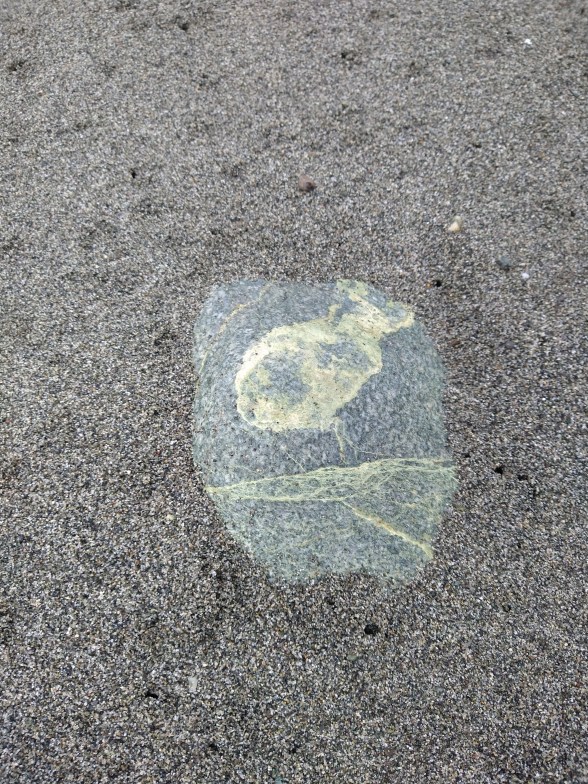
What do you see?

What do you see in this rock?

Broken rock

Water breaks rocks.

How? It does wear them down, but it can also break blocks off. Water goes into any tiny crack. When it freezes, it expands. Over time, the crack is widened, until the rock breaks. Rock cannot stand against water.

Top ten causes of death: US 2020

Top ten causes of death US 2020, according to JAMA, here.

Total deaths: 3,358.814
Contrast total deaths in 2019, at 2,854,838. That number had been on a very slow rise since 2015 (2,712,630) to 2019 (2,854,838). That increase over four years is 142,208 people. Then the death rate suddenly jumps 503,976 people in one year. Ouch. I cannot say that I understand vaccine refusal.

1. Coronary artery disease: 690,882
Heart disease still wins. And it went up 4.8%. It is suspected that people were afraid to go to doctors and hospitals. I saw one man early on in the pandemic for “constipation”. He had acute appendicitis. I sent him to the ER and his appendix was removed that day. He thanked me for seeing him in person. Might have missed that one over zoom.

2. Cancer deaths: 598,932
This is cancer deaths, not all of the cancers.

3. Covid-19: 345,342
I have had various people complain that covid-19 is listed as the cause of death when the person has a lot of other problems: heart disease, cancer, heart failure. The death certificate allows for more than one cause but we are supposed to list the final straw first. I cannot list old age, for example. I have to list: renal failure (kidneys stopped working) due to anorexia (stopped eating) due to dementia. That patient was 104 and had had dementia for years. But dementia is not listed as the final cause. So if the person is 92, in a nursing home for dementia and congestive heart failure, gets covid-19 and dies, covid-19 is listed first, and then the others.

4. Unintentional injuries: 192,176
Accidents went up, not down, which is interesting since lots of people were not in their cars. However, remember that the top of the list for unintentional injuries is overdose death, more by legal than illicit drugs. If there is no note, it’s considered unintentional. Well, unless there is a really high blood level of opioids and benzos and alcohol. Then it becomes intentional. They do not always check, especially if the person is elderly. The number rose 11.1%, which seems like a lot of people.

5. Stroke: 159,050
This rose too.

6. Chronic lower respiratory diseases: 151,637
This went down a little. This is mostly COPD and emphysema. So why would it go down? Well, I think bad lung disease people were dying of covid-19, right?

7. Alzheimer’s: 133,182
This seems to belie me putting renal failure due to anorexia due to Alzheimer’s. I think they actually read the forms and would put that as Alzheimer’s rather than renal failure, because it is not chronic renal disease.

8. Diabetes: 101,106
This rose too. 15.4%, again, probably partly because people avoided going to clinic visits. Also perhaps some stress eating. Carbohydrate comfort.

9. Influenza and pneumonia: 53,495
So this went up too in spite of a lot less influenza. Other pneumonias, presumably.

10. Kidney disease: 52,260
This went up.

And what fell out of the top ten, to be replaced by covid-19?

11. Suicide: 44,834
This actually went down a little. What will it do in 2021?

So what will 2021 look like? I don’t know. It depends what the variants of covid-19 do, depends on what sort of influenza year we have, depends on whether we are open or closed, depends if we bloody well help the rest of the world get vaccinated so that there is not a huge continuing wave of variants.

Today the Johns Hopkins covid-19 map says that deaths in the US stand at 608,818 from covid-19. If we subtract the 2020 covid-19 deaths, we stand at 263,495 deaths from covid-19 so far this year. Will we have more deaths in the US from covid-19 than in 2020? It is looking like yes, unless more people get immunized fast.

Take care.

I don’t think I realized what I had gotten myself into, but it seemed like the potential for fun and insanity were there in equal parts

sometimes you know things
without knowing

sometimes you no things
without noing

sometimes you know things
without noing

sometimes you no things
without knowing

sometimes you koanow things
without knowing

sometimes you no things
without koanowing

sometimes you koanow
without koanowing

sometimes you koanow

snow

also published on another site today.