Adverse Childhood Experiences 13: unsense

As a child in an alcoholic/addict household where you can not trust adults, who do you trust?

You either trust yourself or you buy in the alcohol story.

If you buy in, you have a high probability of either becoming an addict or marrying one, depending if you prefer the enabler or the enablee role.

If you trust yourself, you develop certain senses. You pay attention to people’s emotions. You pay attention to what people FEEL, what people DO and not what people SAY. You do not care what they say: what matters is what they do. My sister said she used to walk my parent’s house during high school and try to feel the mood. Did she need to hide?

The enabler role is trying to control the other person. There are amazing variations on this. I cared for a person whose sister would not take care of herself. Every time the sister is hospitalized, the person goes and cleans tons of garbage and rotted food from the apartment.

“Stop doing that,” I say, “You are enabling her. Call Adult Protective Services to go look at it instead.”

It can be very difficult to stop and can take years. People can change.

I have noticed that the enabler role is lethal. The enablers seem to die before the enablee. Certainly in my immediate family and with many patients too.

Enablee is the person controlled. Alcohol, drugs, gambling, anger, emotions. It is very very interesting to watch. I have read parts of my mother’s diaries. She was the enabler, with my father as the enablee. However, the diaries document them fighting in the middle of the night when he is drunk. And I remember high school, putting the pillow over my ears, because they were screaming at each other.

But wait. Why would she argue with her drunk husband? Why would anyone argue with a drunk person? You have to wait until they are sober.

And slowly I realize that my mother too was an alcoholic. I remember her drinking. Best cover for an alcoholic is a worse alcoholic, right? It’s fairly horrid. But it explains some stories and my food insecurity. They would not get up in the morning to feed me. My mother told stories of me trying to feed myself: cheerios and laundry soap. If my father was hung over, ok, but, why wouldn’t my mother get up? I think they were both hung over. That or else she really did not want a child. Especially a nine month old with opinions while she was trying to get over tuberculosis. She never got to hold me after birth until 9 months. And then I did not want her. I wanted her mother.

Trusting yourself, life can be a bit complicated. You sense the emotions others are hiding. Being a physician allows me to ask about the hidden things, very gently. Sometimes they come out right away. Sometimes it takes months. Sometimes years and sometimes never. My sister and I discussed going to parties and thinking, oh, that person is the child of an addict/alcoholic. This person is in pain. This person is quite happy but hiding stuff.

I told a counselor I do not know how to turn it off. She replies, “Why do you think I am a counselor?”

I don’t see auras. I feel things: like a cloud. Like a tiger, like a bear, like a whale, singing.

I think I will go with the whale.

small child

You work at healing
For years

You dive in the swamp
Of your psyche
Turn over the mud
Tunnel through it
Breath it
See lilies arise
From the muck

The Beloved is a deer
Dainty hooves
In the swamp

At last you come
To bedrock

So you rest
Bedrock
You think

Until you notice
A chink in the rock
You look away
You avoid it

At last you look
It isn’t going away

The Beloved is a bittern
In the reeds

Fluid leaks
From the chink

Foul black bilious
Acidic
Burning holes in the slanted rock
Again you look away
But not for long

You step forward
Touch the rock

I am present you say
Who is there?

The stream of foul black
Increases
Pours from a widening crack

Beloved is a tiger
Paw against the rock

You see the acid burning
Her paw
But she does not run
She stands guard

Who are you?
You whisper

The rock crumbles

There is a child

Go away” says the child
Ancient

No you say
Beloved and I
Stay present

The black is swirling around you
It’s hard to keep your footing
Beloved, an orca
Steadies you, swimming

No one stays says the child

We stay present you say

I was born I loved I was abandoned When I was afraid

We are present now you say
Swimming by the Beloved
Hand on black fin

I was abandoned When I grieved

We are here now you say

I was abandoned In my despair

We are here you say

You say
You fought
Out of love
You argued
Out of love
You gave
Out of love
Please child
Let us cradle you

The child is silent

The tide is slowing
The rock has crumbled away
A trickle of clear water bubbles

You will stay? says the child

We stay you say

Beloved is a whale
Singing in space
Singing to the stars

Am I lovable? says the child

You and Beloved
Earth and sky
Wind and trees
Moon and stars
Answer yes

Am I loved?

Yes
Yes

8/27/2007

Ode to defiance

Is oppositional defiance running YOUR life?

I am oppositional defiant. I have been for as long as I can remember. I ALWAYS want to argue when someone tells me to do something or gives me advice. BUT, I have learned to work with it.

I work with it by arguing with myself.

Give me a topic. Or advice. I will promptly argue the opposite, internally or externally. Then I will argue the original side. Then my demon fights my angel until they are both tired and decide to go have a beer. Somewhere along the way I will make a decision and also I will laugh, because it’s funny.

B has figured this out. “You argue with EVERYTHING.” he says.

“Yes, and if there is no one around, I argue with myself. All the time.”

However, he is also oppositional defiant. He is smart too, and doing some self examination.

“I am thinking about my life. I think ALL of my important decisions were oppositional defiant ones.”

“Someone told you you couldn’t do that?

“Yes.”

He’s chewing on that. Heh. He accuses ME of overthinking. I replied that I am making up for his underthinking, heh. He suggests that I STOP overthinking and I say, “You want to DESTROY the SOURCE of my poetry?” Double heh.

The point is, some of us are oppositional defiant, but really, we don’t want that to run our lives EITHER. We don’t want ANYTHING or ANYONE to tell us what to do.

B says, “I think that everyone refusing the vaccine is oppositional defiant.” He has a lot of friends, both liberal and conservative.

“That is interesting.” I say. And I wonder if it is worth dying for, to be oppositional defiant. Not if it’s running your life, right? I don’t want ANYTHING to run my life except ME.

So then I spend a bunch of time arguing with myself about the causes of refusing the vaccine. And I have not reached a conclusion. Yet.

I took the photograph at the Bellevue Mall on Monday. A three story waterfall. Really? Isn’t there enough rain in Seattle? We should have a three story sun instead.

Why care for addicts?

I posted this in November, 2015. I am reposting it.

_________________

Why care for addicts?

Children. If we do addiction medicine and help and treat addicts, we are helping children and their parents and our elderly patients’ children. We are helping families, and that is why I chose Family Practice as my specialty.

Stop thinking of addiction as the evil person who chooses to buy drugs instead of paying their bills. Instead, think of it as a disease where the drug takes over. Essentially, we have trouble with addicts because they lie about using drugs. But I think of it as the drug takes over: when the addict is out of control, the drug has control. The drug is not just lying to the doctor, the spouse, the parents, the family, the police: the drug is lying to the patient too.

The drug says: just a little. You feel so sick. You will feel so much better. Just a tiny bit and you can stop then. No one will know. You are smart. You can do it. You have control. You can just use a tiny bit, just today and then you can stop. They say they are helping you, but they aren’t. Look how horrible you feel! And you need to get the shopping done and you can’t because you are so sick…. just a little. I won’t hurt you. I am your best friend.

I think of drug and alcohol addiction as a loss of boundaries and a loss of control. I treat opiate overuse patients and I explain: you are here to be treated because you have lost your boundaries with this drug. Therefore it is my job to help you rebuild those boundaries. We both know that if the drug takes control, it will lie. So I have to do urine drug tests and hold you to your appointments and refuse to alter MY boundaries to help keep you safe. If the drug is taking over, I will have you come for more frequent visits. You have to keep your part of the contract: going to AA, to NA, to your treatment group, giving urine specimens. These things rebuild your internal boundaries. Meanwhile you and I and drug treatment are the external boundaries. If that fails, I will offer to help you go to inpatient treatment. Some people refuse and go back to the drug. I feel sad but I hope that they will have another chance. Some people die from the drug and are lost.

Addiction is a family illness. The loved one is controlled by the drug and lies. The family WANTS to believe their loved one and often the family β€œenables” by helping the loved one cover up the illness. Telling the boss that the loved one is sick, procuring them alcohol or giving them their pills, telling the children and the grandparents that everything is ok. Everything is NOT ok and the children are frightened. One parent behaves horribly when they are high or drunk and the other parent is anxious, distracted, stressed and denies the problem. Or BOTH are using and imagine if you are a child in that. Terror and confusion.

Children from addiction homes are more likely to be addicts themselves or marry addicts. They have grown up in confusing lonely dysfunction and exactly how are they supposed to learn to act β€œnormally” or to heal themselves? The parents may have covered well enough that the community tells them how wonderful their father was or how charming their mother was at the funeral. What does the adult child say to that, if they have memories of terror and horror? The children learn to numb the feelings in order to survive the household and they learn to keep their mouths shut: it’s safer. It is very hard to unlearn as an adult.

I have people with opiate overuse syndrome who come to see me with their children. I have drawings by children that have a doctor and a nurse and the words β€œheroes” underneath and β€œthank you”. I  have had a young pregnant patient thank me for doing a urine drug screen as routine early in pregnancy. β€œMy friend used meth the whole pregnancy and they never checked,” she said, β€œNow her baby is messed up.”

Addiction medicine is complicated because we think people should tell the truth. But it is a disease precisely because it’s the loss of control and loss of boundaries that cause the lying. We should be angry at the drug, not the person: love the person and help them change their behavior. We need to stop stigmatizing and demeaning addiction and help people. For them, for their families, for their children and for ourselves.

ring

I dream a night sky thick with stars

all the stars start falling

I think “That isn’t good.”
sore afraid

all the stars are angels falling

I think “That isn’t good.”
sore afraid

an angel falls close past me
in space
face at perfect peace

I think “Why do they fall?”
sore afraid

I am falling in space
head down
no earth beneath me
with the angels

crying, imperfect acceptance
sore afraid

I wake
I put the dream away

it comes back
in a decade

I write about wings
sore afraid

I try to understand
sore afraid

I am asked what my small self
my child self
wants

wings

I say yes
no longer
sore afraid

did you hear the bell?

yes

Covid-19: Emotional weather

I do not think of emotions as bad or good. None of them are bad or good. They are information, controlled by electrical impulses and hormones, evolved over millions of years (or endowed by our creator, for those who swing that way).

I don’t dismiss emotions. I listen to them.

I think of myself as an ocean. There is all sorts of stuff happening in the depths that I don’t understand. Probiotics, for example. I don’t take them. If not for penicillin, I’d be dead many times over, from strep A pneumonia twice and other infections. I don’t think we understand probiotics yet. We don’t understand the brain, either.

The emotions are the weather in my life. I don’t really control them but they don’t control my ocean, either. Some days are sunny and gorgeous and then a storm may blow up. I am afraid of hurricanes, one destroyed my grandparents’ house in North Carolina, on the outer banks. I think all the cousins still mourn that house. And I miss my grandparents too, all of them. And my parents and my one sister.

See? The weather got “bad” there for a moment, but it isn’t bad. Storms have their own beauty though we hope to batten the hatches and that not too much damage is done. Maybe there is rain, scattered showers, sun breaks, a lenticular cloud. In the Pacific Northwest on the coast, the weather can change very quickly and we have microclimates. My father lived 17 miles away, but inland from me and in a valley. It was warmer in the summer and colder in the winter.

My goal with my weather emotions is to pay attention to them, let the storms blow in and out, and try not to harm anyone else because of my weather. When my sister was in hospice, we had a sign up in my small clinic. It said that my sister was in hospice with cancer and that clinic would be cancelled at some point with little warning. Patients were kind and gentle with me. And then it was cancelled, when she died. I got cards from people. They were so kind, thank you, thank you, and I could barely take it in. My maternal family then dealt with grief by having lawsuits. I don’t think that is a good way to deal with grief, but we just see things differently. Maybe it’s the right way for them. I don’t know.

Whenever I was having internal emotional weather that stirred me up, I would tell my nurse or office manager. Because they will sense my weather and need to know what is up. I had enormous support from them during a divorce, while my partners treated me horribly. My nurses and office manager knew me and my partners didn’t. My partners distanced me as if a divorce were catching. Whatever. Their loss.

Sometimes patients sensed that I was upset. I could tell by their faces. If they didn’t ask, I would. Bring the emotions out. Reassure them that I AM grumpy but not at them. Stuff in my own life. No worries.

Sometimes clinic is about a patient’s weather. They ask if they can tell me something. Often it is prefaced by “Maybe I need an antidepressant.” or “I feel really bad.” When they tell the story, usually I would say, “I think it is perfectly reasonable and normal that you feel angry/hurt/shocked/horrified/grieved/upset.” And then I would ask about an antidepressant or a counselor and most of the time, the person would say, “Well, I don’t think I need it right now.” What they needed was to know that their weather was NORMAL and REASONABLE.

I am seeing things on Facebutt and on media saying that mental health problems and behavioral health problems are on the rise. Maybe we should reframe that. Maybe we could say, “The weather is really bad right now for everyone and it’s very frightening and it is NORMAL and REASONABLE to feel frightened/appalled/angry/in denial/horrified/confused/agitated/anxious or WHATEVER you feel.” This weather is unprecedented in my lifetime, but as a physician who had very bad influenza pneumonia in 2003 and then read about the 1918-19 influenza, I have been expecting this. Expecting a pandemic. Expecting bad weather. This will pass eventually, we will learn to cope, be gentle with yourself and be gentle with others. Everyone is frightened, grieving, angry, in denial or in acceptance. The stages of grief are normal.

Hugs and prayers for all of us to endure this rough weather and help each other and ourselves..

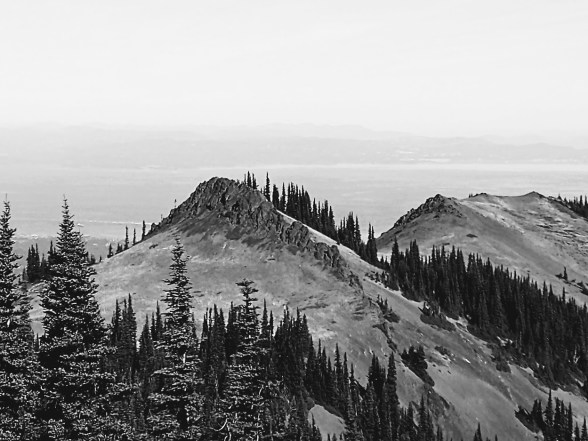
I took the photograph in color. My program made a black and white version. It looks like the back of a stegosaurus to me, a dinosaur now living as a mountain.

For the Ragtag Daily Prompt: rainbow. Because sometimes the rain and sun combine to make a rainbow.

Makeup

Poem: Makeup

For a fellow blogger and for the Ragtag Daily Prompt: Still. I am thinking of both stillness and of still photography. A photograph. For a still, I think that it is usually posed. I like taking portraits when people are not posed.

Advice to Michael

This poem is about a dream that helped me after my mother died and through a divorce. It was not an easy process, to look at my childhood and what happened. It can be a very frightening place to go. Good luck and health to everyone who tries.

Adverse Childhood Experiences 12: welcome to the dark

Welcome to the dark, everyone.

When you think about it, all the children in the world are adding at least one Adverse Childhood Experience score and possibly more, because of Covid-19. Some will add more than one: domestic violence is up with stress, addiction is up, behavioral health problems are up, some parents get sick and die, and then some children are starving.

From the CDC Ace website:

“Overview:Adverse Childhood Experiences (ACEs) are potentially traumatic events that occur in childhood. ACEs can include violence, abuse, and growing up in a family with mental health or substance use problems. Toxic stress from ACEs can change brain development and affect how the body responds to stress. ACEs are linked to chronic health problems, mental illness, and substance misuse in adulthood. However, ACEs can be prevented.”

Well, can they be prevented? Could Covid-19 be prevented? I question that one.

I have a slightly different viewpoint. I have an ACE Score of 5 and am not dead and don’t have heart disease. I spent quite a bit of time thinking about ACE scores and that it’s framed as kids’ brains are damaged.

I would argue that this is survival wiring. When I have a patient where I suspect a high ACE score, I bring it up, show them the CDC web site and say that I think of it as “crisis wiring” not “damaged”. I say, “You survived your childhood. Good job! The low ACE score people do not understand us and I may be able to help you let go of some of the automatic survival reactions and fit in with the people who had a nice childhood more easily.”

It doesn’t seem useful to me to say “We have to prevent ACE scores.” Um. Tsunamis, hurricanes, Covid-19, wars… it seems to me that the ACE score wiring is adaptive. If your country is at war and you are a kid and your family sets out to sea to escape, well, you need to survive. If that means you are guarded, untrusting, suspicious and wary of everyone, yeah, ok. You need to survive. One of my high ACE Score veterans said that the military loved him because he could go from zero to 60 in one minute. Yeah, me too. I’ve worked on my temper since I was a child. Now it appears that my initial ACE insult was my mother having tuberculosis, so in the womb. Attacked by antibodies, while the tuberculosis bacillus cannot cross the placenta, luckily for me. And luckily for me she coughed blood at 8 months pregnant and then thought she had lung cancer and was going to die at age 22. Hmmm, think of what those hormones did to my wiring.

So if we can’t prevent all ACE Scores, what do we do? We change the focus. We need to understand crisis wiring, support it and help people to let go of the hair trigger that got them through whatever horrid things they grew up with. 16% of Americans have a score of 4 or more BEFORE Covid-19. We now have a 20 or 25 year cohort that will have higher scores. Let’s not label them doomed or damaged. Let’s talk about it and help people to understand.

I read a definition of misery memoirs today. I don’t scorn them. I don’t like the fake ones. I don’t read them, though I did read Angela’s Ashes. What I thought was amazing about Angela’s Ashes is that for me he captures the child attitude of accepting what is happening: when his sibling is dying and they see a dog get killed and he associates the two. And when he writes about moving and how their father would not carry anything, because it was shameful for a man to do that. He takes it all for granted when he is little because that is what he knows. One book that I know of that makes a really difficult childhood quite amazing is Precious Bane, by Mary Webb. Here is a visible disability that marks her negatively and yet she thrives.

A friend met at a conference is working with traumatic brain injury folks. They were starting a study to measure ACE scores and watch them heal, because they were noticing the high ACE score people seem to recover faster. I can see that: I would just say, another miserable thing and how am I going to work through it. Meanwhile a friend tells me on the phone that it’s “not fair” that her son’s senior year of college is spoiled by Covid-19. I think to myself, uh, yes but he’s not in a war zone nor starving nor hit by a tsunami and everyone is affected by this and he’s been vaccinated. I think he is very lucky. What percentage of the world has gotten vaccinated? He isn’t on a ventilator. Right now, that falls under doing well and also lucky in my book. And maybe that is what the high ACE score people have to teach the low ACE score people: really, things could be a lot worse. No, I don’t trust easily and I am no longer feeling sorry about it. I have had a successful career in spite of my ACE score, I ran a clinic in the way that felt ethical to me, I have friends who stick with me even through PANDAS and my children are doing well. And I am not addicted to anything except I’d get a caffeine headache for a day if I had none.

For the people with the good childhood, the traumatic brain injury could be their first terrible experience. They go through the stages of grief. The high ACE score people do too, but we’ve done it before, we are familiar with it, it’s old territory, yeah ok jungle again, get the machete out and move on. As the world gets through Covid-19, with me still thinking that this winter looks pretty dark, maybe we can all learn about ACE scores and support each other and try to be kind, even to the scary looking veteran.

Take care.

Fuzzy Poet Doctor and the small child

I think I finally understand what I have been doing in clinic all these years. And not just in clinic. As a theory it explains both why patients, nurses, hospital staff and specialists really really like me and my fellow Family Practice doctors, particularly the males, and the administrators, really really do NOT like me.

I am on a plane flying to Michigan a few weeks ago. Double masked. N95 with another mask over it. Sigh.

A friend keeps saying that he can see into me. He can, but he can see thoughts. Not feelings. I am wondering if I see feelings. But I see the stuffed feelings particularly, the ones that people keep hidden. They are like clouds.

And then I think, oh.

I automatically scan any new person for their small child. The inner small child, who is often damaged and hidden. The small child is hidden under those stuffed feelings, which I think of as monsters. In Ride Forth, I am writing about pulling every monster feeling that I can find stuffed out and letting myself feel them. And that people do not like seeing me like that. Their monsters attack me!

Except that the monsters don’t attack. The monsters come to me and say, “Please, please, help me. I want out. The small child needs to heal.” The monsters lie their monstrous heads in my lap and weep.

Now WHY would I develop this skill? That is weird.

I develop it because my parents both drink. The myth in the family is that it was my father. But my mother’s diaries and also her stories make it clear that she drank heavily too. I think they were both alcoholics. And she told two stories about me trying to get someone to get out of bed to give me food as a toddler. As jokes. But it is not a joke. I have food insecurity. At every meal, I think of the next one and whether there is food available. My daughter has it too….. epigenetics.

I think that the only way I could love my parents was to have compassion for them. Once you see another person’s damaged small child, then how can you not feel compassion for them?

With patients I learned to be very very delicate and gentle about asking about the cloud. Just gently. Sometimes people open up on the first visit. Sometimes they shut tight like a clam and I back off. Sometimes they return the next visit or the 3rd or the 8th or after a couple years… and say, “You asked me about this.”

It’s nonverbal communication. The reason why I take the WHOLE history MYSELF at the first visit is for the nonverbal communication. When the person doesn’t want to answer a question, veers away from a topic, switches subjects: there is my cloud. That is where the hurt is. That is where the pain is.

The first cracks in the United States medical system collapse are appearing. Not doctors quitting, not nurses, but medical assistants. Here is an article about how clinics all over can’t hire medical assistants. Because there are tons of jobs, employers are offering more money, why would you do a job where you may well be exposed to covid-19 if you can do something else? And make as much money or more….

The cracks will widen. Ironically doctors are doing what I have done for the last ten years: “rooming” the patients themselves. Ha, ha, good may come out of it, after the disaster. Which is getting worse fast. If people don’t put their masks on and don’t social distance and don’t get vaccinated, I predict more deaths in the US this winter then last winter. Sigh. And in the US we will run out of medical assistants, doctors and nurses.

It is ok to gently ask a patient about that cloud. It is not polite to “see” it in a Family Medicine colleague or and administrator. I can’t “not see” it. I can’t turn it off. However, on the plane my behavior changed even before I could put all of this into words. The words are that I have to be as gentle with everyone as I am with patients.

And the trip felt so odd. I was putting this into effect before I had words. That is how my intuition works. But everyone, absolutely everyone, was kind to me on the trip. A Chicago policeman helped me in the train station and was super kind. It was weird, weird, weird, with bells on. It took me a few more days to be able to put it into words.

Problem intuited, after 60 years of study. Implementation of solution proceeds immediately. Logical brain struggling to catch up, but results satisfactory long before logical brain gets a handle on it.

Pretty weird, eh? I think so. My doctor said that an episode of Big Bang Theory could be written just by following me around for a day. I think it was both saying that I am smart AND that I have no social skills. But I have implemented the social skills program already. She’s just upset that I gave her justifiable hell two visits ago and also…. I do hide my brain. Because sometimes colleagues are jealous.

But maybe they should not be jealous. Maybe they can learn it too. Maybe I can teach. Maybe….