Alcohol myths

I am back working in Colorado and a recurring theme this month is alcohol and alcohol myths.

Myth: If I only drink on my days off, I am not an alcoholic. Nope. People can binge one day a week and still be an alcoholic. A standard “dose” of alcohol is 12 ounces of 5% beer, 5 ounces of standard wine or 1.5 ounces of liquor. But what if someone drinks 8% beer, 12 ounces? Well, that’s 1.6 standard drinks. An 8% 16 ounce beer? That is 1.6 times 1.3, so 2.08 drinks. Perhaps we should have an app that calculates this. And locks the car ignition when we are over the limit.

How much alcohol means that we are an alcoholic? The guidelines right now in the US say 7 drinks per week maximum for women, 14 for men, no more than one in 24 hours for women, no more than 2 in 24 hours for men and no saving it up for the weekend. Here: https://www.niaaa.nih.gov/health-professionals-communities/core-resource-on-alcohol/basics-defining-how-much-alcohol-too-much#pub-toc3. However, alcohol is bad for the liver, bad for the heart, bad for the brain, and increases cancer risk. There is not a “safe” amount.

What is binging or heavy drinking? For women—4 or more drinks on any day or 8 or more per week, For men—5 or more drinks on any day or 15 or more per week. The rate at which people drink is also part of this.

MYTH: If I don’t throw up, I’m not an alcoholic. Now that’s an interesting one. When we drink, alcohol is absorbed into the blood and goes through the liver. The liver has enzymes which break alcohol down into aldehyde. Aldehyde is a carcinogen, causes cancer. Aldehyde is broken down by other enzymes into acetate and then to carbon dioxide and water. Some people break down the aldehyde quickly, fast metabolizers. They can drink a lot and not throw up because they break the aldehyde down fast. However, the process inflames and kills liver cells. If they keep drinking, the liver slowly dies, and this is cirrhosis. Eventually they will not be able to break down alcohol fast because the liver makes the enzymes. Then they will start throwing up.

Other people make enzymes that are slower or make less, and they get sick and have alcohol poisoning more quickly. The fast metabolizers are at higher risk for cirrhosis and the slow ones for liver cancer, but they can get either.

MYTH: “My blood pressure is fine.” I spoke to a person who stated that their blood pressure was ok during pregnancy so they did not have high blood pressure. The chart shows very high blood pressure for the last three years and I didn’t look back further. I ask, “Did you stop drinking alcohol while pregnant?” “Of course.” When NOT pregnant, this person admits to 4-5 drinks a day. Also, the history in the chart states that they had blood pressure complications in pregnancy. I did not have time to go through the chart and look at that, but this person is in denial. I think of denial as the addiction taking over and the addiction lies. It lies to me but it also lies to the person. They want to believe what they say. They want everyone else to believe what they say even if it is patently a lie and ridiculous. A woman who says a friend gave her something, she didn’t know what it was, for a headache. “How did you take it?” I asked, looking at the urine dip results. “I snorted it.” “So what things do you snort for a headache?” She was positive for cocaine and pleading ignorance was ludicrous. Another person has a positive urine drug screen for multiple things. “Can I try again?” Pause. “Sure.” I say. The first one is a false sample and I am very curious to see what the real sample will have. It has nothing. He is then surprised that I won’t fill his prescription and offer inpatient drug rehabilitation. Come now, sir, you got a urine sample from a dealer when you sold the medicine I gave you for something else. Your dealer must have been annoyed or gave you the wrong sample. When someone is really out of control, they do not have convincing lies and the only person they can convince is themselves. It is interesting to watch someone be all outraged that I do not buy the story, accusing me of discrimination or hating them or hating their race or whatever. They attempt to accuse and distract. It is harder for families because they desperately want to believe their loved one, even when the evidence shouts the opposite.

What does blood pressure have to do with alcohol? Alcohol drives blood pressure up and pulse, especially when it is wearing off. Severe alcohol withdrawal is delerium tremens and people can have such high blood pressure that they have a stroke or a heart attack or encephalopathy — a poisoned brain. They can hallucinate or have seizures and it is very dangerous. “Very dangerous” means they could die or have permanent disability. Tobacco, cocaine, methamphetamines, all raise blood pressure. The number one cause of death in the United States is the heart, but it’s not just from hypertension and weight and cholesterol and inactivity. Addictive drugs have a huge contribution.

There is nothing cheap about the cost of addiction in our country.

For the Ragtag Daily Prompt: cheap.
Climbing the walls

When my father died, he left me a will written more than 40 years earlier. He and my mother and my maternal grandparents were all pack rats. It was a house and two barns and ten years worth of some mail. A mess.

After working on it for a year, I felt like I was in knots and couldn’t relax. I was quite sick of counseling and wanted to do body work instead. I found a massage person and worked with him for over a year.

On the first visit he talked to me and then had me stand and walk around. “You are head forward and your toes are gripping the floor.” “I am not!” I said, lifting my toes. He was right, though. I had to relearn how to walk for two weeks, lifting my toes up.

I went to see him once last spring, knotted up again. I thought I was much better at unknotting during the work. I asked, “So am I pretty relaxed?”

He laughed. “You’re NEVER relaxed. Your baseline is 7/10 but you notice that you are tight when you get up to a 9 or 10.” He said that relaxed was 1-3.

I was hurt and annoyed. All that work and he’d never said that and never given me tools. I tried to contact him by email but he either didn’t remember what he said or just wouldn’t deal with it.

I was grumpy.

Meanwhile in clinic, I was teaching the breathing technique to try to relax, to go from sympathetic fight or flight, to parasympathetic. Breath in for a slow count of 4 seconds, then out for a slow count of 4 seconds. I thought, well, I should do it more too. I decide that when I wake up, I will do the breathing technique.

It promptly put me back to sleep. I have used slowing my breathing to go to sleep. I also had three years in college and after where I did daily zen meditation, facing the wall, on a zafu, for forty minutes. Add my flute playing and singing in chorus for the last 24 years and I can do the count way past four. My mind, however, is a very busy place, and meditation often felt like letting a cage full of crazy monkeys out. They all wanted attention. My understanding of zen is that I am supposed to let the monkeys show up but not hold on to them, converse with them, or let them hold the floor. Return to the breath.

When we wake up, we have a cortisol burst in the morning. It gets us going. I am pretty sure that I have some adrenaline too. The slowed breathing calms that right down. According to the pain clinics, twenty minutes of slowed breathing calms almost everyone down into the parasympathetic state. I don’t think that the high Adverse Childhood Experience people are used to parasympathetic. Honestly, looking at the movies and television and video games, I think our culture is not used to it either.

The breathing in the morning is working. My neck and shoulder muscles are more relaxed (in spite of computer use). Maybe I am down to a 5/10! That would be huge progress, right?

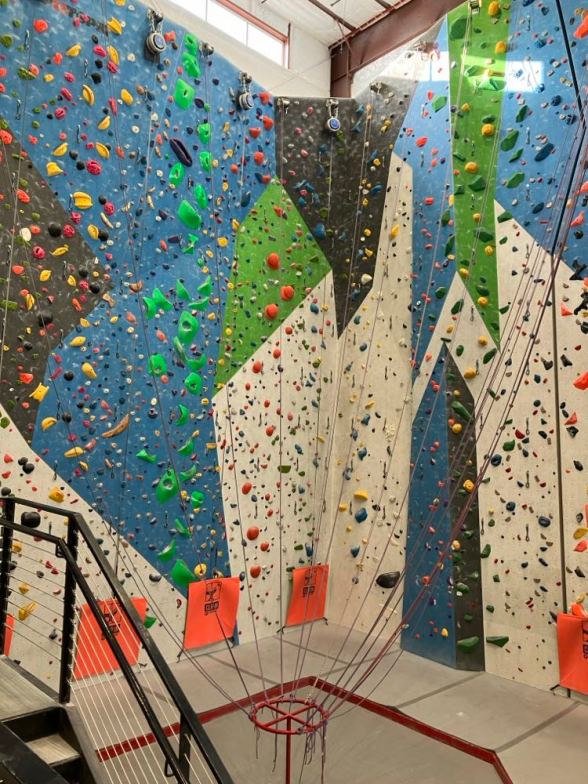
And my muscles love the climbing walls, too. Not that I am that good at it, but my muscles really like the intensity and focus. It is so different from clinic, where everything is focused on listening to the patient, typing as they talk, watching, sensing, trying to get a handle on what is happening with them. The wall is like clinic in focus, but my whole body is involved and there is lots of reaching and stretching out of that contained focus.

Sol Duc seems to be good at slow breathing. Cats go from 1/10 to 10/10 in just a heartbeat, or that’s my impression.

There is no alabaster in this house. Not a bit. Perhaps I will meditate on that.

For the Ragtag Daily Prompt: meditate and alabaster.

Surreal failure

I am still thinking about Friday’s Ragtag Daily Prompt: failure. Now that I am middle aged (by my clinic definition, which put over 90 as older), I think the biggest failure of my generation is a peaceful world. For me, a peaceful extended family. I am good friends with my father’s family and my ex-husband’s family. But the maternal family, well. I have thought about that for the last two days: could I have changed that?

Yes, but at what cost? My sister followed the “family rules” on that side. She is dead from cancer. My mother also followed the rules and died younger than me from cancer. I can’t say that the rules cause cancer. But doesn’t our culture say over and over, be yourself? To fit in the family diaspora, I would have to play the triangulation game and gossip about others as they have gossiped about me. No, thank you, no. I don’t want to. They seem to need a family member to hate and have chosen me and labelled me and call me angry. I think they are silly and emotionally immature. At the very least, I would have had to keep my mouth shut and accept them gossiping about me.

The family failure and untrue gossip, with no one ever asking for my viewpoint, mirrors the US culture. Split and needing someone to hate. At this rate, we’ll need the hippies back, with flowers and joy and counter culture and dropping out. Someone fun, at least until the drugs wear off. Someone to say, we need joy back, we need friends, we need love.

It’s not just my failure though. The family failed. They make cruel choices and target people. It happened in my generation, my mother’s, my grandparents. I wonder if it is happening in my adult children’s generation. Who is the next target? Who will refuse to counter-gossip and fight with each source? My adult children are not part of it at all, because I had less and less interest in spending time with mean gossips and I did not want to expose my children.

Lies and drama and meanness and gossip. I hope my adult children’s generation does better. We went to Wicked on Thursday. I did not like it much. Too much drama. Why do we want drama? The world seems more and more surreal. Give me the lovely hike we did on Friday instead, Echo Canyon.

For the Ragtag Daily Prompts: failure and surreal.

Authenticity and masks

The Ragtag Daily Prompt today is identity. Yesterday I went to work an hour early so I could attend the Friday morning Continuing Medical Education. It was about adult ADHD and the positives and negatives.

I do not have a diagnosis of ADHD. I have one friend who insists that I have it, but I don’t much care. However, the speaker started talking about masks and authenticity. She said that we are told to be authentic at work, but that people with ADHD often find that their authentic self is not welcomed and they learn to mask.

I asked, doesn’t everyone mask somewhat at work? She said, “Good point, and yes, people do.” It got me thinking about identity and masks. I pretty much clammed up in Kindergarten because I was too much of an outlier and culturally wrong. We did not have a television and television was pretty much what the other children talked about. I knew songs and poems but these did not interest my peers. I was interested in science, too, but that was also not popular. I think I was a geek before it was named and as soon as I learned to read, I became a bookworm. I am not sure if having a television would have made any difference, either.

Fast forward to after high school. I went to Denmark as an exchange student my senior year and then needed to make up credits to graduate. Another high school student was in my Community College classes. After a bit, she said, “I thought you were shy in high school.” I said, “No, I just didn’t talk.”

Currently I am more authentic in the room with patients than with the rest of the staff. Corporations are very weird hierarchical places. My authentic self always questions authority but I am trying not to do it all the time. At least, not out loud. The patients seem to be fine with it. I had a very difficult conversation with an elderly couple this week about memory and planning, now, before they can’t. I got hugs at the end of the visit even though we’d gone into frightening and difficult territory. They did very well. Yesterday was my last day at that clinic and next week I am in another one. Even after just four months in this clinic, I will miss many of the patients and hope they do well.

Yesterday I really did Urgent Care. My schedule only had a few people and then six more sick ones were added on. We had to call an ambulance for one, the first time I’ve had to do that here.

What is authenticity and what is our identity? Is the work mask less real than the self in our minds?

I took the photograph at a small hot springs resort. A friend that I’ve known since high school and I met there. I love the bookworm rabbit. I think she represents the happy bookworm part of me. I read about 7 novels a month, haunting the library here. Maybe I will get to know some more people over the next 6 months.

For the Ragtag Daily Prompt: identity.

Bolster meaning

It did not even occur to me that yesterday’s dream could be taken as complaints about patients! That was not my meaning!

I wrote the dream out because I wanted to know what it was trying to tell me. And I look at it from the perspective of all the people in the dream being aspects of myself.

So who is the whiny guy (me) who won’t cooperate with authority (me) and who wants attention and is difficult? That’s not a very nice aspect of myself!

First of all, he reminds me of my father. My father really did not like authority and did not like most men. When I was quite small, I announced that he would have to die first, because he couldn’t live without my mother, but she could live without him. I was wrong as well as being an awkward child. My father’s dislike of authority interfered with his employment and he was mostly underemployed. He finished a Master’s in Mathematics, but never wrote the thesis for his PhD. I asked him why once and he said, “I was bored.” I don’t know how much alcohol interfered with his working.

I am not brilliant with authority either, though I am trying. I notice systems and often annoy authority by asking why something is run a certain (foolish and unproductive) way. I used to study whatever system I was in and then say, “Here, I’ve thought up a solution for this problem.” Then I would get in trouble for suggesting that there was a problem and I would be the problem. I learned to go to authority first and ask, “So is this (huge problem) a problem? I find it difficult. What is your advice?” Priming the pump, so to speak.

As a temp, the authority problem is weirder. I am an outsider, short term, no one really has to be nice to me. That fast trip home and back made me realize that I am lonelier in a group clinic than I was in a solo clinic. In my solo clinic there was me, my receptionist and the patients. In this group clinic I have less people to talk to and it is lonely. My problem, not theirs. They are about to move me to another clinic and I will see what approach I can take to this. The system might have a Balint Group or I may be able to start one.

What about the frozen looking spouse? Ha, I think that’s the part of me that is trying to keep my mouth shut with authority. The kids? Some days I want to pull the system apart and fix it, but I am not in authority to do that here. The grumpy nurse? I am running behind and I can’t fix everyone. Some people don’t want to be fixed, including me.

I could go home and try another place. However, I think that the cracks in the US medical system are in the whole system. As a country, we built this. I hope that I see single payer healthcare in my lifetime, but I may not. And Martha is right too: I thought that this place was doing better handling a chronic illness than where I worked in 2021, but they aren’t, really. They apply a formula, but the patients don’t get much out of it. They just get shuffled in once every three months. I did upset that apple cart by spending more time with those people and talking to them, but I do not know what the next physician will do. Sigh. The patients are already my patients and are saying goodbye.

For the Ragtag Daily Prompt: meaning.

Intimacy

What IS intimacy? And what is love? And are they the same thing? Do you have to be intimate to love someone? Not meaning sex, but what level of intimacy is “normal” and “appropriate”?

I am thinking of my mother. When I was just starting college, she started talking to me about my father and about his drinking. I became more and more uncomfortable and finally asked her to find a counselor or someone other than me. The thing is, she refused to DO anything about his drinking and in fact, covered it up. The two of them would scream at each other at 2 am and fight when I was in high school. It would wake me up and I would think, I wish they wouldn’t, because I have school tomorrow. But I certainly didn’t go say anything because then they would have screamed at me. And as I got older, I wondered if my mother was drinking heavily too. Because why would she argue with someone drunk at 2 am, that makes no sense. Unless she either was drunk or loved to argue or both.

It is clear that she was drinking heavily at that time from her journals. Over and over she writes, I drank too much last night. Hard to blame her for not intervening with my father if she is drunk too. But she was using him as her cover up. Her family blamed him. My grandmother, her mother, didn’t blame him. She loved them both.

When we had guests, my mother would turn on the charm. She could mesmerize a room and entertain people with stories. My sister and I and others would be the butt of the stories. My father too. After the guest left, she would often talk about them. Analyze them. Talk about their faults and weaknesses. I was fascinated but a bit horrified too. She seemed to like these people so much and to charm them and invite them back, but was talking about them behind their backs. Ick.

So intimacy interests me. I wonder how to do it “right”. Maybe right is not the best word. How to do it “functionally”. I really don’t know what normal is, my maternal family certainly did not model healthy intimacy. My generation still gossips about each other. I quit that at age 19 and refused to be part of it. I don’t think anyone saw my rebellion except my maternal grandmother. She did not say a word but I knew that I had her respect. She did not play the family game with me.

I don’t think that gossip and triangulation are a good form of intimacy or love. Person A talks to person C about person B. Word gets around and sometimes it is person D that says something to person B and person B gets upset when they realize where this came from. And how twisted and one sided the story is. And aren’t we seeing this play out on a national level? All these people saying that THEY KNOW the status of the President’s memory. I don’t. I can’t judge it from a debate. And frankly, if we are going to do a psychiatric evaluation of one, I think we have to do BOTH. Stop following stupid rumors. Why not require a neuropsychiatric evaluation on every candidate for President and Senate and House of Representatives and the Supreme Court. And make them public. That would cause some chaos, wouldn’t it? And how do you decide who is “sane” enough to govern?

I think that gossip and triangulation is a dysfunctional form of intimacy. People feel closer when someone is whispering a secret to them. I don’t think it’s healthy. It might be normal for our culture, though. Normal does not mean healthy, after all. What do you think?

This election is like a bad hallucination. Why do we accept candidates that behave badly? Are we so addicted to television and movie drama that we want it to happen in our government? I don’t. How about you?

For the Ragtag Daily Prompt: hallucination.

Coping or manipulation?

I see someone in clinic with a difficult boss.

This brought up work stories. Now, are these coping skills or manipulation or a bit of both? You decide.

Long ago I work in a lab at the National Institutes of Health. We are super busy and doing a lot of overtime and have some media pressure as well. Our boss gets us together and gives us hell, about making mistakes. I am annoyed, because I’ve been really careful. I stew. I write a letter, what I think he should have said, which is telling us all great job, you’ve worked super hard, we are under pressure and also we need to not make mistakes. I circulate it to the four other lab techs, who enjoy it. The lab cheers up a bit. Eventually I get brave and give it to the boss. He likes it and reads it to everyone, who try not to laugh. A year after I leave the lab, I visit, and he has that letter up on his bulletin board.

Long ago I am made chief of staff at a hospital. My goal is to finish the monthly meeting in an hour. I have two senior doctors who always blow up about something in the meeting. I decide to be proactive and go to each one before the meeting and prime them. I pick a topic, say I am worrying about it, and what do they think? They each then blow up in the meeting, but now they have no opposition so there is no brawl. I prime them about something that is not really controversial. I do get the meetings done in an hour.

One year I go to the lake with my family. My children are small. My father has been drinking heavily. I call ahead and say, “Will you treat our tent site like my house and not come there if you are drinking?” “You don’t own the lake land,” says my father. “We don’t have to come.” I reply. He agrees not to drink at our tent site.

He is angry, though, and pretty much won’t speak to me. I ask if he would come to a family sing at my site. He says no. I think about it for a while and ask my cousin to hold a sing at her cabin. My father agrees to that, not knowing that I am the instigator. He is happy at it because he’s said no to me and yes to her, and I am happy too, because I love to sing and sing with him.

My father was one of eight people to start Rainshadow Chorale in 1997. I sang with him in the chorale from 2000 until the year he died.

Where is the line between manipulation and coping with a difficult person?

I think this is a time travelogue, so let it be my Ragtag Daily Prompt for today.

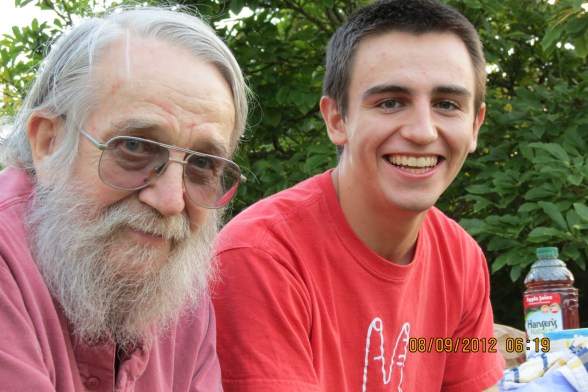
The photograph is of my father in 2012. He died in 2013.

Adverse Childhood Experiences 15: Guidelines

I wrote Adverse Childhood Experiences 14: Hope quite a while ago.

The American Academy of Pediatrics has a guideline that physicians should introduce and screen for Adverse Childhood Experiences. The American Academy of Family Practice is skeptical, here: https://www.aafp.org/pubs/afp/issues/2014/1215/p822.html. Here are two more writeups: https://www.aafp.org/pubs/afp/issues/2020/0701/p55.html and https://www.aafp.org/pubs/fpm/blogs/inpractice/entry/screen_for_aces.html.

It is difficult to screen for ACE scores for the same reason that it is difficult to screen for domestic violence and to talk about end of life plans. These are difficult topics and everyone may be uncomfortable. Besides, what can we DO about it? If growing up in trauma wires someone’s brain differently, what do we do?

I don’t frame it as the person being “damaged”. Instead, I bring up the ACE score study and say that first I congratulate people for surviving their childhood. Good job! Congratulations! You have reached adulthood! Now what?

With a high ACE score comes increased risk of addictions (all of them), mental health diagnoses (same) and chronic disease. Is this a death sentence? Should we give up? No, I think there is a lot we can do. I frame this as having “survival” brain wiring instead of “Leave it to Beaver” brain wiring. The need to survive difficulties and untrustworthy adults during childhood can set up behavior patterns that extend into adulthood. Are there patterns that we want to change and that are not serving us as adults?

This week a person said that they blow up too easily. Ah, that is one that I had to work on for years. Medical training helps but also learning that anger often covers other feelings: grief, fear, shame. I had to work to uncover those feelings and learn to feel them instead of anger. Anger can function as a boundary in childhood homes where there are not adult role models, or where the adults behave one way when sober and an entirely different way when impaired and under the influence. There may be lip service to behave a certain way but if the adult doesn’t behave, it is pretty confusing. And then the adult may not remember or be in denial or try to blame someone else, including the child, for “causing” them to be impaired.

What if someone had a “normal” childhood but the trauma all hit as a young adult? I think adults can have trauma that changes the brain too. PTSD in non-military is most often caused by motor vehicle accidents. At least, that is what I was told in the last PTSD talk I went to. Now that overdose deaths have overtaken motor vehicle accidents as the top death by accident yearly in the US, I wonder if having a fentenyl death in the family causes PTSD. Certainly it causes trauma and grief and anger and shame.

I agree with the American Academy of Pediatrics that we should screen for Adverse Childhood Experiences. We need training in how to talk about it and how to respond. I have had people tell me that their childhood was fine and then later tell me that one or both parents were alcoholics. The “fine” childhood might not have been quite as fine as reported initially. One of the hallmarks of addiction families is denial: not happening, we don’t talk about it, everything is fine. Maybe it is not fine after all. If we can learn to talk to adults about the effects on children and help people to change even in small ways, I have hope that we will help children. We can’t prevent all trauma to children, but we can mitigate it. All the ACE scores rose during the Covid pandemic and we are still working on how to help each other and ourselves.

Here is another article: https://www.aafp.org/pubs/fpm/issues/2019/0300/p5.html.

Blessings.

For the Ragtag Daily Prompt: open wound.

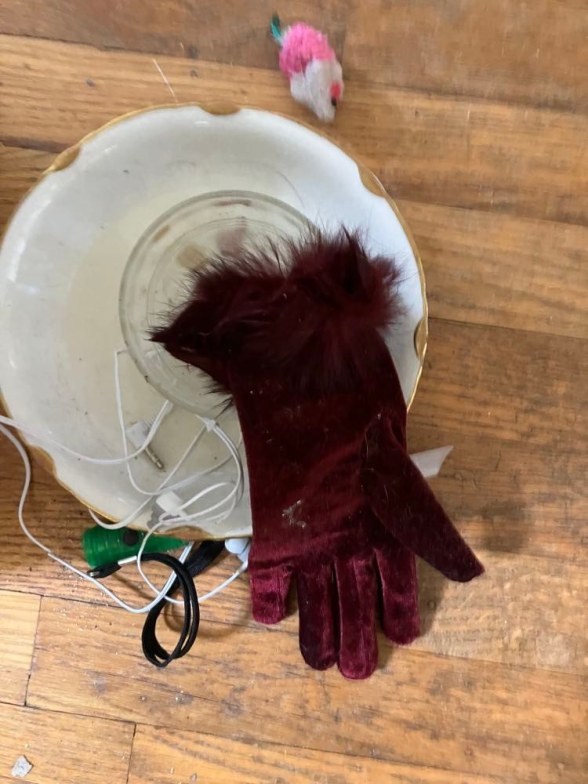
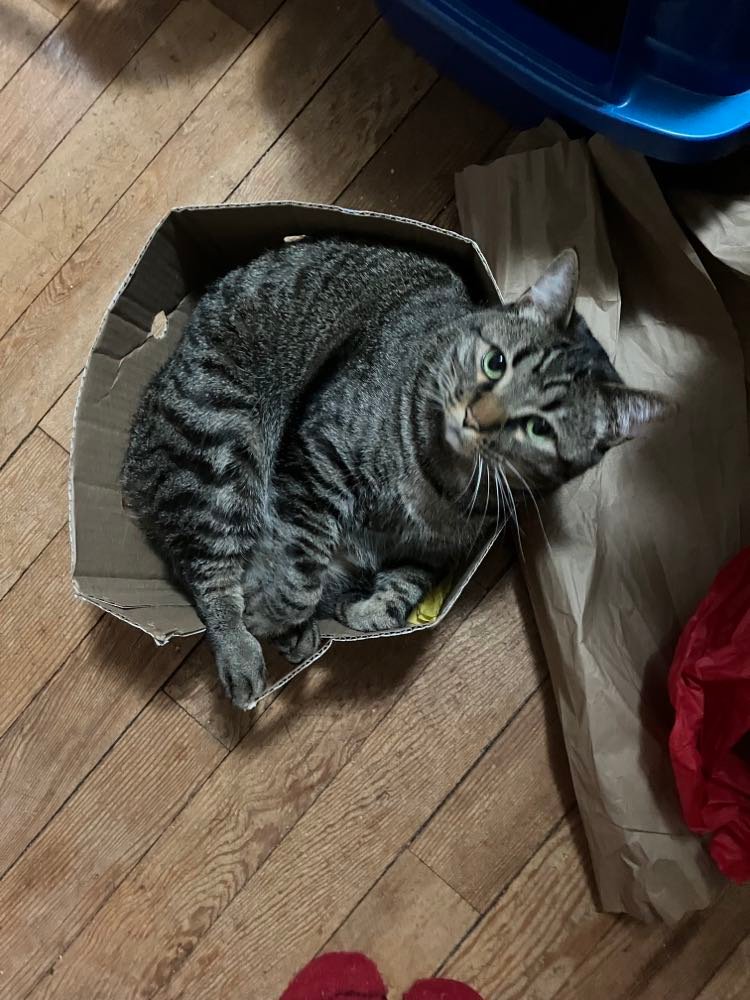
The photograph is one of Elwha’s cat art installations. He would pile toys on his bowl. Two bowels because I need to keep out the little ants. Sol Duc would do it too but not as often. I fed them in separate rooms. They would pile things on the bowl whether there was food left or not.

Elwha is still missing, sigh. That is a wound. The photographs are from March 2023.

Adverse Childhood Experiences 12: welcome to the dark

Welcome to the dark, everyone.

When you think about it, all the children in the world are adding at least one Adverse Childhood Experience score and possibly more, because of Covid-19. Some will add more than one: domestic violence is up with stress, addiction is up, behavioral health problems are up, some parents get sick and die, and then some children are starving.

From the CDC Ace website:

“Overview:Adverse Childhood Experiences (ACEs) are potentially traumatic events that occur in childhood. ACEs can include violence, abuse, and growing up in a family with mental health or substance use problems. Toxic stress from ACEs can change brain development and affect how the body responds to stress. ACEs are linked to chronic health problems, mental illness, and substance misuse in adulthood. However, ACEs can be prevented.”

Well, can they be prevented? Could Covid-19 be prevented? I question that one.

I have a slightly different viewpoint. I have an ACE Score of 5 and am not dead and don’t have heart disease. I spent quite a bit of time thinking about ACE scores and that it’s framed as kids’ brains are damaged.

I would argue that this is survival wiring. When I have a patient where I suspect a high ACE score, I bring it up, show them the CDC web site and say that I think of it as “crisis wiring” not “damaged”. I say, “You survived your childhood. Good job! The low ACE score people do not understand us and I may be able to help you let go of some of the automatic survival reactions and fit in with the people who had a nice childhood more easily.”

It doesn’t seem useful to me to say “We have to prevent ACE scores.” Um. Tsunamis, hurricanes, Covid-19, wars… it seems to me that the ACE score wiring is adaptive. If your country is at war and you are a kid and your family sets out to sea to escape, well, you need to survive. If that means you are guarded, untrusting, suspicious and wary of everyone, yeah, ok. You need to survive. One of my high ACE Score veterans said that the military loved him because he could go from zero to 60 in one minute. Yeah, me too. I’ve worked on my temper since I was a child. Now it appears that my initial ACE insult was my mother having tuberculosis, so in the womb. Attacked by antibodies, while the tuberculosis bacillus cannot cross the placenta, luckily for me. And luckily for me she coughed blood at 8 months pregnant and then thought she had lung cancer and was going to die at age 22. Hmmm, think of what those hormones did to my wiring.

So if we can’t prevent all ACE Scores, what do we do? We change the focus. We need to understand crisis wiring, support it and help people to let go of the hair trigger that got them through whatever horrid things they grew up with. 16% of Americans have a score of 4 or more BEFORE Covid-19. We now have a 20 or 25 year cohort that will have higher scores. Let’s not label them doomed or damaged. Let’s talk about it and help people to understand.

I read a definition of misery memoirs today. I don’t scorn them. I don’t like the fake ones. I don’t read them, though I did read Angela’s Ashes. What I thought was amazing about Angela’s Ashes is that for me he captures the child attitude of accepting what is happening: when his sibling is dying and they see a dog get killed and he associates the two. And when he writes about moving and how their father would not carry anything, because it was shameful for a man to do that. He takes it all for granted when he is little because that is what he knows. One book that I know of that makes a really difficult childhood quite amazing is Precious Bane, by Mary Webb. Here is a visible disability that marks her negatively and yet she thrives.

A friend met at a conference is working with traumatic brain injury folks. They were starting a study to measure ACE scores and watch them heal, because they were noticing the high ACE score people seem to recover faster. I can see that: I would just say, another miserable thing and how am I going to work through it. Meanwhile a friend tells me on the phone that it’s “not fair” that her son’s senior year of college is spoiled by Covid-19. I think to myself, uh, yes but he’s not in a war zone nor starving nor hit by a tsunami and everyone is affected by this and he’s been vaccinated. I think he is very lucky. What percentage of the world has gotten vaccinated? He isn’t on a ventilator. Right now, that falls under doing well and also lucky in my book. And maybe that is what the high ACE score people have to teach the low ACE score people: really, things could be a lot worse. No, I don’t trust easily and I am no longer feeling sorry about it. I have had a successful career in spite of my ACE score, I ran a clinic in the way that felt ethical to me, I have friends who stick with me even through PANDAS and my children are doing well. And I am not addicted to anything except I’d get a caffeine headache for a day if I had none.

For the people with the good childhood, the traumatic brain injury could be their first terrible experience. They go through the stages of grief. The high ACE score people do too, but we’ve done it before, we are familiar with it, it’s old territory, yeah ok jungle again, get the machete out and move on. As the world gets through Covid-19, with me still thinking that this winter looks pretty dark, maybe we can all learn about ACE scores and support each other and try to be kind, even to the scary looking veteran.

Take care.

Aces again

I am singing: “You are coming up ACES!”

Ok, but, hopefully not. Because I am talking about ACE scores, Adverse Childhood Experiences. See the CDC website, this is all based on a ginormous Kaiser study in the 1990s.

Here: About the CDC-Kaiser ACE Study |Violence Prevention|Injury Center|CDC

Yep. A very very interesting topic for a rural family practice physician.

For the Ragtag Daily Prompt: ACE.