From my yard.
For Cee’s Flower of the Day.

From my yard.
For Cee’s Flower of the Day.
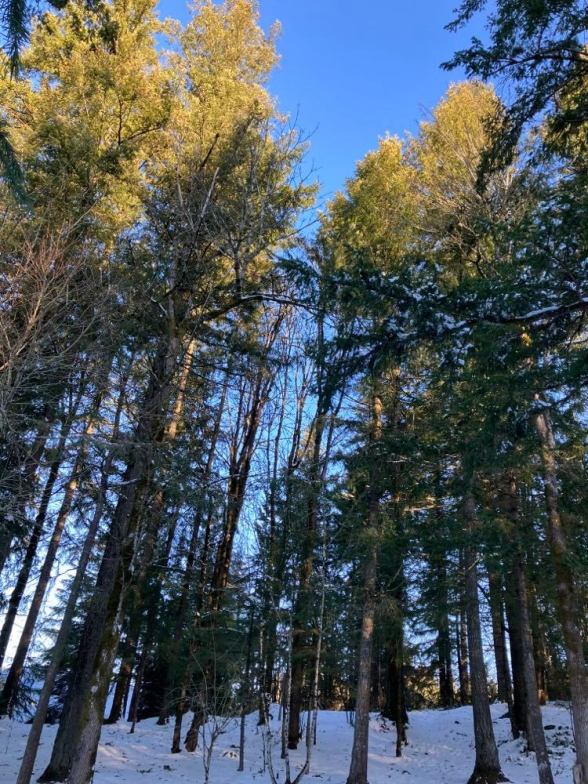
I went to Portland to meet my daughter, when she was up visiting friends. I stayed with one friend for two nights and then picked up my daughter and took her to another friends’ house. They currently have an empty garage apartment.
My daughter was supposed to fly out Thursday, but the 10.8 inch snow dump happened on Wednesday night. My friends are on this road that is mostly gravel and steeper than it looks in this picture.

The tracks that you see are driveway. The line in the trees is the road.
My friend has a pickup and chains and left for work at 6:30. My daughter and I put my chains on my Scion, and tried the hill. We blew the left chain off twice and the right one was mostly off as well.
That was probably a good thing because her plane was cancelled and there were accidents all over town.
We spent 2 hours and 30 minutes on hold with the airline and got her rescheduled for Saturday at 11:30.
She left the next morning with my friend in his truck. He dropped her at the metro and she stayed with friends who live close to the airport and are on the metro line.
My friends and I tried my chains again on Saturday morning. B blew one chain off too and we figured that a link had to be locked in a certain way. He drove up the driveway and we followed in the truck. He drove along the road until we were down to where chains were not needed. I thanked them all and headed out. Down the road a little there were three more abandoned vehicles: a truck with chains on and two cars. There were still patches of ridged ice on the 405 bridge. It took from 10 am to 12:22 to get back to Washington State! So hooray for chains and friends!
For the Ragtag Daily Prompt: chains.
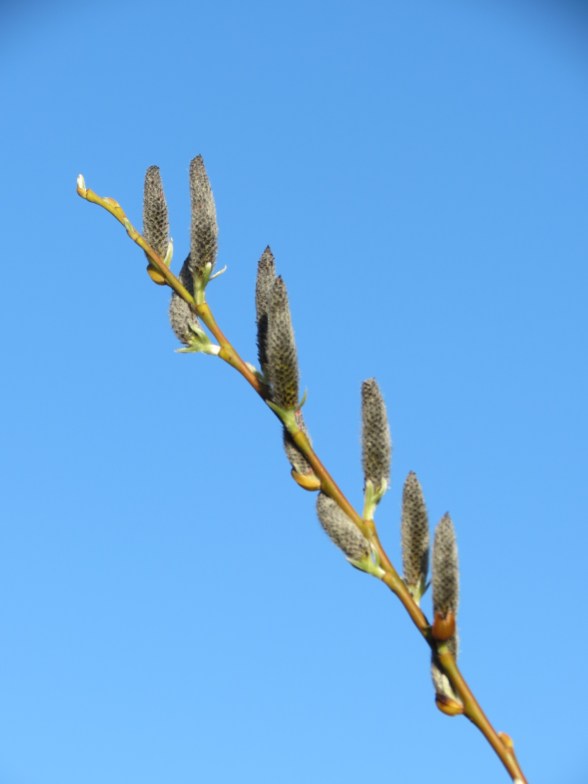
I got home yesterday from a trip prolonged by snow in Portland!
Here is another early spring photograph from Kai Tai Lagoon.
And here is another park photograph:

For Cee’s Flower of the Day.
I am watching a four part video from the UK about illness and trauma.
The first part is about how trauma memories are stored differently from regular memories. Regular memories are stored in files, like stories in a book or a library.
Trauma memories are stored in the amygdala and often are disjointed and broken up and have all of the sensory input from the worst parts, including the emotions.
The therapist is talking about healing: that our tendency is to turn away from the trauma, smooth it over and try to ignore it.
However, the amygdala will not allow this. It will keep bringing the trauma up. And that is actually its’ job, to try to warn and protect us from danger!
The therapist counsels finding a safe time and place and safe person (if you have one) and then making space for the trauma to come back up. One approach is to write out the story, going through that most traumatic part, but not stopping there. What happened next? Writing the story and then putting it aside. Writing it again the next day and doing this for four days. As the story is rewritten and has an ending, even if it is not a happy ending, the story is eventually moved from the amygdala to the regular files. People can and do heal. They may need a lot of time and help, but they can heal.
I am not saying that four days of writing stories is enough. That is one approach, but nothing works for everyone and people need different sorts of help. There are all sorts of paths to healing.
In my Family Practice clinic I would see people in distress. With some gentle prompting and offering space, they would tell me about trauma and things happening in their personal life or work life. Things that were feeling so overwhelming that they could not tell their families or friends and they just could not seem to process the feelings about it. I would keep asking what was happening and give them the space to tell the story. Many times when they reached the present they would stop. There would be a silence. Then I would say, “It seems perfectly reasonable that you feel terrible, frightened, horrified, grieved, whatever they were feeling, with that going on.” And there was often a moment where the person looked inwards, at the arc of the story, and they too felt that their feelings were reasonable.
I would offer a referral to a counselor. “Or you can come back. Do you want to come back and talk about it if you need to?”
Sometimes they would take the referral. Sometimes they would schedule to come back. But nearly half the time they would say, “Let me wait and see. I think I am ok. I will call if I need to. Let me see what happens.”
When a person goes through trauma, many people cut them off. They don’t want to hear about it. They say let it go. They may avoid you. You will find out who your true friends are, who can stand by you when you are suffering. I have trouble when someone tries to show up in my life and wants to just pretend that nothing happened. “Let’s just start from now and go forward.” A family member said that to me recently. Um, no. You do not get to pretend nothing happened or say, “I wanted to stay out of it.” and now show back up. No. No. You are not my friend and will not be. And I am completely unwilling to trade silence about my trauma for your false friendship.
Yet rather than anger, I feel grief and pity. Because this family member can’t process his own trauma and therefore can’t be present for mine. Stunted growth.
People can heal but they need help and they need to choose to do the work of healing.
The four videos are here: https://www.panspandasuk.org/trauma.
This song is a darkly funny illustration: she may be trying to process past trauma, but the narrator doesn’t want anything to do with it. And he may not have the capacity to handle it. He may have his own issues that he has not dealt with. And maybe they both need professionals.


My feelings are not that complicated now
I feel sorry for your need to be quite cruel
Sorry and occasionally wonder how
You justify acting like a stubborn mule
a distillation of your treatment is quite clear
you choose to keep the people you control
promises mean nothing when you feel fear
Telling yourself we’re evil takes a toll
You feel free and safe when you axe another friend
You feel that all your problems are at bay
A new need immediately builds again
Who will be the next victim of the day?
Your world shrinks every day you live
A stone cold heart forgetting how to give.
Sonnet 14
____________________
Isn’t it an amazing tree? Complicated and yet forming an overall beautiful shape.
For the Ragtag Daily Prompt: complicated.

On Sunday I was in Portland with a friend and went to a memorial at the Laurelthirst. It was for a musician named Turtle. Local musicians showed up like crazy. There were at least six very fine guitar players, three on stage at a time and sometimes more. They switched in and out and switched styles. It was a beautiful tribute.
My two favorites were “They threw me out of the band” and one that bemoaned everyone playing music and drinking and that he had to sing another song about another dead band member. Funny and sad.
___________________
For the Ragtag Daily Prompt: delete.
The forum gathers.
Red Paw puts her elbows on the table and her chin in her hands. “Told you so. Been telling you for 11 years.”
The small child/angel is sitting in a chair that morphs from regular boardroom chair to youth chair as she morphs back and forth.
“Nice job with the chair.” says Red Paw.
The two split and now there is a Small Child and an angel, sitting in two chairs.
Red Paw morphs too, into a bright red angel with a black halo and black bat wings.
The White angel nods and a feather drops. The feathers are bright white. Her halo is made of gold glittery pipe cleaners and attached at the shoulders.
Red Paw’s halo floats and seems to pull at the room.
The Quiet Woman sits in the fourth chair, with a cup of tea. “Anyone else?” she asks.
The others shake their heads.
“We are discussing the diaspora. Is it time to let them go?”
“Has been for 11 years.” says Red Paw nastily.
The small child nods.
The White angel says, “They want to believe what they want to believe. Let them go.”
“T, B, S, C, S, D, A, F, N, C, T, L, K, R and then next generation as well?”
All three nod.
The small child says, “They can contact us at any time.”
“They won’t.” says Red Paw.
“People can change,” says the White angel.
“And do they always?” says Red Paw.
“No.” says the White angel.
“I agree,” says the Quiet Woman. “We are done.” She brings a gavel down on the table, which rings like a singing bowl. The other three blur and melt in to her.
“We are done.”
_____________________
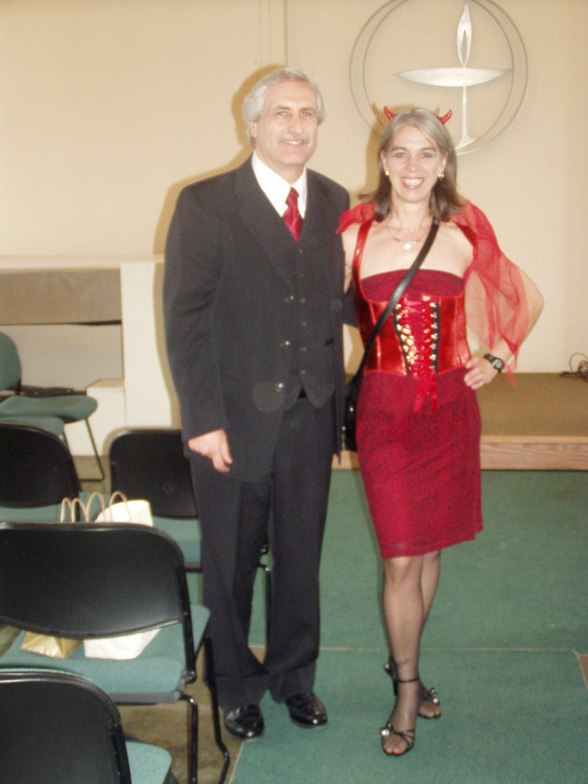
The photograph was taken 2016 or earlier when Halloween was on a Sunday. I dressed up and so did the minister.
For the Ragtag Daily Prompt: forum.
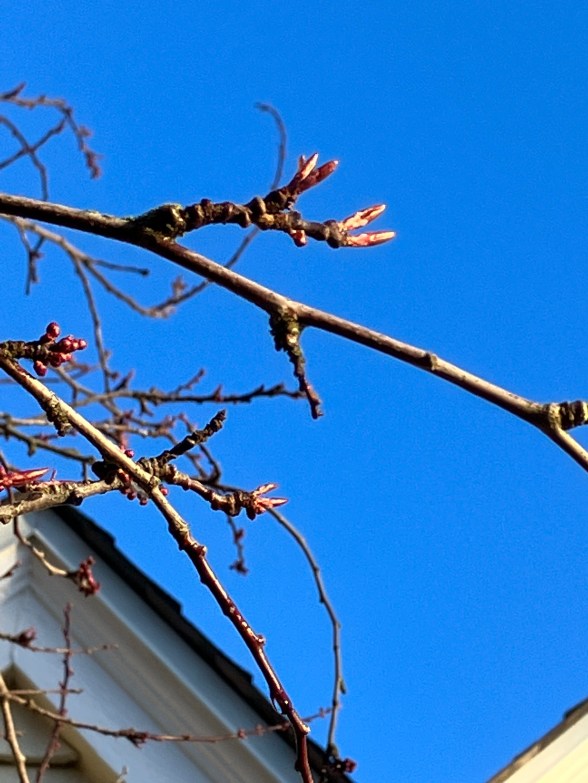
For Cee’s Flower of the Day.
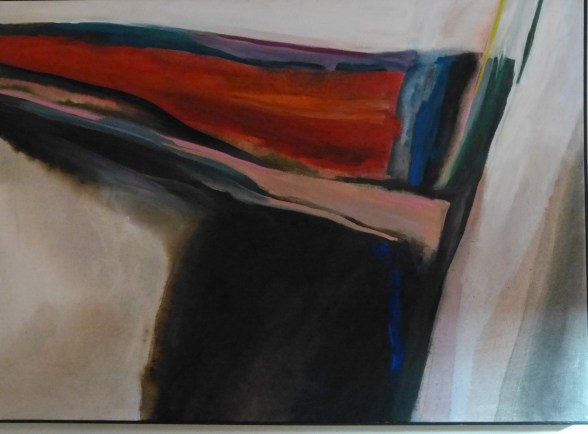
An old friend died this morning. She was a college friend of my parents and has known me since birth. I will miss her quite terribly.
She and I took a road trip in September. She had lost thirty pounds, not on purpose. I thought I had better do the road trip while we could. We went from Michigan to visit five households of old friends in Wisconsin. I lived with her and her family for a year during college in Madison, Wisconsin in the early 1980s. She is a beloved mentor.
She also introduced me to all sorts of groups. She has an amazing record collection.
I went with her to see Warren Zevon in Madison.
The painting is my photograph of one of her oil paintings. It is about 3 by 5 feet and gorgeous.
Dona nobis pacem and much love.
For the Ragtag Daily Post: filter.
BLIND WILDERNESS
in front of the garden gate - JezzieG
Discover and re-discover Mexico’s cuisine, culture and history through the recipes, backyard stories and other interesting findings of an expatriate in Canada
Or not, depending on my mood
All those moments will be lost in time, like tears in rain!
An onion has many layers. So have I!
Exploring the great outdoors one step at a time
Some of the creative paths that escaped from my brain!
Books, reading and more ... with an Australian focus ... written on Ngunnawal Country
Engaging in some lyrical athletics whilst painting pictures with words and pounding the pavement. I run; blog; write poetry; chase after my kids & drink coffee.
Coast-to-coast US bike tour
Generative AI
Climbing, Outdoors, Life!
imperfect pictures
Refugees welcome - Flüchtlinge willkommen I am teaching German to refugees. Ich unterrichte geflüchtete Menschen in der deutschen Sprache. I am writing this blog in English and German because my friends speak English and German. Ich schreibe auf Deutsch und Englisch, weil meine Freunde Deutsch und Englisch sprechen.
En fotoblogg
Books by author Diana Coombes
NEW FLOWERY JOURNEYS
in search of a better us
Personal Blog
Art from the Earth
𝖠𝗇𝗈𝗍𝗁𝖾𝗋 𝖶𝗈𝗋𝖽𝖯𝗋𝖾𝗌𝗌.𝖼𝗈𝗆 𝗌𝗂𝗍𝖾.
Taking the camera for a walk!!!
From the Existential to the Mundane - From Poetry to Prose
1 Man and His Bloody Dog
Homepage Engaging the World, Hearing the World and speaking for the World.
Anne M Bray's art blog, and then some.
My Personal Rants, Ravings, & Ruminations
 KO Rural Mad As Hell Blog
You must be logged in to post a comment.