Downtown on Halloween.
For Cee’s Flower of the Day.


Downtown on Halloween.
For Cee’s Flower of the Day.

Ok, this is a weird little poem to my sister Chris, who died a decade ago. My father died thirteen months later. My mother was already dead. Mother and sister of cancer and father of emphysema, damn the Camels. There was no family slaughter, unless it was by cancer. There was a family meltdown on my mother’s side. Sometimes you have to let people go.
Sister sister mister miss her
look, Chris, I’m happy
Cancer cancer crabby dancer
look, Chris, I’m singing
Daughter daughter family slaughter
look, Chris, I’m healing
Healer healer wheeler dealer
look, Chris, no drama
Wombing wombing quiet blooming
look, Chris, I’m growing
The photograph is of a family cabin in Ontario. It is called “The New Cabin”, “Helen’s Cabin” (after my mother) or “Chris’s Cabin” after my sister. As you can see, it is suffering through neglect worsened by Covid-19. I put those screens up a decade ago, but they are not surviving the winters and the porch roof has a hole. It was a lovely porch to sleep on. I was last there in 2018, and up on that roof trying to tar holes as a temporary fix. We did not dare go on the porch roof, too late for that. Things change and fall away and sometimes we have to let them go. Especially if they are beyond repair. The photograph is taken earlier this year by the people who care for the cabins when we are not there.
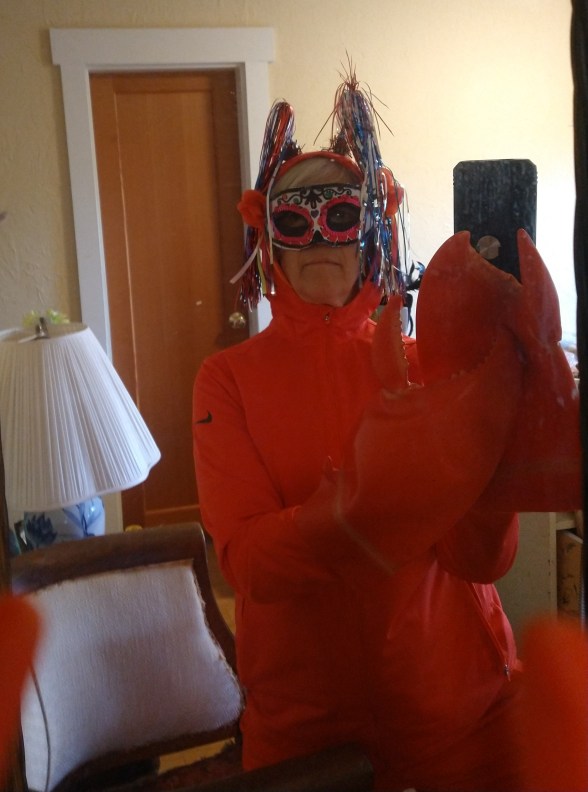
She wears two masks out in public.
Infectious control, don’t you know.
For the Ragtag Daily Prompt: lobster.

home home welcome home
home is where you are, Beloved
and you are everywhere
not in churches, not for me
I run outdoors, long to be free
you are everywhere I see
the beauty in the world
love and grief and pearls
small child dance and twirl
I have crossed the boundary
over and over again
Beloved, let me stay, friend
I’ve searched for you so long
Beloved, you make us so strong
look everywhere that’s wrong
home home welcome home
home is where you are, Beloved
and you are everywhere
________________________________
August 31, 2022

My cardiologist told me to go to the Mayo Clinic six months ago.
I saw him last week and he wanted an update.
I said, “I filled out a request for a visit and my primary care referred me, but Mayo Clinic never called.”
He replies: “I will refer you.”
A week later I get a call from Mayo Clinic. But I do not have an appointment yet because
At the moment this seems insurmountable, but I will keep chipping away at all the insane barriers and paperwork. What a stupid medical system the US has, right?
We still need single payer and medicare for all. There would be one set of patient assistance papers, not five.
https://www.nature.com/articles/s41398-021-01700-4
The article is a proposal for diagnostic criteria for autoimmune obsessive compulsive disorder, a relatively rare version of OCD. Important because the treatment has to include searching for infection that triggers the antibody response, which in turn attacks the brain. Antibiotics to treat a “psychiatric” disorder. Mind and body connection, right?
The ironic thing about this new proposed diagnosis is that I do not have obivious OCD in any way, shape or form. It is masked by packrat. Also, my OCD is focused. When I was working, it was focused on patients. My clinic charts were thorough, 100% of the time. I was brutally thorough and wouldn’t skip anything. The result was that I got a reputation for being an amazing diagnostician. Usually it was because I wanted ALL the puzzle pieces and the ones that don’t fit are the ones that interested me. They have to all fit. Either the patient is lying or the diagnosis is not as simple as it appears. Occam’s Razor be damned, people can have more than one illness.
In fact, an article 20 years ago looked at average patient panels and said that the average primary care patient has 4-5 chronic illnesses. Hypertension, diabetes, emphysema, tobacco overuse disorder, alcohol overuse disorder, well, yeah. And then the complex ones had 9 or more complex illnesses. You can’t see the person for one thing, because if the diabetic has a toe infection, you’d better look at their kidney function because the antibiotic dose can kill their kidneys if you don’t adjust it. So do not tell me to see the patient for one thing. Malpractice on the hoof. Completely crazy and evil that administrators tell doctors to do that.
No one looking at my house would ever think I have any OCD. I am not a hoarder (ok, books) but the packrat force is strong in me. My daughter did not inherit that gene. She is a minimalist. However, she has come to appreciate the packrat a little.
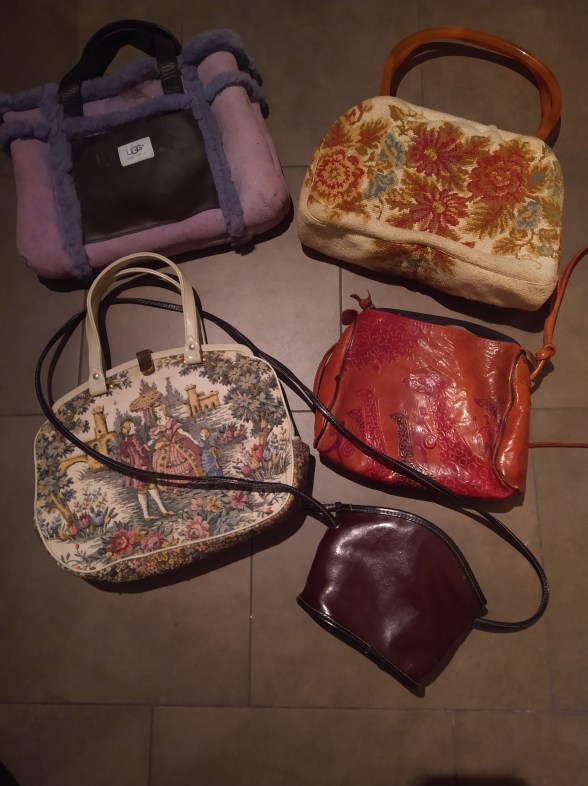
This summer she said that her purse is wearing out. As a minimalist she has one purse. I ask, “Would you like to see if I have one that you like?” It so happens that as I was trying to recover from pneumonia, a local garage sale had 20+ year old designer purses for $3 each, because the house was going on the market. Got to get rid of the stuff.
“Yes, please.” says my daughter.
I start with the weird ones that I know she will not want. I get eye rolls. But I am progressing towards the purses that are close to the one she has. At last I produce a small leather purse, the right size, in good shape, and she sits up. “Let me see that one.” Like Eeyore with his popped balloon, putting it in a jar and taking it out, she tries putting her phone and wallet in the purse and taking it out. “Yes, I like this!” She calls it “Shopping mom’s closet.” I think it is delightfully comic. The benefits of a packrat mother.
Back to the Nature article and OCD. The diagnostic criteria are gaining steam. Having watched a conference this summer about Pandas and Pans, mine is mild. Some young people have a version where killer T cells invade the brain and kill neurons. I had a moment of panic when the conference was discussing a case, but then I thought, if I had the neuron killing kind I would be dead or demented by now.
Instead, I’m just a little neurologically unusual.

https://www.cdc.gov/nchs/fastats/leading-causes-of-death.htm
There is an article about US doctors, that primary care would have to work around the clock to apply all of the guidelines, here: https://news.uchicago.edu/story/primary-care-doctors-would-need-more-24-hours-day-provide-recommended-care.
Yes, but this is not new news. There was a trio of articles twenty years ago that said the same thing. And the guidelines have only expanded. Primary care is doing the same thing it has always done: what it can. Meanwhile we go to “Continuing Medical Education” and the other specialists ALL say we are not doing enough, we need to do more. Makes a woman cynical, don’t it?
Family Practice is a specialty, did you know that? We do a three year residency. Internal medicine is also three years, but many then “sub specialize” — further training in cardiology or rheumatology or nephrology, and etc. Sometimes we get a primary care doctor who doesn’t do the extra years but gets interested in something and they learn to subspecialize. We had a pulmonologist on the peninsula here, best I’ve worked with, who had not done the fellowship but learned it on the job. She was excellent and is now retired.
So you as a patient need to be aware of the top ten causes of death and do some thinking. Heart is still number one, in spite of Covid-19. All the cancer deaths are number two, but that’s only a fraction of the cancers. You want cancer screening, to pick it up before it is lethal. Pap smears, colon cancer screening, get your skin checked. Covid-19 is number three in 2020. Let’s look at the list.
US top ten causes of death, 2020.
The list changes. What has fallen out of the top ten, since Covid-19 was not on the list back in 2019? “Intentional self-harm” aka suicide, was number ten in 2019.
Let’s go through the list one at a time and give you some basic tools and ideas about prevention, since your physician doesn’t have enough time to deal with all of it.
Since your doctor does not have time to think about all of this every time you stop by, it’s partly up to you. I don’t trust Dr. Google at all, but the sites I go to are the CDC, the Mayo Clinic, NIH, AAFP (American Academy of Family Practice). I look at lots of quack sites too, to see what is being sold, but I am not advertising them!
Be careful out there.
The photograph is Elwha watching the four point buck and wondering if it will eat him or not. From last week.

I took this with the zoom all the way out. We’d argued about whether it was a log. I said it was not a log. I was correct.
This creature is definitely bouyant but is not floating in the picture. He or she is lying on a high sandbar or piece of rock. There wasn’t room with the others, or perhaps he or she eschews the crowd.

For the Ragtag Daily Prompt: bouyant.

I keep reading bits about despair and about how a generation of children is being “ruined” by the pandemic.
Not so, I say. There is hope. We need to support each other to survive and then to thrive.
This generation WILL have a higher than average ACE score. If the Adverse Childhood Experience scale is from zero to eight, children in this time period will have at least one higher point than average and many will have three or four or more. Loss of a parent, a sibling, beloved grandparents during covid. Increases in domestic violence, child abuse and addiction. These are all part of the ACE score.
What does this do to children? They have survival brain wiring. They will do their best to survive what is happening. A friend and I both have high ACE scores, 5 or more, and we are both oppositional defiant. We showed this in different ways. He grew up in the same community. He escaped from home and knew all the neighbors. He walked to the local church and attended at age 3 or 4. He has lived in this community all his life.
His oppositional defiance showed up at home, where he consistently refused to obey. And in school, where he confounded and disobeyed teachers and passed anyhow.
My family moved every 1-5 years. I hated moving. I wouldn’t talk to kids in a new school for a year. It was very difficult. So my oppositional defiance was very very internal. I hid in books and in my head. In 6th grade I got in trouble for hiding novels inside the school book I’d already read. I also would just not listen and my respect for the teacher got even lower when she would be angry that I knew the answer to the question once she’d repeated it. I wasn’t listening because I was bored. She was the first teacher that I thought, well, she is not very bright. The next year they stuck me in the honors class and I stopped being bored, though I still questioned practically every opinion every teacher had. I wanted evidence and I did not believe it just because the teacher said it.
I am not saying that oppositional defiance is in every high ACE score. I don’t know that. Why oppositional defiance? Imagine you are a small child and you are beaten. There isn’t rhyme or reason. You can’t predict when the adult will be out of control. Why would you behave “well” if it makes no difference? You might as well do what you want, because nothing you do will change the adult. Or imagine you are a small child who is with one person, passed to another, then to another. You may not exactly trust adults after two or three repetitions. And you want to survive.
There is an increase in addictions, behavioral health diagnoses, and chronic illness in adults with a high ACE score. A researcher when I first heard a lecture about it said, “We think perhaps that addiction is a form of self medication.” I thought, oh, my gosh, how are we ever going to treat THIS? Well, we have to figure that out now, and we’ve had 30 years to work on it.
I was very comfortable with the oppositional defiant patients in clinic. I got very good at not arguing with them and not taking their behavior personally. They might show up all spiky and hostile and I might be a little spiky and gruff back: sometimes that was enough. I think the high ACE score people often recognize each other at some level, though not always a conscious one. With some people I might bring up ACE scores and ask about their childhood. Sometimes they wanted to discuss it. Sometimes they didn’t. Either was ok.
One thing we should NOT do is insist that everyone be “nice”. We had a temporary doctor who told us her story. Her family escaped Southeast Asia in a boat. They had run out of water and were going to die when they were found by pirates. The pirates gave them water. They made it to land and were in a refugee camp for eight years or so. She eventually made it to the US. She was deemed too “undiplomatic” for our rural hospital. I wondered if people would have said that if they knew her history and what she had been through. It’s not exactly a Leave it to Beaver childhood, is it? When she was telling us about nearly dying of thirst in the boat, my daughter left her chair and climbed on my lap. She was under ten and understood that this was a true and very frightening story.
We can support this generation of children. This has been and is still being Adverse Experiences for adults as well. Family deaths, job loss, failure of jobs to support people, inflation. Remember the 1920s, after World War I and the last pandemic, of influenza. “On October 28, 1919, Congress passed the National Prohibition Act, also known as the Volstead Act, which provided enabling legislation to implement the 18th Amendment.” (wikipedia). There were forces trying to legislate behavior, as there are now. The result in 1920s of making alcohol illegal was speakeasies, illegal alcohol, and violence. Some people acted wild after WWI and the influenza pandemic and some people tried to lock down control, by controlling other peoples’ behavior. It did not work then and it will not work now. The wildness is out of control grief, I think, grief dysfunctional and drinking and shooting and doing anything and everything, legal or not. We remember how the 1920s ended too. Let us not repeat that. Let us mourn and grieve and support each other and support each other’s decisions and autonomy.
Blessings.

The CDC has guidelines for Long Covid and it can qualify for disability in the United States.
Here: https://www.cdc.gov/coronavirus/2019-ncov/long-term-effects/index.html
And here: “As of July 2021, “long COVID,” also known as post-COVID conditions, can be considered a disability under the Americans with Disabilities Act (ADA). Learn more: Guidance on “Long COVID” as a Disability Under the ADA, Section“
Here is the list of “most common” symptoms from the CDC:
General symptoms
Respiratory and heart symptoms
Neurological symptoms
Digestive symptoms
Other symptoms
There are recommendations for a work up by physicians. Depending on symptoms, this may include labs, ECG, echocardiogram (heart ultrasound), CT scan and other tests.
A friend has just gone through those four tests . They are “normal” except for her heart rate. At rest her heart rate is 70 with a normal oxygen level. Walking, her heart rate jumps to 135. Over 100 is abnormal in this athlete who is NOT exerting heavily.
So WHAT is going on with NORMAL testing? I think this is “Covid-19 Viral Pneumonia”, a complication of Covid-19, just as “Influenza Viral Pneumonia” is a complication of influenza. Ralph Netter MD has an illustration of lungs from a person who died of influenza viral pneumonia: the lungs are swollen and inflamed and bruised. WHY is the testing “normal” then? The swelling is throughout the lungs, so a chest x-ray sees it as all the same density and a CT scan also sees it as all the same density. The lungs may have mildly decreased breath sounds, but the sounds are even throughout the lungs. The useful TEST is a walk test. I have tested patients with “walking pneumonia” in clinic for years: get a resting heart rate and oxygen level. Then have my patient walk up and down the hall three times and sit back down. Watch the heart rate and oxygen level. If the heart rate jumps 30 beats up or is over 100, the person needs to continue rest until the heart rate stays under 100 or jumps less than 30 beats. It is important to observe the heart rate until they recover. Sometimes the oxygen saturation will drop as the heart rate comes down, and some people qualify for oxygen. Steroids do not seem to work for this. The length of time to healing is not totally surprising, because a lobar pneumonia that is visible on chest xray takes 6-8 weeks to fully clear. It is not too amazing that a bad walking pneumonia could also take 6 weeks or more to clear. If the person returns to work too soon, they prolong the lung inflammation and they are at risk for exhaustion and for a secondary pneumonia. The treatment is REST REST REST and support.
Do they need oxygen? Currently oxygen is covered only if the person’s oxygen saturation drops down to 88%. However, I think that oxygen would help recovery and make them less exhausted. With my first walking pneumonia, which was influenza, my walking heart rate was 135 and my resting heart rate was 100. Both were abnormal for me. Neither I nor my physician could figure it out. This was in 2003. I did look in my Netter book: I took one look at the painting of the influenza lungs and shut the book. “Oh.” I thought. “That’s why I can’t breathe.” The image is here, though I wish it were bigger.
It took two months for my heart rate to come down, the lung swelling to improve, and me to return to work. I read the text of Dr. Netter’s image a year later and then I read an entire book about the 1918-1919 influenza. Since then I have walked people who come in complaining of exhaustion after a “cold” or “bad cough”. Viruses can cause this and so can bacteria: mycoplasma pneumonia, chlamydia pneumonia, pneumococcal pneumonia, legionella and strep A. If the fever is gone, the infection has probably resolved, but it still can take days or weeks for the lung tissue to recover.
For Covid-19, I would add a third test: walking with weights. We test cardiac patients by asking if they can carry two bags of groceries up a flight of stairs. That is 3 Mets, a measure of the heart load. We need to measure the lung load as well. If the lung tissue is swollen, the amount of airspace is cut down and can be half normal. The heart attempts to take up the slack. The person may tolerate a heart rate of 135 for a while, but it is like running a marathon. If they are older or have heart disease, this can trigger a heart attack. I would walk the person carrying hand weights, and see the recovery.
Also, brain fog is unsurprising. If your oxygen level is borderline, it is darn hard to think. I write really strange songs when I am hypoxic. I get goofy and feel weird. The fast heart rate also feels like anxiety: I think that the body is trying to tell me to rest.
The definition of Long Covid is symptoms after 30 days. Please see your physician if you are still ill and continue to have symptoms.
Blessings.
Here is a recent article about T-cells and inflammation in the lungs of Covid-19 patients: https://www.ncbi.nlm.nih.gov/pmc/articles/PMC8460308/
and this: https://www.frontiersin.org/articles/10.3389/fimmu.2020.589380/full
BLIND WILDERNESS
in front of the garden gate - JezzieG
Discover and re-discover Mexico’s cuisine, culture and history through the recipes, backyard stories and other interesting findings of an expatriate in Canada
Or not, depending on my mood
All those moments will be lost in time, like tears in rain!
An onion has many layers. So have I!
Exploring the great outdoors one step at a time
Some of the creative paths that escaped from my brain!
Books, reading and more ... with an Australian focus ... written on Ngunnawal Country
Engaging in some lyrical athletics whilst painting pictures with words and pounding the pavement. I run; blog; write poetry; chase after my kids & drink coffee.
Coast-to-coast US bike tour
Generative AI
Climbing, Outdoors, Life!
imperfect pictures
Refugees welcome - Flüchtlinge willkommen I am teaching German to refugees. Ich unterrichte geflüchtete Menschen in der deutschen Sprache. I am writing this blog in English and German because my friends speak English and German. Ich schreibe auf Deutsch und Englisch, weil meine Freunde Deutsch und Englisch sprechen.
En fotoblogg
Books by author Diana Coombes
NEW FLOWERY JOURNEYS
in search of a better us
Personal Blog
Art from the Earth
𝖠𝗇𝗈𝗍𝗁𝖾𝗋 𝖶𝗈𝗋𝖽𝖯𝗋𝖾𝗌𝗌.𝖼𝗈𝗆 𝗌𝗂𝗍𝖾.
Taking the camera for a walk!!!
From the Existential to the Mundane - From Poetry to Prose
1 Man and His Bloody Dog
Homepage Engaging the World, Hearing the World and speaking for the World.
Anne M Bray's art blog, and then some.
My Personal Rants, Ravings, & Ruminations
 KO Rural Mad As Hell Blog
You must be logged in to post a comment.