written 12/26/17. I wrote this about another writing site. It is falling to bits, like a old building not maintained. It makes me sad, because it is where my sister used to write.She died in 2012and I still often miss her.
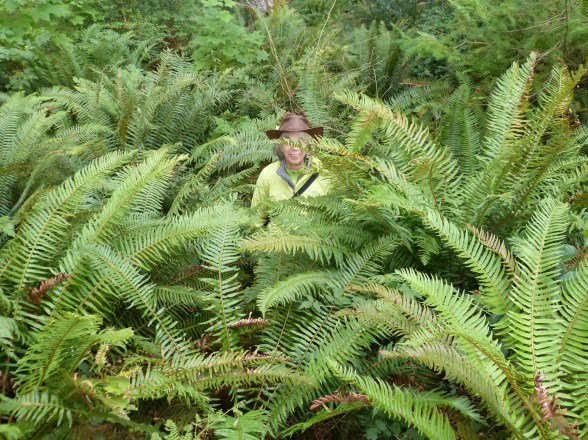
I give my camera to a friend to have this picture taken. I am excited about it because I am in this amazing forest of ferns. I think it will be beautiful.
But he does not see me. He thinks it is funny that my face is obscured.
My maddest baddest skill, shared with my younger sister, is reading hidden emotions. Children of alcoholics and addicts learn that one young. Or die. Or start drinking/drugging to numb young.
Our culture is bloody weird. Emotions are stuffed like turkeys until people are near bursting. I swear that half my clinic time was letting people talk about emotions and then saying, well, those seem like pretty reasonable feelings in view of the insanity going on in your family. There would be a silence while the person thought about the horrible terrible feelings being reasonable and then I would say, “You said you want an antidepressant. Do you want to discuss that?”
Often people put it off. Once the feelings are OUT and present and looked at instead of stuffed/contained/terrifying, the person would say, “I don’t know. I don’t know if I need it.”
“Do you want to schedule to come back in two weeks?”
Sometimes yes, sometimes no. If they wanted to start an antidepressant, I would caution that the recommendation was to stay on it for six months minimum if tolerated. Also, if they were starting it in June, I would say, “Don’t stop it in January. Wait until the sun is back. Here that can be July 4th. At least wait until spring.”
The plants are all thinking about spring now. My magnolia would like three more days of sun and then it will burst into bloom. The plums are budding and close to exploding. My camellia is usually first, but I trimmed it at the wrong time of year and so it is not blooming. It looks healthy, though. It is sort of sulking for a season. I would like to sulk for a season too.
Why is our culture, the US, so terrified of emotion? We think everything should be about logic. Emotions are both hormonally and electrically mediated through nerves and blood and they are INFORMATION about our environment and each other. We should let emotions roll through us like waves, and not worry about them so much. I think of myself as an ocean. The emotions are the weather. They roll through. Ok, big storm. Then rain, and lightening. Then low clouds and some fog. Then sun and a beautiful day to sail with a light breeze. But the deeper currents change slowly and the weather is not really that important. I reside in the depths.
The furor over rising prices seems ridiculous to me. The roaring twenties has begun already in housing and buying stuff on Amazon. I have bought two things from Amazon in the last two years. I like to buy local. One order was for my future daughter in law’s wish list. I think people are buying so that they do not have to feel. It is cultural mania. Everyone is rushing around trying to make money instead of grieving. Yesterday I thought, if this keeps up, we WILL have a depression like 1929.
Don’t do it. Don’t buy stuff to avoid the stuff inside. Sit still twice a day, for at least five minutes, and just listen. Try to listen to the depths.
As a child in an alcoholic/addict household where you can not trust adults, who do you trust?
You either trust yourself or you buy in the alcohol story.
If you buy in, you have a high probability of either becoming an addict or marrying one, depending if you prefer the enabler or the enablee role.
If you trust yourself, you develop certain senses. You pay attention to people’s emotions. You pay attention to what people FEEL, what people DO and not what people SAY. You do not care what they say: what matters is what they do. My sister said she used to walk my parent’s house during high school and try to feel the mood. Did she need to hide?
The enabler role is trying to control the other person. There are amazing variations on this. I cared for a person whose sister would not take care of herself. Every time the sister is hospitalized, the person goes and cleans tons of garbage and rotted food from the apartment.
“Stop doing that,” I say, “You are enabling her. Call Adult Protective Services to go look at it instead.”
It can be very difficult to stop and can take years. People can change.
I have noticed that the enabler role is lethal. The enablers seem to die before the enablee. Certainly in my immediate family and with many patients too.
Enablee is the person controlled. Alcohol, drugs, gambling, anger, emotions. It is very very interesting to watch. I have read parts of my mother’s diaries. She was the enabler, with my father as the enablee. However, the diaries document them fighting in the middle of the night when he is drunk. And I remember high school, putting the pillow over my ears, because they were screaming at each other.
But wait. Why would she argue with her drunk husband? Why would anyone argue with a drunk person? You have to wait until they are sober.
And slowly I realize that my mother too was an alcoholic. I remember her drinking. Best cover for an alcoholic is a worse alcoholic, right? It’s fairly horrid. But it explains some stories and my food insecurity. They would not get up in the morning to feed me. My mother told stories of me trying to feed myself: cheerios and laundry soap. If my father was hung over, ok, but, why wouldn’t my mother get up? I think they were both hung over. That or else she really did not want a child. Especially a nine month old with opinions while she was trying to get over tuberculosis. She never got to hold me after birth until 9 months. And then I did not want her. I wanted her mother.
Trusting yourself, life can be a bit complicated. You sense the emotions others are hiding. Being a physician allows me to ask about the hidden things, very gently. Sometimes they come out right away. Sometimes it takes months. Sometimes years and sometimes never. My sister and I discussed going to parties and thinking, oh, that person is the child of an addict/alcoholic. This person is in pain. This person is quite happy but hiding stuff.
I told a counselor I do not know how to turn it off. She replies, “Why do you think I am a counselor?”
I don’t see auras. I feel things: like a cloud. Like a tiger, like a bear, like a whale, singing.
This video is from 2011. I was invited to be a speaker and had ten minutes to present the Mad as Hell Doctor program, talking about single payer healthcare, medicare for all.
If there is a good thing to get from Covid-19, for me it is single payer healthcare. Because doctors and nurses and staff are worn out, sick, quitting, dying. We need people to take out sick appendixes. We need people to work in nursing homes. We need to support our medical people and I am NOT talking about insurance corporations. They are making more profit than ever. Twenty percent of every dollar paid to them or more.
People say, but it’s socialized medicine, to have medicare for all. Well, no. The only socialized medicine in the US currently is the Veterans Administration. No one that I talk to wants to take away Veterans benefits. Or any of the other government programs: medicare, medicaid, active duty military. The oldest, the poorest and disabled and the people defending our country.
But physicians can do a better job if they are not worrying about prior authorization from 500 + companies, each with multiple different insurance contracts, and who can change what they cover at any time. I get emails all the time: we have changed what we cover. Great. Like I have time to read and learn 500+ insurance contracts. I memorize medicare rules and they change too. Medicare for all, one set of rules and then if you ask if something is covered, we will know.
I am not the only physician who wants single payer: Physicians for a National Healthcare Program.
The answer is yes, yes, yes. And there would be a continuous ongoing battle about what is covered and what isn’t but that already happens. For two reasons: medicine changes continuously as the science changes and there is a vocal strong fringe, which is occasionally correct. I don’t trust the fringe, but then I don’t trust insurance companies, herbal medicine makers or politicians either.
_____________________________
I can’t credit the videographer because I did not know that the video was being taken or that it was posted. I found out when a new patient said she was seeing me because of my video. I had to look it up.
These are etchings by my mother, Helen Burling Ottaway, who died in 2000.
All four are done with the same etching plate.
Winter is done first. The zinc plate is covered with a protective layer and then she draws with tools, including dental tools. The plate is placed in an acid bath. The acid etches where the drawings are, different depths. The protective layer is removed. The plate is inked. Most of the ink is gently wiped off and the plate is placed on the press. Wet paper is laid on the plate and the heavy wool covers are folded down over that. The press is run. The wool is folded back on the other side and the paper is lifted and laid to dry.
The plate is re inked for each one.
She puts the protective cover back on the plate and adds the buds for spring. These are etched. Winter is now gone, the plate has changed. She prints all of the spring series.
Next is summer. Leaves are added. She prints those.
Last is autumn. Now there are leaves on the ground as well. She does some the plates with more than one ink color. This was one of her largest etchings. She did a small series first, where the etchings were about 4 by 6 inches. This was 18 by 24. She had a really big etching press. I don’t know who has it, my sister took it to California and it disappeared.
I have the etchings and I have all the plates. I can’t run this series, I could only run autumn. I grew up surrounded by my mother doing art, etchings, watercolors, oils, lithography, a constant sketchbook and crafts. I took a painting class a few years ago. The instructor says, “Acrylics are NOT watercolors.” I reply, “I know how to DO watercolors.” I was being quite creative with the acrylics only I automatically used the watercolor techniques that I grew up with.
The photograph doesn’t really do them justice. I will have to take some more. Plus I have her slides in some of the boxes left from when my father died. More cataloging.
I am thinking about the roaring twenties a lot. I think people went a little nuts, not because of the war, but because they had difficulty being emotionally honest about the influenza pandemic. I think we humans will do it again to forget the deaths, to go into denial, to refuse to grieve.
Yes, that is my prediction.
Be very quiet, I am hunting wabbits.
Be careful in our future roaring twenties. Money will flow like honey and people will go nuts. Hold fast, hunker down, don’t go out without your macintosh, wear clean underwear. Remember what your mother told you, remember what your father tells you. Because that was followed by the Depression and that is one risk.
I don’t know if it will start this spring or next spring. Ok, I AM hoping that my son and future daughter-in-law can get married in early May, since they’ve put it off for two years. But. The 1918-19 influenza was really three years, not two. It tailed off. Half the people in the world got it. In Samoa, half the adults died, or was it 70%? They had little exposure to infection but a ship brought it. They KNEW they were high risk, but a sailor didn’t know he was sick yet.
Why a roaring twenties? Because we want to forget this pandemic, as the last one was forgotten. Our history books say that the Roaring Twenties was about the end of World War I. We teach lots about that. We barely mention the influenza world pandemic. I am reading a book about the 1918-19 influenza pandemic published in 2018. The author says that it is only now, 100 years later, that we are starting to really tell the stories of that pandemic. She gathers stories from all over the world, including stores of different infection control strategies in two cities. One guessed right and one guessed wrong, and in the wrong one, way more people died.
I read about that 1918-19 pandemic after influenza nearly killed me in 2003. I was 42, healthy, a physician, a mother, an athlete. I had NO risk factors except stress. Now it looks like it was a PANS reaction, but at the time, neither my doctor nor I could figure out why I was short of breath and tachycardic walking across a room for two months. Fatigue, chest pain, tachycardia, shortness of breath. Hmmm, what does that sound like? My partners thought I was faking and I was so sick that I could barely communicate. The stresses were my mother dying of ovarian cancer in May 2000 and my marriage being pretty on the rocks and me working way too hard. My psychiatrist said I should take time off. I said, I can’t. He said, you’d better. Then I got flu. “See?” he said. The body decides, not the conscious brain. He was correct, damn him.
The book I read in 2004 looked dry and medical from the outside. It had pages and pages of footnotes. It had photographs of Los Angeles. They knew the influenza was coming towards them like a wave and they tried to get ready. Bodies under sheets were stacked five deep in the hallways of the hospitals. It hit that fast. People, usually age 20-50, turned blue and fell over dead. WHY? It was the immune response. The 20-50 year olds had a better immune response than the 50 and older and their lungs would swell until there was no airspace left. Even then, that pandemic death rate was only 1-2 % in the US. But it was so fast and spread so quickly that everything was disrupted because it was the workers that were deathly ill and at home and there was no one to work.
People wore masks in public, except for the mask refusers, but not in their homes. So entire families would get ill. I don’t think they had figured out viral loads yet. If you are the last one standing, and you are trying to take care of a spouse and six children, you were high risk from viral load and exhaustion.
The Roaring Twenties WAS a way to grieve, it’s just a dysfunctional one. The stages of grief: denial, bargaining, anger, grief and acceptance. My sister said that acting out and revenge ought to be added as stages of grief. She died of breast cancer after fighting it for 8 years. Roaring is denial and bargaining and acting out and revenge, all at once. Everyone grieves differently, remember that. There is not an order to the stages of grief and you don’t do them once. You do them over and over and over.
I am a Cheerful Charlie, right?
War is one way to forget/deny/act out. Let’s not do that. Let’s not have a civil war of forgetfulness and denial.
I am oppositional defiant. I have been for as long as I can remember. I ALWAYS want to argue when someone tells me to do something or gives me advice. BUT, I have learned to work with it.
I work with it by arguing with myself.
Give me a topic. Or advice. I will promptly argue the opposite, internally or externally. Then I will argue the original side. Then my demon fights my angel until they are both tired and decide to go have a beer. Somewhere along the way I will make a decision and also I will laugh, because it’s funny.
B has figured this out. “You argue with EVERYTHING.” he says.
“Yes, and if there is no one around, I argue with myself. All the time.”
However, he is also oppositional defiant. He is smart too, and doing some self examination.
“I am thinking about my life. I think ALL of my important decisions were oppositional defiant ones.”
“Someone told you you couldn’t do that?
“Yes.”
He’s chewing on that. Heh. He accuses ME of overthinking. I replied that I am making up for his underthinking, heh. He suggests that I STOP overthinking and I say, “You want to DESTROY the SOURCE of my poetry?” Double heh.
The point is, some of us are oppositional defiant, but really, we don’t want that to run our lives EITHER. We don’t want ANYTHING or ANYONE to tell us what to do.
B says, “I think that everyone refusing the vaccine is oppositional defiant.” He has a lot of friends, both liberal and conservative.
“That is interesting.” I say. And I wonder if it is worth dying for, to be oppositional defiant. Not if it’s running your life, right? I don’t want ANYTHING to run my life except ME.
So then I spend a bunch of time arguing with myself about the causes of refusing the vaccine. And I have not reached a conclusion. Yet.
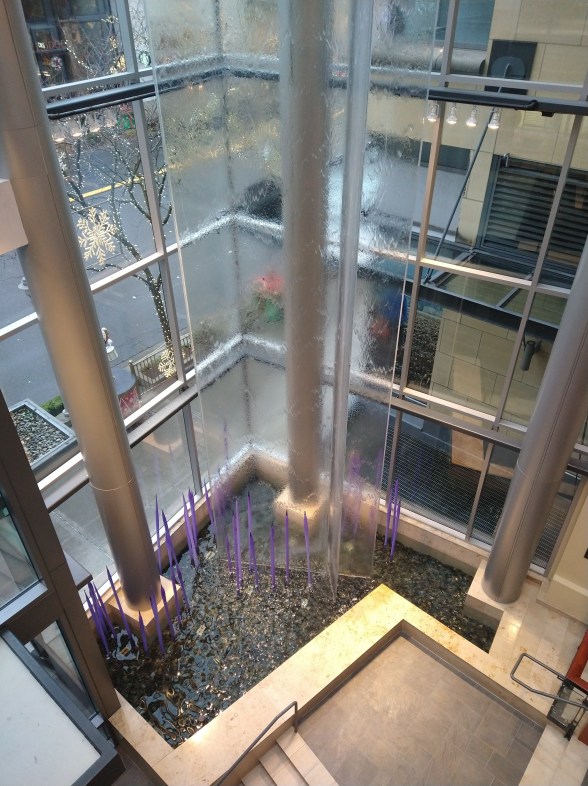
I took the photograph at the Bellevue Mall on Monday. A three story waterfall. Really? Isn’t there enough rain in Seattle? We should have a three story sun instead.
Discover and re-discover Mexico’s cuisine, culture and history through the recipes, backyard stories and other interesting findings of an expatriate in Canada
Engaging in some lyrical athletics whilst painting pictures with words and pounding the pavement. I run; blog; write poetry; chase after my kids & drink coffee.
Refugees welcome - Flüchtlinge willkommen I am teaching German to refugees. Ich unterrichte geflüchtete Menschen in der deutschen Sprache. I am writing this blog in English and German because my friends speak English and German. Ich schreibe auf Deutsch und Englisch, weil meine Freunde Deutsch und Englisch sprechen.





 KO Rural Mad As Hell Blog
You must be logged in to post a comment.