acoustic bicycle

Over KwanChunChrisSoliday, we discuss bicycles. We now have a plethora of electric bicycles, so we need a phrase that describes the “old” style bicycle. We came up with acoustic or analog. I like acoustic bicycle, because it sings.

My friend B-from-Arlington (BfA): “But they don’t make noise.” He didn’t approve of either idea.

“Well, we had spoke bells, and playing cards. My bikes make noise.” Sometimes it’s me making it.

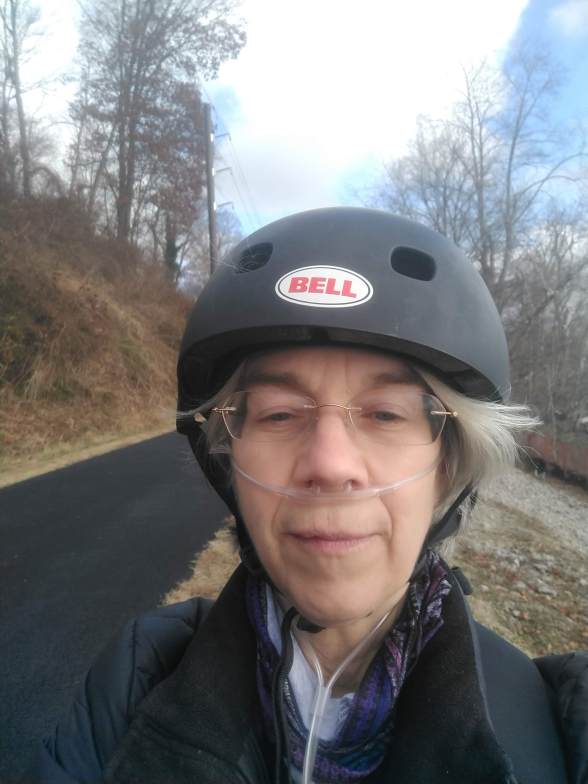
We are riding on a rails to trails path in Northern Virginia. Seven of us and me on oxygen. It’s only my second bike ride since March 2021, when my lungs fell apart. We are all on acoustic bicycles.

I feel pretty strong for most of it, 14.5 miles. It seems flat, though it is a very gentle downgrade, until the last 0.5 mile, which is gently up hill. Oh, my lungs don’t like that bit at all and by now my muscles are saying Why are we doing this? I am relieved when we get to the coffee shop destination. Three of us will stay there, while the other four will ride back and get the cars. I hang out with K-f-A, BfA’s spouse, and their son. Their son examines my phone, asks why it has four camera eyes. I have no idea, so he proceeds to figure it out. We play with the slow motion camera for a while.

We know what a penny farthing is, and safety bicycles and tricycles. The early safety bicycles did not have brakes and had wooden rims and wooden spokes. My brother outlaw has one, from the 1880 or 90s. Another friend collects penny farthings and has one that is entirely of cast iron. It would be a little bumpy and the seat is pretty hard. It is also massively heavy. So now we add acoustic bicycles to the electric ones.

Go, google, spread the word.

________________________________

Dang, others have come up with it too. Traditional bicycle sounds too fogey.
https://www.reddit.com/r/ebikes/comments/hp2l30/can_we_please_stop_calling_traditional_bicycles/
https://www.bikebiz.com/what-shall-we-call-the-non-electrified-bicycle/

Covid-19: aftermath

I am thinking about the roaring twenties a lot. I think people went a little nuts, not because of the war, but because they had difficulty being emotionally honest about the influenza pandemic. I think we humans will do it again to forget the deaths, to go into denial, to refuse to grieve.

Yes, that is my prediction.

Be very quiet, I am hunting wabbits.

Be careful in our future roaring twenties. Money will flow like honey and people will go nuts. Hold fast, hunker down, don’t go out without your macintosh, wear clean underwear. Remember what your mother told you, remember what your father tells you. Because that was followed by the Depression and that is one risk.

I don’t know if it will start this spring or next spring. Ok, I AM hoping that my son and future daughter-in-law can get married in early May, since they’ve put it off for two years. But. The 1918-19 influenza was really three years, not two. It tailed off. Half the people in the world got it. In Samoa, half the adults died, or was it 70%? They had little exposure to infection but a ship brought it. They KNEW they were high risk, but a sailor didn’t know he was sick yet.

Why a roaring twenties? Because we want to forget this pandemic, as the last one was forgotten. Our history books say that the Roaring Twenties was about the end of World War I. We teach lots about that. We barely mention the influenza world pandemic. I am reading a book about the 1918-19 influenza pandemic published in 2018. The author says that it is only now, 100 years later, that we are starting to really tell the stories of that pandemic. She gathers stories from all over the world, including stores of different infection control strategies in two cities. One guessed right and one guessed wrong, and in the wrong one, way more people died.

I read about that 1918-19 pandemic after influenza nearly killed me in 2003. I was 42, healthy, a physician, a mother, an athlete. I had NO risk factors except stress. Now it looks like it was a PANS reaction, but at the time, neither my doctor nor I could figure out why I was short of breath and tachycardic walking across a room for two months. Fatigue, chest pain, tachycardia, shortness of breath. Hmmm, what does that sound like? My partners thought I was faking and I was so sick that I could barely communicate. The stresses were my mother dying of ovarian cancer in May 2000 and my marriage being pretty on the rocks and me working way too hard. My psychiatrist said I should take time off. I said, I can’t. He said, you’d better. Then I got flu. “See?” he said. The body decides, not the conscious brain. He was correct, damn him.

The book I read in 2004 looked dry and medical from the outside. It had pages and pages of footnotes. It had photographs of Los Angeles. They knew the influenza was coming towards them like a wave and they tried to get ready. Bodies under sheets were stacked five deep in the hallways of the hospitals. It hit that fast. People, usually age 20-50, turned blue and fell over dead. WHY? It was the immune response. The 20-50 year olds had a better immune response than the 50 and older and their lungs would swell until there was no airspace left. Even then, that pandemic death rate was only 1-2 % in the US. But it was so fast and spread so quickly that everything was disrupted because it was the workers that were deathly ill and at home and there was no one to work.

People wore masks in public, except for the mask refusers, but not in their homes. So entire families would get ill. I don’t think they had figured out viral loads yet. If you are the last one standing, and you are trying to take care of a spouse and six children, you were high risk from viral load and exhaustion.

The Roaring Twenties WAS a way to grieve, it’s just a dysfunctional one. The stages of grief: denial, bargaining, anger, grief and acceptance. My sister said that acting out and revenge ought to be added as stages of grief. She died of breast cancer after fighting it for 8 years. Roaring is denial and bargaining and acting out and revenge, all at once. Everyone grieves differently, remember that. There is not an order to the stages of grief and you don’t do them once. You do them over and over and over.

I am a Cheerful Charlie, right?

War is one way to forget/deny/act out. Let’s not do that. Let’s not have a civil war of forgetfulness and denial.

Let us remember clearly and lean on each other.

Playing for change: lean on me

I think this fits the Ragtag Daily Prompt: inflammable.

My sister’s blog: https://e2grundoon.blogspot.com/2009/01/chemo-not-in-vain.html . She died on March 29, 2012. The start of the blog is here: https://e2grundoon.blogspot.com/2002/02/ .

Blessings.

______________

I got Cheerful Charlie from Pogo comics: read the Albert Alligator section. https://comicstrips.fandom.com/wiki/List_of_Pogo_characters
More recently, Downton Abby used Cheerful Charlie. https://downtonabbey.fandom.com/wiki/The_Cheerful_Charlies

sweep

sweep through the woods
sweep past the forest
the car winds along the road
we are warm inside

new broom sweep clean
new years starts again
old broom used and worn
old year illness torn

new broom brought to floor
new year contemplated
old broom set aside
old year must abide

new broom awkward feel
new year challenge real
old broom may have use
old year research truth

__________________________

For the Ragtag Daily Prompt.

small child

You work at healing
For years

You dive in the swamp
Of your psyche
Turn over the mud
Tunnel through it
Breath it
See lilies arise
From the muck

The Beloved is a deer
Dainty hooves
In the swamp

At last you come
To bedrock

So you rest
Bedrock
You think

Until you notice
A chink in the rock
You look away
You avoid it

At last you look
It isn’t going away

The Beloved is a bittern
In the reeds

Fluid leaks
From the chink

Foul black bilious
Acidic
Burning holes in the slanted rock
Again you look away
But not for long

You step forward
Touch the rock

I am present you say
Who is there?

The stream of foul black
Increases
Pours from a widening crack

Beloved is a tiger
Paw against the rock

You see the acid burning
Her paw
But she does not run
She stands guard

Who are you?
You whisper

The rock crumbles

There is a child

Go away” says the child
Ancient

No you say
Beloved and I
Stay present

The black is swirling around you
It’s hard to keep your footing
Beloved, an orca
Steadies you, swimming

No one stays says the child

We stay present you say

I was born I loved I was abandoned When I was afraid

We are present now you say
Swimming by the Beloved
Hand on black fin

I was abandoned When I grieved

We are here now you say

I was abandoned In my despair

We are here you say

You say
You fought
Out of love
You argued
Out of love
You gave
Out of love
Please child
Let us cradle you

The child is silent

The tide is slowing
The rock has crumbled away
A trickle of clear water bubbles

You will stay? says the child

We stay you say

Beloved is a whale
Singing in space
Singing to the stars

Am I lovable? says the child

You and Beloved
Earth and sky
Wind and trees
Moon and stars
Answer yes

Am I loved?

Yes
Yes

8/27/2007

Covid-19: Good and Bad News

I am writing this on Christmas morning.

The good news is this: National Guard Empties Bedpans and Clips Toenails at Nursing Homes. “In Minnesota, an ambitious initiative is training hundreds of Guard members to become certified nursing assistants and relieve burned-out nursing home workers.” (1) Well, hooray, the National Guard is called out to help, because the nursing homes are out of staff and we aren’t supposed to abuse our elderly. I think this is AMAZING. And the National Guard may learn some things about work and the elderly too. Hoorah and Hooray!

The bad news is a snippet from New York State: Omicron is milder, BUT the exception may be children. (2) Child cases of Covid-19 are going up really fast and hospital admissions of children. ICU work is hard hard hard, but child and infant ICU is even harder. Blessings on the nurses who do this and the physicians too. When I did my pediatrics rotation way back in Richmond, VA, in a tertiary care hospital, I had children who were dying: one with a brain tumor, one with liver cancer, one with Wilm’s disease. Hard work. I chose Family Practice. I have still had pediatric patients die, including an 18 month old where I had taken care of mother through the pregnancy, but not terribly many. Even less in the last ten years since my average patient was about age 70. All of my kids in the last ten years were complicated: one with Down’s, another a leukemia survivor, others. Children can be very medically complicated. I had two adults who had survived infant heart surgery as well. They were set up with UW’s Adults who had Childhood Heart Surgery Clinic, though that is not the correct name. I am pretty happy to have that sort of back up only two hours away. They both had pretty awesome heart murmurs and that midline chest zipper scar. Ouch.

So, why post this on Christmas? If the cases are rising in children, maybe that will inspire some folks to get vaccinated or at least not yell at family who refuse to bring small children to an unvaccinated Christmas gathering. Judging by the posts on the doctor mom facebook group, there is quite a bit of family yelling going on. Stand down, folks, and respect other peoples’ boundaries.

The problem is, if enough children are sick, we run out of beds. And staff. “As of Thursday, there were 1,987 confirmed or suspected pediatric covid-19 patients hospitalized nationally, a 31 percent jump in 10 days, according to a Washington Post analysis.” (3)

Blessings.

1. https://www.nytimes.com/2021/12/22/health/covid-national-guard-nursing-homes.html?action=click&campaign_id=154&emc=edit_cb_20211223&instance_id=48593&module=RelatedLinks&nl=coronavirus-briefing&pgtype=Article®i_id=165651500&segment_id=77808&te=1&user_id=c97a1a8547f511fe3bd45b0806ed713c

2. https://www.nytimes.com/2021/11/23/us/covid-cases-children.html

3. https://www.washingtonpost.com/health/2021/12/24/omicron-children-hospitalizations-us/

Covid-19: A tiny bit of good news

This: https://www.healio.com/news/primary-care/20211216/teen-drug-use-decreased-during-pandemic-survey-finds.

“Since 1975, the Monitoring the Future survey, funded by the National Institute on Drug Abuse (NIDA) and conducted by researchers at the University of Michigan Institute for Social Research, has been tracking substance use among adolescent students in the U.S.”

The numbers are interesting, aren’t they? “There was a sharp decrease in reported use (of alcohol) among 10th graders, from 40.7% in 2020 to 28.5% in 2021, and a mild decrease among 12th graders, from 55.3% in 2020 to 46.5%.”

What do YOU think the cause is? More parental supervision or less in person time with peers or something else or both? The news yammers about increased behavioral health issues and “crisis, crisis, crisis” but hello, it’s normal to be stressed during this. Learning to handle stress is important and useful. My elderly patients who lived alone came in to clinic after the first couple months of Covid-19, because they needed human contact. Since I had a one doctor clinic with me and a receptionist, my clinic was safer than the grocery store. We screened everyone for Covid-19 symptoms before they came in and diverted them to the testing site if they had symptoms. Only two of my people got Covid-19 by the time I closed, and both had traveled out of state. Neither one came in to clinic. They went and got tested because of symptoms.

Anyhow, I think it’s both parental supervision and less peer time in person. There is still a significant amount of alcohol consumed. A previous study of well off and very well off households showed increased risk of addiction by age 22 and 25 because 1. money 2. opportunity 3. parents more inclined to be in denial. Parents would turn a blind eye if grades were good. The biggest correlations for NOT being addicted were 1. family dinners and 2. parents who yapped about drugs/alcohol/addiction quite a lot. Caring, I think. Not giving up as the child enters their teens, but staying present and opinionated. Not to mention setting an example of moderation. The households where the parents use methamphetamines or heroin locally are higher risk for the teens.

More here: https://www.drugabuse.gov/drug-topics/trends-statistics/monitoring-future

This fits the Ragtag Daily Prompt: enigma.

Covid-19: Long Haul

https://www.bbc.com/news/av/world-us-canada-58918869 Some people with Long Haul Covid-19 are having to relearn how to walk and talk.

https://www.bbc.com/news/uk-england-leicestershire-59674203. Patients who were hospitalized are still affected at 5 months and one year after they are released from the hospital. Being female and obese are big risk factors. The article says “Long Covid has the potential to become highly prevalent as a new long-term condition.”

One more:

https://www.ncbi.nlm.nih.gov/pmc/articles/PMC8146298/ ” While the precise definition of long COVID may be lacking, the most common symptoms reported in many studies are fatigue and dyspnoea that last for months after acute COVID-19. Other persistent symptoms may include cognitive and mental impairments, chest and joint pains, palpitations, myalgia, smell and taste dysfunctions, cough, headache, and gastrointestinal and cardiac issues.”
“One puzzling feature of long COVID is that it affects survivors of COVID-19 at all disease severity. Studies have discovered that long COVID affects even mild-to-moderate cases and younger adults who did not require respiratory support or hospital or intensive care. Patients who were no longer positive for SARS-CoV-2 and discharged from the hospital, as well as outpatients, can also develop long COVID [24,30,31,41,50]. More concerningly, long COVID also targets children, including those who had asymptomatic COVID-19, resulting in symptoms such as dyspnoea, fatigue, myalgia, cognitive impairments, headache, palpitations, and chest pain that last for at least 6 months [51–53].”

And the symptoms? “The most common ongoing symptoms were fatigue, muscle pain, physically slowing down, poor sleep and breathlessness.”

Yes, the same as mine.

My initial evaluation of Long Haul Covid-19 patients will cover three areas:

1. Behavioral Health. Are they having brain fog, feeling slowed, feeling like they can’t think? Is that what happened during the Covid-19 or did the opposite happen? Were they manic/ADHD/OCD etc? What happened in the weeks leading up to getting sick? Any major worries or life trauma? Lose a job, a relationship, someone in the family die? I am looking for a dopamine antibody pattern.

2. Musculoskeletal Chronic Fatigue. What muscles work and which muscles don’t work? If they need to lie in bed for 20 hours a day, both slow and fast twitch muscles are affected. If they are short of breath, they should have pulmonary function tests, including a loaded and unloaded walk test. Are their oxygen saturations dropping? They also need a sleep study. Check for sleep apnea. Any signs of ongoing infection with anything? Teeth, sinuses, ears, throat, lungs, stomach, lower gut, urinary, skin.

3. Musculoskeletal Fibromyalgia. WHEN do their muscles hurt? Is it after eating? Do they fall asleep after they eat or does their blood pressure drop after eating? What diet changes have they made? Are there things they have identified that they can’t eat? Gluten, lactose, meat, sucrose, fructose, nightshades, whatever. I am looking for antibodies to lysogangliosides.

Treatment:

High antibody levels can be lowered somewhat just with “lifestyle changes” aka no drugs.

A. Treat infection if present. Look for strep A with an ASO, since we have an occult one that is in the lungs, not the throat. For fungal infection, even just on the skin, lower blood sugar as much as tolerated. This may mean a ketotic diet.

B. Treat behavioral health with drugs if emergent. If suicidal or really losing it (meaning job/relationships/whatever), then drugs may be needed. But not forever. Avoid benzodiazepines. Check for addictions.

C. Lower antibody levels:
a. Lower stress. Many people will resist this. Counseling highly recommended, ‘cept they are all swamped. Have the person draw the three circles: a day in the present life, their ideal life and then what their body wants. Listen to the body.

b. You can sweat antibodies out: hot baths, hot shower, steam room, sauna, exercise. Daily in the morning, because cortisol rises when we get up, and so levels should be lowered.

c. Is there a stimulant that works for this person to calm them down? Or an antidepressant if they are slowed instead of sped up. The relatives of dopamine that work for ME are coffee caffeine and terbutaline. Ones that do NOT work for me include albuterol and tea caffeine. Ones that I have not tried include theophylline, that new relative of albuterol and ADHD meds like adderall. This will be individual to the person because we all make different antibodies. We are looking for a drug that displaces the dopamine antibodies. For people who are slowed or have brain fog, the stimulants may not work. I would try the SSRI antidepressants first, like sertraline and citalopram, unless the patient tells me they don’t work or make them anxious. I would screen for PTSD. For high PTSD scores and high ACE scores, I would use the old tricyclics, mirtazapine (which is NOT a benzodiazepine), wellbutrin or trazodone. Again, avoid benzodiazepines. Also check how much alcohol and marijuana are on board, because those are definitely going to make brain fog worse. The functional medicine people are treating mystery patients with hyperbaric oxygen chambers and I suspect that this works for the people with blocker tubulin antibodies.

d. Muscle pain/fibromyalgia symptoms. Avoid opioids, they will only work temporarily and may addict. Avoid muscle relaxants, they will only work temporarily. Again, the tricyclics may help. The newer antiseizure drugs that are indicated for fibromyalgia are possibilities, though as an “old” doctor I am conservative about “new” drugs. Gabapentin, pregabalin, and if the person is sped up, antiseizure medicines that are used for mania. GENTLE exercise. The line between me having a good day today and overdoing is knife thin. On the overdoing days I go to bed at 5 pm. I went to sleep at 5 pm yesterday and 6:30 last night. I sang for church last night and even though I’d driven myself there, one of the quartet offered to drive me home. “Do I look that grey?” I asked. “Yes.” he said. I turn grey from fatigue and it can be sudden. Right now it’s after my second meal. If I am active, I will fall asleep after lunch if I can. If I go really light on lunch, I crash right after dinner. And remember, I am one of the lucky people who only have fast twitch muscles affected, not fast and slow twitch.

I am adding this to yesterday’s Ragtag Daily Prompt: hopeful.

Strangels

Angels can take peculiar form.

This is for my Ragtag Daily Prompt: angel.

These Strangels are spotted at the Kinetic Sculpture Race in 2015.

This is during the water trial, to make sure that they float. The sculptures have to be human powered and have to move on land, through mud and through water. The water temperature is between 50-55 degrees, which is cold.

The Strangels are support for this Kinetic Racer.

We have angelic Kinetic Kops too. Sometimes the structures look so peculiar that people forget that they can weigh tons. You do not want to be run over by one.

A Kinetic Kop with wings.
Another racer. It’s a lot to paddle.

Hooray for Strangels and all the other racers. I hope Kinetic can happen in 2022.

hat trick cat tree

I am not sure that the photograph really fits the prompt, the Ragtag Daily Prompt: sleekit. But maybe a yelling rubber chicken is appropriate. I start my tree this year with a bare stick with a fork in it.

I add lights to my stick.

I add ornaments to my stick.

The cats promptly knock it over and break some.

I remove delicate ornaments and get out the plastic and soft ones.

I finally add four branches from my cedar.

This is my adult children’s fault. They told me not to get a live tree. I figured that a dead one is legit, right?

Pretty sleekit, right?

But mom, what is for?