I wrote this poem a long time ago. I was thinking about how being a physician and taking care of other people let me avoid my own feelings. Doctors are trained to hide their feelings. When I was an intern, a patient died on my day off. I came back to find the person gone. No one on the team said anything. I was afraid I’d done something wrong. Was it my fault? Finally I screwed up my courage and spoke the the attending physician. “Oh!” he said, “I meant to talk to you about that patient. They had a lethal pulmonary embolus from the clot in their leg. They were appropriately anticoagulated. You did nothing wrong. This happens.”
I think the war is more of the same. Chaos, to avoid feeling. Let’s not do that. Let us grieve as a world. Let us not melt down in a conflagration. That is my prayer.
Chaos
So familiar
If there’s a mess And chaos Home that’s home Busy busy Run around Fire fire Fix it Crisis Now what Deal with it
No time for feelings
No no
No time
I don’t want chaos Liar liar
Chaos is so safe
Hero hero Put out the fire Catch the baby Confront Not a hero really Scared Hiding
If I stop the chaos I will have to feel
Maybe it’s ok To feel a little
I forgive myself I understand the chaos I can let go of it by degrees
I feel so vulnerable In the quiet clean safe place Take your time sweet self
I am thinking about the roaring twenties a lot. I think people went a little nuts, not because of the war, but because they had difficulty being emotionally honest about the influenza pandemic. I think we humans will do it again to forget the deaths, to go into denial, to refuse to grieve.
Yes, that is my prediction.
Be very quiet, I am hunting wabbits.
Be careful in our future roaring twenties. Money will flow like honey and people will go nuts. Hold fast, hunker down, don’t go out without your macintosh, wear clean underwear. Remember what your mother told you, remember what your father tells you. Because that was followed by the Depression and that is one risk.
I don’t know if it will start this spring or next spring. Ok, I AM hoping that my son and future daughter-in-law can get married in early May, since they’ve put it off for two years. But. The 1918-19 influenza was really three years, not two. It tailed off. Half the people in the world got it. In Samoa, half the adults died, or was it 70%? They had little exposure to infection but a ship brought it. They KNEW they were high risk, but a sailor didn’t know he was sick yet.
Why a roaring twenties? Because we want to forget this pandemic, as the last one was forgotten. Our history books say that the Roaring Twenties was about the end of World War I. We teach lots about that. We barely mention the influenza world pandemic. I am reading a book about the 1918-19 influenza pandemic published in 2018. The author says that it is only now, 100 years later, that we are starting to really tell the stories of that pandemic. She gathers stories from all over the world, including stores of different infection control strategies in two cities. One guessed right and one guessed wrong, and in the wrong one, way more people died.
I read about that 1918-19 pandemic after influenza nearly killed me in 2003. I was 42, healthy, a physician, a mother, an athlete. I had NO risk factors except stress. Now it looks like it was a PANS reaction, but at the time, neither my doctor nor I could figure out why I was short of breath and tachycardic walking across a room for two months. Fatigue, chest pain, tachycardia, shortness of breath. Hmmm, what does that sound like? My partners thought I was faking and I was so sick that I could barely communicate. The stresses were my mother dying of ovarian cancer in May 2000 and my marriage being pretty on the rocks and me working way too hard. My psychiatrist said I should take time off. I said, I can’t. He said, you’d better. Then I got flu. “See?” he said. The body decides, not the conscious brain. He was correct, damn him.
The book I read in 2004 looked dry and medical from the outside. It had pages and pages of footnotes. It had photographs of Los Angeles. They knew the influenza was coming towards them like a wave and they tried to get ready. Bodies under sheets were stacked five deep in the hallways of the hospitals. It hit that fast. People, usually age 20-50, turned blue and fell over dead. WHY? It was the immune response. The 20-50 year olds had a better immune response than the 50 and older and their lungs would swell until there was no airspace left. Even then, that pandemic death rate was only 1-2 % in the US. But it was so fast and spread so quickly that everything was disrupted because it was the workers that were deathly ill and at home and there was no one to work.
People wore masks in public, except for the mask refusers, but not in their homes. So entire families would get ill. I don’t think they had figured out viral loads yet. If you are the last one standing, and you are trying to take care of a spouse and six children, you were high risk from viral load and exhaustion.
The Roaring Twenties WAS a way to grieve, it’s just a dysfunctional one. The stages of grief: denial, bargaining, anger, grief and acceptance. My sister said that acting out and revenge ought to be added as stages of grief. She died of breast cancer after fighting it for 8 years. Roaring is denial and bargaining and acting out and revenge, all at once. Everyone grieves differently, remember that. There is not an order to the stages of grief and you don’t do them once. You do them over and over and over.
I am a Cheerful Charlie, right?
War is one way to forget/deny/act out. Let’s not do that. Let’s not have a civil war of forgetfulness and denial.
I am oppositional defiant. I have been for as long as I can remember. I ALWAYS want to argue when someone tells me to do something or gives me advice. BUT, I have learned to work with it.
I work with it by arguing with myself.
Give me a topic. Or advice. I will promptly argue the opposite, internally or externally. Then I will argue the original side. Then my demon fights my angel until they are both tired and decide to go have a beer. Somewhere along the way I will make a decision and also I will laugh, because it’s funny.
B has figured this out. “You argue with EVERYTHING.” he says.
“Yes, and if there is no one around, I argue with myself. All the time.”
However, he is also oppositional defiant. He is smart too, and doing some self examination.
“I am thinking about my life. I think ALL of my important decisions were oppositional defiant ones.”
“Someone told you you couldn’t do that?
“Yes.”
He’s chewing on that. Heh. He accuses ME of overthinking. I replied that I am making up for his underthinking, heh. He suggests that I STOP overthinking and I say, “You want to DESTROY the SOURCE of my poetry?” Double heh.
The point is, some of us are oppositional defiant, but really, we don’t want that to run our lives EITHER. We don’t want ANYTHING or ANYONE to tell us what to do.
B says, “I think that everyone refusing the vaccine is oppositional defiant.” He has a lot of friends, both liberal and conservative.
“That is interesting.” I say. And I wonder if it is worth dying for, to be oppositional defiant. Not if it’s running your life, right? I don’t want ANYTHING to run my life except ME.
So then I spend a bunch of time arguing with myself about the causes of refusing the vaccine. And I have not reached a conclusion. Yet.
I took the photograph at the Bellevue Mall on Monday. A three story waterfall. Really? Isn’t there enough rain in Seattle? We should have a three story sun instead.
my cousin says that people learn to stay away from angry people
I am hurt and then let that go and think, yes, she is right my cousins say over and over that I am too angry when I’m not angry until it makes me angry
my cousin gives good advice I let go and stay away it’s not my anger
I thought allopathic medicine was where we listened to the patient I let go of that too, disillusioned
a family member wants to be free I let go
I let go of you slowly I let go of coffee I let go of sitting next to you I let go of seeing you daily I let go of asking I let go of driving by
I let go of hope
I have not let go of longing
I think that I can fall without letting go of longing
it is only a thread like a spider’s web thrown into the universe
I do not think of emotions as bad or good. None of them are bad or good. They are information, controlled by electrical impulses and hormones, evolved over millions of years (or endowed by our creator, for those who swing that way).
I don’t dismiss emotions. I listen to them.
I think of myself as an ocean. There is all sorts of stuff happening in the depths that I don’t understand. Probiotics, for example. I don’t take them. If not for penicillin, I’d be dead many times over, from strep A pneumonia twice and other infections. I don’t think we understand probiotics yet. We don’t understand the brain, either.
The emotions are the weather in my life. I don’t really control them but they don’t control my ocean, either. Some days are sunny and gorgeous and then a storm may blow up. I am afraid of hurricanes, one destroyed my grandparents’ house in North Carolina, on the outer banks. I think all the cousins still mourn that house. And I miss my grandparents too, all of them. And my parents and my one sister.
See? The weather got “bad” there for a moment, but it isn’t bad. Storms have their own beauty though we hope to batten the hatches and that not too much damage is done. Maybe there is rain, scattered showers, sun breaks, a lenticular cloud. In the Pacific Northwest on the coast, the weather can change very quickly and we have microclimates. My father lived 17 miles away, but inland from me and in a valley. It was warmer in the summer and colder in the winter.
My goal with my weather emotions is to pay attention to them, let the storms blow in and out, and try not to harm anyone else because of my weather. When my sister was in hospice, we had a sign up in my small clinic. It said that my sister was in hospice with cancer and that clinic would be cancelled at some point with little warning. Patients were kind and gentle with me. And then it was cancelled, when she died. I got cards from people. They were so kind, thank you, thank you, and I could barely take it in. My maternal family then dealt with grief by having lawsuits. I don’t think that is a good way to deal with grief, but we just see things differently. Maybe it’s the right way for them. I don’t know.
Whenever I was having internal emotional weather that stirred me up, I would tell my nurse or office manager. Because they will sense my weather and need to know what is up. I had enormous support from them during a divorce, while my partners treated me horribly. My nurses and office manager knew me and my partners didn’t. My partners distanced me as if a divorce were catching. Whatever. Their loss.
Sometimes patients sensed that I was upset. I could tell by their faces. If they didn’t ask, I would. Bring the emotions out. Reassure them that I AM grumpy but not at them. Stuff in my own life. No worries.
Sometimes clinic is about a patient’s weather. They ask if they can tell me something. Often it is prefaced by “Maybe I need an antidepressant.” or “I feel really bad.” When they tell the story, usually I would say, “I think it is perfectly reasonable and normal that you feel angry/hurt/shocked/horrified/grieved/upset.” And then I would ask about an antidepressant or a counselor and most of the time, the person would say, “Well, I don’t think I need it right now.” What they needed was to know that their weather was NORMAL and REASONABLE.
I am seeing things on Facebutt and on media saying that mental health problems and behavioral health problems are on the rise. Maybe we should reframe that. Maybe we could say, “The weather is really bad right now for everyone and it’s very frightening and it is NORMAL and REASONABLE to feel frightened/appalled/angry/in denial/horrified/confused/agitated/anxious or WHATEVER you feel.” This weather is unprecedented in my lifetime, but as a physician who had very bad influenza pneumonia in 2003 and then read about the 1918-19 influenza, I have been expecting this. Expecting a pandemic. Expecting bad weather. This will pass eventually, we will learn to cope, be gentle with yourself and be gentle with others. Everyone is frightened, grieving, angry, in denial or in acceptance. The stages of grief are normal.
Hugs and prayers for all of us to endure this rough weather and help each other and ourselves..
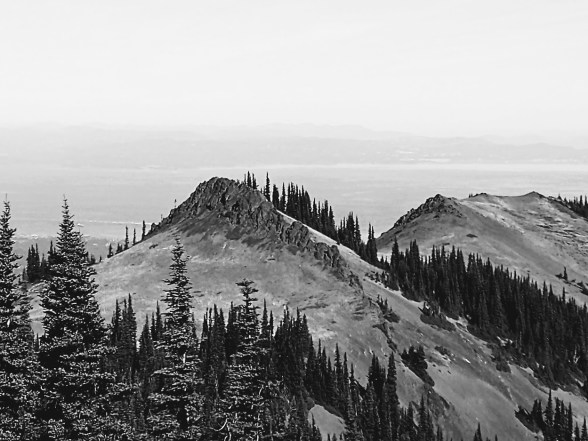
I took the photograph in color. My program made a black and white version. It looks like the back of a stegosaurus to me, a dinosaur now living as a mountain.
For the Ragtag Daily Prompt: rainbow. Because sometimes the rain and sun combine to make a rainbow.
This is a poem that I wrote in 2015 or before. It was previously posted here and on everything2.com. I just read a blog where two hockey dads are dead of covid-19. The author is writing about grief. I wrote this when I was struggling with grief and how to really let it in.
grounded
grief is an ox that stands in the room with me and overshadows everything
no grief is a plow pulled by an ox I try to guide it in the furrows
no grief is the heavy ground the plow turns it the ox pulls I guide it in the furrows
no I am grieving I let it be close I don’t push it in to an ox in to a plow in to the earth I let it in I grieve
I am trying to wrap my mind around an aspect of Adverse Childhood Experience Scores. Ace scores.
Raised in war or chaos or an addiction household or a crazy household, kids do their best to survive and thrive. I acknowledge that first. “You survived your terrible and terrifying childhood. You are amazing. You have crisis wiring in your brain. You had to wire that way in order to survive.”
And what does that mean? High alert, high adrenaline, high cortisol, reactive. One veteran says that the military loved him being able to go from zero to 60 instantly.
“Yes, and how is that serving you now?” I ask. “Do you want to change it?”
“No.” he says.
“Why not?” I say.
“Because I know I can protect myself.”
He can protect himself, as I can too. But being on the alert for a
crisis, being good in a crisis, being able to fire up like a volcano, is
that what I want and is that what he wants? If not, how do we change
it?
I think of it as being able to see monsters. Other people’s monsters.
My crisis childhood wiring is to pay attention to the non-verbal
communication: what people do not what people say. The body language,
the tone of voice, what the person is not saying in words, when someone
is being polite but the body language is a shut down, a rejection, a
dismissal, posturing, aggressive, they don’t like me no matter what the
words are, belittling. But if I or my high ACE score patients respond to
the body language and emotional feeling, we have named the monster. And
the person is being “polite” and will not admit to the monstrous
feelings. Those feelings are unconscious or at least the person does not
want to admit if they are at all conscious.
In clinic I have learned to dance with the monstrous feelings. I
don’t always succeed, but I keep leveling up. It’s a matter of delicacy,
inviting the person to admit the monstrous. Some do, some don’t, some
don’t the first time or second or third, but the fourth time the
monsters are brought out. And they aren’t monstrous feelings after all.
They are normal. All I do then is listen and say that the feeling sounds
normal for what is happening. It’s like letting off a steam valve.
So how do I and my high ACE score folks learn to do this in social
settings as well? When someone is talking to me with a monstrous
feeling, meanly, I challenge it. Because I am not afraid of that
monstrous feeling. But I have then broken a social contract and the
person will like me even less then they already did. And maybe that
monstrous feeling is not really about me at all. It’s about their own
current life events and the feelings that they try not to feel, are
ashamed of, are afraid of. It’s not polite of me to challenge that
feeling in a social setting, I am not this person’s doctor or therapist
and they didn’t ask me. It’s hard because I feel so sorry for the
monstrous feeling and for the person feeling it. I am moving to
compassion and love for that feeling rather than taking it as directed
at me, taking it personally.
That is my intention. We will see how well it goes.
A naturopath told me to have the intention to release old grief. It’s not old grief though. It’s ongoing grief. Grief for all of the monstrous feelings that swirl around daily and the monsters that are not loved. Most people try to ignore them. I don’t. I love them, because someone has to and because they are so lonely and sad. They are crying. Don’t you hear them? That’s what love is, when you can love your own monstrous feelings and other people’s too.
Discover and re-discover Mexico’s cuisine, culture and history through the recipes, backyard stories and other interesting findings of an expatriate in Canada
Engaging in some lyrical athletics whilst painting pictures with words and pounding the pavement. I run; blog; write poetry; chase after my kids & drink coffee.
Refugees welcome - Flüchtlinge willkommen I am teaching German to refugees. Ich unterrichte geflüchtete Menschen in der deutschen Sprache. I am writing this blog in English and German because my friends speak English and German. Ich schreibe auf Deutsch und Englisch, weil meine Freunde Deutsch und Englisch sprechen.





 KO Rural Mad As Hell Blog
You must be logged in to post a comment.