X is for X-Acto knife

I am blogging A to Z about artists, particularly women artists and mostly about my mother, Helen Burling Ottaway.

My mother disliked cutting mats more than almost anything except vacuuming and cutting glass. In the late 1980s and early 1990s my grandmother lived two doors down in Alexandria, Virginia. My mother took over part of the basement for matting, glass cutting and framing. Times right before shows included complaints about cutting mats and glass, her saying that she didn’t have enough things framed (though she always did) and at least one piece of glass broke. The X-Acto knife was the tool for mat cutting at that time. My mother usually cut herself at least once for each show. She was particularly annoyed if she bled on the freshly cut mat or the painting or etching.

Hanging the show involves a lot of time out words as well, but she would get excited once it was hung. Then it was time for dress up. Shows were a command performance: my sister and I were to go as well. We dressed up and talked to people politely and ate the strawberries when my mother was not looking. The opening of the show would include food and usually wine. In small glasses. And no, we weren’t allowed to have any. We had to look at the art and be polite to adults.

The photograph today is another of my poems with my mother’s etching. And look, she has avoided cutting a mat. She bought special frames, with two slots. One holds the glass. The second holds the mat with the mounted etching. If the glass rests on the etching, it can ruin it. She mounted all of our ten prints and poems this way. Clever artist and they look wonderful.

ATOZBLOGGINGCHALLENGE2022 #art #Women artists #Helen Burling Ottaway #ATOZCHALLENGE #Christine Robbins Ottaway #APRILATOZ

For more information about the #AtoZChallenge, check out this link.

W is for Window

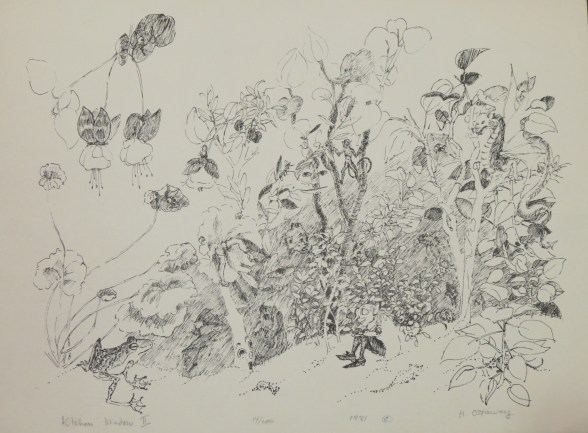
There are two Kitchen Window pen and ink drawings, then reproduced in a limited edition: this is Kitchen Window II.

My mother Helen Burling Ottaway always had a wonderfully chaotic garden inside and outside. Kitchen Window is a pen and ink drawing that she then did a limited edition of copies, numbered and signed. She had many dual drawings and etchings. One would be realistic and the second…. maybe the second is what she saw.

ATOZBLOGGINGCHALLENGE2022 #art #Women artists #Helen Burling Ottaway #ATOZCHALLENGE #Christine Robbins Ottaway #APRILATOZ

For more information about the #AtoZChallenge, check out this link.

Stages of PEACE

We have stages of grief. Now if we are going to make peace, we need to break it down into the stages that we need to go through. I think this incorporates and embodies the stages of grief. We need to plan peace. We need a map to get there, and it is not a simple road. We can’t just say I am peaceful. We must do the work. Here are the stages I can think of and I have certainly gotten stuck in some of these stages. What about you? No…or are you in denial? And if not you, I would bet money that you can name someone who you think or feel is stuck in one of these. Takes one to know one though, right? No, maybe that’s wrong. Stop confusing me!

And maybe we don’t all go through all of these stages. Or go through them in the same order. When I watch families grieve after a death, they often fight. They fight about how to grieve. The family members may be in very different stages, or the family may have stages or roles assigned to certain people, who may or may not accept the assigned role. My maternal family has anger assigned to me. I don’t really care any more. Since I am not angry, presumably they can’t handle anger and need to outsource it. I got tired of saying “I am not angry” and being told that yes, you are angry until I would get angry… you see the problem, right? It got ridiculous. My sense of the absurd kicked in and then I would try to really enjoy being angry. You are supposed to give things your best effort, right? Snort.

Message me if you think of some stages that I’ve missed! Then we can all get to work, on working through these. MAKE PEACE, PEACE OUT, PEACE ME, PEACE YOU, PEACE THE WORLD! Might take a while. Get on it, get to work.

Twisting words

Confusion

Denial

Bargaining

Anger

Bitterness

Revenge

Acting Out

Oppositional Defiance

Acceptance

Forgiveness

Healing

Hope

Reconciliation

Peace

_____________

What does the helmet have to do with this? Nothing… I just like the helmet. I keep thinking that it could be a breastplate instead of a helmet. And it is a clue to my May blogging… where am I? Where is this helmet?

making peace

denise levertov writes making peace
that it is an active process
it is not the absence of war
but a process in itself: how do we make it?
Make Peace

how do we wage peace?
wage is not the word
we do not do it for money
we must be more active than hoping
engender peace?
spread peace: like a pandemic
a pandemic of peace

the comfort of peace
the joy of peace
the love of peace

the peace of the grave
the peace of sleep
the peace of heaven
peace here now
peace not distant nor below the earth
peace conscious, aware and present
peace alive, breathing, welling up in everyone
peace here now

a pandemic of peace
a river of peace
peace flowing through and around, above and below us
peace full, peace out, peaced
let us verb it
I am peaced today
I peace you
I peace Russia
I peace the soldiers
I peace the Ukraine
I peace the entire world

I peace you
please, will you peace me?
peace me now, then there will be two
and everyone else
peace the world now
a pandemic of peace
make peace

___________________

I taped a conversation with a wren one morning in Wisconsin. I never saw my wren and clearly I have not got the language down, but she kept talking to me anyhow.

Conversation with a wren.

U is for unruly

I am blogging from A to Z about Helen Burling Ottaway, my artist mother, and other women artists.

Artists are unruly. They are not obedient. They are usurpers. They are unreasonable. This is another etching of my mother, a self portrait, titled “Giantess”. She looks giant, rising from an ocean. Will she have arms and hands and legs, or is she an octopus? We do not know. It may depend on her mood.

ATOZBLOGGINGCHALLENGE2022 #art #Women artists #Helen Burling Ottaway #ATOZCHALLENGE #APRILATOZ

For more information about the #AtoZChallenge, check out this link.

S is for Shame

I am reading Kim Addonizio’s Ordinary Genius for a Centrum poetry class.

She challenges white poets: why don’t you write about racisim?

I write that we are afraid. I think it is more than that: it is shame. Thinking about her words, I thought about one of my mother’s pieces of art and how it makes me uncomfortable. And that my discomfort with it is new. I wrote this poem.

Race forward

Kim Addonizio asks
Why don’t white poets write about race?

Chickenshits, I think.
Afraid. We are afraid.
My mother called one color Nigger Pink.
She says, “It’s the color that only looks good on black people.”
She looks wicked as she says it and I know that I never should.
She didn’t think she was racist nor a feminist.

One time she says, “Maybe I am a feminist.”
“Why do you say that?” I ask.
“We had a group of women who went to plant trees. None of them could dig a hole.”
“Oh,” I say.
“They didn’t know how to use a shovel!”

She might be horrified how many high school graduates today would call a spade a shovel.

A mentor art teacher says, “Stop being small,” to her. “Get bigger.”
She starts pastel portraits, larger than life.
One that I love is titled “One Fist of Iron.”
Now: don’t lie. What race do you think the person is? And what gender?

Did you guess correctly?
African American and male.

Another friend tells me he is trying to get his father to stop calling Brazil nuts nigger toes.
My mother told me that term too.
And that it was unacceptable.
At my friend’s father’s birthday, I focus my camera on the birthday man.
He holds a bowl of nuts. He says to himself, “I will now eat a politically incorrect nut.” and the camera clicks. I love this photograph because he is 90 and white and reluctantly changing his wicked words.

My mother says there might be hope when a small black child trick or treats her house in black face, in Alexandria, Virginia, in the 1990s.

I think there IS hope, even though the race seems slow and painful and there is so much anger
Look in the mirror, white poets.
And write the words.

One Fist of Iron, by Helen Burling Ottaway

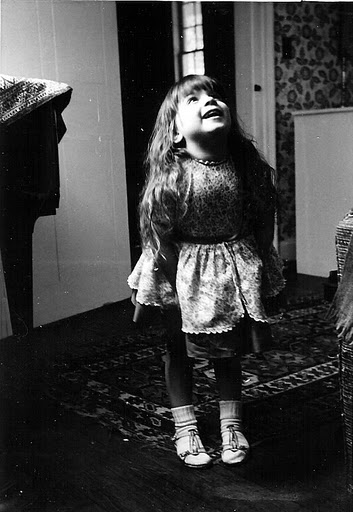
The photograph at the beginning of this is not my mother. It is her mother’s mother, Mary Robbins White. I have pictures of five generations of women with that serious expression. She was the wife of George White, the Congregationalist Minister who was president of Anatolia College in Turkey. They and my grandmother and siblings were escorted to the Turkish border in 1916. George White and his wife were two of the main witnesses of the genocide of the Armenians in Turkey.

Let us not stand by and witness more genocides.

ATOZBLOGGINGCHALLENGE2022 #art #Women artists #Helen Burling Ottaway #ATOZCHALLENGE #APRILATOZ

For more information about the #AtoZChallenge, check out this link.

T is for tree

I am blogging from A to Z about Helen Burling Ottaway, my artist mother, and other women artists.

My mother loved painting trees and doing etchings of trees, but this is a tree peony. Another etching, and this printed with two colors at the same time. Delicate work, to ink the plate with two colors and gently wipe off the excess without mixing them.

ATOZBLOGGINGCHALLENGE2022 #art #Women artists #Helen Burling Ottaway #ATOZCHALLENGE #APRILATOZ

For more information about the #AtoZChallenge, check out this link.

Are our immune systems failing because of isolation? No, and here is why.

A friend quotes her son, who says that our immune systems are failing because we have been in isolation. I respond that it’s not isolation: it is stress. Anyone who is not stressed by the addition of war to a pandemic needs to have their head examined. Why does stress mess up our immune systems?

We have two main systemic states: sympathetic and parasympathetic. Sympathetic is the high stress, fight or flight, muscles fired up, gut on hold, and unfortunately we have a pretty sympathetic state culture. Add a pandemic on top of that and then a war and no wonder everyone is flipping out. Parasympathetic is the one we don’t hear about: the happy, relaxed one that likes stupid cat videos and laughter.

Without the sympathetic nervous system, we can survive. Without the parasympathetic, we die.

I have written about how we metabolize cholesterol, depending on whether we are in a sympathetic or parasympathetic state. When we are relaxed, or less stressed, we make more sex hormones and thyroid hormone. That is parasympathetic.

When we are in a crisis, or more stressed, we make more adrenaline and cortisol. That is in the sympathetic nervous system arousal state.

A pain conference I went to at Swedish Hospital took this a step further. They said that chronic pain and PTSD patients are in a high sympathetic nervous system state. The sympathetic nervous system is the fight or flight state. It’s great for emergencies: increases heart rate, dilates air passages in the lungs, dilates pupils, reduces gut mobility, increases blood glucose, and tightens the fascia in the muscles so that you can fight or run. But…. what if you are in a sympathetic nervous system state all the time? Fatigue, decreased sex drive, insomnia and agitated or anxious. And remember the tightened fascia? Muscle pain. The high cortisol level also is not good for the immune system, so we are more likely to get sick. High cortisol also raises blood sugar and the immune system is hyperalert. We are more likely to develop autoimmune disorders.

When we are relaxed, the parasympathetic system is in charge. Digesting food, resting, sexual arousal, salivation, lacrimation, urination, and defecation. So saliva, tears, urine, and bowel movements, not to mention digesting food and interest in sex. And muscles relax.

If the sympathetic nervous system is in overdrive, how do we shut it off? I had an interesting conversation with a person with PTSD , where he said that he finds that all his muscles are tight when he is watching television. He can consciously relax them.

“Do they stay relaxed?” I asked.

“I don’t know.” he replies, “but my normal is the hyperalert state.”

“Maybe the hyperalert state, the sympathetic state, is what you are used to, rather than being your normal.”

He sat and stared at me. A different idea….

So HOW do we switch over from the sympathetic to the parasympathetic state?

Swedish taught a breathing technique.

Twenty minutes. Six breaths per minute, either 5 seconds in and 5 seconds out, or 6 in and 4 out. Your preference. And they said that after 15 minutes, people switch from the sympathetic to the parasympathetic state.

Does this work for everyone? Is it always at 15 minutes? I don’t know yet. But now I am thinking hard about different ways to switch the sympathetic to parasympathetic.

Meditation.
Slow walking outside. No headphones! We need to listen to the birds and wind, watch the trees, really look at nature. All of the new sensory input relaxes us.
Rocking: a rocking chair or glider.
Breathing exercises: 5 seconds in and 5 seconds out. Work up to 20 minutes.
Massage: but not for people who fear being touched. One study of a one hour massage showed cortisol dropping by 50% on average in blood levels. That is huge.
Playing: (one site says especially with children and animals. But it also says we are intelligently designed).
Yoga, tai chi, and chi kung.
Whatever relaxes YOU: knitting, singing, working on cars, carving, puttering, soduku, jigsaw puzzles, word searches, making bean pictures or macaroni pictures, coloring, a purring cat, throwing a ball for a dog…..and I’ll bet the stupid pet photos and videos help too….

My patient took my diagrams and notes written on the exam table paper home. He is thinking about the parasympathetic state: about getting to know it and deliberately exploring it.

More ideas: http://www.wisebrain.org/ParasympatheticNS.pdf