Colored ink

I write every day, both in my journal and here and other places. Ok, the other places are not every day.

I love colored ink. My mother did too. My sister and I were raised “devout atheist”. We did not go to church and my parents claimed to be atheist, but my mother loved holidays and decorated. Christmas, Easter, and we did the elaborate eggs with layers of color then wax then a second color then more wax. My parents also held music parties for folk songs. They sang in big choruses too, so my bible education was all masses and the Messiah. My mother set up a creche at Christmas and hung gilded pears in her avocado tree along with a partridge. She scorned “modern” Christmas carols so we just learned the old traditional ones.

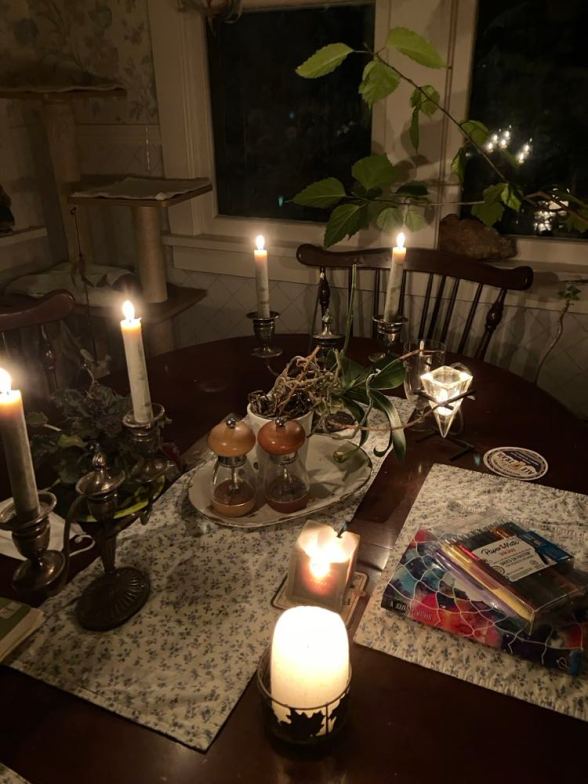
My mother was an artist. She did art every single day. She kept a much more erratic journal than me, but kept it for years. My sister and I had art supplies of all sorts and art lessons whether we wanted or not. I love color. I use my InkJoy pens and write every day. I switch colors each day. Sometimes I have stickers or stamps or drawings or doodles. Each journal is a different form. I have lots of fun with them.

For the Ragtag Daily Prompt: ink.

Fear and Finials

The word finial takes me straight to Portland, Oregon and Family Medicine Residency. My grandmother loaned us the down payment for a house and we were in Southeast, on Belmont Street. The neighborhood was coming up rapidly. My son was six months old when we moved there.

Across the street were two houses owned by two couples. All four worked for the Oregon Shakespeare Festival in the summers. One woman quit and started a landscaping business. She had six foot tomato plants in her back yard by the end of the summer. She had a gorgeous flower garden in front. She also put up a decorative fence with elegant plexiglass finials.

One day all the finials were smashed. We were all sure that it was Mike. Mike lived in a duplex next to us and was terrifying. Initially it was his mother living there with a potbelly pig that would use a ramp to go down in the yard. The son moved in with his wife and child. His mother and the pig left and then the wife and child did too. Before the wife and child left, Mike knocked on my door and asked about exchanging baby sitters. I explained that we had an arrangement with someone and could not do that. After he left, I told my husband, “Don’t let that man into our house ever.”

As a neighborhood, we discussed what to do if Mike came at one of us. We figured he was on crack, he was terrifying, and we should go for head or knees, because we did not think pain would slow him down. This sounds over the top, right? Nope. My little family was in Eastern Oregon for a ten week rotation. “You missed the fun,” said our neighbors. “Mike threatened to shoot himself, they called out the SWAT team. He shot himself but he missed and only creased his head. He’s in the state hospital for six months.” Except he was back in three months. I’ve also written about him chasing his upstairs neighbor into traffic stark naked, trying to hit him with a five iron. Rush hour traffic stopped dead to watch the show.

We thought the 5 iron probably took out the finials. The owner of the house next door sold it and Mike left. We were all terribly relieved. And that is what the word finial brings up.

For the Ragtag Daily Prompt: finial.

The photograph is not from Portland, Oregon in the 1990s. It is from London in March 2022.

1932 Letter

My cousins sent me a packet of letters. Some are from my mother to her mother, but this one is from… well, see if you can guess.

Dear Mother and Father,

We got in the car and Grandfather and me sat in front and Grandmother sat in back. Grandmother said, “Do you want your window closed?” and I said, “No.” Then, in a few minutes after that I said, “I am getting kind of chilly.” Then in a few minutes after that I tumbled over the back of the seat into the back seat. Then I shot my pistol out the window and tried shutting it again but it wouldn’t go. Then I waited awhile and then I shot off my pistol again and it worked. Then I shot off my pistol again in a few minutes after that but somehow it didn’t work. And then after awhile it started raining.

Then we got home. After a little while Eva May came over. Then after awhile Jimmie came. Jimmie brought over his gun with him. He had a long gun.

After supper I took my sparklers over to Jimmy’s and Eva May’s house. They invited me over before supper and then I started lighting my sparklers. I lit one after another and in a few minutes I said, “I’ll go over and get my pistol,” so I did.Then I went back for awhile and then I came home and stayed and we had the rest of my sparklers in the house. And then we all went to bed pretty early.

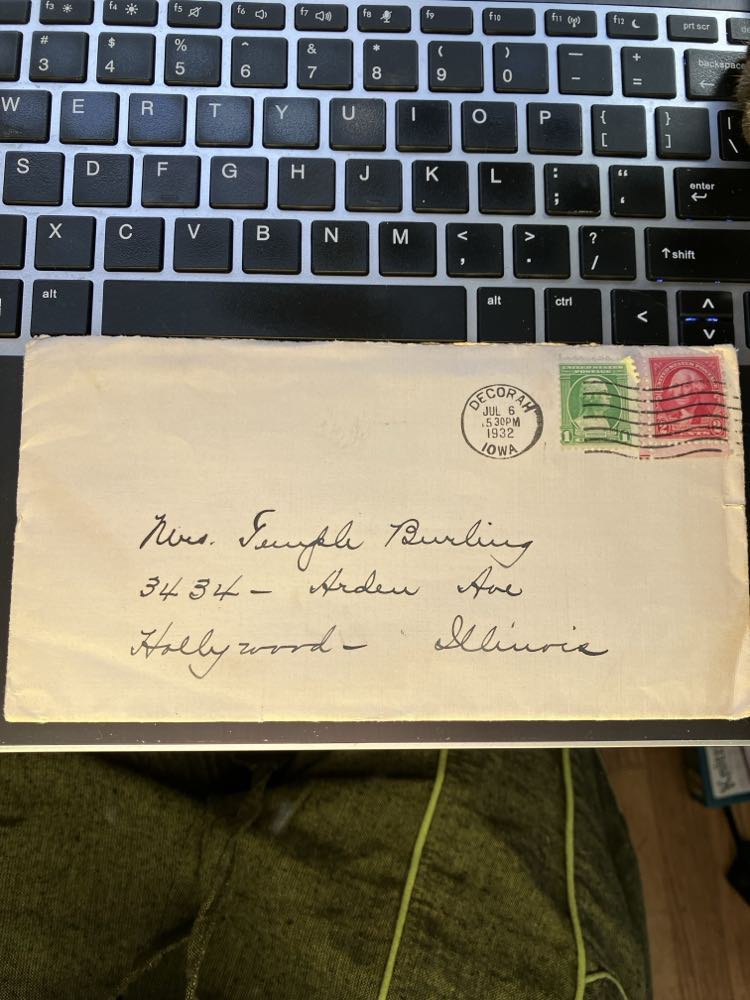
This is postmarked July 6, 1932 Decorah, Iowa. It cost .03 cents in stamps to mail. It was sent to Mrs. Temple Burling, 3434 Arden Ave, Hollywood, Illinois. The handwriting is quite beautiful. The letter is signed “Bobby” in quite different handwriting. The letter was sent from “Bobby” — Robbins Burling, age 6, as the narrator, with one of his grandparents transcribing to his mother (my grandmother) Mrs. Temple Burling (Katherine White Burling). I think it is a charming letter and so like a kid, with the repeats: “and then in awhile”. I am going to send it to “Bobby’s” grandson, who now has a child of his own. Here is the rest:

In the morning I got up and got dressed. Before I got up I was real quiet because I thought they were asleep because they were so quiet and they thought I was asleep because I was so quiet. Then finally they came past the door and when I knew – it they were awake – and they knew it – I was awake. And then I got up and got dressed.

Then after breakfast Grandmother and me went out and weeded. In a few minutes I said, “I’ll get the hay off the lawn for you.” so I did. I told her if she thought it was worth a penny and Grandma said, “Yes.” And then I said, “Do you think it’s worth any more than a penny?” and Grandma said “Yes.” In a few minutes we came in and she gave me a cent.

I left the penny in my hand and Jimmie came over and called me and we decided that we would make giant fingers and then as we were making giant fingers we decided we would make funny masks but we didn’t. We decided to make Chinamen’s hats but we didn’t.

Jimmie wore his hat in a funny pointed way and I wore mine with a round hole in the middle and kind of crooked too. And we went out to scare the girls and at first we didn’t scare girls but we scared Jimmie’s mother and we didn’t scare the girls after all. He went out to scare a man and he told me he’d be back and I got an idea while he was gone but he didn’t appear.

And then we went out and did some errands – got some peanut butter and then went to the library to see if they had any Dr. Doolittle books and they did. At first they asked if we’d read Dr. Doolittle at the Circus and I said, “I have.” and they put that back and looked some more and found another and asked me about that and it was called Dr. Doolittle and the Movie. Then at night Grandma read me some. We read part of it while I was in bed and then I started talking to Sixen and fell asleep finally and work up next morning. Then we had breakfast and I raked some more and I got another penny.

Bobby

For the Ragtag Daily Prompt: letter.

Story morph

I’ve been seeing some embroidered stories. They are based on a true story, but the details are wrong or exaggerated.

One is an old friend of my sister. He notices a chair in his garage and contacts me. Now, my sister died in 2012. He says the chair is from Grandmother Tessie and that my sister told him “It’s the only thing I have left from my grandmother.” He wants the chair to go to my sister’s daughter and he may be willing to have it recovered for her.

He sends me photographs. Touches your heart, doesn’t it?

Except that Tessie was not our grandmother. She was my maternal grandfather’s mother, so my great grandmother. I have never seen the chair before and it would have to be late 1800s or bought late in her life. It does not look that old, though it looks chewed. Also, we all got boxes of stuff from my maternal grandmother Katherine, to the point where we all agreed it was ok to get rid of some of it. We offered it to each other first. Seven cousins and I got two pitchers. I asked my mother, “Why two pitchers?”

“After your uncles and I picked what we wanted, we lined up seven boxes. Then we went pitcher, pitcher, pitcher, pitcher. There were enough to send everyone two.”

Oh. My grandmother was a serious packrat. I got a silver plate pitcher and sugar bowl that look like they are from the 1930s, art deco. I had never seen them before they came in the box. So they are not attached to my memories of my grandparents at all, but I like them very much.

I send the chair message on and I don’t know if my niece will want the chair. Nor do I know if it was great grandmother Tessie’s chair. I had an enormous box of tablecloths and pulled thread doilies and so forth after my parents died. I would bet money that there was something from Tessie Temple in there. I offered it to both my children and my niece. They each took one tablecloth and napkins. I kept a few and got rid of the rest.

The other day I noticed that one cloth that I kept is signed Margaret White. She was my maternal grandmother’s oldest sister. I have Margaret’s small leather sewing kit as well, made in Germany and stamped with her name. I’ve had that since my teens and used it until the leather corners are wearing down. My mother said that my grandmother found her sister Margaret difficult, but I don’t know if that is true either.

At one point I emailed with a family member found on Ancestry.com. This is my paternal grandmother’s father’s half-sister’s descendant. She said the family rumor was that they were related to John Philip Sousa. I said, “My great grandfather, Fredrik Bayers, played saxophone in John Philip Sousa’s band.” She said, “Oh, that must be where that story came from.”

Are these stories benign or not? With social media and the ongoing trials of various people from both the government and investment schemes, the stories seem less benign to me. If my niece wants the chair, I think that is very kind of my sister’s friend to make the effort to get it to her, but the story was rather garbled. It makes me want to be careful with the stories I tell.

Peace.

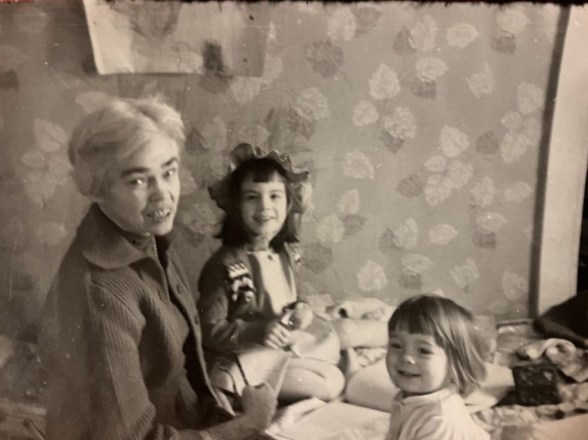
The photograph is from 1965 or 1966, of my grandmother Katherine White Burling, me, and my sister, Christine Robbins Ottaway. I would guess that my grandfather took it.

Child memories

This photograph is from a box sent by my cousin. My sister Chris and my mother Helen. On the back it says “pear tree”. My mother would try to assemble the parts of the Twelve Days of Christmas. When I was in my teens, she would hang glittery pears on her avocado tree that she had grown from a seed. One partridge, two calling birds. She had seven tiny glass swans that she would set swimming on a mirror lake, with white fluff around it for snow. I don’t think she got past seven. My mother had wonderful traditions that she developed for Christmas. She loved the old carols and wouldn’t sing the modern ones at all.

I think my grandfather or grandmother took this photograph. I thought, why isn’t it square? But it isn’t: it was cut from a page and is a bit of a trapezoid.

My sister is about four, so this would be from around 1968.

For the Ragtag Daily Prompt: children.

Love tale

An older couple comes to me in clinic. She is losing her memory, they explain. They are looking for a doctor who will respect her wishes. Once she goes in the nursing home, no intervention. No antibiotics, no shots, no iv, no hospital.

Yes, I say.

It is about a year before she goes in to the nursing home. I do my regular visits.

After a number of years I happen to meet her husband in the hall. “She is talking about her twenties.” he says. “She lived in an apartment and ran errands for her uncles. I am hearing all sorts of stories I never heard! I go home and type them and send them to the family.”

“That is wonderful,” I say. He visits daily.

I go on to her room. She says, “That man comes to see me. He says he’s my husband. I don’t remember, but he is such a nice man!” I think she falls in love with him again daily. He visits and is where she is in her memory.

Some time later the nursing home calls me. “She has a fever of 101 and has not eaten for two days.” I go visit and call her husband. “Should I do anything?”

“No! She’d kill me!”

“Ok. She might die.”

“I know.”

She doesn’t die. The fever comes down and she gets out of bed and is thirsty.

There is a year between my years at the hospital and setting up my private clinic. We send out postcards, trying not to send them to anyone who has died.

Her husband comes to the clinic opening. “She died last year,” he says.

“I am so sorry! We tried not to send postcards if people had died!”

“It’s ok,” he says, “I wanted to come and thank you.”

He dies about a year after she does. I hope they are together again.

For the Ragtag Daily Prompt: true love.

Neurogognitive effects of Long Covid I

Here is the first part of my notes from this lecture: May 24, 2023 Neurocognitive effects of Long Covid (International) part 2, by Dr. Struminger PhD, neuropsychologist.

I am trying to make this fairly clear to almost anyone. Some words may be unfamiliar to start with, but I will bet that you can sort it out. I would be happy to try to clarify any part if needed. These are my notes from the first half of this lecture, fleshed out to be clearer.

This is the Schmidt Initiative for Long Covid Global in English with real time translation into Arabic, French, Spanish, Portuguese and closed captions. Session recordings: https://app.box.com/s/onh1ma57ttjpi2c19qqxvmdao0kd2nsr

Dr. Struminger said that 1/4 to 1/3 of Long Covid patients have cognitive symptoms. A study comparing Long Covid patients with people who never got Covid-19 shows the Long Covid people to be three times more likely to have attention deficits or confusion. Part of the barrier to treatments is to define the problem, figure out the mechanisms and then start studying treatments. She said that she would share a few proposed mechanisms for cognitive impairment in Long Covid, but that it is probably multifactorial and it’s a rat’s nest. (Ok, I said rat’s nest. Dr. Struminger did not use that term.)

There are two main phenotypes of Long Covid brain problems: Hypoxic/anoxic and Frontal/subcortical. In hypoxic/anoxic certain brain functions are intact: Attention, visuospatial, cognitive fluency and memory encoding. There is impairment in problem solving and memory retention. This pattern is associated with the people who were hospitalized, deathly ill, on ventilators, or heart/lung bypass machines.

Frontal/subcortical is more common in the people who were never hospitalized and were not on a ventilator or ECMO machine. It can show up even in people who seemed to have mild Covid-19. The impairment is in attention, cognitive fluency and memory encoding, while the intact functions are visuospatial, memory retention and problem-solving.

Here are those lists in a table, HA for hypoxic/anoxic and FS for Frontal/subcortical.

Attention: HA intact, FS impaired
Visuospatial skills: HA intact, FS intact
Cognitive fluency: HA Intact, FS impaired
Memory Encoding: HA intact, FS impaired
Memory retention: HA impaired, FS intact
Problem-Solving: HA impaired, FS intact

The two types probably have different mechanisms and the super sick are more often the hypoxic anoxic. And there can be a mixed or both presentation.

Neuropsychologists test people to see what parts of the brain are working. Testing locally usually takes about four hours or more. Some brain functions have been mapped to parts of the brain but others are still mysterious. Efforts continue to match function to neuroanatomy. Going through each of the brain functions, some are mapped and others are not.

Attention is mapped and mediated by the frontal lobes. Attention is impacted by physical fatigue, dysautonomia, pain, shortness of breath, further impacted by emotional symptoms. It is REALLY easy to get stuck in a vicious cycle where physical symptoms or pain or hypoxia decrease attention function, which in turn makes physical symptoms worse. For example, hypoxia can decrease attention, which makes the person anxious and tachycardic, which in turn affects attention more.

The frontal lobes are very sensitive to hypoxic damage and to inflammation. Any inflammation in the body messes with them. The frontal lobes need oxygen and glucose. If a person can’t breathe, this messes up attention; if they are dizzy, it messes up attention.

Cognitive fluency. The anatomical correlates are less clear. Probably frontal and temporal, vulnerable to hypoxia and broad networks in the brain, vulnerable to physiological and mood disturbance. So vulnerable to the same things as the frontal lobes.

Learning and memory: Map to the hippocampi – sensitive to hypoxia and can be injured while the rest of the brain is comparatively unscathed. People have difficulty with retention of new information and not just attention/encoding problems. Neuropsychology distinguishes between attention/encoding and retention/recall problems. Those are different. In alzheimer’s, there is trouble retaining new information, even though people can encode it. In the frontal/subcortical long covid brain fog, there is more difficulty with attention/encoding. That is, if the person is tachycardic or in pain or dizzy or short of breath, it is more difficult to pay attention and encode information into memory.

Executive functioning. Frontal lobe: sensitive to hypoxia and metabolic dysregulation, significantly impacted by physical symptoms and mood disturbance.

The hypoxic/anoxic pattern has effects more like Alzheimer’s or a dementia. The frontal/subcortical is more like a concussion or traumatic brain injury. Neither sounds great, but there is more healing from the second than the first. Treatments for now are coming from the Alzheimer’s/dementia established treatments or from the concussion/traumatic brain injury established treatments. The first part of treatment is rest, rest, rest, and try to keep the brain from getting overwhelmed. I will write more about the ongoing changing recommendations.

More at: https://hsc.unm.edu/echo/partner-portal/echos-initiatives/long-covid-global-echo.html

The photograph is a screen shot of the brain from below from one of the conferences. There were over 300 people attending this zoom lecture, which is encouraging and hopeful.

For the Ragtag Daily Prompt: covert. The covert damage from Covid-19 is being sorted out.

Memory trip

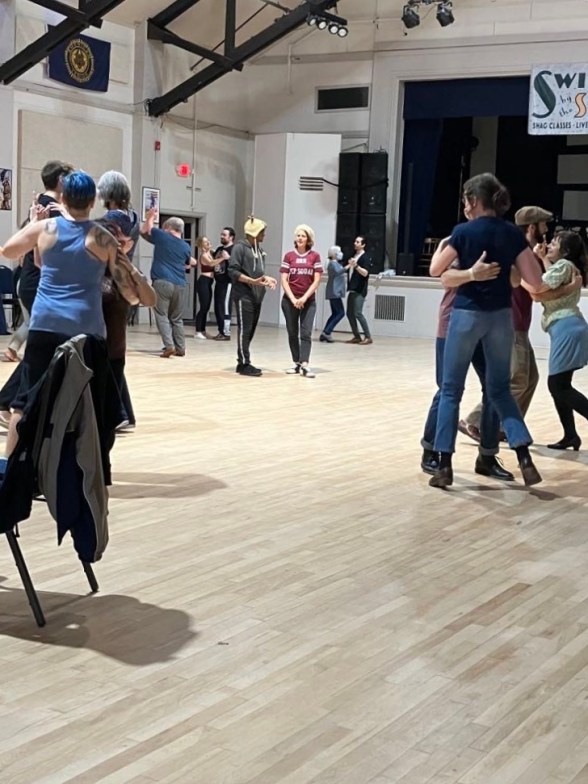
The Swinging by the Sound dance weekend was a memory trip for me.

I met my future husband dancing, back in 1986. We met contra dancing, but he was already learning Lindy Hop. We took a class together and met people that I am still in touch with. We went to dances at the Spanish Ballroom, in Cabin John, Maryland, with 400+ people. We had an hour of teaching and three hours of dancing, in the old park which did not allow alcohol. The Ballroom was not heated in the winter and would be in the upper 90s in the summer. I remember winter dances with the band needing space heaters. The dancers did not need heat: we were generating it.

I took this photograph at a Swinging by the Sound class. People choose Lead or Follow and the instructors have the Leads rotate every few dances. I am happy seeing so many people learning both, because it makes you a much better dancer.

We loved our bands too, and Daryl Davis and his band played at our wedding.

For the Ragtag Daily Prompt: trip.

Daily Evil: G is for Grumpy

Gruff, grouchy, grumpy and garden! The watercolor is a small one by Helen Burling Ottaway, my mother. She did not date any of the watercolor sketches in it. I think it is from the 1970s. I very much remember the pot that the tree is in. That is an avocado that she grew from a pit.

Is being grumpy evil? I don’t think so. I don’t think we should inflict our grumpiness on others, but we may have very good reasons to be grumpy. When I was having difficult things at home, I would give a heads up to my nurse that I was grumpy but not at her or the patients. That helped a lot, because I did not have a perfect wall about my emotions. I also hate when people are pretending to be nice when they are angry or hurting or frustrated or grumpy.

Sometimes people say, “I don’t like to be around people who aren’t positive.” Well, now, wait. Do they have to be positive if a family member dies? If they lose their job? If they are very worried about making ends meet when a car has broken down? That would be a fair weather friend, who is only present in the good times, and abandons me when I am stressed. That person is not really a friend at all. The true friends are the ones who notice I am grumpy but stay present anyway. And they ask if it is about them. They do not try to fix it or ignore it: it’s my mood, not theirs. Hooray for real friends who are present through thick and thin!

Who would I be?

If I have had PANS since birth, who would I be if I had not contracted it?

No one knows. We are still arguing about whether PANDAS and PANS exist. But, my daughter says, we make up all the words. The definitions of illnesses CHANGE over time, and what an illness MEANS. Tuberculosis was an illness of poets and people too noble for this world, until microscopes became advanced enough to see the tiny bacterium, and then it became an illness of the crowded unclean poor. Medicine and science continued to study it. Once we recognized that it is an airborne illness, tuberculosis sanatoriums were set up, to quarantine people. My mother was diagnosed with tuberculosis when she coughed blood 8 months pregnant, so I was born in a sanatorium and avoided contracting tuberculosis as a newborn.

Antibodies cross the placenta, even though the tuberculosis bacterium does not. Usually infants contract tuberculosis and die, at least when I was born. The antibodies can trigger PANS or PANDAS.

The antibodies prime the fetus’s immune system. This makes sense, right? The fetus has a sick mother and best if its’ immune system is ready to fight.

Did my younger sister have it? I do not know. Not as badly, would be my guess. My mother said that as kids, we’d both get sick, but I got sicker. We both had strep A many times. My sister got mumps, off from school for three weeks, and I did not get it. But I got everything else.

Now the estimate for children with PANS or PANDAS is 1 in 200. This is enormous. A high prevalence. Antibodies, that I suspect are adaptive and lie in readiness for a pandemic or a crisis. And now we have had another pandemic, with the last really world wide bad respiratory one 100 years ago. Is the prevalence rising because of the pandemic or are we figuring out some of the cause of behavioral health illness or is the definition of illness changing or all three? I think all of them.

My cousin’s mother had polio either during her pregnancy or very soon after. My anthropologist uncle took his family to Bangladesh, where he was doing linguistics. So does my cousin have PANS or PANDAS? I do not know.

And what of my children? My pregnancy with my older child was fourth year medical school and went well. My pregnancy with my second was very complicated. I was in my first year of work as a rural Family Practice doctor and working too hard. I ended up on bed rest for three months and on a medicine. Is labor at 23 weeks an illness? Does it affect the fetus? I was on medicine from 23 weeks to 37 weeks. What effect does it have?

Medicine is still changing and changing quickly. We don’t know. There is so much we do not know.

_______________

PANS/PANDAS: https://www.pandasppn.org/guidelines/

_______________

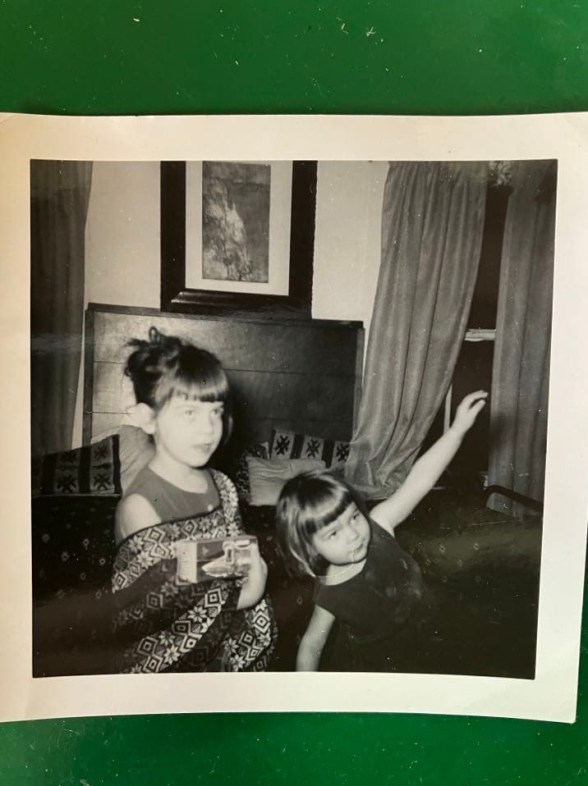
The photograph is me and my sister, in about 1967ish. I do not know who took it.