talking about silence

we are talking about silence
yours deliberate
you don’t want people to know
how you make your money

you are angry, I notice
at how people treat you
you are a self made man
with a lot of money

I don’t much care
about your money
happy for you
& etc

I am more interested in silence
I go silent in Kindergarten
because I am too weird
have no tv
and want to sing

I do not bother to lie
because people don’t listen anyhow
and they don’t believe me

I listen, you say
I read everything you send me

That is not enough, I think
I don’t say it
I think about saying it
I don’t say it

I stopped sending you my poems
months ago
when you got angry
I asked if you would respond
something
a positive
a negative
even just “Read it.”
I don’t understand
why you got angry
and I am not scared
so much as surprised

I guess you brook no criticism
ever
I wonder why you must be perfect
seems tiring to me
at any rate
I am not sending you any poems
any more
since then

you could read my blog
I post some there
selected ones
unexceptional
less personal
though I suppose you could still
be angry

you say you know I am angry
when I go silent

I go silent, thinking about that

you are right that there is anger there in the room with us
you sense it
it is yours, not mine
the bear chained in the dungeon
roaring

poor bear
I send it love
and it is crying
bitter tears
wet and cold
in a pool of tears
I can’t free it
only you can

for a moment you are aware
that I am silent about my poems
then you slam the dungeon door again
and talk about guns and science
and what you will do next

and what you will do next
with your bear
and without me

___________________

For the Ragtag Daily Prompt: distorted.

stranded mermaid, cilia and tubulin

I took this photograph last summer at North Beach. I thought she looks like a stranded mermaid, thrown up on shore. I couldn’t move her, she was twice my length. The rock attachment had come too, up from our sea beds.

Happy solstice. Today marks the one year day from when I realized that I was having my fourth round of pneumonia, with hypoxia, agitation, fast twitch muscle dysfuntion and felt sick as could be. I am way better but not well. That is, I still need oxygen to play flute, to sing, to do heavy exercise and to carry anything heavy. Which is WAY better then having to wear oxygen all the time. Today I find a connection between the lungs and the brain, in quanta magazine. This video talks about a new found connection between cilia and the brain. We were taught that cilia and flagella are for locomotion, powered by tubulin. However, this shows that cilia behave like neurons and there is a connection. Since my peculiar illness seems to involve cilia dysfunction in my muscles and lungs, so that I get pneumonia, and the brain, because I am wired when it hits, this is a fascinating connection. If neurons developed from cilia, the dual illness makes a lot more sense. Hooray for quantum mechanics! We use it in medicine every single day.

Happy solstice! Here comes the sun!

Covid-19: Approach to Long Haul

Covid-19: Approach to Long Haul

This is written primarily for physicians, but is for anyone to read. This is a working theory.

I am very interested in Long Haul because I was diagnosed with PANS by an older psychiatrist who worked exclusively with physicians in 2012. That was during my third flare. The evidence is mounting that Long Haul is an autoimmune disorder like PANS. I am sharing my approach to Long Haul based on both my clinic and personal experience.

Step 1. Validate the patient. Patients are terrified, understandably, to have something “like” chronic fatigue, fibromyalgia, or are worrying that they are “crazy”. Evidence is appearing that Long Haul, chronic fatigue and fibromyalgia are all complex autoimmune disorders with multiple antibodies. We do not yet have vast antibody tests. So the first step is to say that we believe patients and also that we can help. This is a very new and evolving field. I tell patients that it will change fast over the next few years. What I tell them today may change within a year as we get new information. If this makes them anxious, remind them of the Women’s Health Initiative and how that changed hormone therapy, and that cancer treatments keep improving.

Step 2. Lower stress and antibody levels. When we are high stress, cortisol and adrenaline go up and impair the immune system. The immune system is fired up and looking for something to do. Bacteria like strep A have evolved with us and have surface proteins that “look like us”. Our bodies make antibodies to the Strep A or Covid-19 and sometimes those antibodies attack us too, because our own proteins look the same. One way of lowering the antibody level is sweating. Hot bath or shower, sauna, hot tub, exercise. Support these and explain. A second way to lower the antibody level is to quiet the sympathetic nervous system and activate the parasympathetic nervous system. The parasympathetic is the quiet, relaxed and laughing one. Where does the patient feel safe, relaxed, quiet? After my father died, leaving a complicated and messy estate with an out of date will, I did a Sudoku daily for a year. I realized that the Sudoku relaxed me because I could not solve the estate quickly, but I could nearly always solve the Sudoku. Stupid cat videos, rocking chairs, knitting, gentle walk in the neighborhood if it feels safe, a walk in a mall (without one’s purse if overspending is an issue) — how does this particular person relax? Teach the slow breathing: in for a slow count of five and out for a slow count of five. Or square breathing: in for five, hold five, out five, in five. Twenty minutes of slow breathing supposedly moves almost everyone from sympathetic to parasympathetic. It may take practice and feel unfamiliar: I have had a veteran say that it felt very very weird to relax and he was not used to it. He kept at it.

Step 3. Symptom picture. At present I am basing this on my own experience with PANS. This is my working theory. Antibodies can block receptors or “turn the key” and activate receptors. Buprenorphine does BOTH (though it is not an antibody): at lower levels it turns the key and at higher levels it blocks. I would ask specifically about five fields. You many well be able to come up with more.

a. Brain function. In my PANS, I have antibodies to dopamine that turn dopamine on very high. Other physicians assume that I am manic. I am not quite manic, but it certainly feels awful. I feel like I have been shot out of a cannon when I wake up, with the morning cortisol rise. For me, the caffeine in coffee calms me, and my assumption is that it displaces the anti-dopamine antibodies. Tea does not work. I quit coffee for seven years until the latest flare. Albuterol doesn’t work. Terbutaline does work. I don’t know about theophylline or adderall, I have not tried them. If someone has “brain fog”, I assume that they have blocker antibodies OR be sure to ask if they were different in the first 4-6 months of the illness. For me, the antibodies rise for about 2-3 months and then take 2-3 months to drop. I have a lot of fatigue when they finally leave and this time I could tell the day that the last antibodies “fell off” or dropped to my “normal” level.
For blocked people, does caffeine help? How about albuterol? Adderall, theophylline, SSRIs. Every person will have different antibodies. Treatment needs to be tailored.

b. Muscle function. My anti-tubulin antibody (I have PANS, remember?) shuts down my “fast twitch” but not my “slow twitch” muscles. Tubulin is what makes the lung cilia function, so presumably mine are paralyzed during a flare and that is why I get pneumonia. I am tachycardic, resting heart rate 100 and walking slowly or talking heart rate 135, so I get very short of breath. Both the lung dysfunction and antibodies that upregulate my dopamine receptors make me tachycardic. I think that the people who can barely get out of bed with chronic fatigue have both fast and slow twitch muscles blocked. They need validation and lower stress. With support, perhaps the antibody level can be lowered enough that they can function again. I also found that my muscles hurt when my blood sugar was up and that if I keep it low, I have minimal muscle pain. I do not know if this is true for other people.

c. Gut function. In PANS, there appears to be an antibody to lysoganglioside. I don’t understand it but when I am sick, I cut carbohydrates way back or I am horribly ill. I tolerate lactose but not fructose, sucrose or gluten. One year after getting my last flare, I can eat everything except gluten. With this round I figured out that rising blood sugar when I am sick makes me acidic. This in turn worsens lung function more, as my body automatically slows my breathing to balance the acidity. I found that taking bicarb before a meal helped tremendously. In the worst/highest antibody part of the flare, I eat fats, because anything else makes me ill. SO: what can the patient eat or not eat and support them. Food intolerances are on the rise. Ask if there are foods that they cannot eat and support them not eating them. They can go to a very restricted diet that works for them and wait three weeks. After three weeks, food antibody levels are supposed to drop. They can start adding foods back in, one every three days. I do not know if this will work in a bad flare, the antibodies may be too high.

d. Lungs: do a resting heart rate and oxygen saturation. Do a walking heart rate and sat. Then do a LOADED heart rate and sat, with the person carrying the equivalent of two bags of groceries or their toddler. If they are young, they may hold their sats, but if their heart rate jumps to 135, that is like running a continuous marathon. Try oxygen and see if the heart rate comes down. Sleep apnea testing is also highly recommended. If they are tachycardic with daily activities, of course they have fatigue! Rest. Patients can learn to check a pulse or have a pulse ox, but fingers and second hand are cheap.

d. Other. I am reading that the main complaints in Long Haul are fatigue, brain issues, tachycardia and shortness of breath. What else really bothers the person? Sound sensitivity, loss of the sense of smell. The first step in helping with this is to listen and validate.

Covid-19: long haul II

A few days ago my primary care doctor texts that she wonders if I have the autoimmune form of fibromyalgia.

Red alert. I have not heard about this.

I did a search last night and find this: https://www.sciencedaily.com/releases/2021/07/210701120703.htm.

Now, if you have been paying attention, you know that I was diagnosed with PANDAS in 2012, though Isuspect that it is really PANS. Both are autoimmune disorders. I also think that long haul covid is the same thing or something similar.

Meanwhile, they are now saying Covid-19 Long Haul may ALSO be an autoimmune disorder. Multiple sites below.

There is a paper in Nature that I don’t have access to, annoyingly enough. The fibromyalgia story in the above story is that they have spun antibodies down from human serum of affected and unaffected people and then injected them into mice. The mice get fibromyalgia symptoms from the affected antibodies but not from the unaffected ones. The symptoms in the mice go away when the antibodies fade out, in a few weeks. Aha.

The long haul story says that death from Covid-19 may be an autoimmune response, the antibodies going really nuts and making people bleed or their lungs close down. That is, swell shut. They have been drawing blood to study at different stages of Covid-19 and also checking autopsy patients. Usually autoimmune diseases are more prevalent in women then men but Covid-19 seems to be worse in men. This: “The mechanisms behind the production of such autoantibodies aren’t yet clear. Widespread and long-term inflammation during severe COVID-19 may cause the immune system to produce antibodies to pieces of the virus it wouldn’t normally recognize. Some of those pieces might resemble human proteins enough to trigger the production of autoantibodies.

Excessive inflammation could also boost production of autoantibodies that had previously only existed in the body at very low levels. Vaccination against COVID-19 is much less inflammatory than infection with the virus. In a separate study that looked at COVID vaccination, none of the healthy volunteers developed autoantibodies.” (2)(*)

Here is another fibromyalgia paper: https://www.verywellhealth.com/autoimmunity-neuroinflammation-in-fibromyalgia-5197944. That paper lists the autoantibodies that they are finding in fibromyalgia including gangliosides. The fourth antibody in PANDAS/PANS is anti-lysoganglioside. Aha! So this is sparking a serious revolution in medicine: it is looking like many of the mysterious and difficult to describe and quantify diseases may be autoantibody disorders. The anti-ganglioside antibodies were found in 71% of fibromyalgia patients. There are seven antibodies listed, including one to serotonin. In PANS, they are blaming two anti-dopamine antibodies. None of the fibromyalgia patients had ALL seven, but all of them had some of them. A different pattern in every patient, because we all make different antibodies. Fascinating.

One more: https://pubmed.ncbi.nlm.nih.gov/28339361/. People with lupus are more likely to have fibromyalgia and visa versa. “Increasing evidence indicates that N-methyl-D-aspartate receptors (NMDARs) play a major role in the induction and maintenance of central sensitisation with chronic pain. In this study, we evaluated the role of anti-NMDAR antibodies in the development of FM in patients with SLE.” Lupus and fibromyalgia share an autoantibody. Holy cats. NMDA is ALSO a neurotransmitter. Makes me wonder quite a bit about “psychiatric” disorders.

Remember that we make up all the words. So the autoimmune diseases are usually found by testing for a few antibodies. In the most common autoimmune disorder, hypothyroidism, we usually check the TSH and T4 level, so patient hormone levels rather than antibody levels. Over the last 30 years, we are able to test for more antibodies. Systemic lupus erythematosis, celiac, rheumatoid arthritis, juvenile rheumatoid arthritis. When I was in medical school in 1989, the rheumatology book was an inch and a half thick and there were loads of different patterns of disease. I am sure it is twice as thick now. Our initial test for autoimmune disease is for inflammation: an antinuclear antibody and an erythrocyte sedimentation rate. Some people have rheumatoid arthritis but their RF is negative: they have “sero-negative” rheumatiod arthritis, which is more likely “a different autoantibody that we have not tracked down” rheumatoid arthritis. In chronic fatigue and fibromyalgia, the antinuclear antibody and erythrocyte sedimentation rate are usually normal. I suspect both disorders of being “post” inflammation.

My prediction is a serious medical revolution, where we start regularly testing for autoantibodies. Whether that will be something like a pregnancy test but with hundreds of autoantibodies tested for, or whether there are some key indicator ones that we can find, is not clear. At any rate, trauma, stress and infection all increase the likelihood of getting one of these disorders and we have to figure out how to lower the load of all three.

Do you think people are instinctively quitting their jobs?

I had a phone visit with my pulmonologist yesterday. She was running about 35 minutes late, I sat on Zoom until she showed up. She looks exhausted. “We have less doctors and more patients.” she says. “I was on call for the critical care unit last week and I am on call Monday and Tuesday.” “Please take care of yourself,” I say, “We really need you.” She is smiling the whole time. She is worried about me dropping weight and I am worried about her.

Prayers and blessings all around.


1. https://www.cedars-sinai.org/newsroom/covid-19-can-trigger-self-attacking-antibodies/
2. https://www.nih.gov/news-events/nih-research-matters/autoimmune-response-found-many-covid-19
1. https://www.cedars-sinai.org/newsroom/covid-19-can-trigger-self-attacking-antibodies/
2. https://www.nih.gov/news-events/nih-research-matters/autoimmune-response-found-many-covid-19
3. https://thehill.com/policy/healthcare/591528-long-covid-study-author-explains-four-factors-that-can-predict-how-you-get
4. https://www.the-scientist.com/news-opinion/studies-identify-risk-factors-for-long-covid-69648
5. https://www.dailymail.co.uk/health/article-10436473/Is-people-sicker-Covid-19.html
*If that paragraph does not make people get the vaccine, they are living completely in a mad dream world, IMHO.
6. https://www.nih.gov/news-events/nih-research-matters/misdirected-antibodies-linked-severe-covid-19

For the Ragtag Daily Prompt: flickering. As in flickering hope.

Covid-19: Long Haul

https://www.bbc.com/news/av/world-us-canada-58918869 Some people with Long Haul Covid-19 are having to relearn how to walk and talk.

https://www.bbc.com/news/uk-england-leicestershire-59674203. Patients who were hospitalized are still affected at 5 months and one year after they are released from the hospital. Being female and obese are big risk factors. The article says “Long Covid has the potential to become highly prevalent as a new long-term condition.”

One more:

https://www.ncbi.nlm.nih.gov/pmc/articles/PMC8146298/ ” While the precise definition of long COVID may be lacking, the most common symptoms reported in many studies are fatigue and dyspnoea that last for months after acute COVID-19. Other persistent symptoms may include cognitive and mental impairments, chest and joint pains, palpitations, myalgia, smell and taste dysfunctions, cough, headache, and gastrointestinal and cardiac issues.”
“One puzzling feature of long COVID is that it affects survivors of COVID-19 at all disease severity. Studies have discovered that long COVID affects even mild-to-moderate cases and younger adults who did not require respiratory support or hospital or intensive care. Patients who were no longer positive for SARS-CoV-2 and discharged from the hospital, as well as outpatients, can also develop long COVID [24,30,31,41,50]. More concerningly, long COVID also targets children, including those who had asymptomatic COVID-19, resulting in symptoms such as dyspnoea, fatigue, myalgia, cognitive impairments, headache, palpitations, and chest pain that last for at least 6 months [51–53].”

And the symptoms? “The most common ongoing symptoms were fatigue, muscle pain, physically slowing down, poor sleep and breathlessness.”

Yes, the same as mine.

My initial evaluation of Long Haul Covid-19 patients will cover three areas:

1. Behavioral Health. Are they having brain fog, feeling slowed, feeling like they can’t think? Is that what happened during the Covid-19 or did the opposite happen? Were they manic/ADHD/OCD etc? What happened in the weeks leading up to getting sick? Any major worries or life trauma? Lose a job, a relationship, someone in the family die? I am looking for a dopamine antibody pattern.

2. Musculoskeletal Chronic Fatigue. What muscles work and which muscles don’t work? If they need to lie in bed for 20 hours a day, both slow and fast twitch muscles are affected. If they are short of breath, they should have pulmonary function tests, including a loaded and unloaded walk test. Are their oxygen saturations dropping? They also need a sleep study. Check for sleep apnea. Any signs of ongoing infection with anything? Teeth, sinuses, ears, throat, lungs, stomach, lower gut, urinary, skin.

3. Musculoskeletal Fibromyalgia. WHEN do their muscles hurt? Is it after eating? Do they fall asleep after they eat or does their blood pressure drop after eating? What diet changes have they made? Are there things they have identified that they can’t eat? Gluten, lactose, meat, sucrose, fructose, nightshades, whatever. I am looking for antibodies to lysogangliosides.

Treatment:

High antibody levels can be lowered somewhat just with “lifestyle changes” aka no drugs.

A. Treat infection if present. Look for strep A with an ASO, since we have an occult one that is in the lungs, not the throat. For fungal infection, even just on the skin, lower blood sugar as much as tolerated. This may mean a ketotic diet.

B. Treat behavioral health with drugs if emergent. If suicidal or really losing it (meaning job/relationships/whatever), then drugs may be needed. But not forever. Avoid benzodiazepines. Check for addictions.

C. Lower antibody levels:
a. Lower stress. Many people will resist this. Counseling highly recommended, ‘cept they are all swamped. Have the person draw the three circles: a day in the present life, their ideal life and then what their body wants. Listen to the body.

b. You can sweat antibodies out: hot baths, hot shower, steam room, sauna, exercise. Daily in the morning, because cortisol rises when we get up, and so levels should be lowered.

c. Is there a stimulant that works for this person to calm them down? Or an antidepressant if they are slowed instead of sped up. The relatives of dopamine that work for ME are coffee caffeine and terbutaline. Ones that do NOT work for me include albuterol and tea caffeine. Ones that I have not tried include theophylline, that new relative of albuterol and ADHD meds like adderall. This will be individual to the person because we all make different antibodies. We are looking for a drug that displaces the dopamine antibodies. For people who are slowed or have brain fog, the stimulants may not work. I would try the SSRI antidepressants first, like sertraline and citalopram, unless the patient tells me they don’t work or make them anxious. I would screen for PTSD. For high PTSD scores and high ACE scores, I would use the old tricyclics, mirtazapine (which is NOT a benzodiazepine), wellbutrin or trazodone. Again, avoid benzodiazepines. Also check how much alcohol and marijuana are on board, because those are definitely going to make brain fog worse. The functional medicine people are treating mystery patients with hyperbaric oxygen chambers and I suspect that this works for the people with blocker tubulin antibodies.

d. Muscle pain/fibromyalgia symptoms. Avoid opioids, they will only work temporarily and may addict. Avoid muscle relaxants, they will only work temporarily. Again, the tricyclics may help. The newer antiseizure drugs that are indicated for fibromyalgia are possibilities, though as an “old” doctor I am conservative about “new” drugs. Gabapentin, pregabalin, and if the person is sped up, antiseizure medicines that are used for mania. GENTLE exercise. The line between me having a good day today and overdoing is knife thin. On the overdoing days I go to bed at 5 pm. I went to sleep at 5 pm yesterday and 6:30 last night. I sang for church last night and even though I’d driven myself there, one of the quartet offered to drive me home. “Do I look that grey?” I asked. “Yes.” he said. I turn grey from fatigue and it can be sudden. Right now it’s after my second meal. If I am active, I will fall asleep after lunch if I can. If I go really light on lunch, I crash right after dinner. And remember, I am one of the lucky people who only have fast twitch muscles affected, not fast and slow twitch.

I am adding this to yesterday’s Ragtag Daily Prompt: hopeful.

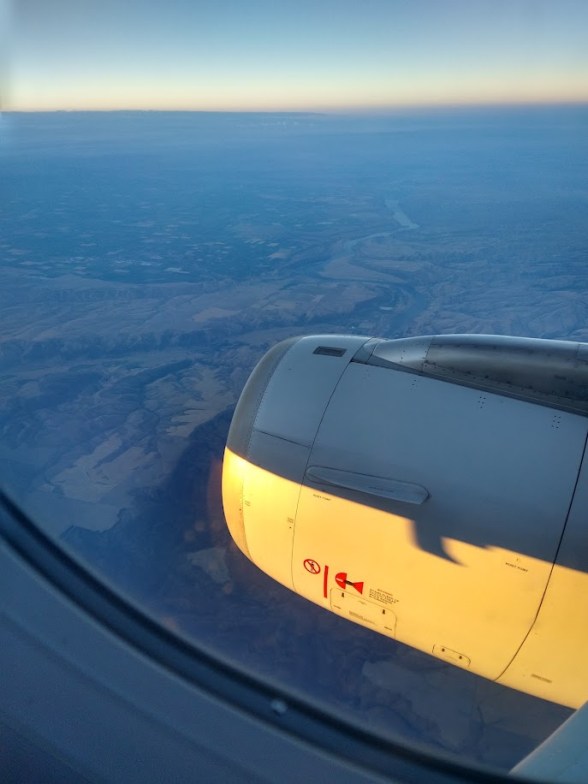
plane view

I took this last month when I flew to Michigan for an almost brother’s birthday. He turned 50. The rising sun was just amazing and I could see the mountains beautifully. Yesterday’s photograph was also from the plane. I flew from Seattle to Chicago. In Chicago I took a taxi to the train station. There I waited for a train for four hours and then rode up into Michigan. It was my first real journey with the oxygen concentrator. My carry on had the concentrator, three back up batteries, my camera, a laptop and phone and charging cords for all of them. A heavy bag and I had to pull out laptop, batteries and camera at security. Fun, eh? But I had enough oxygen for a 12 hour journey and could plug in on the train. I could have plugged in on the plane too, but the cord was in the overhead compartment. Anyhow, it worked. Oxygen tubing, N95 mask and second mask over the N95… whew.

I also learned that I need to let the airline know 48 hours in advance that I am traveling on oxygen. They tend to seat you by a window so no one trips over your tubing. Though I was in an aisle seat on the way back. Anyhow…. made it, hoorah!

Covid-19: simplified self care

  1. I am a Family Practice Physician for 30 years. I have had pneumonia four times. I last got pneumonia on March 20, 2021 and I am still off work and on oxygen. This is the first time I have been on oxygen. No tobacco, no marijuana, no lung disease found to date but my mother had tuberculosis when I was born and my father smoked unfiltered Camels. With the hospital beds filling up, this is to help keep people out of the emergency room if they don’t need to be there and to help people track how sick they are.
  2. Learn to take your pulse. You need a second hand. Your heart rate is the number of beats in 60 seconds. Take it at rest (which means sitting or lying down). Then try taking it after you walk. It should be regular unless you have known atrial fibrillation. Also, if you are fifty or older, you may skip some beats so that you have early or late ones. That is not worrisome.
  3. Normal is 60-100. If you are very out of shape, you might go up to 120 after you run up the stairs or walk fast.
  4. If your resting pulse is 120 or higher, call your physician. If you are very short of breath with that or your lips are turning blue, call an ambulance right away.
  5. If your resting pulse is normal, say, 70 beats per minute, and your pulse after walking goes up 30 points or over 100, you are sick. If you are very short of breath after walking you may need oxygen. Call your physician and walk… really… slowly. When your lungs are swollen, there is less air space to exchange oxygen and your heart makes up the difference. If your heart is beating at over 100 for long, it is like running a marathon. Don’t stop walking completely because you are at risk for blood clots. But walk really slowly.
  6. If your resting pulse is normal and your walking pulse is ok, try a loaded walk. Carry something that weighs 20 pounds if you can. Then sit down and check a pulse again. If it is over 100 or jumps 30 points, you too have lung swelling, it’s just a little more subtle. You need to rest too.
  7. With practice, you will have a good idea what your pulse is before you do a formal count.
  8. You can use a pulse oximeter but you have to use it accurately. The fingers should be not moving and lying on the person’s knee or table or something. Otherwise it will give inaccurate readings and scare you. With a regular heart rate, look for the light to be picking up regularly before you believe the oxygen level. O2 sats under 87% need oxygen, but also if someone is going below 95% or is a child, call doctor or ambulance.
  9. Take a multivitamin. It is a lot of work for your heart to race fast. Rest, rest, rest. I have had 4 rounds of pneumonia with lung swelling. It took two months, two months, a year and this time I am five months post pneumonia and still on oxygen.
  10. Don’t use quack supplements and don’t take veterinarian ivermectin. Hello, you are not a sheep.
  11. Remember that if someone is hypoxic, they may act goofy, happy and unconcerned or be scared or have memory loss or just be confused. I write really weird rhyming songs when hypoxic and have the poor judgement to sing them to my doctor.
  12. GETTING VACCINATED IS YOUR BEST BET TO NOT DIE OF COVID-19. AND WEARING A MASK ALL THE TIME AROUND OTHER PEOPLE.

Good luck and take care.