April A to Z reflection

April was a very interesting month! I went to Europe for the first time since 1988 and got covid, so had to stay an extra 8 days. The version I got was a mild cold and my lungs did not get worse. Traveling on oxygen is really challenging. I was anxious to get home because my son and daughter-in-law got married after postponing in 2020 and 2021, so they married on April 30th! It was a wonderful wedding!

So, I had to do some planning for the A to Z, writing about women artists, mostly Helen Burling Ottaway, my mother. I took a number of my mother’s etchings to give to friends in Europe and used those because they were what I had. In typing up her resume, I learned more about her! She was a prolific artist and I want to get more of her art out there. I had originally planned to set up an on line shop of her work, but the Europe trip, covid and the wedding derailed that idea! I still want to do that, but I am a bit slow about it. I need to catalog and photograph her work, after I recover from the wedding extravaganza.

When I got home from my trip on April 12, I started doing two posts a day. I did the present letter and then worked from the end of the alphabet, setting up Z for Zarathustra to go live on April 30th. By the last week of April, I had it all set to go live day by day. This is good, because there was no way I would have posted from the last Wednesday on!

I did not get to surf other writers blogs as much as I had planned. Too busy in Europe and too busy with wedding. This week I mostly want to do not very much. I am sorting wedding photographs, the ones I took, and sending them to the new bride and groom.

The picture is of my two aunts at the music rehearsal. I was cantor and led the two hymns. Both of my father’s sisters are church organists. They played four hands for the processional and the recessional and were wonderful! With both my parents gone I was very very grateful to have them present.

speaking up

A friend says he does whatever he wants. He refuses to answer questions about how he makes his money. He doesn’t care if this annoys people. I suspect he may enjoy it.

I have one of those public jobs. Well, had. I have now been disabled from Family Medicine for a year. My lungs are much better than a year ago but they are not normal. And I have now seen 17 specialists and 3 primary care doctors since 2012. The consensus is “We don’t know.” Though many specialists are not willing to say that. What they say instead is, MY testing is NORMAL, go to someone else. My lungs are not normal, but I am on my fourth pulmonologist. I saw a cardiologist this year and the first thing he says is, “It’s your lungs, not your heart.” Well, yeah, I know that.

I miss my patients, but there is something freeing about not working. Ok, more money would be nice, but I am doing ok. Meanwhile, I am thinking about what to do now. I can write full time. Write, make music, travel (on a budget) and sing. And speak up.

Doctors have interesting portrayals on television. We went from Dr. Kildare to Dr. House, working our way through the shows with an emergency room and medical residents. ER drove me nuts. No one EVER dictated a chart so at the end of each show I hyperventilated at the hours of paperwork/computer/dictating they had left. House interests me because it’s always the thing that the patient is hiding or lying about that is the key. “Go search his apartment.” says House. I have figured out cases by getting permission to call family or a group home. More than once.

But a physician is a public figure. I had been here for less than a year when a woman comes up to me in the grocery store and says “What are my lab results?” I look at her blankly. I can’t remember if I really did the snappy comeback that comes to mind: “Take off your clothes and I will see if I remember.” I respond politely and she says, “Oh. I should call the office, right?” “Yes, I try to leave the work there,” I say. If a particularly difficult person was bearing down on me, I would whisper “cry” to my kids. That worked. They would act out on cue and I would be the harassed mother. The person would back off.

I am in a small town. We have three grocery stores. I see patients everywhere, now that it has been 22 years. If I remember every detail, that means they are or were really sick. And we have the layers of relationships: someone might have kids the same age or work with boats or be in chorus with me. Once I take my daughter to a party. The mom introduces me to two other mothers. “She’s my doctor,” says the introducing mom. “Well, me too.” says the second. “And me,” says the third. We all laugh.

Once I am visiting my brother outlaw’s bicycle shop. He has a customer. The customer starts talking to me too. Brother outlaw says, “Do you two know each other?” The customer eyes me. I have my neutral doc face on. “She’s seen me NAKED!” says the customer and I howl with laughter. What a great reply. And my brother outlaw gets it.

Docs have to pay attention to HIPAA. When three women say that I am their doctor, I reply, “Yeah and I left my brain at work, so I can’t remember a thing.” Those three were healthy, so I really do not remember labs or the results of a pap smear. Once I was in cut off shorts and waved at an older woman who was at the ophthalmologist’s. She sniffs and looks away. I get the giggles: I think she did not recognize me. My town is only 10,000 people, so after 22 years I have taken care of many of them. Though sometimes people thank me for taking care of their mother, and after it sounds unfamiliar I ask if they mean Dr. Parkman? Oh. Yes. People get me mixed up with two other small Caucasian woman doctors.

I started the “outfits inappropriate for work” category last year when I was still very sick and short of breath and on oxygen. I did not go out much, partly to avoid covid. My pneumonia was something other than covid and it was my fourth pneumonia and I should not need oxygen. Now I’ve had mild covid and the oxygen is only part time. I sang at my son’s wedding, off oxygen, so I can sing off oxygen for a short time. I danced off oxygen too and did get QUITE short of breath. Since I am no longer a public figure, I can speak out and speak up more. I am thinking about that, particularly with the recent Supreme Court news. I do not agree with what they seem to be planning.

Are our immune systems failing because of isolation? No, and here is why.

A friend quotes her son, who says that our immune systems are failing because we have been in isolation. I respond that it’s not isolation: it is stress. Anyone who is not stressed by the addition of war to a pandemic needs to have their head examined. Why does stress mess up our immune systems?

We have two main systemic states: sympathetic and parasympathetic. Sympathetic is the high stress, fight or flight, muscles fired up, gut on hold, and unfortunately we have a pretty sympathetic state culture. Add a pandemic on top of that and then a war and no wonder everyone is flipping out. Parasympathetic is the one we don’t hear about: the happy, relaxed one that likes stupid cat videos and laughter.

Without the sympathetic nervous system, we can survive. Without the parasympathetic, we die.

I have written about how we metabolize cholesterol, depending on whether we are in a sympathetic or parasympathetic state. When we are relaxed, or less stressed, we make more sex hormones and thyroid hormone. That is parasympathetic.

When we are in a crisis, or more stressed, we make more adrenaline and cortisol. That is in the sympathetic nervous system arousal state.

A pain conference I went to at Swedish Hospital took this a step further. They said that chronic pain and PTSD patients are in a high sympathetic nervous system state. The sympathetic nervous system is the fight or flight state. It’s great for emergencies: increases heart rate, dilates air passages in the lungs, dilates pupils, reduces gut mobility, increases blood glucose, and tightens the fascia in the muscles so that you can fight or run. But…. what if you are in a sympathetic nervous system state all the time? Fatigue, decreased sex drive, insomnia and agitated or anxious. And remember the tightened fascia? Muscle pain. The high cortisol level also is not good for the immune system, so we are more likely to get sick. High cortisol also raises blood sugar and the immune system is hyperalert. We are more likely to develop autoimmune disorders.

When we are relaxed, the parasympathetic system is in charge. Digesting food, resting, sexual arousal, salivation, lacrimation, urination, and defecation. So saliva, tears, urine, and bowel movements, not to mention digesting food and interest in sex. And muscles relax.

If the sympathetic nervous system is in overdrive, how do we shut it off? I had an interesting conversation with a person with PTSD , where he said that he finds that all his muscles are tight when he is watching television. He can consciously relax them.

“Do they stay relaxed?” I asked.

“I don’t know.” he replies, “but my normal is the hyperalert state.”

“Maybe the hyperalert state, the sympathetic state, is what you are used to, rather than being your normal.”

He sat and stared at me. A different idea….

So HOW do we switch over from the sympathetic to the parasympathetic state?

Swedish taught a breathing technique.

Twenty minutes. Six breaths per minute, either 5 seconds in and 5 seconds out, or 6 in and 4 out. Your preference. And they said that after 15 minutes, people switch from the sympathetic to the parasympathetic state.

Does this work for everyone? Is it always at 15 minutes? I don’t know yet. But now I am thinking hard about different ways to switch the sympathetic to parasympathetic.

Meditation.
Slow walking outside. No headphones! We need to listen to the birds and wind, watch the trees, really look at nature. All of the new sensory input relaxes us.
Rocking: a rocking chair or glider.
Breathing exercises: 5 seconds in and 5 seconds out. Work up to 20 minutes.
Massage: but not for people who fear being touched. One study of a one hour massage showed cortisol dropping by 50% on average in blood levels. That is huge.
Playing: (one site says especially with children and animals. But it also says we are intelligently designed).
Yoga, tai chi, and chi kung.
Whatever relaxes YOU: knitting, singing, working on cars, carving, puttering, soduku, jigsaw puzzles, word searches, making bean pictures or macaroni pictures, coloring, a purring cat, throwing a ball for a dog…..and I’ll bet the stupid pet photos and videos help too….

My patient took my diagrams and notes written on the exam table paper home. He is thinking about the parasympathetic state: about getting to know it and deliberately exploring it.

More ideas: http://www.wisebrain.org/ParasympatheticNS.pdf
mysterious

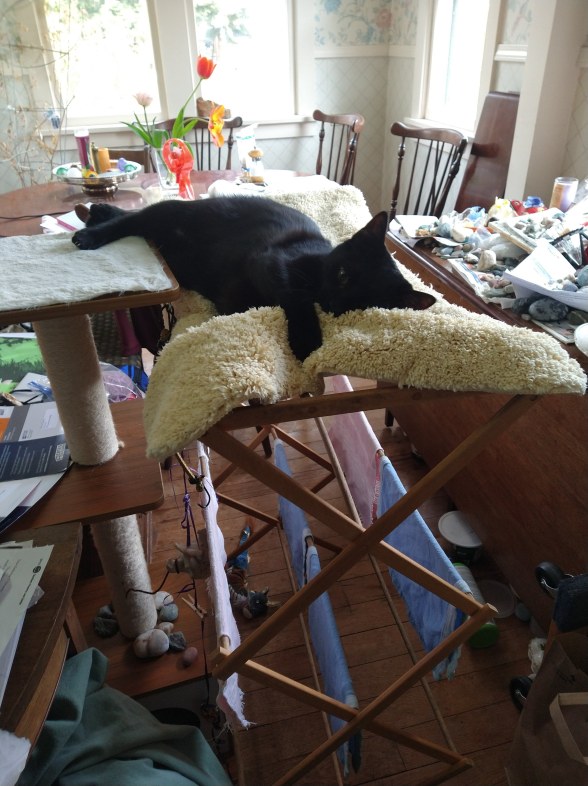
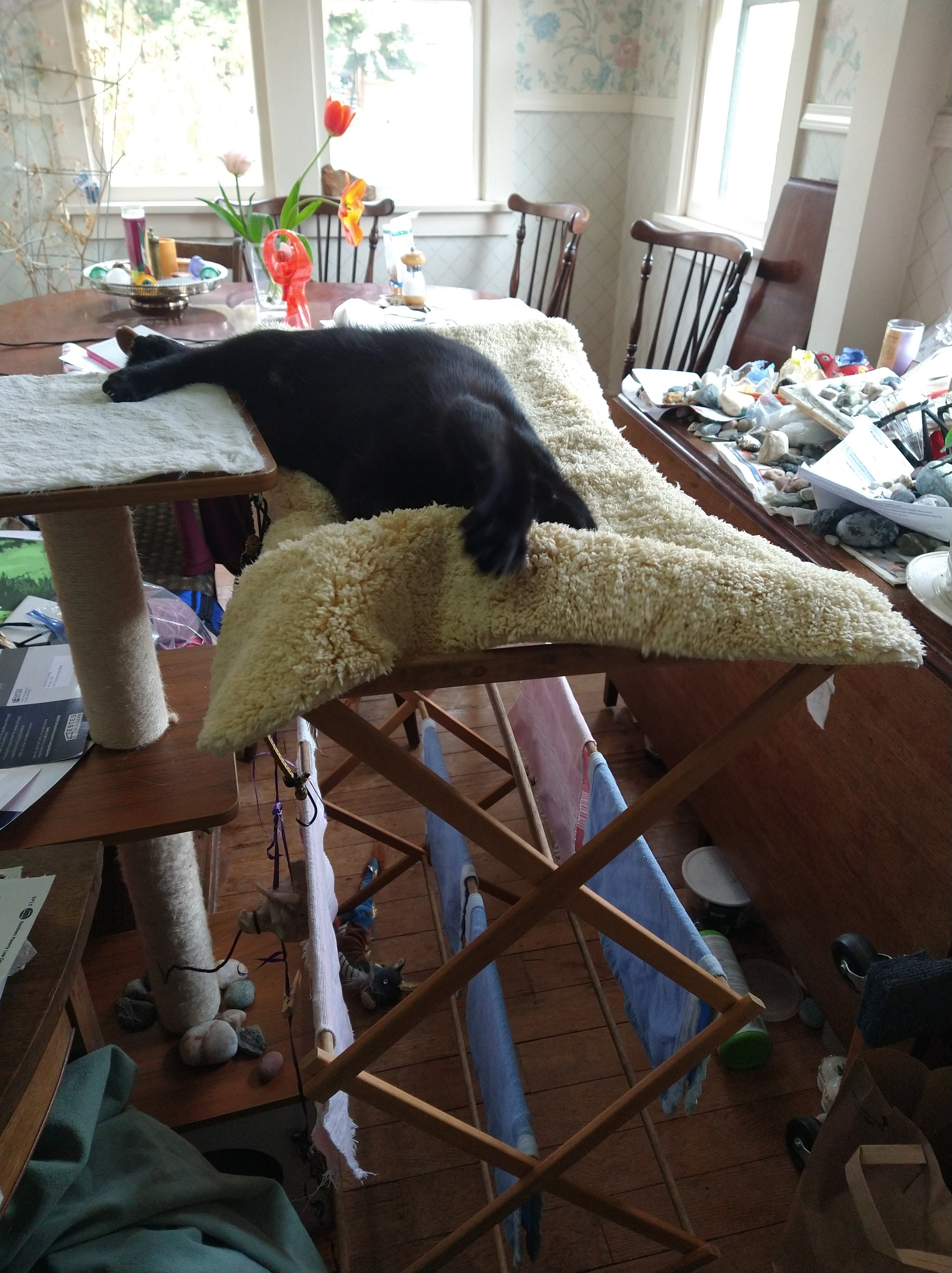
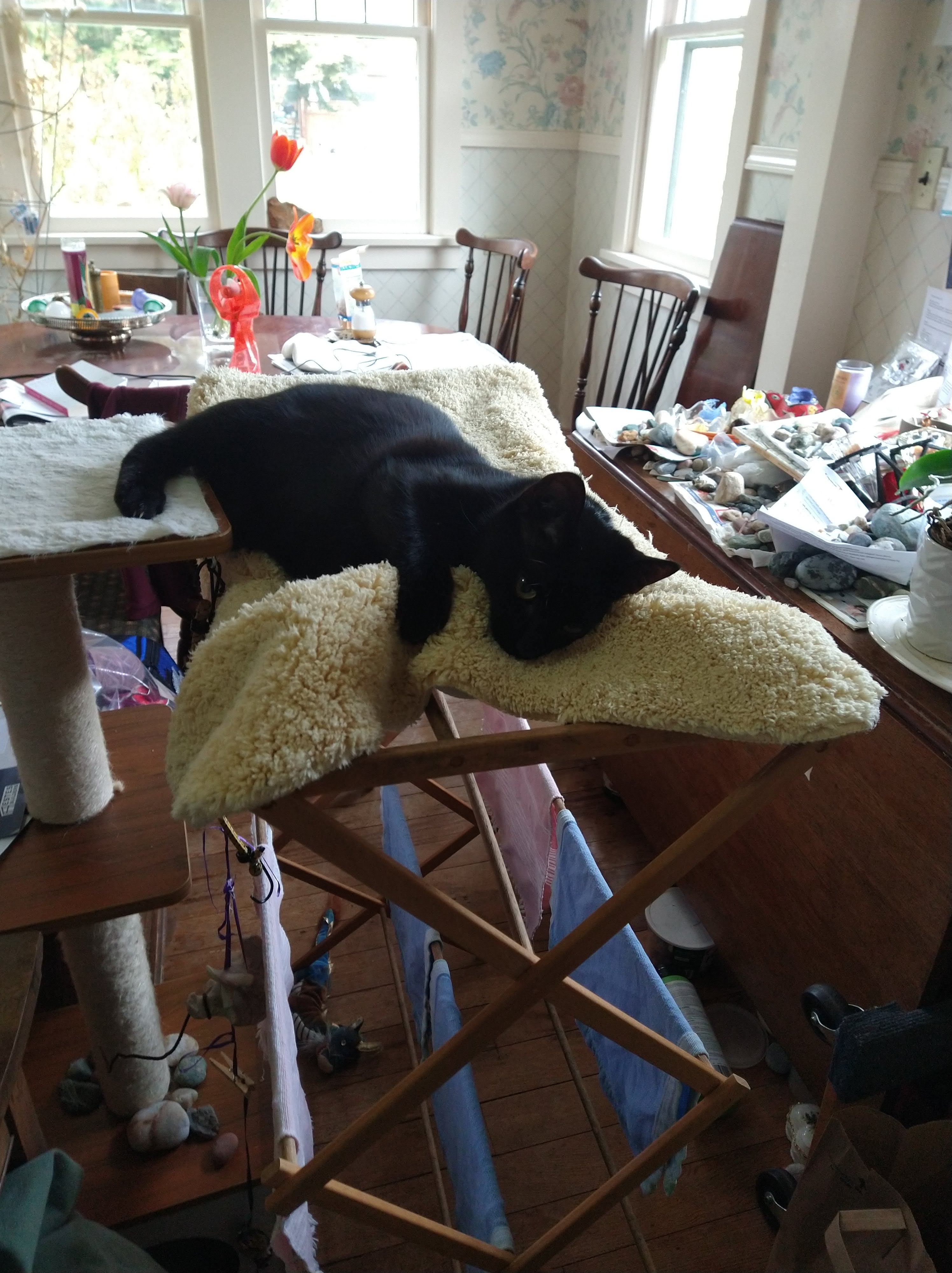
Ok, so the reason the bath mat is on the rack is because it is WET. And what does Sol Duc do? Climb right one and lie on it. Me: “The bath mat is wet AND the rack can fall down.”

Sol Duc: “I am totally loving wet bath mat plus it needs fur.”

Me: “All we need is for Elwha to join in.”

Siblings can be SOOOO annoying.

OOOOOoooo this fits the Ragtag Daily Prompt for Monday: PITCH. As in Sol Duc’s fur, pitch black.

N is for Normal.

I am blogging A to Z about artists, particularly women artists and mostly about my mother, Helen Burling Ottaway.

My family was not Normal. No, no, not normal. I don’t think anyone is normal, really. In clinic one year I think, wow, all of my people are SO interesting. Why am I so lucky to have all of these wonderful people? And then I think: OH. Everyone is interesting. No one is “normal”. They may try really hard to pass for normal. I certainly had MY work cut out. And why is that, you say. I am so glad you asked that question!

My parents were both obsessed. My mother was obsessed with art. With music, a secondary joy. My father was all about music. Mathematics and language was his secondary joy. By age nine I discover poetry and that is it for me. That is the be all end all. I am so obsessed that I am amazed at age 40 when I make a discovery: poetry is not it for everyone.

I am fired by the hospital for fighting a clinic quota of patients. I might have kept the job if I had shut my mouth and been diplomatic, but I was not diplomatic. I write a protest song and sing it at the open mike and sing it into the CFO’s voicemail. I think I could be the poster girl for the opposite of diplomatic, right?I thought about quitting and then thought, no, I stay and fight this for my patients. I am fired the next day.

A group of people try to intervene and get me rehired. At some point I suggest sending one of my poems to the hospital commissioners. Six people email: NO!

I am confused: What do you mean, no? Why not?

YOU DO NOT COMMUNICATE WITH HOSPITAL COMMISSIONERS VIA POETRY.

I am still confused: I communicate by poetry. Poetry is the highest form of communication.

HOSPITAL COMMISSIONS DO NOT LIKE OR UNDERSTAND POETRY.

Ok, THAT is mind blowing for me. I call my father. What is this about?

My father says People are afraid of poetry.

I say You are kidding me.

My father says Poetry is magic. People are afraid of magic.

I say I’m not afraid of poetry.

That is because you are a poet, says my father.

And I really look at my thoughts on writing and poetry. I realize that writing and poetry are SO IMPORTANT to me that I assume that EVERYONE WANTS TO WRITE AND BE A POET. I ask my group of people trying to get me reinstated. None of them want to be poets. I ask my father. He does not want to be a poet. I am completely floored. I realize that I thought my mother loves art but wants to be a poet. My father loves music but wants to be a poet. Wrong. Wrong, wrong, wrong.

It must have been rather weird for my sister Chris, three years younger. She has three people who are all obsessed with their form of art. My sister Chris was a brilliant writer, an excellent musician and an artist. But I don’t think she was obsessed with any of them the way the rest of the family was. That must have been a little lonely.

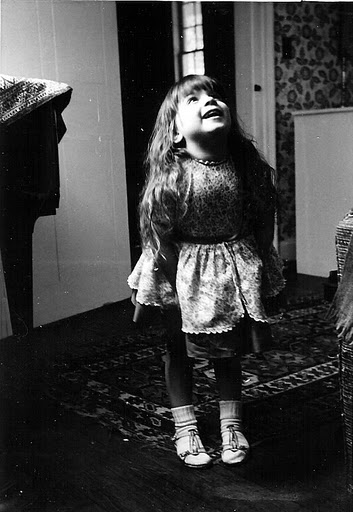
The photograph is me and my sister in 1965. I am four and she is one year.

I say to a counselor once that in spite of alcohol problems in the family, the music was amazing and my sister and I learned it. The counselor replies, “Children connect with adults where they can.” I think OH. That is amazing. My sister and I see my father praise my mother for knowing all the words to the songs. She is always be the last one singing because she knows verse 8, 9 and 10. My sister and I assume that this is a woman’s job: memorize the words. We did. We photocopy the back of Beatles albums and on long car trips we memorize ALL THE WORDS. I think I can still sing Yellow Submarine start to finish.

I start school. I know there will be singing. No one knows my songs. The songs they know are the songs to television shows and we do not have one. I quickly go silent. I play flute and I sing all the songs in my head when I am bored, but I do not sing out loud. And I choose medicine because I want to understand people, for the writing. I still think people are very very weird. But I have written the whole time, every single day. And that is how my mother did art and how my father did music. Every single day.

ATOZBLOGGINGCHALLENGE2022 #art #Women artists #Helen Burling Ottaway #ATOZCHALLENGE #APRILATOZ

For more information about the #AtoZChallenge, check out this link

M for Maline and mothers

I am blogging A to Z about artists, particularly women artists and mostly about my mother, Helen Burling Ottaway.

Maline Robinson is a mentor to me and one of many mothers. As a baby, my mother has tuberculosis, so I am passed around and get a bit confused about the intentions of adults. Maline went to school at the University of Tennessee with my parents and knew me from birth. I went to college at the University of Wisconsin, Madison and got to know her there. I had very little money and we went second hand store shopping together. As well as her wonderful oil paintings and silk screens, she refurbished antiques and had small stalls to sell these treasures. She makes earrings, often from antique buttons, as well.

She also is a brilliant gardener. These photographs are from her house in Michigan. She lives near one of her sons and his family. My mother is gone, in 2000, so I get to visit and have her as another mother and wise woman in my life.

ATOZBLOGGINGCHALLENGE2022 #art #Women artists #Helen Burling Ottaway #ATOZCHALLENGE #APRILATOZ

For more information about the #AtoZChallenge, check out this link.

K-k-k-Katy

I am blogging A to Z about artists, particularly women artists and mostly about my mother, Helen Burling Ottaway.

This is a multigenerational post. I am Katy, Katherine after my maternal grandmother. The drawing is of that grandmother, done by my mother H. Ottaway in 1978. My mother mailed me the sketch diary for Christmas. My grandmother was Katy B, for Katherine Burling, and I was Katy O, for Katherine Ottaway. I have inherited a spoon that has Gertrude, Margaret and Kathryn engraved on the bowl. A different spelling, so I don’t know which Kathryn that was.

So K is for Katy. My father used to sing K-k-k-Katy to me when I was very little. It is from 1917!

ATOZBLOGGINGCHALLENGE2022 #art #Women artists #Helen Burling Ottaway #ATOZCHALLENGE

For more information about the #AtoZChallenge, check out this link.