OOOOOO, ornery. What a lovely word! It can be purely negative or it can be positive and joking, or it can just mean stubborn.
This is one of Helen Burling Ottaway’s self portraits. My photograph, through glass. This is 20 by 26 inches, pastel chalk, dated 1979.
I had this up in the guest room, but a guest said he felt nervous with her watching. I laughed and said, “Ok, yeah, I can see that.” I moved it. My mother always looked fierce when she was concentrating. She captures that expression very well. People often thought she was angry when she was teaching, but it’s just concentration. I could tell the difference but the students could not.
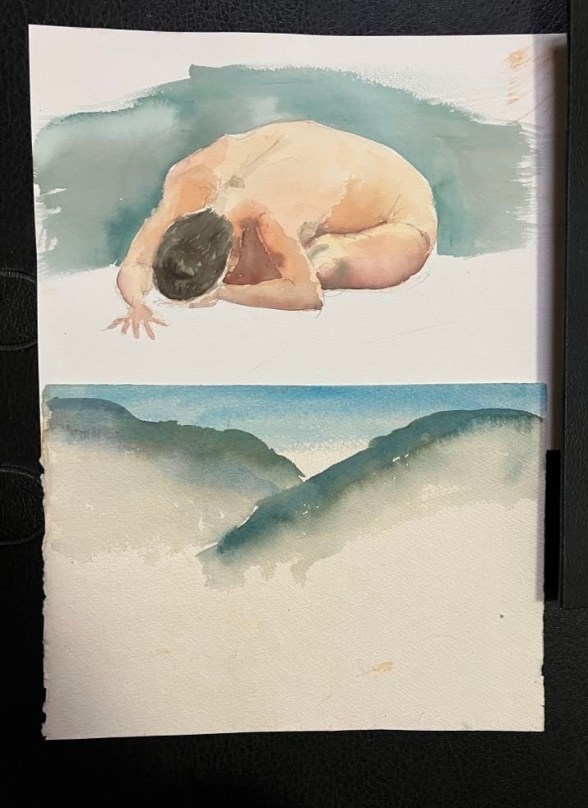
Let’s talk about knowledge and technique in art. Above are two watercolors by my mother, Helen Burling Ottaway. Neither has a date. The lower one is certainly unfinished and I am not sure about the upper one. I can tell by the technique that the lower one is a much earlier painting. Some of the watercolor nudes do have a year: 1998. That was two years before she died of cancer. I think the lower one is from the 1970s, but the use of wet and dry paper for painting is already apparent, as well as color and line.
Another watercolor, 14 by 27, 1987. There is another older watercolor, no year, on the reverse. Misty mountains. This could be West Virginia, the panhandle where my grandmother lived for a while, or a trip to the northwest.
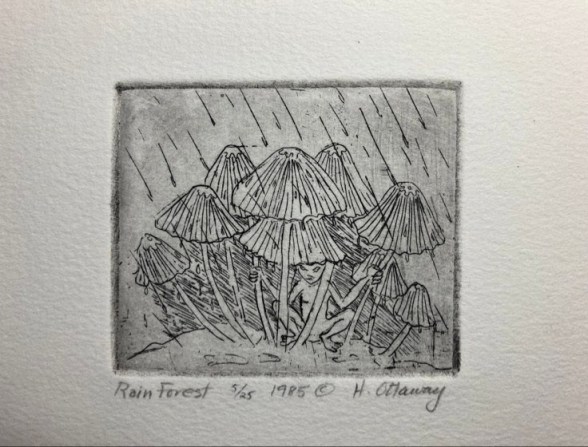
I am feeling a bit like this elf: irritated about the rain.
Ok, yeah, I did move to the Pacific Northwest 23 years ago, and I could have moved away. I love the beaches and the mountains here. But when we are having sun once every 10 days or two weeks in the season they call “spring” here, I do get a little irritated at the rain. Yesterday and today the wind is howling too. Whitecaps and I am very happy not to be out in a boat.
This etching is 2.5 by 3 inches, titled Rain Forest, number 5 out of 25, 1985.
Gruff, grouchy, grumpy and garden! The watercolor is a small one by Helen Burling Ottaway, my mother. She did not date any of the watercolor sketches in it. I think it is from the 1970s. I very much remember the pot that the tree is in. That is an avocado that she grew from a pit.
Is being grumpy evil? I don’t think so. I don’t think we should inflict our grumpiness on others, but we may have very good reasons to be grumpy. When I was having difficult things at home, I would give a heads up to my nurse that I was grumpy but not at her or the patients. That helped a lot, because I did not have a perfect wall about my emotions. I also hate when people are pretending to be nice when they are angry or hurting or frustrated or grumpy.
Sometimes people say, “I don’t like to be around people who aren’t positive.” Well, now, wait. Do they have to be positive if a family member dies? If they lose their job? If they are very worried about making ends meet when a car has broken down? That would be a fair weather friend, who is only present in the good times, and abandons me when I am stressed. That person is not really a friend at all. The true friends are the ones who notice I am grumpy but stay present anyway. And they ask if it is about them. They do not try to fix it or ignore it: it’s my mood, not theirs. Hooray for real friends who are present through thick and thin!
F is also for Final. Death is frustratingly final. I can keep talking to the person, but they don’t talk back, except maybe in dreams. Even then, it’s my version of them.
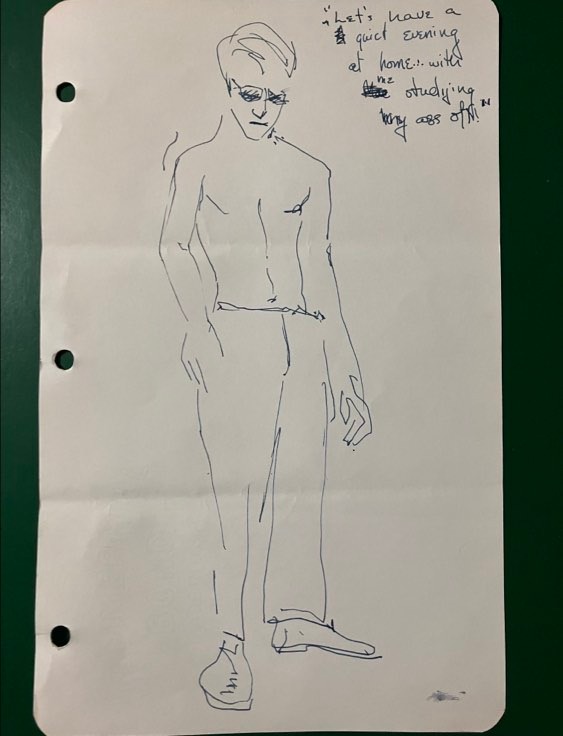
F is also for fine art and father. This is a drawing of my father in college by my mother. My mother did art all the time and carried a sketchbook around nearly all the time. Every so often she mislaid it, searched, and started a new one until the old one surfaced. I was two when she did these drawings. My impression of fine art was that it involved continuous practice. My mother thought about art most of the time, as her diaries confirm. I love the sketch books.
These two drawings are on notebook paper. My mother sent them to her mother with letters when I was two. My grandmother was in Europe.
I am a Creaky Cranky Crone with Crepitus this morning. I volunteered at the Swinging on the Sound dance weekend. I was not going to dance, because of my right shoulder. But, well, my feet were fine, so I did the basic. Then in the last class, there were more “follows” than “leads”. I thought, well, my left arm works. I jumped in, explaining that I couldn’t use the right arm. Switching from “follow” to “lead”, I have to reverse the foot work. The instructor did not know about my arm and scolded the class for some people not dancing in the closed position. That was me. Oh, well.
So I am not VERY cranky. I am really delighted that I got to dance and practiced the basic step for collegiate shag.
The woman in the picture is not a Creaky Cranky Crone. It is my grandmother Katherine White Burling, drawn from a photograph by my mother Helen Burling Ottaway. This is an 18 by 24 drawn with I think conte crayon. Apologies for the reflection, I am photographing through glass.
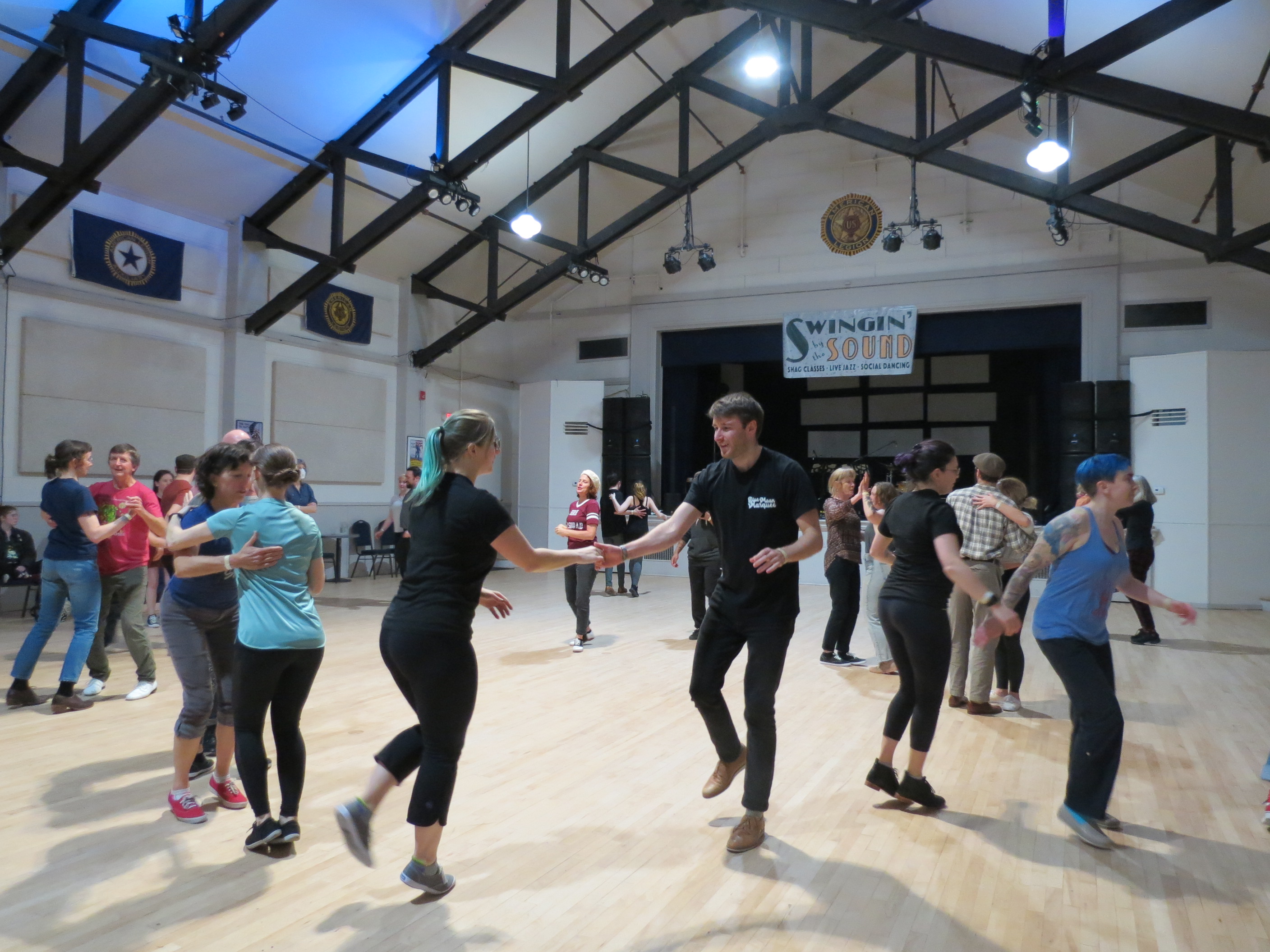
And here is a photograph from one of the collegiate shag classes, on Saturday. People of all genders danced both lead and follow. One person did the contest as an amateur follower and an advanced lead. Good for them!
I have been thinking in a desultory manner or perhaps not really thinking about the A to Z April Challenge. I want to have a whole month of my mother’s fabulous art, but what is my theme? Mothers? No. Women artists? No. Discrimination against women artists? Sigh, no. Oh! I read an article yesterday about how the negative and nasty headlines get the major clicks. Today I read another very nice kind blog post about putting something nice into the world. So that gives me my theme! My mother’s art and daily evil impulses.
Impulses, not actions. Don’t we all feel those nasty impulses? Now I am interested in my own theme: how does that tie into my mother’s art? You don’t know? I don’t know either, but I know that many of us have complex feelings about our mothers. You might too. What does her art reveal or what does it trigger in me? And you get to enjoy her art, while you react with prim or gleeful horror at the Daily Evil Art Impulse.
Happy April!
______________
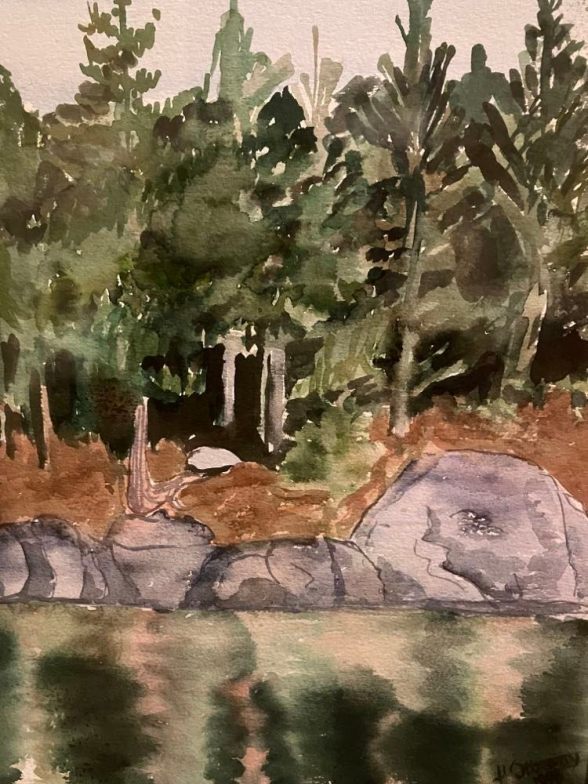
The first photograph is of one of Helen Burling Ottaway’s watercolors. It is signed, matted and shrink wrapped. Date: 1996. She died of cancer in 2000. I do not know the title, but this is Lake Matinenda, in Ontario, Canada. My maternal family has land there and I have gone there since age 5 months.
I am blogging A to Z about artists, particularly women artists and mostly about my mother, Helen Burling Ottaway.
My mother loved water colors, but she also did etchings, for as long as I can remember. We had the largest etching press that she could get back in the 1960s. When I was 14, we moved from Johnson City, New York, to Alexandria Virginia for my father’s job. The press went into the basement, along with numerous boxes of books. Soon after we moved, there was torrential rainfall and the sewers in the Del Ray neighborhood backed up. The water stopped draining and just piled up! There was a crack in the foundation of our basement with a waterfall pouring down. My mother wanted the engine of the press saved first! She and my father and I could barely carry it up the stairs, but managed to. Next came boxes of books, some of which were so waterlogged that they were floating. The water was cold, dirty and up to my upper thighs. We unloaded box after box of wet books and spread them out to dry.
I think that my mother’s art was not in the basement, so we did not lose much of that! We installed an automatic sump pump eventually, because that was not the last flood. That was the most spectaular, though. The water was 8-12 inches deep in the front yard. Buses would still drive through the water, sending a wave to hit our front steps.
Afterwards we wished we had taken a photograph in the canoe in the front yard, to use for Christmas. Our Christmas ornaments were flooded too. All the color peels off the balls, so our tree was silver and glass that Christmas. My mother claimed she liked that better and kept it that way from then on!
Etchings are diddly, as my mother would say. A zinc plate, coated with a tar mixture. Then a drawing in the tar, set the plate in acid, and wait for the drawing to etch into the plate. At a certain point, my mother would take the tar off and run some proofs. These were experimental, trying different colors. She would put the tar back on and continue with the drawing. When she was satisfied with the proof, she would start running the edition. The tar is removed, and for each etching the plate is inked with a roller. The ink is gently wiped off, until it is light on the remaining flat parts of the plate and heavier in the lines. The plate is placed on the press, a piece of paper that is soaked is placed on the plate, heavy felt cloth is lowered over it and the plate and paper are run through the press. We had a guard, but keep your fingers away! The felt is lifted, the paper is lifted and the paper is set to dry. The plate is wiped and inked again. The edition is numbered: 1/20 or 1/50. My mother ran some plates many many times. A tiny one named Tag, of a unicorn playing tag with butterflies, is done in multiple colors. Others were a much smaller edition, of 20 or 30. The very large plates are a challenge to ink and wipe. It takes practice to wipe the ink but not wipe it out of the lines.
I have three photographs of H. Ottaway’s Iris and Poppies etching. The featured image is 17/30, colored edition, 1976. The one below is a proof for the color edition. The last one is a proof for her black and white edition.
Iris and Poppies Etching, by Helen Burling Ottaway, proof for color edition.Iris and Poppies Etching, black and white proof, Helen Burling Ottaway, 1976.
#ATOZBLOGGINGCHALLENGE2022 # art # Women artists # Helen Burling Ottaway #ATOZCHALLENGE
This month my topic for Blogging from A-Z is art and particularly my mother, the artist Helen Burling Ottaway, born May 31, 1938. She died May 15, 2000, of ovarian cancer. I am starting with her sketches, and the self portrait. My mother sent me a sketchbook for Christmas, 1978, that I still have. I was 17 and was an exchange student to Denmark. She drew pictures of lots of family and friends and mailed me the sketchbook. I really love it still.
I love her comments, too. They are often very funny. Here is my father and what was happening.
Sketch of Malcolm Kenyon Ottaway by Helen Burling Ottaway
Discover and re-discover Mexico’s cuisine, culture and history through the recipes, backyard stories and other interesting findings of an expatriate in Canada
Engaging in some lyrical athletics whilst painting pictures with words and pounding the pavement. I run; blog; write poetry; chase after my kids & drink coffee.
Refugees welcome - Flüchtlinge willkommen I am teaching German to refugees. Ich unterrichte geflüchtete Menschen in der deutschen Sprache. I am writing this blog in English and German because my friends speak English and German. Ich schreibe auf Deutsch und Englisch, weil meine Freunde Deutsch und Englisch sprechen.













 KO Rural Mad As Hell Blog
You must be logged in to post a comment.