Mitochondrial envy

Just think if Dr. Freud were alive today.

He’d be studying mitochondrial envy.

After all, the sperm have no mitochondria. Only the egg has mitochondria, so the mitochondria are matrilineal, from the mother only. And it is from mother to daughter to daughter that they are handed down.

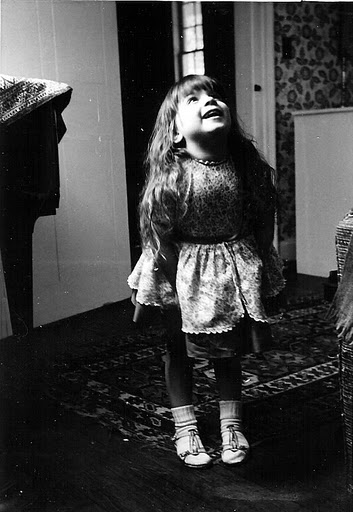
I have a photograph of my mother’s mother’s mother. Mary Robbins White. She is looking straight at the camera, no smile, serious. Her thoughts are contained, her eyes give nothing away. I have photographs of my mother’s mother, my mother, me and my daughter, all with the same expression. On guard.

The mitochondria are the powerhouses of the cells as well. They may have been a separate cell that moved in and made a deal with a larger cell: you take care of me and I will power you. An exchange. A bargain. A treaty. Sounds like a sensible female move to me.

My son has my mitochondria. His children, if he has them, will have his wife’s mitochondria. I think he has chosen well. I like her very much. I hope to see grandchildren.

Perhaps mitochondria are the magic that early hominoids worship when they make the earth figurine, the stone figure with generous breasts and belly and hips. The nurturer, the fecund mother, the destroying hungry mother who swallows her children and will not let them go.

I am reading Joseph Campbell, Myths to Live By, 1972. I wonder what he would say about the matrilineal mitochondria, the second set of genetic material in each cell, the part that comes from the mother only. I think he would be fascinated and he would be writing another book.

Spring, summer, fall

I visit my friend Amy in Portland. We are friends from medical school at the Medical College of Virginia, now VCU, Richmond, Virginia.

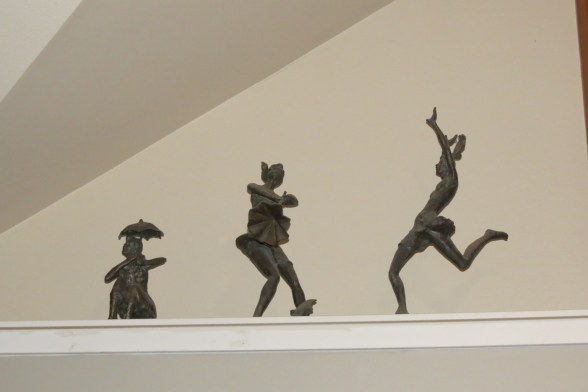
Her mother is Nancy Clough and lives nearby. Amy’s house is surrounded by bronze sculptures, because Nancy Clough works in bronze and pottery.

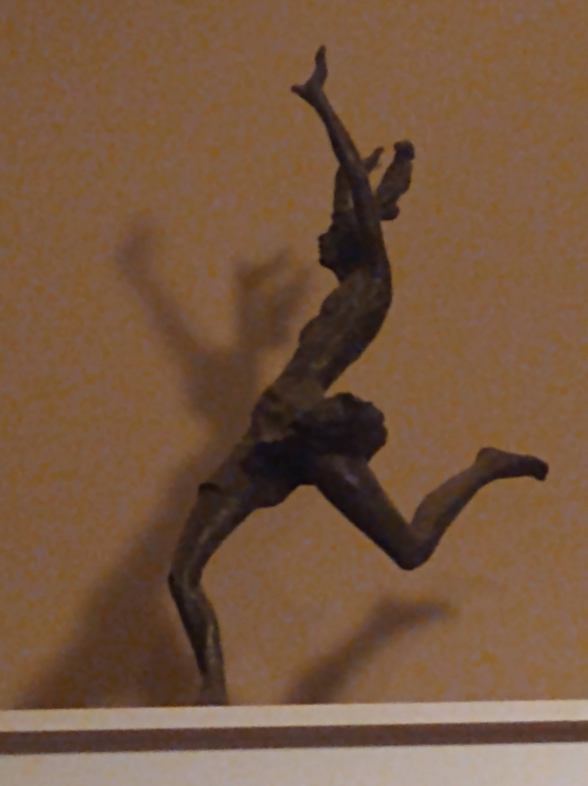
This series is in Nancy’s house. She says that she sold winter and needs to pour another. More than one set is out there.

I love the joy in these sculptures.

Years ago I bought a vase from Nancy Clough, when I was visiting Amy on the west coast. I still have that vase and now a new one, from this trip. I bought the smallest vase back years ago, because it was all that I could afford. My mother was an artist, so I know how much it means to artists to have people buy their work. And anyhow, I love the flowers on the vase.

I tried googling her and find her on LinkedIn. She can be reached regarding her sculptures, just message me. I want to photograph more of the sculptures in the yard, so I will have to plan another trip. Heads up, Amy, I am coming back.

Dinosaur dreams

Dinosaur Dreams

The problem
With Intelligent Design
Is those old bones
Those dinosaurs

Also that of 10,000 dreams of creation
One would be right
And the followers of all the others
Consigned to hell
If so, I go gladly, clutching
Dinosaur bones to my chest
And will enjoy the diversity
Not the narrow heaven with a narrow
Small-minded deity

But is evolution right?

Well, I think it’s on the right track

But wholly done and all correct?

After all, think how often
Medicine has been wrong
Think of tobacco and vioxx
Think of Galen, over 2000 years ago
Thinking that evil humors built up in the uterus
Causing hysteria
External pelvic massage was the cure
For over 2000 years
For old maids, widows and nuns
Who had no male to cleave unto
Massage was a treatment into the early 1900s
And now we wonder about prozac too

Evolution is an evolving science

I think of when my son was four
And he watched “Jurassic Park”
Against my wishes
Because I thought it was too violent
He studied it carefully many times

One day he asked me, anxiously,
“Mom, is DNA real?”
To check that it wasn’t another of those Santa stories
I was able to reassure him
Yes, I think DNA is real
He was pleased

A few days later he announced
That when he grows up
He wants to be a plant and animal scientist
Extract DNA from amber
And grow those dinosaurs

A laudable ambition
For any four year old

If God left the dinosaur bones
Around to fool us
And they never lived
She has a nasty sense of humor
And my son and I will not forgive

I believe in evolution
And dream of dinosaurs

written in 2009

Adverse Childhood Experiences 13: unsense

As a child in an alcoholic/addict household where you can not trust adults, who do you trust?

You either trust yourself or you buy in the alcohol story.

If you buy in, you have a high probability of either becoming an addict or marrying one, depending if you prefer the enabler or the enablee role.

If you trust yourself, you develop certain senses. You pay attention to people’s emotions. You pay attention to what people FEEL, what people DO and not what people SAY. You do not care what they say: what matters is what they do. My sister said she used to walk my parent’s house during high school and try to feel the mood. Did she need to hide?

The enabler role is trying to control the other person. There are amazing variations on this. I cared for a person whose sister would not take care of herself. Every time the sister is hospitalized, the person goes and cleans tons of garbage and rotted food from the apartment.

“Stop doing that,” I say, “You are enabling her. Call Adult Protective Services to go look at it instead.”

It can be very difficult to stop and can take years. People can change.

I have noticed that the enabler role is lethal. The enablers seem to die before the enablee. Certainly in my immediate family and with many patients too.

Enablee is the person controlled. Alcohol, drugs, gambling, anger, emotions. It is very very interesting to watch. I have read parts of my mother’s diaries. She was the enabler, with my father as the enablee. However, the diaries document them fighting in the middle of the night when he is drunk. And I remember high school, putting the pillow over my ears, because they were screaming at each other.

But wait. Why would she argue with her drunk husband? Why would anyone argue with a drunk person? You have to wait until they are sober.

And slowly I realize that my mother too was an alcoholic. I remember her drinking. Best cover for an alcoholic is a worse alcoholic, right? It’s fairly horrid. But it explains some stories and my food insecurity. They would not get up in the morning to feed me. My mother told stories of me trying to feed myself: cheerios and laundry soap. If my father was hung over, ok, but, why wouldn’t my mother get up? I think they were both hung over. That or else she really did not want a child. Especially a nine month old with opinions while she was trying to get over tuberculosis. She never got to hold me after birth until 9 months. And then I did not want her. I wanted her mother.

Trusting yourself, life can be a bit complicated. You sense the emotions others are hiding. Being a physician allows me to ask about the hidden things, very gently. Sometimes they come out right away. Sometimes it takes months. Sometimes years and sometimes never. My sister and I discussed going to parties and thinking, oh, that person is the child of an addict/alcoholic. This person is in pain. This person is quite happy but hiding stuff.

I told a counselor I do not know how to turn it off. She replies, “Why do you think I am a counselor?”

I don’t see auras. I feel things: like a cloud. Like a tiger, like a bear, like a whale, singing.

I think I will go with the whale.
Hurricane Ridge

This is my mother’s biggest watercolor painting. I have it hanging in my guest room. It is huge and gorgeous, nearly the width of the double bed.

I miss her. Helen Burling Ottaway. I will put more of her artwork up. She died in 2000, but I still have the art.

saved

when your parents die
you will find what they saved

you will find things in the house
that you do not know why they saved

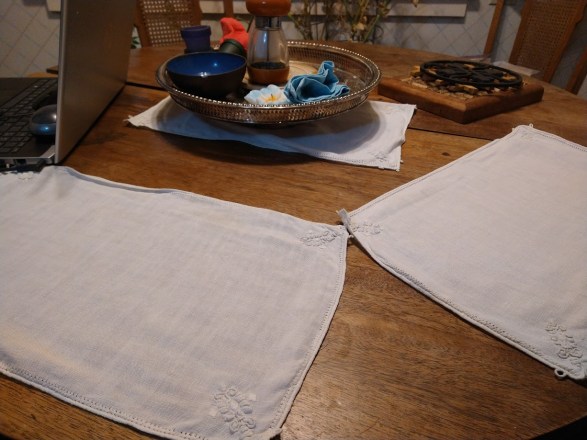
you may find linens carefully folded
and papers from the past

the linens embroidered by ancestors
but you cannot ask which ones

photographs of people you don’t know
and which are not labeled

a reference to a ring that your great aunt had
but she has been dead since 1986

when you go to your parents’ house
ask them what they have saved

ask them why it has been saved

ask them now
because when they are gone
it is too late

to ask about what they saved

________________________

There are also families estranged, where they have cut ties or emigrated or escaped abuse, and have reason not to save anything or speak about it.

We want freedom but we want love too. For the Ragtag Daily Prompt: freedom.

Four seasons

These are etchings by my mother, Helen Burling Ottaway, who died in 2000.

All four are done with the same etching plate.

Winter is done first. The zinc plate is covered with a protective layer and then she draws with tools, including dental tools. The plate is placed in an acid bath. The acid etches where the drawings are, different depths. The protective layer is removed. The plate is inked. Most of the ink is gently wiped off and the plate is placed on the press. Wet paper is laid on the plate and the heavy wool covers are folded down over that. The press is run. The wool is folded back on the other side and the paper is lifted and laid to dry.

The plate is re inked for each one.

She puts the protective cover back on the plate and adds the buds for spring. These are etched. Winter is now gone, the plate has changed. She prints all of the spring series.

Next is summer. Leaves are added. She prints those.

Last is autumn. Now there are leaves on the ground as well. She does some the plates with more than one ink color. This was one of her largest etchings. She did a small series first, where the etchings were about 4 by 6 inches. This was 18 by 24. She had a really big etching press. I don’t know who has it, my sister took it to California and it disappeared.

I have the etchings and I have all the plates. I can’t run this series, I could only run autumn. I grew up surrounded by my mother doing art, etchings, watercolors, oils, lithography, a constant sketchbook and crafts. I took a painting class a few years ago. The instructor says, “Acrylics are NOT watercolors.” I reply, “I know how to DO watercolors.” I was being quite creative with the acrylics only I automatically used the watercolor techniques that I grew up with.

The photograph doesn’t really do them justice. I will have to take some more. Plus I have her slides in some of the boxes left from when my father died. More cataloging.

Blessings and good memories of my mother.

If

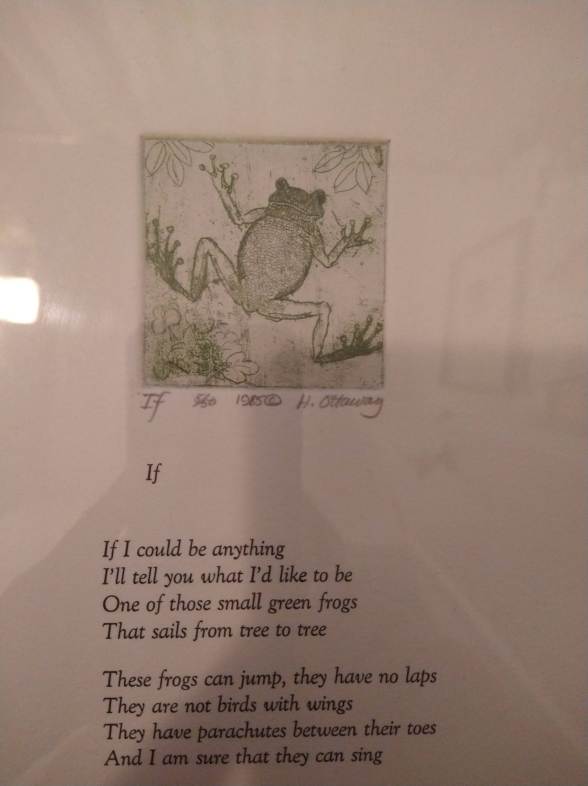
This is one of the ten poems that my mother made etchings for, the year I was just done with college. 1983-4. I wanted to write, but had no idea what to do with the poems that I was writing. My mother Helen Burling Ottaway had done a series of etchings with a family friend’s poems, so I asked if she would do the same with me. She said, “Yes, on one condition.” “What is that?” “They have to rhyme.” She did not like the free verse. Almost all of the poems were about animals, except for one about my sister. Another friend printed the poems on a lead type press and then my mother worked on editions numbered 1-50 of each, inking the plate separately for each one. This one is number 5/50. You can see the imprint of the plate on the paper in the photograph.

If I could be anything
I’ll tell you what I’d like to be
One of those small green frogs
That sails from tree to tree

These frogs can jump, they have no laps
They are not birds with wings
the have parachutes between their toes
And I am sure that they can sing

They spread their toes and jump so high
To float like snowflakes in the air
Frogs fall like rain from clear blue skies
It must be nice up there

Why they jump I do not know
Maybe escaping hungry eyes
Perhaps to catch a tender bug
Or they just like to fly

If I could be anything
I’ll tell you what I’d like to be
One of those small green frogs
That sails from tree to tree.

Loss

It seems to be one of my irritable days
They come rolling round in the month of May
I don’t feel friendly and don’t want to play
It seems to be one of my irritable days

It seems to be one of those days when I’m mad
At nothing particular. I feel really bad
I hate those damn tourists who always wear plaid
I really intensely dislike feeling sad

I haven’t felt quite this bad since last year
But I’m not one to cry. I don’t like weak tears
I’m not one to let myself feel any fears
I haven’t felt this bad for almost a year

It seems to be one of those days when I’m mad
I think I’ll go pick a nice fight with that lad
He looks too damn happy and just too damn glad
When I’m punching his lights out I won’t feel so sad

It seems to be one of my irritable days
Going to work on them just doesn’t pay
My boss’s revenge just goes on for days
Today it’s so bad that I can’t even pray

Helen Burling Ottaway, my mother, died May 15, 2000. I wrote this poem in the early 2000s. Her birthday was May 31, right near Memorial Day. Mother’s Day always falls near her death.

I am putting up a series of poems that I titled Falling angels, after a dream, where all the stars in the sky started falling. I was frightened and then realized that they were all angels. Then I was more frightened.

I think we need poetry and dreams and angels during this difficult time. Even if the angels are all falling.

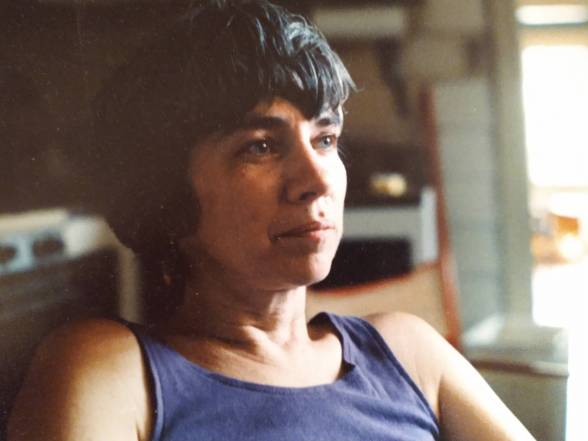
I took the photograph of my mother. A friend loaned me his 35mm camera and I took one roll of pictures and gave the camera back to him. Almost all of the photographs I took were portraits.