I took this photograph last summer at North Beach. I thought she looks like a stranded mermaid, thrown up on shore. I couldn’t move her, she was twice my length. The rock attachment had come too, up from our sea beds.
Happy solstice. Today marks the one year day from when I realized that I was having my fourth round of pneumonia, with hypoxia, agitation, fast twitch muscle dysfuntion and felt sick as could be. I am way better but not well. That is, I still need oxygen to play flute, to sing, to do heavy exercise and to carry anything heavy. Which is WAY better then having to wear oxygen all the time. Today I find a connection between the lungs and the brain, in quanta magazine. This video talks about a new found connection between cilia and the brain. We were taught that cilia and flagella are for locomotion, powered by tubulin. However, this shows that cilia behave like neurons and there is a connection. Since my peculiar illness seems to involve cilia dysfunction in my muscles and lungs, so that I get pneumonia, and the brain, because I am wired when it hits, this is a fascinating connection. If neurons developed from cilia, the dual illness makes a lot more sense. Hooray for quantum mechanics! We use it in medicine every single day.
Trigger warning: this is about dementia. I wrote this over ten years ago.
wearing sunglasses in the rain
I am weeping for you both
you have cared for her for better or worse, for richer or poorer, in sickness and health
and she has lost her memory
you told me on the phone that it’s not that bad
you say it again in the room
I knew before I saw her that it was bad, very bad, much worse she is only 60
she becomes agitated when we try to weigh her old style doctor’s scale frightens her to try to step up. gentle caregiver that you have hired pushes her, until I say stop, stop, stop her weight does not matter
shuffling gait she is frightened to be in a new place I ask her questions gently she does not want to sit in the chair in the exam room “No!” she says “No!” I leave the room until she’s calmer
when I return I give her choices “Shall I examine you first with my stethoscope or shall I talk to your husband?” I choose for her, the latter she relaxes, a little later, I tell her each step before I do it she is slightly tense when I lay the stethoscope on her thin shoulders, but she doesn’t fight
she tenses as I ask her husband questions about the memory loss ten years now, a steady course I ask him what he understands about the prognosis he shifts uncomfortably and I ask her if she would like to wait in the waiting room while I talk to him Firm and clear: “Yes, I would.”
She is not in the room now he says that she is not too bad the picture comes slowly in to focus mild memory loss, is what he thinks
there are three stages of memory loss, I say mild, the short fibers, where short term memory is affected we forget what someone just said moderate, the medium axons we forget the recipe that we’ve know for 50 years we forget how to do math we forget names and how to get to the store we forget how to operate the car severe, the long axons executive function we do not initiate things we forget to get dressed we forget how to speak we forget our potty training
his eyes grow sadder and sadder
at last, we return to being a baby we forget everything at last, we remember the womb we no longer want to eat
is she forgetting to eat?
he is not ready to answer
as we leave the room he says that she is not sleeping well she seems to be awake at night eyes closed but her fingers are moving, as in play he doesn’t speak to her he needs to sleep and thinks she should too
should he give her a sleeping pill?
maybe she is happy, I say maybe in bed in the dark you are there and it is safe no one is making her get dressed no one is making her bathe maybe that is where she wants to be awake I would not give her a sleeping pill
the dogs are in the room he says and the tv is on just a little maybe she is happy
he is wearing sun glasses as they cajole and help her in to the van
he is wearing sun glasses though it is overcast, low clouds and raining
sometimes it is so hard to say what I see to try to say the truth
sometimes the truth is not gentle but sometimes the truth is love
Walking in the woods or on the beach, fear and worry and anger fall away. No headphones because I want to hear the birds and the waves and the other people. I took this a few days ago.
I wrote this in 2016, when at least nine people died of overdoses in Vancouver, BC at Christmas, from fentanyl. I knew fentanyl was hitting my corner of the Washington State too. Warning, this contains a lot of swearing (edited so this does not become a “mature” site). I was in a very bad mood when I wrote it. It is meant to be black humor, to help me deal with grief.
See, heroin is rather labor intensive to produce, being from the opium poppy and all that. (When people say “I only take natural supplements.” I want to say, “You mean like opium and heroin? You know, plant based.”) Also, Afganistan, those fungkers shoot you as soon as look at you. It turns out that fentanyl is cheaper to make and you can source the ingredients from China.
And then, you can make fake oxycodone tabs and fake hydrocondone pills and sell them for bitcoin on the silk road. But you know, ya gotta mix the sheet right. If you mix it wrong and a buncha people overdose and die, there are complaints. Ya might get some scared clients, like, junkie friends of junkies. And then there are also those chronic pain people who aren’t junkies but been forced onto the streets to treat they habit, I mean, pain. We got a good thing going, the pill thing, because the junkies think that pills is safer than heroin. You might scare the fungkers and then how the fungk will I be able to buy that island with my bitcoin?
So dealers, ya’ll fungkheads, ya messing it up if you don’t get the goddarn mix right. See, fentanyl is not routinely tested for on the blood and urine drug screens. So the person gets labelled as an oxycodone overdose and no one knows that it’s fake pills. But when there are too many deaths, the goddarn feds and doctors get suspicious and start testing the pills.
Same with heroin. Cheapens things to cut it with fentenyl. But you gotta calculate right, because if you kill a whole bunch of clients at once, 1. you cut into profits 2. you make the cops and docs suspicious. You gonna ruin it for everyone, you goddarn morons.
And now I hear we got a new mix. Carfentanil, an elephant tranquilizer. Read the recipes carefully, morons, it’s 10,000 times as strong as morphine, you gotta dilute the sheet 10,000 times. Don’t you know math? Take a goddarn chemistry course.
Don’t fungk things up for the responsible drug dealers. A live client keeps on paying.
Wait, another? We don’t go through the stages of grief once. We go around and around, like a spiral. Some days we want to lie down in the driveway and just not move. Others it seems like the there might be a tiny bit of sun in the world after all. A mourning handout from the American Academy of Family Practice writes about a culture where one is considered “legitimately crazy” for a year after the death of someone loved. The person is allowed to be emotional, complain, wear their bathrobe all day and call people at 3 am.
Maybe we are all in that stage right now.
Stages of Grief Playlist 2
Denial
The Offspring: Pretty Fly for a White Guy
Bargaining
Kate and Anna McGarrigle: Hard Times Come Again No More
My theme for the April AtoZ blog challenge this year is art. I think it will mostly be my mother’s art. She died in 2000 of ovarian cancer. My only sibling died in 2012 of breast cancer and my father in 2013 of emphysema. And I have the art: my parents were both packrats and trying to deal with the house and an out of date will took about three years. Moving stuff around, getting rid of stuff. The art initially went in to a storage unit and then into my house. My mother Helen Burling Ottaway was prolific! And she kept every single piece of art and her diaries back to high school! I found a suitcase with my grandfather’s poetry as well: that will be for another day.
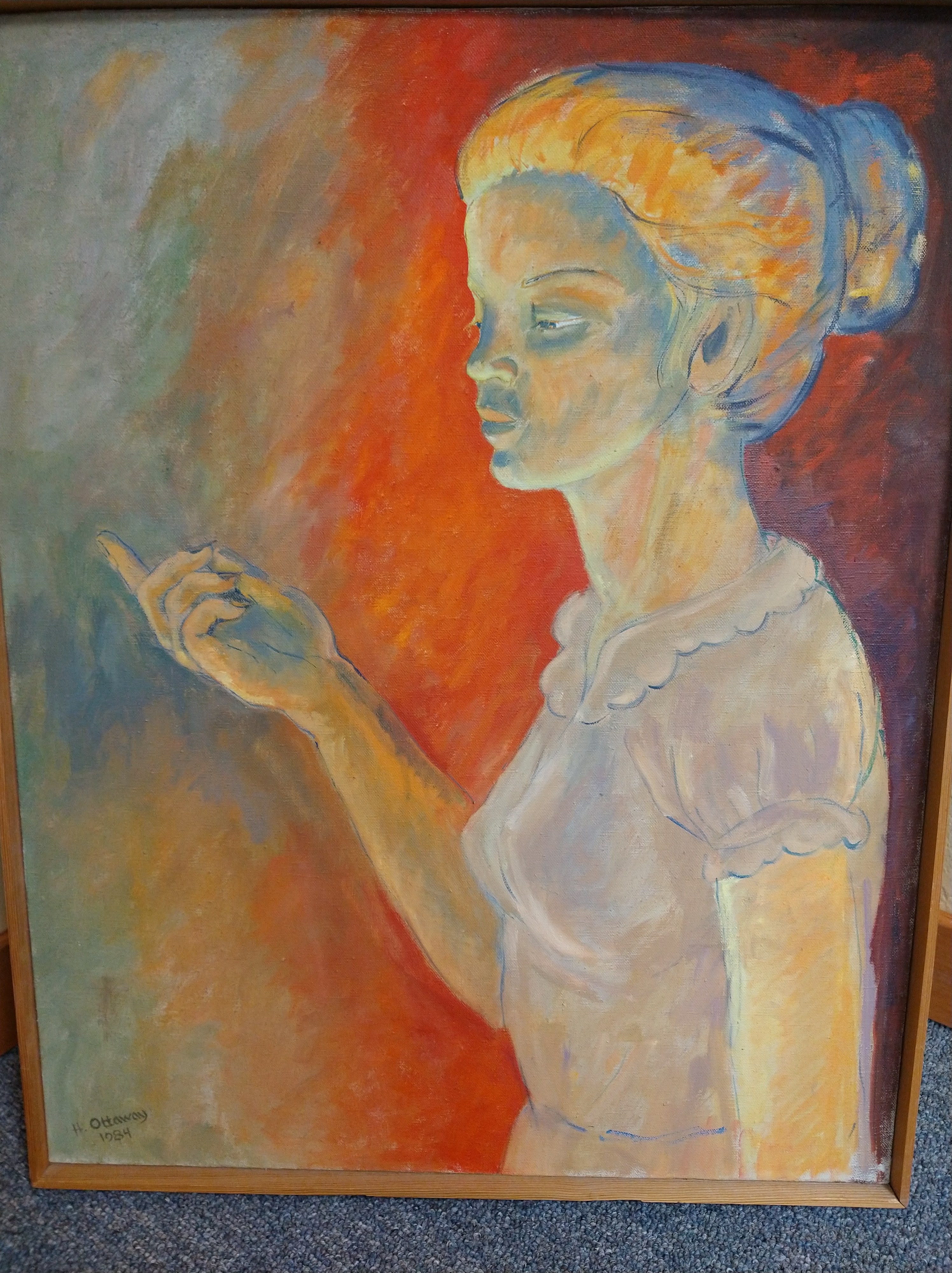
This painting is of my sister. My mother started oils later in her career and Michael Platt, a DC artist, said something like, “Quit doing tiny things. Do something big.” My mother started doing life size and larger than life portraits in chalk pastel and in oils. This painting captures my sister when she was twenty: emotions. I like it but I also think that it is frightening.
Christine Robbins Ottaway age 20, by Helen Burling Ottaway, oil, 1984
I am taking a writing class and our next book is on cultural appropriation.
This interests me. I tend to be a little gender blind and race blind when I meet people. I am using my super skill instead. My skill is developed from a really scary childhood: I read the stuffed emotions. The stuff people are hiding.
No way, you say. Oh, yes, I say.
My sister described coming home from high school and stopping when she walked into the house. She was trying to sense what was going on. Were our parents fighting? Was our father drunk? Yes, he was drunk, but which stage?
We talked about the stages and which we hated most.
Stage goofy/silly was annoying but not toxic. We said we had homework.
Stage asleep in a fetal ball in the upstairs hallway. My sister said she would step over him to get to her room.
Stage maudlin. We both agreed this was the worst. He would cry and say, “You can tell me anything.” Once he caught me in that stage and I was in tears by the time my mother got home. I left the room. The next morning mother said, “He said you two were discussing the cat’s disappearance.” I didn’t answer. We never said a word about the cat. I didn’t know if he was lying or was too drunk to remember it the next day, so made it up. Don’t care. Avoid.
He was never physically abusive. He and my mother would scream at each other at 1 or 2 am through most of high school. Reading her diaries, she writes that she drinks too much. I think they were both alcoholics, thought the family story is that he was the bad one. But I can’t imagine yelling with a drunk at 1 or 2 am for an hour. What is the point? They are drunk. So either she was drunk too or needed to fight.
Emotionally abusive, yes, both parents. My mother would take any show of fear or grief and tell it as a very very funny story to every person she ran into. Is it any surprise that I had to go into therapy after she died to learn to feel fear or grief? My sister would say, “She’s got her stone face on,” about me. Um, yeah, I am NOT going to let my family see my emotions…
Anyhow, that is what I read in people when I first meet them. It’s not the suit, the clothes, the make up, the race, the gender. I pretty much ignore those. I was fashion blind in junior high, a girl geek, could not read the code and did not care. I had given up on socializing with my fellow students. I was hopelessly bad at it. I did a lot better with the adults around my parents. I could have actual conversations with them.
I had one patient who was transgender where I couldn’t remember which direction. I didn’t care, either. That was a really angry person. Anger is always covering other emotions, so I avoided pronouns and tried to be as gentle as possible.
I complained to a counselor once that I can’t turn this “off”. And that it’s fine in clinic with patients, but it screws with my relationships with my peer doctors. They do not like it if I “read” them.
It took me years, but I finally realized that I have to use my clinic skills with everyone. I can’t turn off “reading” any more than you turn off your eyes when you meet a new person. But I can be as gentle with everyone as I am in clinic. I realized that as I started on a trip and the trip was amazing, everyone was so nice.
This reading is a product of a high ACE Score: Adverse Childhood Experiences. I score about a 5. One of my patients set off my ACE alarms on the first visit. I asked if he had had a rough childhood and gave a very short explanation of ACE scores. “Oh, I am a ten out of ten,” he said. He was, too. Ran away from home at age 6 or 8.
The ACE scores of all the children are rising from the last two years. The war will raise them even more, worse for the children there and the kids trying not to starve in Afganistan and Syria and world wide.
It will be interesting to read about cultural appropriation. But I don’t care much: I don’t “see” those things when I meet someone.
Hugs and blessings.
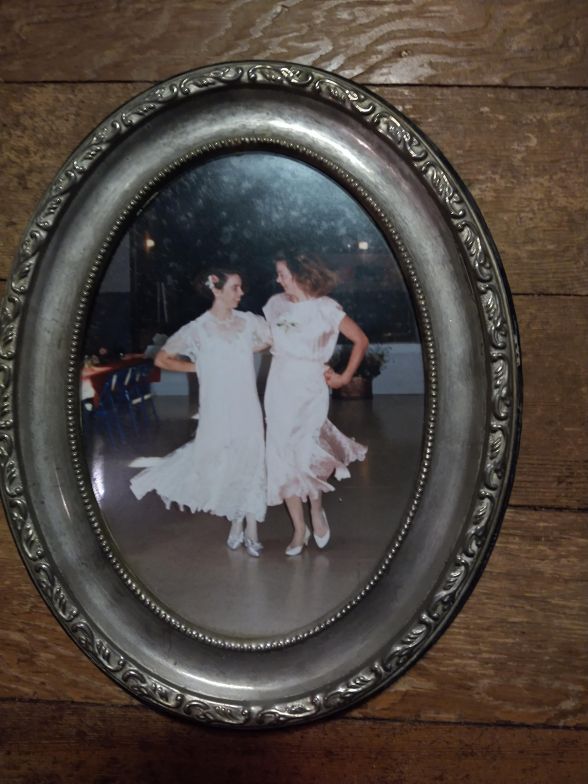
The photograph is me and my sister Chris in 1987, before my wedding. We were dancing before the wedding. She died in 2012 after 7 years of breast cancer.
Doctors and nurses and hospital staff are the last caregivers for the elderly alcoholics and addicts who are alone, whose families have finally cut them off. I think this song illustrates their pain. We try to take care of them.
Discover and re-discover Mexico’s cuisine, culture and history through the recipes, backyard stories and other interesting findings of an expatriate in Canada
Engaging in some lyrical athletics whilst painting pictures with words and pounding the pavement. I run; blog; write poetry; chase after my kids & drink coffee.
Refugees welcome - Flüchtlinge willkommen I am teaching German to refugees. Ich unterrichte geflüchtete Menschen in der deutschen Sprache. I am writing this blog in English and German because my friends speak English and German. Ich schreibe auf Deutsch und Englisch, weil meine Freunde Deutsch und Englisch sprechen.






You must be logged in to post a comment.