denise levertov writes making peace
that it is an active process
it is not the absence of war
but a process in itself: how do we make it?
Make Peace
how do we wage peace? wage is not the word we do not do it for money we must be more active than hoping engender peace? spread peace: like a pandemic a pandemic of peace
the comfort of peace the joy of peace the love of peace
the peace of the grave the peace of sleep the peace of heaven peace here now peace not distant nor below the earth peace conscious, aware and present peace alive, breathing, welling up in everyone peace here now
a pandemic of peace a river of peace peace flowing through and around, above and below us peace full, peace out, peaced let us verb it I am peaced today I peace you I peace Russia I peace the soldiers I peace the Ukraine I peace the entire world
I peace you please, will you peace me? peace me now, then there will be two and everyone else peace the world now a pandemic of peace make peace
___________________
I taped a conversation with a wren one morning in Wisconsin. I never saw my wren and clearly I have not got the language down, but she kept talking to me anyhow.
you are angry you say
I don’t think those are the right words, I say
not angry? you say
bored, I say
BORED you say
Yeah, I say
Well, you say you don’t love me
You say you won’t change
You say you changed once, in the past
You say you won’t go in a church
You say you did that
You say you won’t go in a casino
You did that
I’m BORED
My first thought about the church
My first thought about the casino
Is that is clearly where I can go
If I want to avoid you
My second thought about the church
My second thought about the casino
is ICK. Why am I hanging around
someone who doesn’t love me
someone who doesn’t plan to change?
My sister and I talk about the people who don’t change about the people who remain the same about the stubborn who bury their heads
We notice them shrinking as the world changes around them the things they are willing to do the people they are willing to talk to the places they are willing to go get smaller and smaller and smaller
You dream of a small cabin in the wilderness
your brother shows up and an attacking bear
in another dream I am well and busy and happy
May all your dreams come true
my love
if you really want them to
I am blogging A to Z about artists, particularly women artists and mostly about my mother, Helen Burling Ottaway.
My family was not Normal. No, no, not normal. I don’t think anyone is normal, really. In clinic one year I think, wow, all of my people are SO interesting. Why am I so lucky to have all of these wonderful people? And then I think: OH. Everyone is interesting. No one is “normal”. They may try really hard to pass for normal. I certainly had MY work cut out. And why is that, you say. I am so glad you asked that question!
My parents were both obsessed. My mother was obsessed with art. With music, a secondary joy. My father was all about music. Mathematics and language was his secondary joy. By age nine I discover poetry and that is it for me. That is the be all end all. I am so obsessed that I am amazed at age 40 when I make a discovery: poetry is not it for everyone.
I am fired by the hospital for fighting a clinic quota of patients. I might have kept the job if I had shut my mouth and been diplomatic, but I was not diplomatic. I write a protest song and sing it at the open mike and sing it into the CFO’s voicemail. I think I could be the poster girl for the opposite of diplomatic, right?I thought about quitting and then thought, no, I stay and fight this for my patients. I am fired the next day.
A group of people try to intervene and get me rehired. At some point I suggest sending one of my poems to the hospital commissioners. Six people email: NO!
I am confused: What do you mean, no? Why not?
YOU DO NOT COMMUNICATE WITH HOSPITAL COMMISSIONERS VIA POETRY.
I am still confused: I communicate by poetry. Poetry is the highest form of communication.
HOSPITAL COMMISSIONS DO NOT LIKE OR UNDERSTAND POETRY.
Ok, THAT is mind blowing for me. I call my father. What is this about?
My father says People are afraid of poetry.
I say You are kidding me.
My father says Poetry is magic. People are afraid of magic.
I say I’m not afraid of poetry.
That is because you are a poet, says my father.
And I really look at my thoughts on writing and poetry. I realize that writing and poetry are SO IMPORTANT to me that I assume that EVERYONE WANTS TO WRITE AND BE A POET. I ask my group of people trying to get me reinstated. None of them want to be poets. I ask my father. He does not want to be a poet. I am completely floored. I realize that I thought my mother loves art but wants to be a poet. My father loves music but wants to be a poet. Wrong. Wrong, wrong, wrong.
It must have been rather weird for my sister Chris, three years younger. She has three people who are all obsessed with their form of art. My sister Chris was a brilliant writer, an excellent musician and an artist. But I don’t think she was obsessed with any of them the way the rest of the family was. That must have been a little lonely.
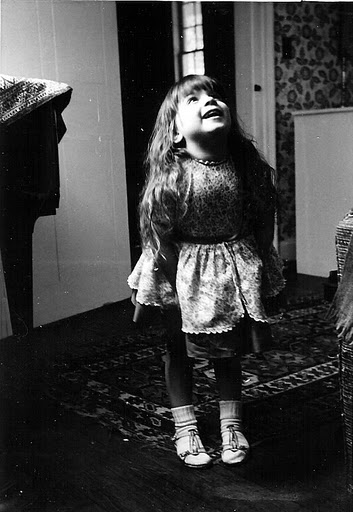
The photograph is me and my sister in 1965. I am four and she is one year.
I say to a counselor once that in spite of alcohol problems in the family, the music was amazing and my sister and I learned it. The counselor replies, “Children connect with adults where they can.” I think OH. That is amazing. My sister and I see my father praise my mother for knowing all the words to the songs. She is always be the last one singing because she knows verse 8, 9 and 10. My sister and I assume that this is a woman’s job: memorize the words. We did. We photocopy the back of Beatles albums and on long car trips we memorize ALL THE WORDS. I think I can still sing Yellow Submarine start to finish.
I start school. I know there will be singing. No one knows my songs. The songs they know are the songs to television shows and we do not have one. I quickly go silent. I play flute and I sing all the songs in my head when I am bored, but I do not sing out loud. And I choose medicine because I want to understand people, for the writing. I still think people are very very weird. But I have written the whole time, every single day. And that is how my mother did art and how my father did music. Every single day.
I am blogging A to Z about artists, particularly women artists and mostly about my mother, Helen Burling Ottaway.
My mother loved water colors, but she also did etchings, for as long as I can remember. We had the largest etching press that she could get back in the 1960s. When I was 14, we moved from Johnson City, New York, to Alexandria Virginia for my father’s job. The press went into the basement, along with numerous boxes of books. Soon after we moved, there was torrential rainfall and the sewers in the Del Ray neighborhood backed up. The water stopped draining and just piled up! There was a crack in the foundation of our basement with a waterfall pouring down. My mother wanted the engine of the press saved first! She and my father and I could barely carry it up the stairs, but managed to. Next came boxes of books, some of which were so waterlogged that they were floating. The water was cold, dirty and up to my upper thighs. We unloaded box after box of wet books and spread them out to dry.
I think that my mother’s art was not in the basement, so we did not lose much of that! We installed an automatic sump pump eventually, because that was not the last flood. That was the most spectaular, though. The water was 8-12 inches deep in the front yard. Buses would still drive through the water, sending a wave to hit our front steps.
Afterwards we wished we had taken a photograph in the canoe in the front yard, to use for Christmas. Our Christmas ornaments were flooded too. All the color peels off the balls, so our tree was silver and glass that Christmas. My mother claimed she liked that better and kept it that way from then on!
Etchings are diddly, as my mother would say. A zinc plate, coated with a tar mixture. Then a drawing in the tar, set the plate in acid, and wait for the drawing to etch into the plate. At a certain point, my mother would take the tar off and run some proofs. These were experimental, trying different colors. She would put the tar back on and continue with the drawing. When she was satisfied with the proof, she would start running the edition. The tar is removed, and for each etching the plate is inked with a roller. The ink is gently wiped off, until it is light on the remaining flat parts of the plate and heavier in the lines. The plate is placed on the press, a piece of paper that is soaked is placed on the plate, heavy felt cloth is lowered over it and the plate and paper are run through the press. We had a guard, but keep your fingers away! The felt is lifted, the paper is lifted and the paper is set to dry. The plate is wiped and inked again. The edition is numbered: 1/20 or 1/50. My mother ran some plates many many times. A tiny one named Tag, of a unicorn playing tag with butterflies, is done in multiple colors. Others were a much smaller edition, of 20 or 30. The very large plates are a challenge to ink and wipe. It takes practice to wipe the ink but not wipe it out of the lines.
I have three photographs of H. Ottaway’s Iris and Poppies etching. The featured image is 17/30, colored edition, 1976. The one below is a proof for the color edition. The last one is a proof for her black and white edition.
Iris and Poppies Etching, by Helen Burling Ottaway, proof for color edition.Iris and Poppies Etching, black and white proof, Helen Burling Ottaway, 1976.
#ATOZBLOGGINGCHALLENGE2022 # art # Women artists # Helen Burling Ottaway #ATOZCHALLENGE
I am blogging A to Z about artists, particularly women artists and mostly about my mother, Helen Burling Ottaway.
I am the daughter of an artist. My sister Chris and I had drawing lessons and paints and just about all of the art supplies you can imagine. Our mother either wore jeans and t-shirts with ink from etchings, or else was very dressed up for art shows or an opera or other festivities. She only wore make up for those times. My sister and I rebelled by refusing to call colors by their names and instead asking each other for the “boy” crayon or the “girl” crayon. We had all the colors divided in male and female. My mother was outraged. “Green is not a boy color.” We just ignored her and kept doing it.
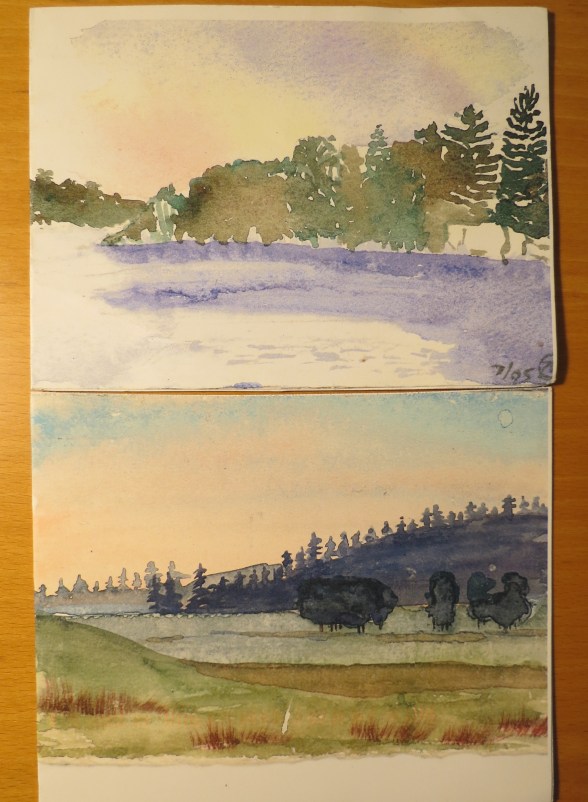
We did learn, though. The picture today is of two postcards. This is a photograph of two color xeroxes, because I don’t have the originals with me. My mother did the lower one and I did the upper one. You can see how much she influenced me and how much I absorbed about water color technique.
I took a class two years ago, which turned out to be acrylics. My mother rather scorned acrylics though she was fine with crayons and crafts. I was painting and the teacher came to look over my shoulder. “They are not watercolors,” he said. “Yes, I know,” I said, “but I am using them like watercolors.” He laughed. Well, I know how to use watercolors and I don’t know much about acrylics. I know how to print etchings too and got an infected finger very young using the forbidden woodcut tools. I tried to hide it and the doctor yelled at both me and my mother. He scared me a lot.
My sister did beautiful art as well, also influenced by my mother. I think I only have one of her pieces.
#ATOZBLOGGINGCHALLENGE2022 # art # Women artists # Helen Burling Ottaway
This month my topic for Blogging from A-Z is art and particularly my mother, the artist Helen Burling Ottaway, born May 31, 1938. She died May 15, 2000, of ovarian cancer. I am starting with her sketches, and the self portrait. My mother sent me a sketchbook for Christmas, 1978, that I still have. I was 17 and was an exchange student to Denmark. She drew pictures of lots of family and friends and mailed me the sketchbook. I really love it still.
I love her comments, too. They are often very funny. Here is my father and what was happening.
Sketch of Malcolm Kenyon Ottaway by Helen Burling Ottaway
Discover and re-discover Mexico’s cuisine, culture and history through the recipes, backyard stories and other interesting findings of an expatriate in Canada
Engaging in some lyrical athletics whilst painting pictures with words and pounding the pavement. I run; blog; write poetry; chase after my kids & drink coffee.
Refugees welcome - Flüchtlinge willkommen I am teaching German to refugees. Ich unterrichte geflüchtete Menschen in der deutschen Sprache. I am writing this blog in English and German because my friends speak English and German. Ich schreibe auf Deutsch und Englisch, weil meine Freunde Deutsch und Englisch sprechen.







 KO Rural Mad As Hell Blog
You must be logged in to post a comment.