Hormones and rabbit holes

Medicine is confusing right now. Ok, it is always confusing because we try to base it on science and science is always changing. There are always special areas that are currently a mess. Hormones!

I speak to a patient recently who is female, premenopausal, and is getting hormone replacement therapy for hot flushes and not sleeping well from an outside source. The person wants me to order hormone tests. I do order hormone tests but not the ones she has in mind. I test a TSH, thyroid stimulating hormone, to see if she is low or high in thyroid.

She is thinking of me testing estrogen and progesterone and other related hormone levels. The party line from gynecology MDs and DOs is that these are not useful tests because women’s hormone levels are so varible. However, there are lots of naturopaths out there and functional medicine MDs and DOs who will test levels. Why is the patient asking ME to test them? Most of those naturopaths and functional medicine providers do not take insurance and charge cash. Also, insurance may not pay for them anyhow because the party line is that they aren’t useful. Why would the cash providers check levels? One reason is CASH. Another is to prescribe “bioequivalent hormone replacement”. Sounds natural, right? Well, the natural thing was for the hormones to stop at menopause and all of the hormones are either made in a laboratory from plant pre-estrogens or from pregnant mare urine, so bioequivalent seems to imply natural but it really isn’t. Pills do not grow on trees, they are made by humans in laboratories.

However, I question party lines, and off I go down the hormone rabbit hole. The current guidelines are that female hormone replacement, after menopause, should be lowest dose possible and only for a maximum of three years because of the increased risk of breast cancer. This doesn’t address my question: does premenopausal hormone replacement count as part of those three years? I may need to ask gynecology. I don’t think it counts. A woman is postmenopausal when she has had no periods for a year. Or had her ovaries removed. Or if she’s had a hysterectomy and still has her ovaries, a yearly follicle stimulating hormone and lutienizing hormone test. Both tests rise when the ovaries stop making hormones and eggs.

Also, there is another caveat. We know that when men are on opioids, the opioids can suppress their hormones and lower testosterone. Here is a paper: https://pubmed.ncbi.nlm.nih.gov/31511863/. Half the men studied in multiple studies had low testosterone when on chronic opioid therapy. 18429 subjects (patients) in 52 studies. That is a lot. Women studied? NONE. What? Yeah, none. Why? Here is part of the answer: about a decade ago I worked with the UW Telepain group and asked the head of the UW Pain clinic a question. “If opioids lower hormones in men, do they in women too?”

His reply, “I don’t know.”

“Have you ever tested a woman?”

“No.”

“Isn’t that sort of sexist?”

“Yes.”

So here I am, rechecking a decade later, and we still don’t know if giving women chronic opioids messes up their hormone levels. It would be more complicated and difficult to check women. We might have to do individual hormone baselines or something in premenopausal ones, say, 2 weeks after menses. Remember that for most of the history of medicine, clinical drug trials were only done in men, because, well, sexism. They said women could get pregnant. Yes, but then we gave the drugs to women who could get pregnant. Also, postmenopausal women can’t get pregnant. The whole thing seems stupid to me.

There is an interesting new finding here: https://neurosciencenews.com/estrogen-t-cells-pain-28548/ . Apparently in women, estrogen and progesterone work on receptors at the base of the spine to reduce pain signals using T cells, part of the immune system. The article says this doesn’t happen in men, but they were studying mice. The male mice didn’t seem to have worse pain after estrogen and progesterone were blocked. The female mice were in more pain. But wait, estrogen and progesterone are produced in men as a by product of making testosterone. Less than women, until menopause. Then the 70 year old man has more estrogen and progesterone than his postmenopausal wife. The article says that they don’t know why the receptors are in women and female mice (um, my intuitive guess would be childbirth and micebirth, right? Men don’t do that and women giving birth to a child after the first one sometimes say, “WHY did I want to do THIS again?” I think those receptors are so that women and mice can get through more than one pregnancy.) Now I need to read the article again because maybe men and male mice don’t have the receptors, even though they do have some estrogen and progesterone. Maybe they just don’t have enough estrogen and progesterone.

Maybe we can’t figure out women’s hormone because men aren’t smart enough, heh, heh. Yes, that is sexist right back at all those historical figures who didn’t study women.

At any rate, that still doesn’t answer my two questions: does premenopausal hormone replacement count towards the three year total beyond which hormone replacement increases the risk of breast cancer? And does chronic opioid treatment lower women’s hormone levels?

_________________

For the Ragtag Daily Prompt: hormone.

I took the photograph of a Port Townsend rabbit in 2011.

The boring vampire

I meet a boring vampire
when I am boring too
when I am worrying with angst and ire
and have too much to do

It’s in the time of covid
We start to walk the beaches
The vampire won’t take paxlovid
His ego overreaches

He says his life’s perfection
He says his brain can’t fit his head
He has no belief in resurrection
That’s probably because he’s dead

I wonder that he lies
Does he think that I don’t see?
The person that believes the lies
Must be him, not me

I grieve before he ousts me
He says he’ll always be my friend
And he speaks of longing to be free
I know there will be an end

I know before he ousts me
He says we’re friends forever
I blink and calmly see
That it will soon be never

Some vampires don’t need staking
They do it to themselves
Isolation of their making
Hoarding blood upon their shelves

______________________________

The photograph is a “swamp robin” (Varied Thrush) from my yard, December 2022.

This has nothing to do with the Ragtag Daily Prompt: festival. Except that swamp robins are very festive.

Dance the night away

I chose the word hospice for the Ragtag Daily Prompt today. Last weekend I traveled back to Port Townsend to see my friend who is in hospice. She is doing well, but I wish she had more visitors. She has a brother in Alaska, but has always been a fairly solitary person. Maybe I mind more than she does. She said that I was too far away, but no other complaints.

Last night I went to a dance and danced my socks off. This was a fundraiser for the plane in the photograph and the Commemorative Air Force that flies it and takes care of it. And I can’t credit the photographer, one of the gentlemen of the Commemorative Air Force, many thanks!

Isn’t it a fabulous poster? And a live band in a hanger at the airport, two food trucks, classic car and the plane and dancing.

It is nice to be alive.

For the Ragtag Daily Prompt: hospice.

Honey and the ants again

The next two times Honey feels the ants biting from the inside feeling are also on obstetrics.

Both times it is a VBAC. Vaginal birth after cesarean. The woman has has a cesarean section in the past and is trying for a vaginal birth.

Both times, Honey gets the biting ant feeling. There doesn’t seem to be anything wrong with the woman in labor, the nurse is relaxed, the fetal heart monitor looks ok.

With the first one it is the younger male obstetrician who is on call. He is a big man. He sits and peruses the monitor strip outside the room, taking his time. “There were some decelerations back here, but the heart rate looks fine now. Do you really want me to consult?”

Honey can’t stand still, the ants feel so bad. She tries to sound professional and calm. “Yes, this is a VBAC. I would like you to go in and meet her.” She is trying not to shoo him towards the room. He shrugs and gets up, not quite slouching towards the room, Honey trying not to jump up and down in impatience behind him.

In the room, he introduces himself. Again, Honey has not told her patient. The obstetrician says, “Dr. B. asked me to stop by since you have previously had a cesarean section, but everything looks fine.” Two minutes later she and the nurse and the obstetrician all alert as the the fetal heart rate monitor chirp slows, dropping from the 120s down to 60. THERE IT IS! thinks Honey. It stays down, they have the mother roll on her side and pop oxygen on her. It comes back up, but that is that. Off to the operating room. Again, they don’t have to do a crash cesarean. This time it is not clear what was wrong, but everything comes out well.

On the third round, it is the older male obstetrician. He looks at the strip and is calm and goes right into the room. He introduces himself and everything looks fine. Honey is wanting to dance from foot to foot from the ants. Again the fetal heart rate drops, right as the obstetrician gets up to leave the room. The nurse has the woman roll to her side and adds oxygen. The calm obstetrician gives Honey a look and has the nurse get the surgical consent. The heart rate is back up and off they go.

Honey wonders. Ants? Little voices? She knows that we all pick up information from body language and information that is not conscious. That could be a scientific explanation. Information that is not quite conscious. Honey decides that she really does not care what the ants are. When those voices speak, she listens. Who cares what it is, as long as it works.

______________________

What is the word? “Fictionalized”, from fallible, friable memory.

Honey and the ants

Honey is in her second year working. She escapes clinic because she has a labor patient. In the daytime! Not on a weekend or at 2 am! Hooray!

She has to hang out, because this is baby number five, so it could come really really fast. Everything is cool. The mom has more experience than she does, nearly. Well, Honey has done more deliveries, but has only had one baby.

Honey starts to feel itchy. Agitated. It’s not skin at all. Something is bugging her. She goes in and out of the room. The nurse seems totally unperturbed, but Honey feels like ants are attacking her, from the inside. She goes out the room and studies the rhythm strip, the baby’s heartbeat. There is a printer feeding out in the central nurses station.

Screw it, thinks Honey. I make look stupid, but I don’t care. She calls the obstetrician. It’s the woman who is on. Honey is a Family Medicine physician. They are in rival clinics. “Hi,” says Honey, identifying herself, “I need a consult on this woman.” She reels off the medical details, Gravida 5, Para 4, all vaginal deliveries, no complications. “I just feel like there is something wrong. There isn’t anything really bad on the strip. But I need you to come.”

The woman obstetrician comes. She sits and studies the heartbeat strip. Honey still feels like ants are biting from inside. The OB puts the strip down. “There is nothing on this that would get you in trouble. But you’re right: something is wrong. Come on.”

Honey has not told the patient that she’s calling the obstetrician. The patient might be annoyed. They go in the room. The obstetrician introduces herself. “Dr. B called me to consult. We have a bad feeling. We want to do a cesarean section.” Honey is sure the patient will say no. She is wrong.

“Me too,” says the patient. “Do it.”

They do the paperwork and move quickly to the operating room. Not a crash cesarean, not an emergency, so spinal anesthesia, not general. Honey assists.

They are in. There it is. The umbilical cord is wrapped four times around the infant’s neck. It has not tightened down. Honey has goosebumps as they gently unwrap the cord and do the delivery. The baby is fine, no problems, apgars of 9 and 9. They complete the surgery, mom is doing fine too. Honey still feels rattled but the ants have gone away.

The mother is relieved when she wakes, glad they did it, glad to hold her fifth child. The obstetrician is in charge of post operative and Honey is managing the baby. They don’t really talk about it, everyone acts as if it’s all routine. If the cord had tightened down, everything still could have been ok, but it would be a crash cesarean section, general anesthesia, more risky for everyone. It could also have not been ok.

Honey is relieved to go home, adrenaline draining away and leaving her very very tired.

Honey decides that she will listen to those ants, that feeling, any time it shows up.

______________________

Based on a true story, at least, on memories, that are unreliable. Aren’t they?

Visit

It is time to visit. It has been long enough and it is time.

He is in a dungeon. I have to go down flight after flight of stairs. It gets colder and damper and there is mold growing on the walls and puddles. Light comes with me.

I can hear him one flight above finding him. He’s having a tantrum and hitting something.

I find the door in the dungeon. It is thick and moldy damp wood with bars in the window and a huge lock. It is also open. My friend is screaming at the ceiling and hitting the ceiling and walls with a yard long heavy pipe. It clangs and I feel a tremor when he hits metal. There is no window, we are too far underground.

I lean on the doorway. “If you go deeper in to the earth, it will be warm and dry.”

He turns with the pipe held like a bat. He is huge and muscular and dressed in rags and very threatening. The room is mostly dark. He sheds a faint light. He glares at me and then lowers the pipe. He shrinks to his child self, like me. About age three.

“You are awfully cute at three.” I say.

He drops the pipe and lets me come hug him. The cell smells truly awful. There is a drain in the floor that appears to be working, sort of. There is a visible liquid level below the drain.

He is still while I hug him and then relaxes. “Ok,” he says. Silence for a minute. “I didn’t really think you’d come back.”

“Friends forever, right? That’s what you said.”

“Yeah, but,” he hesitates. “You were mad.”

My turn to shrug. “Yes. I got over it.”

“Took you long enough.”

My eyebrows go up. “You could have made the first move.” Now he shrugs.

“How about a picnic?” I say. “This is icky. Let’s get out of here.”

He looks at the ceiling. The stone is scratched and chipped. “Yeah. No progress here. Might as well.”

We leave the cell and go up. “Damn stairs.” I say.

“Your lungs are good.” he says.

“Most people’s lungs are pretty good at three.” I say.

“You are pretty cute at three too.”

“Thanks.” I get tired of the stairs and transport us to a meadow in my garden. It is summer and full of wildflowers. It is on a sloped hill with an enormous willow tree. “This is from when I was 7, really.” I say.

“Nice.” he says.

I have a picnic basket and get food out. We don’t really need to eat but it’s fun anyhow. We can taste food, a bit. His keeps turning black on his plate.

“Cut that out.”

A shrug again. “I like bugs now.”

“Did you at three?”

“Naw, but I ate them if I was hungry. Ants are not good. Grasshoppers are better.”

“Are you making any progress at all?”

He leans back on the hill, about as relaxed as he gets. Still hyper alert to everything around us. “No, and I don’t think I will. He’s 69 now. Getting older.”

“Well, he’s expecting to die of a stroke at 80.”

“Yeah, it’s pretty much too late. There is too much to process. And wine and pot do not help.”

“Using more?”

“Yeah.”

“Let’s talk about something more fun. Politics or taxes or something.”

He laughs.

We talk about cabbages and kings. Why the sea is boiling hot and whether pigs have wings. The sun moves like the real sun.

He is starting to fidget.

“Time?” I say.

“Yeah. You know, it’s not fair that they need us even if they won’t listen.”

“Seems like it.”

He glances at me and away. “Yours listens.”

“You’ve seen the results of that.”

He looks down. “Is she happy?”

“Sometimes. Sometimes sad, sometimes lonely, sometimes impatient. You know, all of it.”

He nods. We start packing up and we trek back to the dungeon and the endless stairs. We have gone down two flights when the landscape shifts. A forest, dark and huge trees and overcast. Damp and cool. He is morphing. “Oh!” he says, “Asleep again! And it’s 4 pm. Must be tv. And wine.” There is a small clearing in sight with a shack. It looks run down, no vehicles. My friend has morphed and split. He is a huge bear with red eyes. And an older man who smells of alcohol and reaches into his shirt for a handgun.

“Really?” I say to the man with the gun.

“They are his memories,” growls the bear. “I have to go.”

“Well, the bear isn’t. Goodbye and good luck.” I say, patting a furry leg. “I will come back.” But he is not paying attention any more, he is focused on the shack.

I go home and he goes to try again. Wake up, my friend, wake up.

_________________________________________

For the Ragtag Daily Prompt: confusion.

Shapes and songs

The Ballad of the Shape of Things is one of those songs that I learned very young and from my cousins, so I did not know who recorded it. Another “dead girl song” only this one is a “dead guy song”. I loved the puns: “They say he died of the chickenpox. In part I must agree, one chick too many had he.” I also liked songs with words I didn’t know: transom, in this one. We were fairly bloodthirsty kids and happily learned songs about death, unfaithful lovers, murder, betrayal, noble suicide to save the highwayman, and so forth. My Darling Clementine, another dead girl song. We had a very educational childhood in song.

We needed the triangular “garment thin that fastens on with a safety pin” explained at the end of the song, because the cloth diapers we’d experienced were rectangular. I find memorizing things that rhyme and especially if there is a story and a tune, much easier than memorizing the varied side effects of drugs such as ACE inhibitors. The story behind the side effects escapes me, though maybe there is one! Think of that, a ballad of the ACE inhibitors, with each one having its individual good and bad effects! I am certain that I could make up a story, even if we don’t really understand all the effects.

For the Ragtag Daily Prompt: triangle.

Here is a side effect song, though not quite what I have in mind.

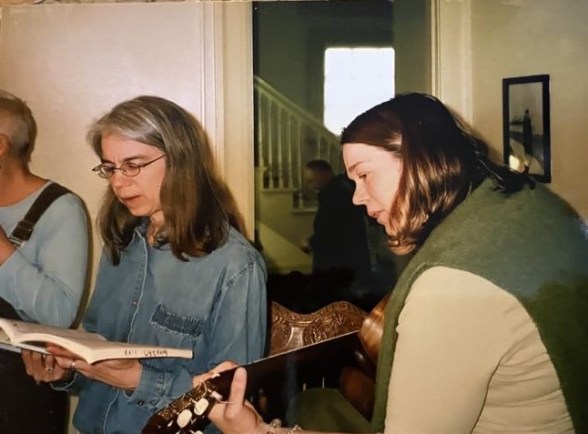
The photograph is my sister Chris and me, at my father’s 70th birthday, 2008, taken by my friend Malene.

Intimacy

What IS intimacy? And what is love? And are they the same thing? Do you have to be intimate to love someone? Not meaning sex, but what level of intimacy is “normal” and “appropriate”?

I am thinking of my mother. When I was just starting college, she started talking to me about my father and about his drinking. I became more and more uncomfortable and finally asked her to find a counselor or someone other than me. The thing is, she refused to DO anything about his drinking and in fact, covered it up. The two of them would scream at each other at 2 am and fight when I was in high school. It would wake me up and I would think, I wish they wouldn’t, because I have school tomorrow. But I certainly didn’t go say anything because then they would have screamed at me. And as I got older, I wondered if my mother was drinking heavily too. Because why would she argue with someone drunk at 2 am, that makes no sense. Unless she either was drunk or loved to argue or both.

It is clear that she was drinking heavily at that time from her journals. Over and over she writes, I drank too much last night. Hard to blame her for not intervening with my father if she is drunk too. But she was using him as her cover up. Her family blamed him. My grandmother, her mother, didn’t blame him. She loved them both.

When we had guests, my mother would turn on the charm. She could mesmerize a room and entertain people with stories. My sister and I and others would be the butt of the stories. My father too. After the guest left, she would often talk about them. Analyze them. Talk about their faults and weaknesses. I was fascinated but a bit horrified too. She seemed to like these people so much and to charm them and invite them back, but was talking about them behind their backs. Ick.

So intimacy interests me. I wonder how to do it “right”. Maybe right is not the best word. How to do it “functionally”. I really don’t know what normal is, my maternal family certainly did not model healthy intimacy. My generation still gossips about each other. I quit that at age 19 and refused to be part of it. I don’t think anyone saw my rebellion except my maternal grandmother. She did not say a word but I knew that I had her respect. She did not play the family game with me.

I don’t think that gossip and triangulation are a good form of intimacy or love. Person A talks to person C about person B. Word gets around and sometimes it is person D that says something to person B and person B gets upset when they realize where this came from. And how twisted and one sided the story is. And aren’t we seeing this play out on a national level? All these people saying that THEY KNOW the status of the President’s memory. I don’t. I can’t judge it from a debate. And frankly, if we are going to do a psychiatric evaluation of one, I think we have to do BOTH. Stop following stupid rumors. Why not require a neuropsychiatric evaluation on every candidate for President and Senate and House of Representatives and the Supreme Court. And make them public. That would cause some chaos, wouldn’t it? And how do you decide who is “sane” enough to govern?

I think that gossip and triangulation is a dysfunctional form of intimacy. People feel closer when someone is whispering a secret to them. I don’t think it’s healthy. It might be normal for our culture, though. Normal does not mean healthy, after all. What do you think?

This election is like a bad hallucination. Why do we accept candidates that behave badly? Are we so addicted to television and movie drama that we want it to happen in our government? I don’t. How about you?

For the Ragtag Daily Prompt: hallucination.

Spirit take flight

Death from memory loss is a mixed bag for families.

In the past, the average time to death from Alzheimer’s was 8 years. I don’t find a number on the CDC website, CDC Alzheimer’s. I find these statistics:

  • Alzheimer’s disease is one of the top 10 leading causes of death in the United States.2
  • The 6th leading cause of death among US adults.
  • The 5th leading cause of death among adults aged 65 years or older.3

The site also says that the number of people with Alzheimer’s doubles every five years after age 65. Sigh. Those numbers are the same ones that they taught me years ago, in a different format. 6% at age 60, then 2% more every year. By 70, 26%, by 80, 46%, by 90 66%. Like hypertension, if you live long enough, you may well get it. And yet, I have had patients over 100 years old with intact memories.

The death of a family member with memory loss can have complicated grief. On the one hand, loss and grief. On the other, a burden is lifted. If the person is in memory care, the cost may be very heavy. In our town, the memory care facility costs $7000 per month. That is a heavy burden to carry when the person no longer recognizes the family or speaks. The family may feel hugely relieved when their person passes and at the same time, feel guilty. This is someone that they love and loved. And yet, they are relieved by death. I think of it as a patient of mine described it: “The grief group at the hospital said that my husband isn’t gone. I said, yes he is, he just left his body.” It is very very hard for a family to watch their loved one deteriorate, lose skills, become confused and/or frightened and/or paranoid and the process can happen for years. With an average death at 8 years, some people live beyond 8. Maybe 12 years. It is very hard.

Blessings on those who care for the memory loss people and the families who do their best for them. Alzheimer’s is one sort of dementia, but we now have many. Pick’s disease, frontotemporal dementia, Parkinson’s dementia, multi stroke dementia, alcohol induced dementia, illegal drug dementia, primary progressive supranuclear palsy, and others.

The spirit has already taken wing and let the body follow.

For the Ragtag Daily Prompt: wing.

My son took the photograph while he was visiting.

Here is the top ten causes of death in 2022: https://www.cdc.gov/nchs/data/databriefs/db492.pdf.

Clementine

If I lose my memory, at least, if it’s Alzheimer’s, it’s like a trip back through time. People seem to lose recent memory and then they are in past memories, which burn out like small fires. Like matches, taking the neuron with it.

I have joked that if I was in memory care, I would be singing. I know 9 verses of Clementine and I would sing and sing and sing, because my earliest happy memories are singing.

I know the silly add on verses.

“Now all ye boy scouts, learn a lesson
from this dreadful tale of mine
Artificial respiration
would have saved my Clementine.”

“How I missed her, how I missed her,
how I missed my Clementine
‘Til I kissed her little sister
And forgot my Clementine.”

“In my dreams she still doth haunt me
dressed in garments soaked in brine
In my life I would have kissed her
Now she’s dead, I draw the line.”

Here is Pete Seeger, banjo and all.

The words change. Second verse for me is “Light she was and like a feather”. His version is “like a fairy”. It’s lovely to see how the versions change over time. I did not learn the churchyard verse, and he does not sing the three verses that I add above.

Meanwhile, Steeleye Span did not do Clementine, at least not on Youtube. But this is my favorite moral song from their albums. Would you run as, well, you’ll have to listen to the ending to hear the three seven year penance punishments.

Anyhow, I learned to sing at the same time that I learned to talk. Singing was the happy and safe part. That is where I will go if my memory fails me.

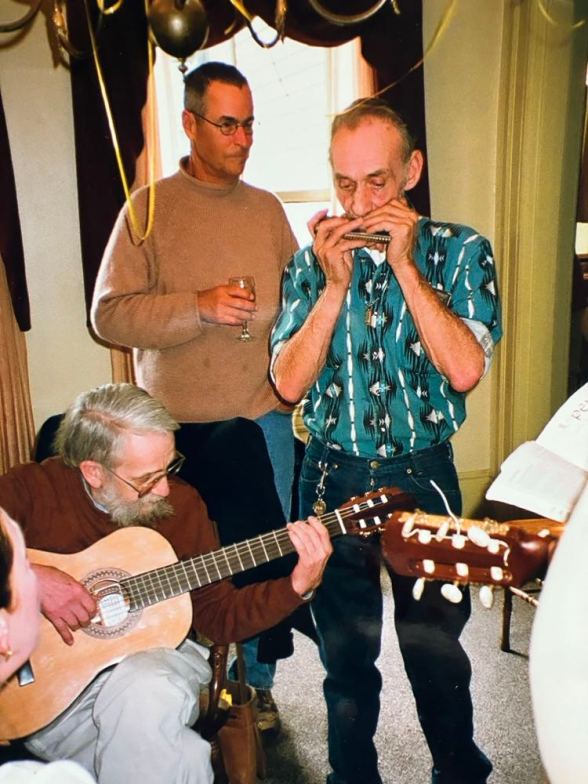
The photograph is from my father’s 70th birthday, in 2008. He is the one with the guitar. Andy Makie is on harmonica and CF is in the back. I don’t know what song this was, not Clementine. My friend Maline took this photograph. She died in 2023. My father died in 2013 at age 75. He was not confused when he wore his oxygen. Without it, he sounded drunk.

For the Ragtag Daily Prompt: dementia.