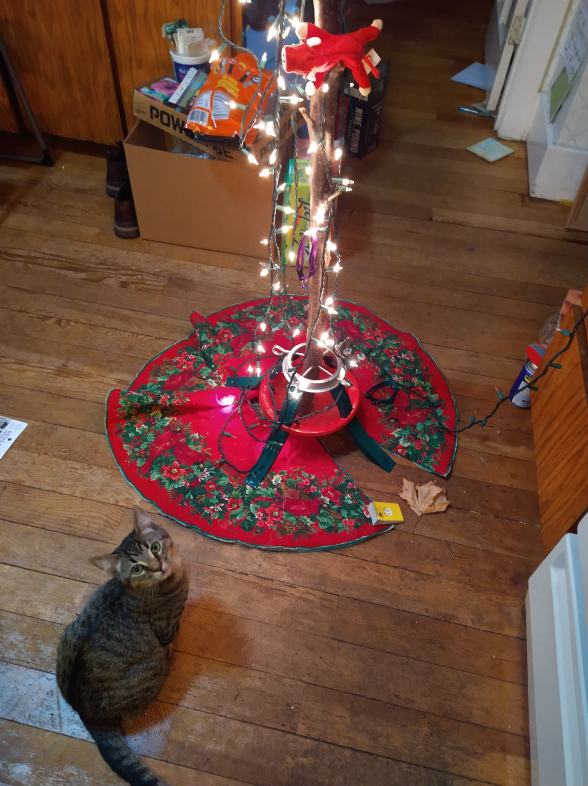
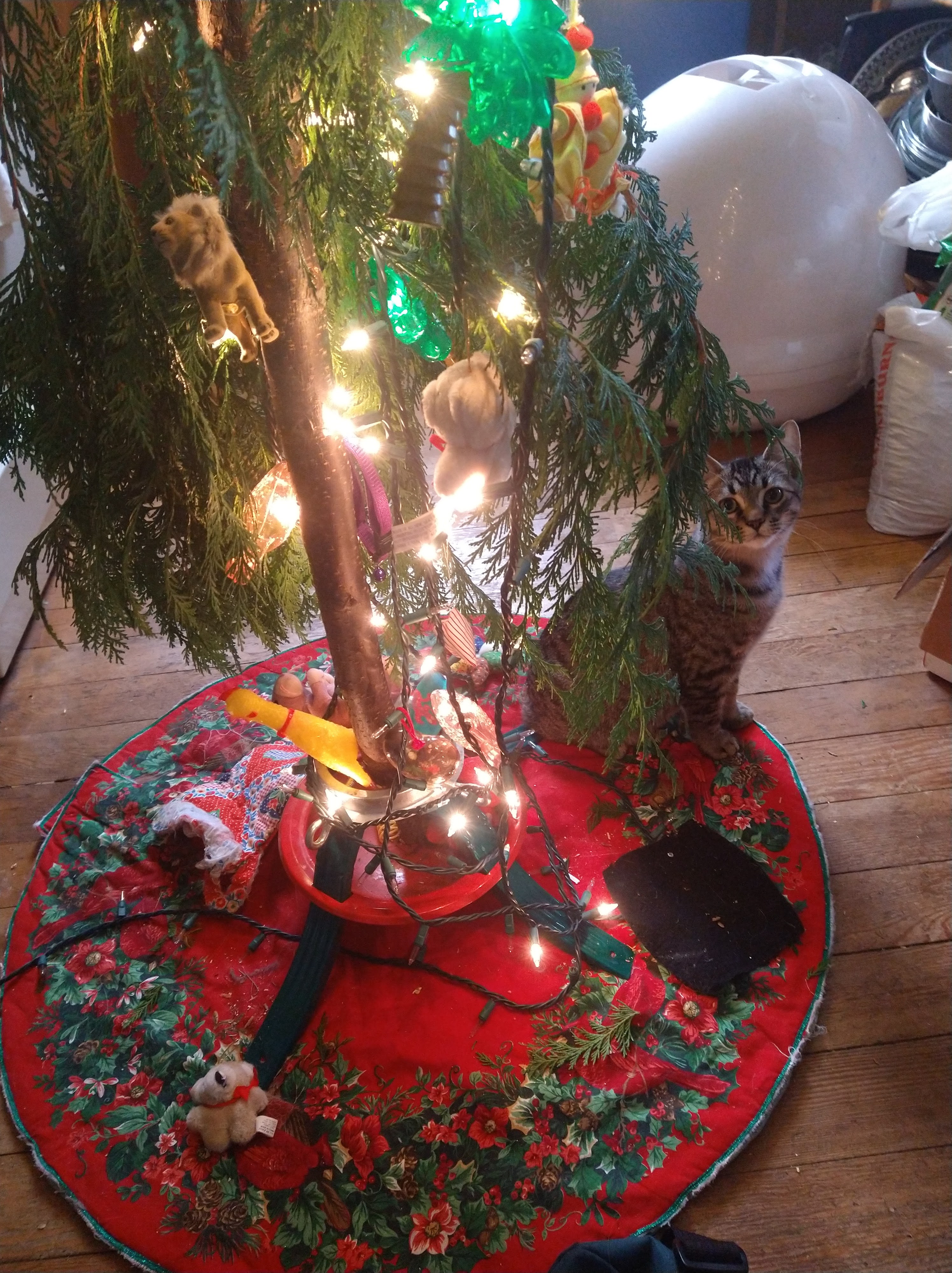
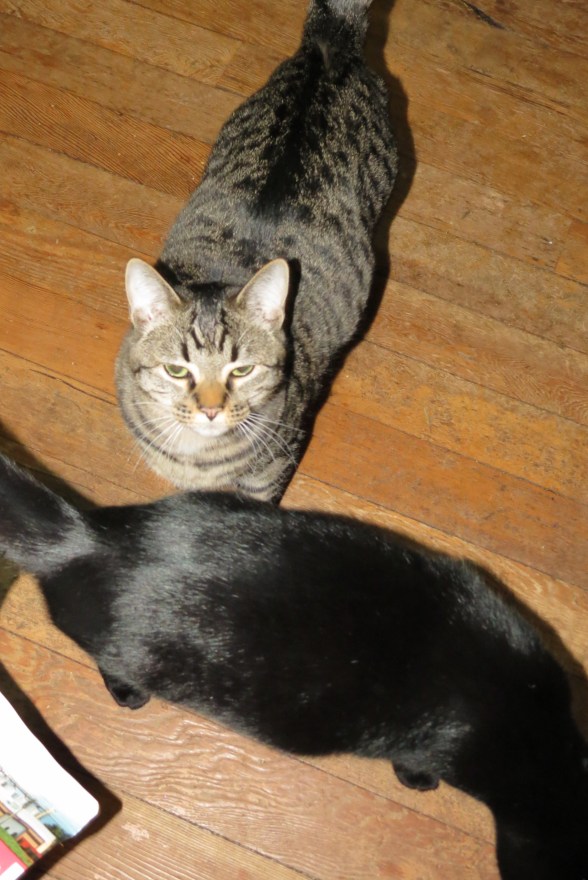
I am going through photographs. This is Elwha before Christmas. “Why stick with lights, mom? What is it for?” Good question.
“I still do not understand the stick with lights and branches. But I love you anyhow, mom.”
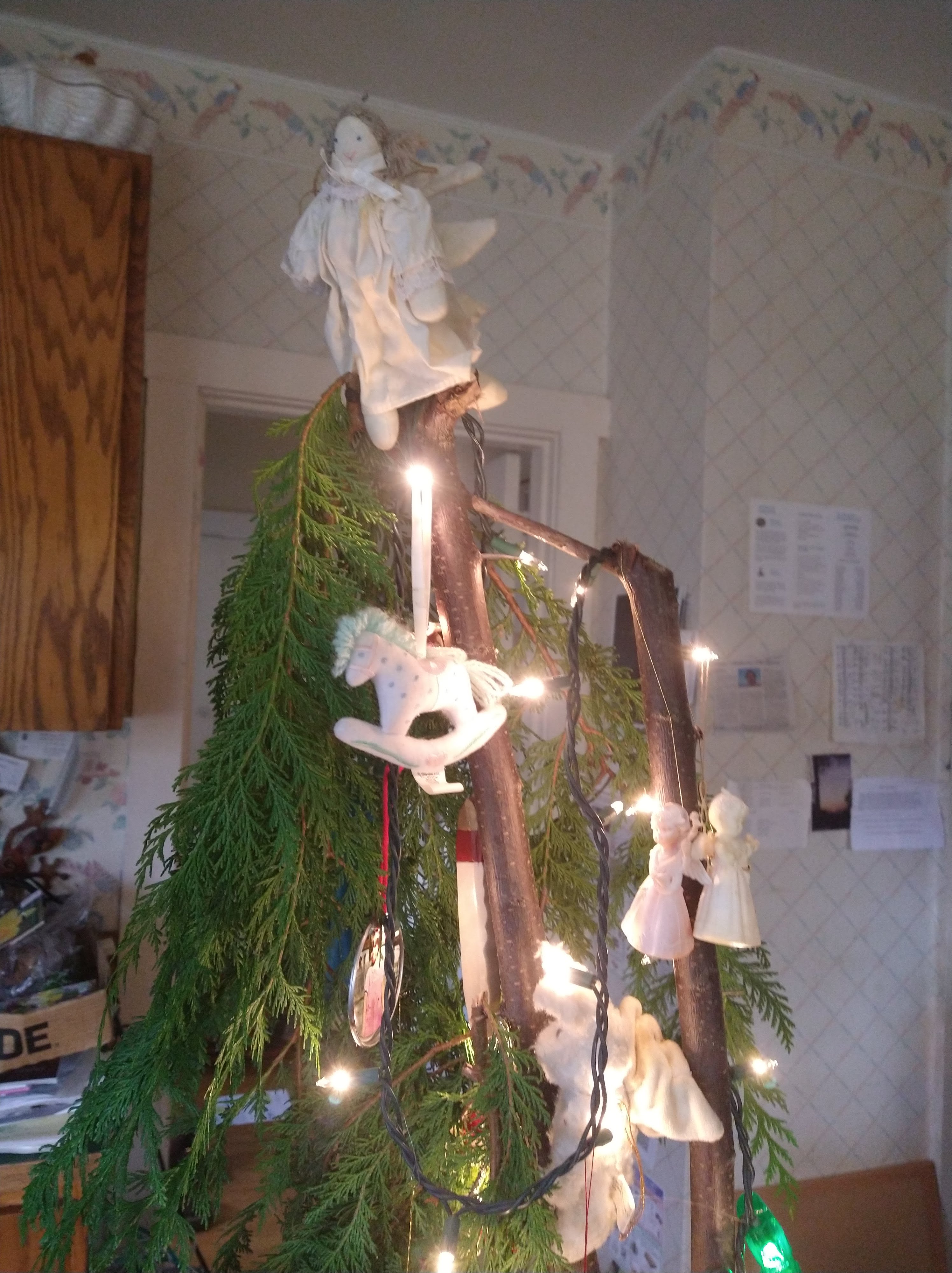
Well, the stick with lights was ok when it got knocked over by young curious cats Elwha and Sol Duc. And I added four branches, but not a whole tree. I was traveling anyhow, so I did not want a formerly live tree.
I am blogging A to Z about artists, particularly women artists and mostly about my mother, Helen Burling Ottaway.
H is for Helen and Hurricane Ridge. Here is one of her water colors.
My mother loved water colors. I think she loved them best of all the art techniques she did. Etchings and water colors were the two most important.
She wanted to move to the Pacific Northwest for years, but she and my father were worried about moving my grandmother, Katherine White Burling. Katy B. died while I was in residency at OHSU in Family Practice, in 1994. My parents then spent at least a year dealing with the will and two houses and stuff and also looking for the right place. They drove all over the northwest. My mother liked the rain and gardening and art. My father wanted sailboats and singing and music. At last they called me and my sister: Chimacum, Washington. “We found a house in Chimacum.”
My sister Chris and I both replied, “WHERE?”
We said to each other that we were mildly horrified that they were selling “our” house in Alexandria, Virginia, though we really had only lived there from when I was 14 and she was 11. My sister had worked for the US Forest Service and lived in Port Angeles on the Olympic Peninsula, so she knew the area much better than I did. I finished residency in Portland in 1996 and moved to Colorado. Shortly after that my parents moved to Chimacum, Washington.
My mother lived four years after they moved. She was diagnosed with ovarian cancer in 1997 and died on May 15, 2000. This is one of her northwest watercolors. I am glad that she had time to do some, though I wish that she had more time.
Here is the Hurricane Ridge park information: https://www.nps.gov/olym/planyourvisit/visiting-hurricane-ridge.htm. Be careful, though, because the park is big and wild and it can be dangerously wet and cold. People are more likely to die of exposure if they get lost than from a cougar or bear. Take some emergency gear if you hike, because the park is very big and wild. My sister wrote about duncehead expeditions, where people camp with inadequate gear. She mostly worked trail crew for the US Forest Service, but they did search and rescue as well. My sister died of cancer as well. Her blog is here: http://e2grundoon.blogspot.com/ .
I am blogging A to Z about artists, particularly women artists and mostly about my mother, Helen Burling Ottaway.
F is for Fish. But… it isn’t a fish, right? It’s a dolphin. At the moment I do not have access to all the art because I am on a trip. I have what I have.
This is one of my mother’s tiny etchings. It is 2 inches by 1.5 inches. She very much enjoyed the tiny etchings. She said that tiny, etching and fantasy were NOT popular with her college professors at the University of Tennessee. She said that her friend, Maline Robinson, was doing large abstract works, both silk screen and oils and that those were much more to the professors’ tastes.
Maline Robinson is another woman artist. Her silk screens are 18 by 24 except then she wanted bigger ones. She built her own frames to do 24 by 36. Her painting tend to be 4 by 6 feet, and she has done triptychs that size. Three large oils that go together. She says that most of her really large works are bought by companies, who hang them in their huge imposing atriums. The tiny dolphin would be lost.
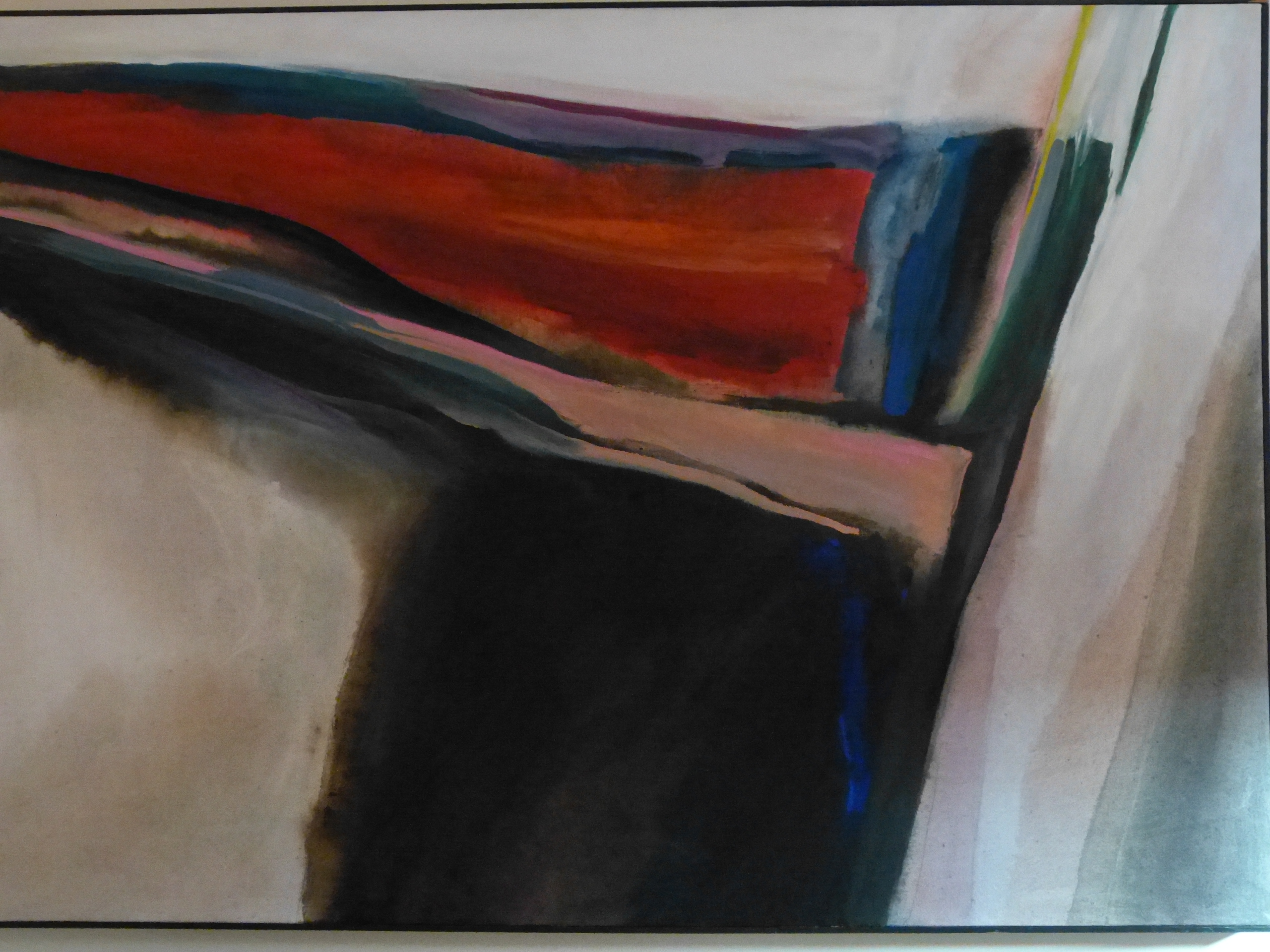
Here is one of Maline Robinson’s works. I took the photograph a few years ago when visiting. I wanted to be immersed in the painting. I think that this one is 4 by 6 feet. I will have to contact Maline for the title!
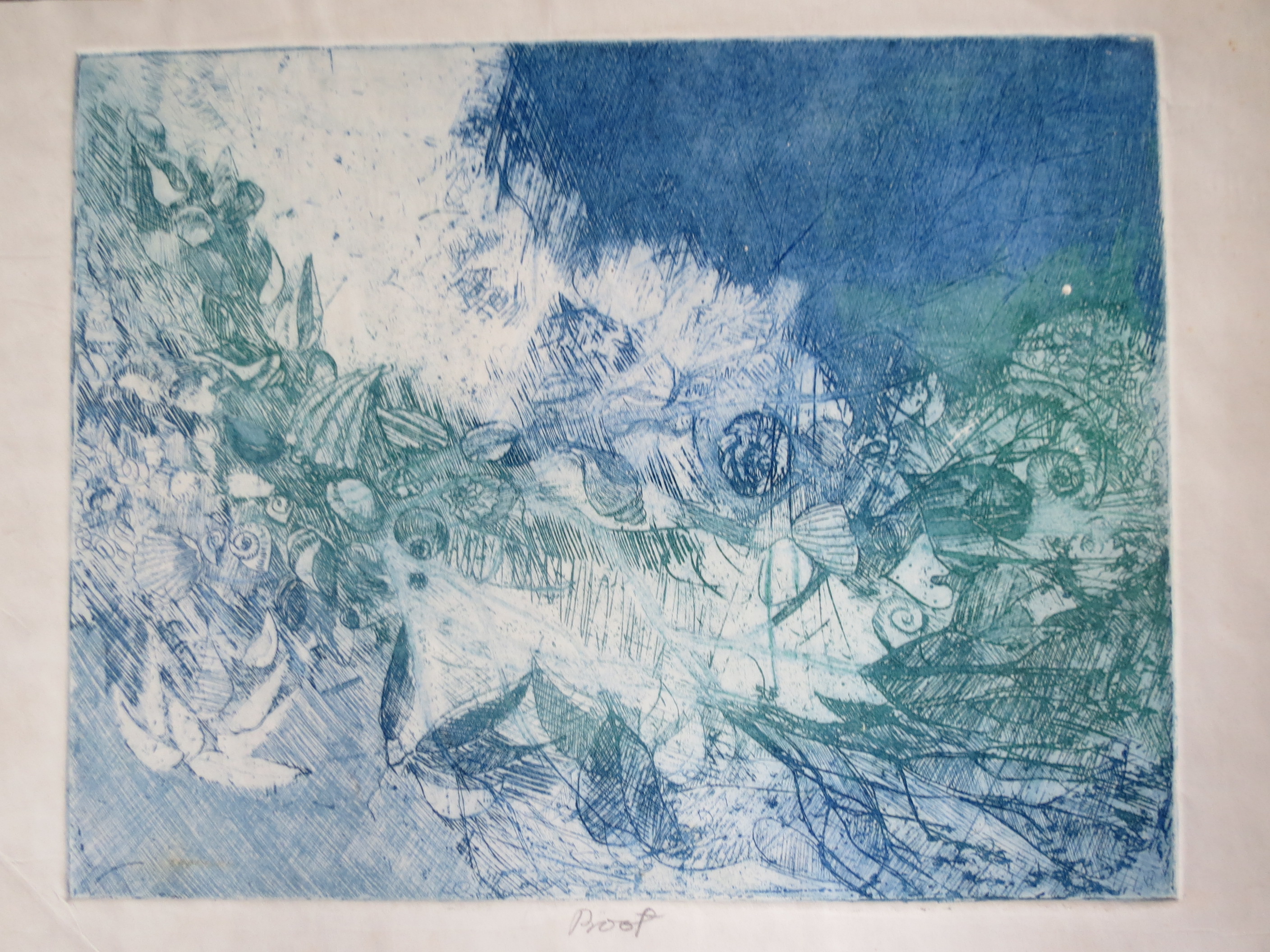
Not all of H. Ottaway’s work was tiny. This etching is another ocean themed one, with the plate size 9 inches by 11 inches. This is a proof and I will have to look up this title as well! She has used two colors together inking the plate. That is one technique. Another is to have multiple plates and run the paper through the press multiple times.
I am blogging A to Z about artists, particularly women artists and mostly about my mother, Helen Burling Ottaway.
My mother loved water colors, but she also did etchings, for as long as I can remember. We had the largest etching press that she could get back in the 1960s. When I was 14, we moved from Johnson City, New York, to Alexandria Virginia for my father’s job. The press went into the basement, along with numerous boxes of books. Soon after we moved, there was torrential rainfall and the sewers in the Del Ray neighborhood backed up. The water stopped draining and just piled up! There was a crack in the foundation of our basement with a waterfall pouring down. My mother wanted the engine of the press saved first! She and my father and I could barely carry it up the stairs, but managed to. Next came boxes of books, some of which were so waterlogged that they were floating. The water was cold, dirty and up to my upper thighs. We unloaded box after box of wet books and spread them out to dry.
I think that my mother’s art was not in the basement, so we did not lose much of that! We installed an automatic sump pump eventually, because that was not the last flood. That was the most spectaular, though. The water was 8-12 inches deep in the front yard. Buses would still drive through the water, sending a wave to hit our front steps.
Afterwards we wished we had taken a photograph in the canoe in the front yard, to use for Christmas. Our Christmas ornaments were flooded too. All the color peels off the balls, so our tree was silver and glass that Christmas. My mother claimed she liked that better and kept it that way from then on!
Etchings are diddly, as my mother would say. A zinc plate, coated with a tar mixture. Then a drawing in the tar, set the plate in acid, and wait for the drawing to etch into the plate. At a certain point, my mother would take the tar off and run some proofs. These were experimental, trying different colors. She would put the tar back on and continue with the drawing. When she was satisfied with the proof, she would start running the edition. The tar is removed, and for each etching the plate is inked with a roller. The ink is gently wiped off, until it is light on the remaining flat parts of the plate and heavier in the lines. The plate is placed on the press, a piece of paper that is soaked is placed on the plate, heavy felt cloth is lowered over it and the plate and paper are run through the press. We had a guard, but keep your fingers away! The felt is lifted, the paper is lifted and the paper is set to dry. The plate is wiped and inked again. The edition is numbered: 1/20 or 1/50. My mother ran some plates many many times. A tiny one named Tag, of a unicorn playing tag with butterflies, is done in multiple colors. Others were a much smaller edition, of 20 or 30. The very large plates are a challenge to ink and wipe. It takes practice to wipe the ink but not wipe it out of the lines.
I have three photographs of H. Ottaway’s Iris and Poppies etching. The featured image is 17/30, colored edition, 1976. The one below is a proof for the color edition. The last one is a proof for her black and white edition.
Iris and Poppies Etching, by Helen Burling Ottaway, proof for color edition.Iris and Poppies Etching, black and white proof, Helen Burling Ottaway, 1976.
#ATOZBLOGGINGCHALLENGE2022 # art # Women artists # Helen Burling Ottaway #ATOZCHALLENGE
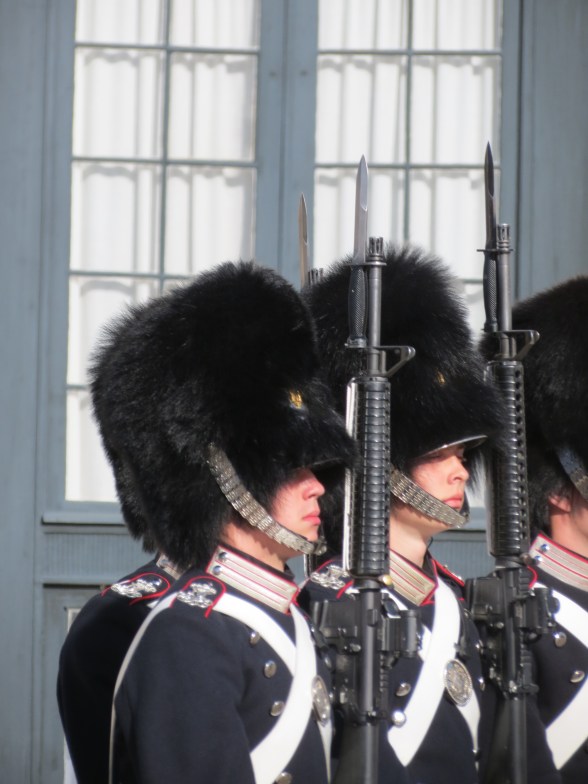
The Ragtag Daily Prompt is tassels today. I saw the changing of the guards recently. I am not sure whether they have any tassels on the uniforms, but the hats seem close enough. Very wonderful.
Discover and re-discover Mexico’s cuisine, culture and history through the recipes, backyard stories and other interesting findings of an expatriate in Canada
Engaging in some lyrical athletics whilst painting pictures with words and pounding the pavement. I run; blog; write poetry; chase after my kids & drink coffee.
Refugees welcome - Flüchtlinge willkommen I am teaching German to refugees. Ich unterrichte geflüchtete Menschen in der deutschen Sprache. I am writing this blog in English and German because my friends speak English and German. Ich schreibe auf Deutsch und Englisch, weil meine Freunde Deutsch und Englisch sprechen.







 KO Rural Mad As Hell Blog
You must be logged in to post a comment.