kooky klothes

I took this May 31, 2022. I was still pretty sick with pneumonia and needed oxygen to do practically anything. I had dropped ten pounds the first week of being sick, March 20th. In 2014 it was six months before I could return to work and then only part time and exhausted. So I knew I was likely to be in for a six month haul. I hadn’t figured on needing oxygen, but it made me feel so much better and be able to think again!

Anyhow, I was entertaining myself by going through my closet and putting on things that I did not wear to work. I like the sun lighting up my legs in this photograph. The dress is shorter than it looks and the jacket has tags in Japanese and is a soft woven silk. I thrift shop by feel, because silk and mohair and cashmere and wool and cotton feel so wonderful.

Later the same day, I took this photograph:

I would wear out very quickly during the day. Today it is pouring here and last summer by now it was much much warmer! The sun made my lungs hurt less.

For the Ragtag Daily Prompt: kooky.

spring fur

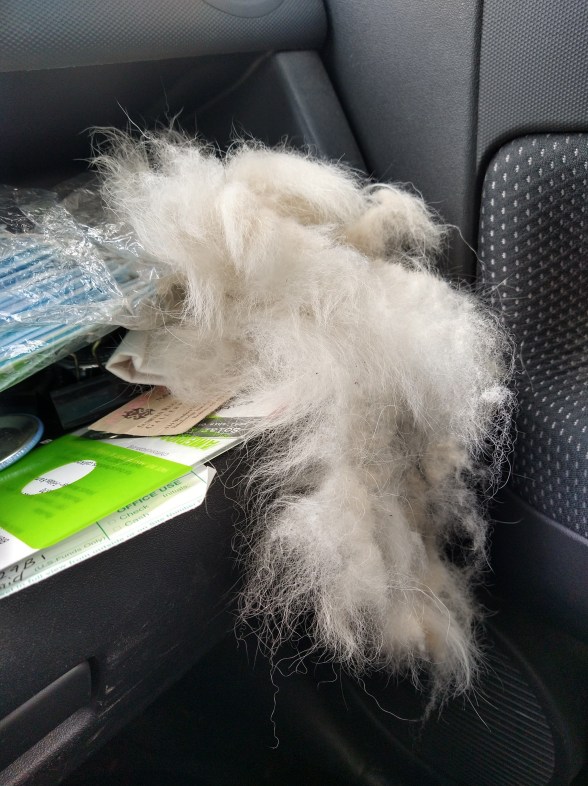
A friend has a dog that sheds in the spring in great piles. On first glance the yard looks like rabbit murder, until you realize that it is dog fur.

And why would it be in my car? I’m not sure I want to say. It has something to do with rocks and eggshells and feathers and a project that is forming in my mind.

For the Ragtag Daily Prompt: allergy.

Lung swelling and long covid

I wrote this in 2017, about influenza. However, I think covid-19 can do the same thing. Part of long covid is letting the lungs really heal, which means infuriating amounts of rest and learning to watch your own pulse. Watching the pulse is easier then messing around with a pulse oximeter. The very basics of pulse is that normal beats per minute is 60 to 100. If your pulse is 70 in bed and 120 after you do the dishes, you need to go back to bed or the couch and REST.

From 2017: Influenza is different from a cold virus and different from bacterial pneumonia, because it can cause lung tissue swelling.

Think of the lungs as having a certain amount of air space. Now, think of the walls between the air spaces getting swollen and inflamed: the air space can be cut in half. What is the result?

When the air space is cut down, in half or more, the heart has to work harder. The person may be ok when they are sitting at rest, but when they get up to walk, they cannot take a deeper breath. Their heart rate will rise to make up the difference, to try to get enough oxygen from the decreased lung space to give to the active muscles.

For example, I saw a person last week who had been sick for 5 days. No fever. Her heart rate at rest was 111. Normal is 60 to 100. Her oxygen level was fine at rest. Her oxygen level would start dropping as soon as she stood up. She had also dropped 9 pounds since I had seen her last and she couldn’t afford that. I sent her to the emergency room and she was admitted, with influenza A.

I have seen more people since and taken two off work. Why? Their heart rate, the number of beats in one minute, was under 100 and their oxygen level was fine. But when I had them walk up and down a short hall three times, their heart rates jumped: to 110, 120. Tachycardia. I put them off from work, to return in a week. If they rest, the lung swelling will have a chance to go down. If they return to work and activity, it’s like running a marathon all day, heart rate of 120. The lungs won’t heal and they are liable to get a bacterial infection or another viral infection and be hospitalized or die.

I had influenza in the early 2000s. My resting heart rate went from the 60s to 100. When I returned to clinic after a week, I felt like I was dying. I put the pulse ox on my finger. My heart rate standing was 130! I had seen my physician in the hospital that morning and he’d gotten a prescription pad and wrote: GO TO BED! He said I was too sick to work and he was right. I went home. It took two months for the swelling to go down and I worried for a while that it never would. I dropped 10 pounds the first week I was sick and it stayed down for six months.

Since the problem in influenza is tissue swelling, albuterol doesn’t work. Albuterol relaxes bronchospasm, lung muscle tightness. Cough medicine doesn’t work very well either: there is not fluid to cough up. The lungs are like road rash, bruised, swollen, air spaces smaller. Steroids and prednisone don’t work. Antiviral flu medicine helps if you get it within the first 72 hours!

You can check your pulse at home. Count the number of beats in one minute. That is your heart rate. Then get up and walk until you are a little short of breath (or a lot) or your heart is going fast. Then count the rate again. If your heart rate is jumping 20-30 beats faster per minute or if it’s over 100, you need to rest until it is better. Hopefully it will only be a week, and not two months like me!


Feel free to take this to your doctor. I was not taught this: I learned it on the job.

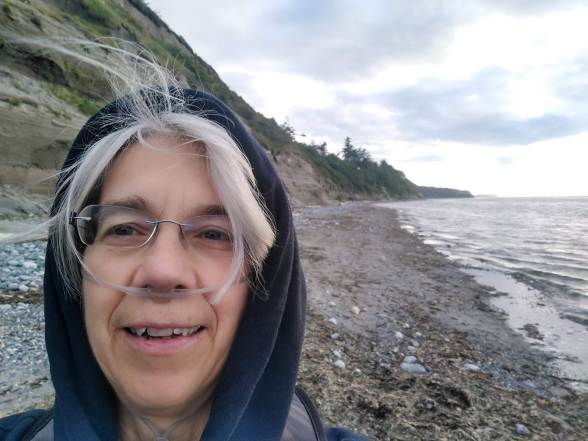
I took the photograph, a stealthie, in June 2021, when I was still on oxygen continuously.

Caduceus Hair

A physician says to me, β€œYou might have had more friends and been more successful in your career if you had been put on medication a long time ago.”

I think, β€œYou f—ing bitch.” Nothing shows on my face. The doctor face is pleasant on the surface and the stone face that guards my feelings is deeper. I could show you the snakes and you would turn to stone but I would go to jail.

Your words don’t go away. They fester, a deep deep wound. I ask my other doctor, β€œIf my only symptom of pneumonia is my mood, no white count, no fever, how would I know if I had pneumonia if I were medicated?”

I think back. Age twenty five with belly pain, emergency room, CT scan and then a sigmoidoscopy. I couldn’t eat, it hurt so bad. The emergency room offers me valium. β€œNo,” I say, β€œmy father is an alcoholic. I won’t take that.” I am sent to counseling. The counselor, smug, blonde, polished, wants to send me to her husband, a psychiatrist, for drugs. β€œNo,” I say, β€œmy father is an alcoholic. I want talk therapy not drugs.” I am very very afraid.

Things get better.  I tell the counselor thank you. β€œYou can’t stop now,” she says, β€œYou must continue the counseling. Or you will have problems later on.” I go once more. She says I must keep coming. I speak to a family friend, a PhD psychologist, who encourages me to say no. I cancel. No regrets.

I am not an alcoholic. I don’t smoke. I don’t use pot nor CBD. I never tried cocaine or meth or opioids or crack. I can tell an addict by their charm: the sick people are not charming nor the people in for maintenance. The moment a person tries to charm me I wonder what they want.

The physician is wrong and cruel besides. Valium is addictive and is still overused. I could have taken the path of psychiatric medicine but I chose not to.

I will find another doctor who is less stupid and cruel. They do exist. I know, because I am one.

____________________________

trap (version II)

why are you so afraid of being trapped?

and it’s attached to women
not to men

that is weird

but we are all weird

I have an explanation
That I won’t share here
Doesn’t matter
doesn’t matter if it is right or wrong

what matters is the pattern
and whether you can break it
and whether you can heal it
and whether you want to heal it
or just repeat it

over and over again

I do not know what you will do
whether you will see the pattern
whether you want to break it
whether you want to heal it

but the pattern is why you chose me
that is clear as glass, as ice, as air
on a very clear cold day

my pattern is that I don’t give up
as you said, I look at things from all sides
I am tolerant to a fault, you say

what matters is my pattern
whether I see the pattern
whether I can break the pattern
whether I want to heal the pattern

and yes I do

I see the pattern thanks to you
what matters is the pattern
I will break the pattern
I will heal the pattern

thank you, love

sometimes we must cut the abscess open
and drain the pus
or rebreak the bone that has healed wrong
or amputate the gangrenous fingers
to save the rest

I see the pattern
I change it
I heal

_______________

May 27, 2022

failure of the medical non-system

One thing that makes me gloomy, as a Family Practice Physician: the only person who has read my medical notes from the multiple specialists is ME.

Since March 2021, I have seen Family Practice, Cardiology, Pulmonology, Infectious Disease, Immunology and Psychiatry. I am in a rural area, so this involves three different hospital systems. They all use the EPIC electronic medical record, but they won’t release information to each other. I have gotten two of them hooked together under ONE of my names and passwords but guess what: my primary care physicain can’t see the notes from the other sites. Only I can. “Proprietary infromation.” Hey, you stupid medical non-systems, this is MY healthcare, MY notes, and YOU SUCK.

My primary care physician COULD request the notes from my pulmonologist but she hasn’t. I find this incomprehensible. I have been on oxygen for over a year. I guess my doctor frankly doesn’t care. Has she farmed my lungs out to pulmonology and doesn’t have to pay attention any more? My goal in practice was to have all of the specialists’ notes. If that was five different specialists, I requested them. Ok, it is next to impossible to get psychiatry notes. I keep wondering if psychiatrists really write notes. The patients never seem to know what diagnosis the psychiatrist is using. One hundred percent of the people that I have seen put on an (addictive) benzodiazepine say that it is for sleep. Meanwhile, at the conferences, the psychiatrists say that primary care should not give the patients benzodiazepines for sleep. I raise my hand: “Even when you psychiatrists have started them? The patients all say it’s for sleep. We don’t know WHAT you have them on it for.” When I try to stop the benzo, the patient has a fit and says that psychiatry said they have to have it. And the psychiatrist has retired or left or changed the phone number and there are no notes ever.

Anyhow, I am counting up specialists. I had really bad strep A pneumonia in 2012 and 2014. Since 2012 I have seen 20 specialists. That is counting the three Family Practitioners, because Family Practice is a specialty too. I thought it was about taking care of the whole person, which to me means reading all the specialists notes, but not one of the ones I have been to has done that.

So the medical system is an abject failure. I blame the US citizens. We choose the system with our votes. We need medicare for all, single payer healthcare, and one electronic medical record for all of the United States. Right now, there is a push to privatize medicare and turn it over to For Profit. We need to fight this and we need to demand better healthcare. Hospital organizations should not be refusing to send my clinic note to my primary care doctor. It is stupid and bad care.

https://pnhp.org/ Physicians for a National Healthcare Program for more information.


website ethics and mine

Two days ago I wrote to the owner of the website that “separated” me for “not explicitly breaking the rules”.

I have not gotten an answer.

Doesn’t matter, you say. I disagree. I think our ethics matters and it matters on line. Isn’t that part of what we are fighting about?

Let’s drill down. The editors stated on this obscure not to be named site that they were tightening rules and removing write-ups that should be logs or are just not high enough quality, and letting the writers repost them as logs. So far they have removed over 250 of my writeups. Ironically, I was one of the two most prolific writers in the last year. Let’s kill the golden goose because she’s annoying, won’t we? The other writer has not been “separated”.

I note that they have removed my write up called “birth of ——–“. Now, this interests me. This was a well received write up, had up votes, and was the start of a category. The category was people explaining how they chose their on line name.

So: the editors are liars and abusing their power. They have removed a well received and well liked write up because they have personal animosity towards me. I have protested the removal of 250+ writeups and asked that they be reposted as logs. No answer.

The other writeups in the how I chose my name category are still there. So this is PERSONAL and the editors of the site are unethical.

Therefore, I hope the site dies. Or gets rid of those editors. I think I want it to die, even though it has writing by my sister. This does matter. As a species, we will either learn to be fair and human on line as well as off line, or we will end in conflagration. The site will certainly not be there if we start lobbing nuclear bombs at each other. The owner works for the US government. Why is he/she not paying attention to this obscure website that he/she owns?

Whether or not the world burns this month, if the editors are manifestly unfair on the site, the site will die and deserves to die. I wish that I could have my sister’s drafts before it shuts down.

I ended my email that is not answered with this: Good luck. I hope that ethics matters to both of us.

Thank you.

on line site name

_______________________

I will not name the site here or anywhere again, until and unless those editors are shut down and the site becomes ethical.

We are fighting this fight as a species, as humanity. We have to learn to be as ethical on line as we are in person. Well, you say, some people AREN’T ethical. Yes, that is true. As a rural physician, my goal is to take care of ANYONE WHO COMES IN. The emergency room physician cares for the family of four hit by the drunk and the drunk too, even if there is a dead child in the family of four. We set our judgement aside and do the best for each and every patient, regardless of the story. At least, that is the goal. It is the highest goal I know of.

Blessings and be your ethical self on line. As my children said to me when I threw their father out of the house once, “We don’t care what he does. We want you to be polite to dad no matter what.” And they were RIGHT! We answer to ourselves and to the Beloved and to our children.

Blessings.

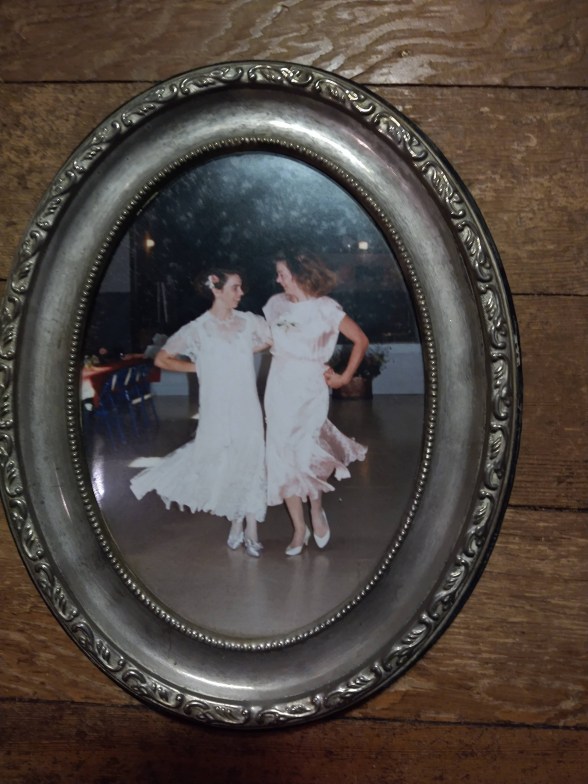
The photo is me and my sister, dancing before my wedding in 1989. She died of cancer in 2012.

On The Edge of Humanity Magazine

Huge thanks to The Edge of Humanity Magazine, for publishing two essays.

The first one on May 9, 2022, that abortion must remain legal for women’s health:

The second today, about behavioral health in a pandemic and war. As caring humans, how could we NOT respond with distress to the suffering and deaths from both Covid-19 and disasters and wars?

I am so delighted to be featured on this platform. I enjoy so many of the artists and writers and poets who are featured there and I am very happy to contribute!

how doctors think, a dual pathway

A friend calls today and says that another person is bleeding and yet they have been set up to be seen Monday. Why isn’t this an emergency?

Based on the limited information the friend tells me, I agree with the doctors. It is NOT an emergency and I explain why. It is uncomfortable for the person because it may be cancer. Why is that not an emergency?

Let’s use chest pain in the emergency room as an example. Doctors have two brain tracks that are triggered simultaneously by every patient. The first one is “What could kill this person in the next five minutes?” The second is “What is common?” Common things are common and more likely. In medical school the really rare things are nicknamed zebras. You know there are a lot of horses but you can’t miss the zebra. I suppose that in Africa the common things are zebras and the rare ones are orcas or something like that.

Anyhow, the killers for chest pain are heart attacks, sudden death. But there could also be a dissecting aortic aneurysm, where the largest artery in the body is tearing. That person can bleed to death really really fast and that is a surgical emergency. No doctor wants to miss it. There could be a pulmonary embolism, a clot blocking the lung. Chest pain could be from a cancer. A very rare chest pain is from the valve leaflets in the heart tearing so that the person goes in to flash pulmonary edema. And there is Takayasu’s Arteritis, “broken heart syndrome”, where the heart suddenly balloons in size and again, heart failure ensues. Heart failure is actually pump failure, so fluid backs up in the lungs or the legs or both. It is usually slow but rarely very fast and dramatic. A collapsed lung can also cause a lot of pain. And my list is still not complete, I haven’t mentioned pericarditis or myocarditis or a compression fracture.

The common things do include heart attacks, but also anxiety, musculoskeletal problems, inflamed cartilage of the chest wall, fibromyalgia flares, broken ribs, trauma and other things. I was very puzzled in clinic by a woman with pain on both sides of her lower chest wall. In front but cutting through her chest. I ruled out many things. I thought that it was her diaphragm. I sent her to a rehab doctor for help. The rehab doctor sent her to radiology. She had a compression fracture of her spine and the nerves were sending pain messages on both sides. That was not even on my “differential diagnosis” list, because she had no back pain at all. My list changed that day.

Physicians and nurse practitioners and physicians assistants and registered nurses and licensed practical nurses and medical assistants are all trained to think of this differential diagnosis. We are alerted by the history and have to think down both pathways. Last year working as a temporary doctor, the medical assistant came to me saying, “This patient’s blood pressure is 80/60.” “Is he conscious?” I asked, as I went straight for the room. “Yes, he’s talking.” He WAS talking, which means that he’s gotten to 80/60 slowly or is used to it. His heart rate was fast, up near 120. I immediately had him drink water and keep drinking, as soon as he denied chest pain. The problem was dehydration: he was developmentally delayed and had only had one cup of fluid that day and it was now midafternoon. I spent time explaining that he needed 8 cups each day. Not more than that, because if he had too much fluid, it would lower his sodium and make his muscles weak. Most days he drank 3-4 cups. His chart graphed the problem: some days he had normal blood pressure and a normal heart rate. Other days his blood pressure was below normal and his heart rate was fast, his heart trying to make up for the low level of fluid. Cars don’t do so well when there is almost no oil, do they? His kidneys were affected as well. I asked him to drink the 8 cups a day, discussed the size of the cup (not 8 gallons, please) and then recheck labs in 2 weeks. If his kidneys did not improve, he would need a kidney specialist. It turned out that he had nearly fainted that morning in the waiting room. His group home person admitted that no one had noticed that he really was not drinking fluid. I thought that the patient understood and would try to drink a better amount of fluid.

So back to the person I was called about. Infection has been ruled out. This is blood in the urine. A kidney stone has been ruled out, but there is something in the kidney. This is urgent, but if the person is not bleeding hard, it is not emergent. When there is blood in the urine it does not take very much to turn it red. If there is a lot of blood, that can be an emergency, but from the story I got third person, it’s not very much. The emergency things are ruled out but there is still not a clear diagnosis. Yes, cancer is one of the possibilities but it could also be benign. Now a specialist is needed to figure out the next step and the differential diagnosis, the list of things it could be. They will order tests in the same dual order: what could kill this person quickly and what do we need to rule out as common? People often can be very anxious during this period, which is normal. The person says, “I don’t care what it ISN’T, I want to know what it IS.” But sometimes it is a zebra and it takes a while to get to that specific test.

Another example is a woman that I sent to the eye doctor. The optometrist thought it was something rare and bad. He sent her to the opthamologist, who ruled out the first thing, but thought it was something else rare and bad. He sent her to a retinal specialist. The retinal specialist ruled out the second rare and bad thing and said, “No, you have something very rare that is benign.” My patient said, “I have three diagnoses. Who do I believe?” I replied, “No, you have one. The optometrist knew it was unusual and sent you to an eye doctor. The eye doctor know it was unusual and sent you to an even more specialized eye doctor (a “sub specialist”. We keep them in basements.) Now you have a diagnosis. It was a scary process, but I think you should focus on the third opinion because hey, she said it’s benign and it won’t hurt you! That is the best outcome!” She thought about it and agreed. The process was frightening but the conclusion could not have been better.

For the Ragtag Daily Prompt: disquieting.

how to use a specialist

I am a rural Family Medicine doctor, board certified and board eligible. I have used the Telemedicine groups in the nearest big University Hospital since 2010.

Initially I started with the Addiction Telemedicine. I accidentally became the only physician in my county prescribing buprenorphine for opioid overuse in 2010. I panicked when I started getting calls. Dr. Merrill from UW had taught the course and gave me his pager number. I acquired 30 patients in three weeks, because the only other provider was suddenly unavailable. Dr. Merrill talked me through that 21 day trial by fire.

I think that I presented at least 20 patients to telemedicine the first year. The telemedicine took an hour and a half. First was a continuing medical education talk on some aspect of “overuse”, aka addiction, and then different doctors would present cases. We had to fill out a form and send it in. It had the gender and year of birth, but was not otherwise supposed to identify the person. TeleAddiction had a panel, consisting of Dr. Merrill (addiction), a psychiatrist, the moderator/pain doctor, and a physiatrist. Physiatrists are the doctor version of a physical therapist. They are the experts in trying to get people the best equipment and function after being blown up in the military or after a terrible car wreck or with multiple sclerosis. There would usually be a fifth guest specialist, often the presenter.

After a while, TeleAddiction got rolled into Telepain and changed days. They added other groups: one for psychiatry, one for HIV and one for hepatitis C. These can all overlap. I mostly attend TelePain and TelePsychiatry.

After a while, I pretty much know what the Telepain specialists are going to advise. So why would I present a patient at that point? Ah, good question. I use Telepain for the weight of authority. I would present a patient when the patient was refusing to follow my recommendations. I would present to Telepain, usually with a very good idea of what the recommendations would be. The team would each speak and fax me a hard copy. I would present this to the patient. Not one physician, and a rural primary care doctor, but five: I was backed up by four specialists. My patients still have a choice. They can negotiate and they always have the right to switch to another doctor. Some do, some don’t.

I am a specialist too. Family Practice is a specialty requiring a three year residency. The general practitioners used to go into practice after one year of internship. My residency was at OHSU in Portland, with rotations through multiple other specialties. We rotated through the high risk obstetrics group, alternating call with the obstetrics residents, which gave me excellent training for doing rural obstetrics and knowing when to call the high risk perinatologist. In my first job I was four hours by fixed wing from the nearest more comprehensive obstetrics, so we really had to think ahead. No helicopter, the distance was too far and over a 9000 foot pass, in all four directions. That was rather exciting as well.