No, really! I am a mature adult! I swear! My inner child has grown up!
Well, maybe not at the end of October.
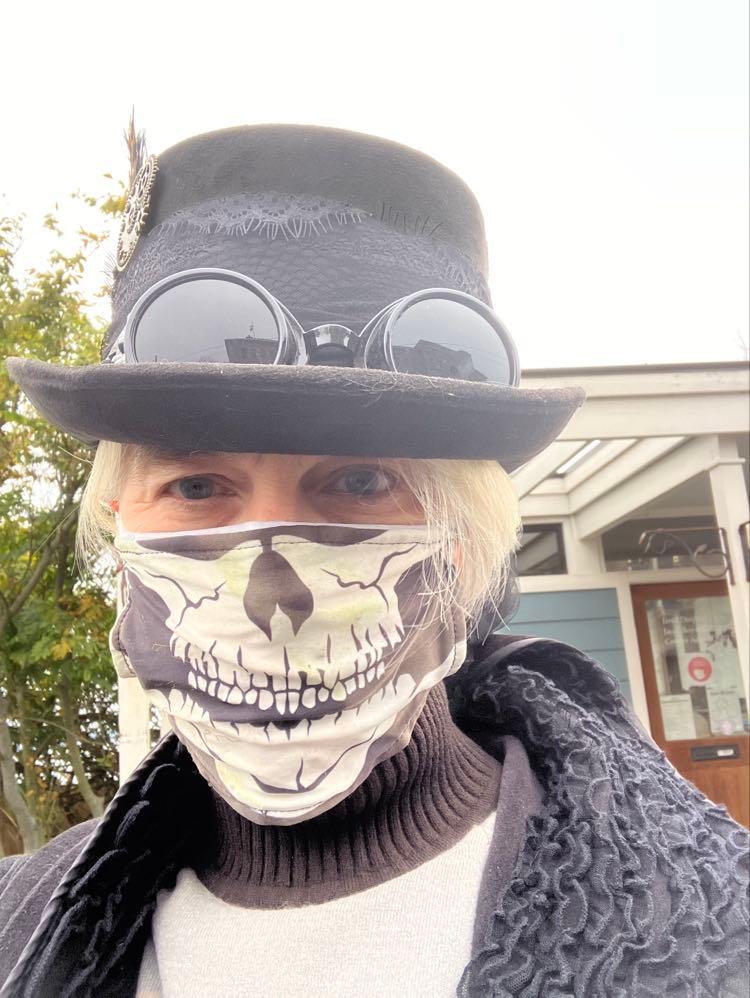
My friend P took the photographs with my phone in 2022.
For the Ragtag Daily Prompt: maturity.


No, really! I am a mature adult! I swear! My inner child has grown up!
Well, maybe not at the end of October.
My friend P took the photographs with my phone in 2022.
For the Ragtag Daily Prompt: maturity.

I was driven yesterday. I have an ill friend. She is currently in a “rehab”, aka “nursing home”, in Sequim. I drive 40 minutes to be with her at an hour appointment. Afterwards we check in at the nursing home and then I drive her back to her house, 40 minutes again. That is where Lily is. Lily is her cat. My friend was in the hospital for six days and now the “rehab” for two weeks. My friend wants to go home. Lily is miserable. She misses her person and hisses and swipes at me. I was driven to take my friend to see her cat.
Lily let me pet her yesterday because I brought her person home. However, the whole thing was a near disaster. My friend has been trying to get stronger, but she is not stronger. She is weaker. She has three steps into her house. We were there for about three hours. She sat to wash the cat’s bowl in the kitchen sink and Lily was very very happy to be near her. My friend was then tired enough that we had real difficulty getting her out of the house and back in the car. I used a bath stool to let her stop and sit about every four feet. She was using a walker, but could barely walk. She sat in the doorway of the house and talked about crawling. However, those muscles in your upper legs? Those are some of the biggest muscles in the body, and if you can barely walk, scooting or crawling is not feasible either.
We made it to the car without having to call an ambulance. I’m pretty strong for my age and size, but I’m not strong enough to carry her alone.
Poor Lily. I don’t think I dare try to get her in a cat carrier and she’d probably cry all the way driving and anyhow, the nursing home would need a shot record.
Lily will have to put up with my care for now.
For the Ragtag Daily Prompt: driven.
I am not my friend’s doctor, I am just a friend.

I really enjoy elder care in Family Medicine. Mostly. Even some of the very difficult or very complicated people.
One thing I would try to figure out is what is the person’s goal? This can be quite funny at times.
“Can we talk about what you would want if you got really sick? If you were too sick to talk to us?”
“I don’t want to talk about death.” Ok, this person is in their 90s.
“That is fine, but if we don’t talk about it, your daughter and I have to guess what you want. And we tend to do more when we don’t know.”
That person glares at me. “Oh, all right.”
Sometimes a person says, “I don’t want to die of cancer.”
It turns out that this is an opening. “Ok, what DO you want to die of?”
“I don’t want to die!”
“Well, me either, but I can’t fix that. There are at least three “ideal” deaths that the Veterans Administration talks to people about. Maybe we could go over them. You could put your request in with your higher power.” I have written about the three here: https://drkottaway.com/2023/10/06/an-ideal-death/. The “Hallmark” or hospice death, sudden death and fight it all the way.
But, other than not dying, what is the goal? To stay in one’s home? To move to a retirement organization that has a nursing home and care until death? Home care insurance to stay home? I do have people imply that they will go into the woods or crash their car or something if they get very sick, but not very often. They are usually aware that I have to respond to any suicide threat. How much care do they want? People often say, “I wouldn’t want to be disabled,” but it turns out that life is often worth living even when very challenging. Most people want to be treated for cancer, for heart disease, for congestive heart failure, to go on.
Sometimes death comes from a cumulative load of chronic problems. We had a gentleman in his 80s in the hospital ICU many years ago. He had pneumonia, congestive heart failure and bad kidneys as well as a host of other problems. I sat down with him. “We are treating you, but when we give you enough medicine to help you breathe, your kidneys are getting worse. This is a small rural hospital. I could transfer you to the Seattle hospital, 2 hours away. You would have a cardiologist, a kidney doctor, a lung doctor. Here you just have me and the nurses. Either way, I do not know if you will live through this. What do you want to do?”
He chose to stay. “My family can visit me here.” His family was visiting daily. “I do not want a breathing tube. I do not want dialysis. If my kidneys go, let me go.” We discussed this with the family.
Four days later it was clear that without dialysis, he was dying. Dialysis might have slowed it, but he may still have died. He was no longer waking up. We withdrew the antibiotics and removed most of the monitoring and switched him to hospice. His family continued to visit and he died a few days later.
He did die in the hospital, and yes, we used some machines up until care was withdrawn, but this still seems like he got to make choices and his family understood. It can be much harder with memory loss when the person really can’t make choices any more.
He was complicated. To keep him breathing well without a machine, we had to give him diuretics, that were eventually too much for his kidneys. A bad heart, lungs with emphysema and pneumonia, and bad kidneys. Sometimes the liver is not working either, and then what is there left to work with? Nearly all drugs are broken down by either the liver or kidneys. Simethicone is not absorbed, so that’s the exception.
Sometimes people get along until too many things accumulate and then they end up in the hospital and on multiple new medicines. It can be very confusing. Regular maintenance is a good idea.
Sometimes the family wants something different from the patient. Or there is an elder parent and three adult children, who all disagree. My job is advocate for the patient. But this is Family Medicine, so I have a responsibility to the patient but also to the family. The person, the family, the community, how is it all fitting together? Sometimes functional, sometimes not.
I had one person who called me when he had been flown to a Seattle hospital. “I have to get home.” he says, “Can you release me? I have to take care of my wife!” I panicked for a moment. “Is your wife bedridden? Where is she? Why are you in the hospital?” She was not bedridden and she was fine. He was being more and more behaviorally squirrelly. He could no longer drive, but drove anyhow. His wife disabled the car, because he would disappear. I sent him to a neurologist for memory testing. The neurologist said, “Hmmm.” and sent him for neuropsych testing. The neuropsych report said dryly that his memory was fine, but he had certain long standing behaviors related to past heavy alcohol use. Oh. He was quite proud of not drinking and going to AA, but he also triangulated with his family and me. I sat him down and said, “Ok, I am not going to talk to a different one of your five children every time you see me in the clinic, because you’ve said, “Don’t tell mom I called you.” Pick ONE person for me to talk to and now you have to have a family member with you when you come to clinic.” He grinned and chose his wife. He had certainly fooled me about his memory, because he blamed his behavior on his memory. The neurologist was not quite fooled. The family calmed down and he did not drive any more, thank goodness. He was not an easy patient, but he was entertaining and educational too. And I felt that I had helped both him and the family.
Sometimes families fight. Sometimes a dysfunctional family will get way worse when someone is sick or dies. Sometimes families go on fighting. Other families are so kind and so good to each other and their elders. Every family is different.
For the Ragtag Daily Prompt: concentration.
Most of us do NOT live in homes practical for aging. My house has four steps in the front and five in the back to get in and out. The main floor has almost everything needed if I cannot climb a flight of stairs: only the laundry is in the basement.
I am helping a friend in her 80s. The issue, from my practical and pragmatic Family Medicine standpoint, is that she is falling. She told me that she was falling, five times in a day, in November. I got involved right away, because she had a surgery canceled because of it. She has three specialists and a primary. I called them all and took her to the emergency room first and then to her primary.
We asked her primary for disabled parking and for home health services. In Washington State, if you can’t leave your house except to the store or the doctor, you qualify for home health. I also fussed about her blood pressure, but her primary thought she was fine.
The thing is, we should not always have a blood pressure goal of 130 or less systolic once we hit 75 or 80. With weight loss, people can drop a blood pressure point for each 2 pounds lost. The blood pressure range that is safer at age 75 or 80 is to keep it around 140-150, unless the person has heart disease or congestive heart failure. Over 150 is getting too high. The brain must get good oxygen by blood flow and if it doesn’t, there are sensors in our neck that make us faint. That can be a full on loss of consciousness, or just a decrease and drop to the floor. There are some instances where the blood pressure still needs to be kept down at 125-130 systolic: bad coronary artery disease and congestive heart failure especially. But being able to stand up and walk is rather important to elder health.
The distraction for my friend’s physicians is that she has had cancer for three years. We are told that she needs an MRI of her head to rule out brain tumors, metastases from her cancer. Yes, brain tumors can cause falls, so that does need to be ruled out. My friend only falls when standing, sometimes at the counter, gets lightheaded and once has had a full on syncope. No chest pain or heart racing.
It took two months to get the brain MRI, which is negative. We saw her oncologist this week and I pushed for her cardiologist to see her sooner than June. He saw her yesterday. She is on medicine for a heart arrhythmia, but it doesn’t sound like her arrhythmia is acting up. He’s still checking: a monitor and heart ultrasound, but meanwhile he says, “I don’t tell many people this, but you need to drink more fluid and eat more salt.”
“They told me low salt. I stopped salt when I cook.”
“Start salt again and more fluid and return in 3 weeks.” She has been falling 1-5 times a day in her home. She lives alone. She is stubbornly resisting leaving her home and I am ok with that. But, it would be most helpful for her health if she was not falling. That is the priority here. She will not live forever, but she wants to stay in her home. Let’s help with that.
I am NOT saying that everyone over 75 should increase salt. If a person has bad hypertension, or heart disease, or congestive heart failure, they should not increase salt unless their doctor has a specific reason. And heart is the number one killer, so there are lots of people who should continue to eat a low salt diet. But falling and breaking a hip is also a killer.
My friend has three steps to get out of her house. The first day last week that I took her to get labs, she fell three times. “But Jim, I’m a doctor, not a nurse!” Ok, I am not a good nurse. However, we got her back inside after labs and getting the CT scan contrast for her to drink. She has not fallen when I have gotten her in or out since. I’ve had to enlist help twice, since she’s taller than me. Going down the steps is worse than going up. Home health is doing physical therapy and she has a raised seat on her commode. That is good, except those are the muscles that help us go up and down stairs. She has a walker too. She is still falling, because to cook, one has to let go of the walker, right?
So if someone wants to stay at home, think about the home. Are there steps? How strong is the person? Do they have the resources to pay for around the clock care if they become bedridden? I am practicing getting down on the floor and back up every single day, because I want to be strong. I have an upstairs and a basement, and I am going to continue with stairs for as long as possible. If I break my leg, those four front stairs are going to be an issue, but I am thinking about it. Perhaps I should design a decorative ramp, or a sloping earth entry.
Will the house accomodate a wheelchair? Is there a bathroom and a bedroom, as well as the kitchen, on the main floor? Is there clutter? I know I am supposed to keep the floors clear to reduce fall risk. I had one person who kept falling at night because he wouldn’t turn on a light. “It would wake my wife and disturb her,” he said. “It will disturb her more if you break your hip.” I said. “Turn on a light or a flashlight or something.”
Harvard Medicine agrees: https://www.health.harvard.edu/staying-healthy/master-the-stairs
Be careful out there. Or maybe in there.
For the Ragtag Daily Prompt: Elder care can’t be laissez-faire.
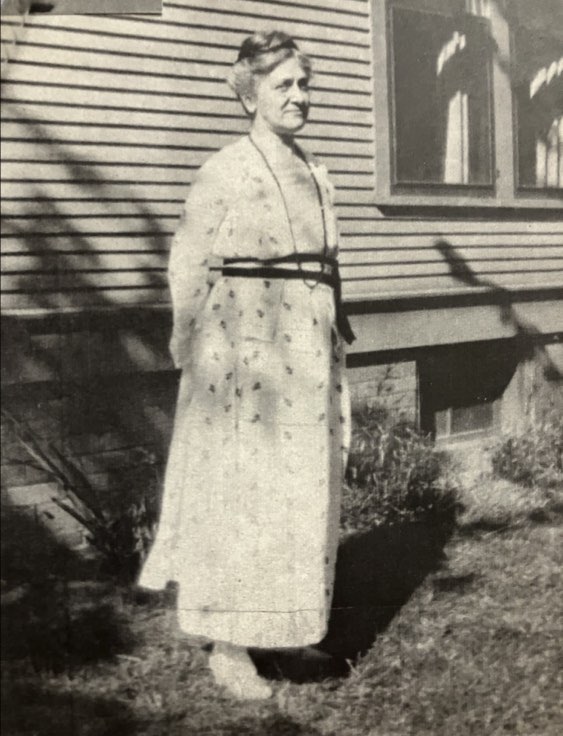
The photograph is not my friend. This is Tessie Temple, my maternal grandfather’s mother. I do not have a date nor who took the photograph. Another photograph is stamped on the back: Battle Creek. She must have gone to one of the famous sanatoriums, like Kellogg’s, for rest or the cures.
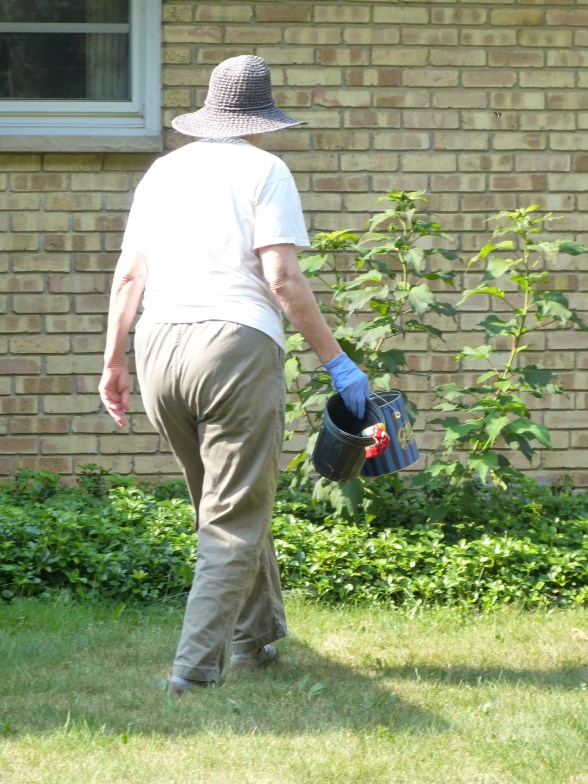
My friend M is twenty years older than me. A friend of my parents since college. When I went to college in Madison, WI, I got to know her and her husband and their two sons. I lived with them my third year of college and it was a ball! I loved the family.
I visited over the years and more often when her husband had lung cancer and died. She wanted me to come out for her younger son’s fiftieth birthday. Her daughter-in-law said, “It’s nice to meet the daughter.” Apparently M considered me a daughter. I was delighted, since both of my parents had died by then.
A year ago M was feeling less well. She started losing weight. A work up was done, finding no cause. She had a rare cancer that had been treated two years prior. But by July, she had lost thirty pounds.
Thirty pounds! As a primary care doctor, RED FLAG! Very high likelihood of dying, if that went on. She was eighty years old.
I flew out in September. We took a road trip, just the two of us, from Michigan back to Wisconsin. We visited multiple old friends of hers. She thanked me afterwards, because one friend had Parkinson’s and died ten days after our visit. We saw her sisters-in-law and we did a circuit around Madison.
Afterwards, she said that was her last time driving on highways.
By December, she had dropped another ten pounds. Then she had difficulty walking. The daughter-in-law called me. She was having trouble getting any medical attention. They had had trouble for a year! Over a week, M went from walking to not being able to support her weight or stand up. I flew up right after New Years.
Something was wrong, clearly. She’d carried her own bags in September. I was the out of state doctor. The daughter-in-law, B, was moving her from bed to chair alone. I couldn’t. I am 5’4″ and M was 5’10” and now my weight. B found a private practitioner.
On my third day there, M had chest pain. We took her to the Emergency Room. The Emergency Room did the usual things. Then the ER doctor came in. “She is not having a heart attack and she doesn’t have pulmonary emboli. So you can take her home.”
“No, something is wrong! She can’t walk! She could walk two weeks ago! We did a road trip in September!”
The ER doctor shrugged. “What do you expect me to do?”
“Figure out what is going on!”
“She is eighty.” he said. As if eighty meant we stop caring.
“No, we won’t take her home. It isn’t safe. We can’t move her. M, do you want to stay?”
“Yes,” said M.
The ER doctor looked annoyed. “All right. I’ll admit her for placement in a nursing home.”
The inpatient doctor was scarcely more interested.
“What do you expect me to do?” he said, knowing he was dealing with an annoying out of town doctor.
“Steroids.” I said, “Maybe it’s a weird form of polymyalgia rheumatica. She deserves a trial of steroids.”
He too shrugged, and started steroids.
The next day she was stronger, and the third day she could stand. It was SOMETHING, but not clearly polymyalgia rheumatica. The hospital was small and did not have a cancer doctor and did not have a neurologist. They were sending her out on steroids. Follow up outpatient.
We looked at a nursing home, but went to a private assisted living instead. The staff were minimally helpful. We took turns sleeping there. Physical therapy and occupational therapy were started. M was a bit better but not the miraculous return to normal that steroids cause in polymyalgia.
I flew home. The private physician saw her. M was set up to see the U of Michigan. B kept asking if it was lymphoma, because that can be a side effect of the treatment for M’s cancer. M’s cancer doctor said no. M got covid and the appointments were delayed two weeks.
In February she went to the U of Michigan. The neurologists came through and said, nope, not polymyalgia rheumatica, and not neurological. The cancer doctor came through. The GI doctors did an upper endoscopy and biopsied. Cancer. Lymphoma.
M said no to treatment. She was discharged to hospice. She died within 24 hours of reaching the hospice.
The cancer doctor sent an apology to B, who was right all along. This was a particular lymphoma that responds to steroids for a while. M had said that if it was another cancer, she would refuse treatment.
So what the hell is going on here? This: https://www.technologyreview.com/2019/08/21/238642/a-doctor-and-medical-ethicist-argues-life-after-75-is-not-worth-living/
“These people who live a vigorous life to 70, 80, 90 years of age—when I look at what those people “do,” almost all of it is what I classify as play. It’s not meaningful work. They’re riding motorcycles; they’re hiking. Which can all have value—don’t get me wrong. But if it’s the main thing in your life? Ummm, that’s not probably a meaningful life.”
Ok, so now some doctors don’t care once you reach 75. That’s it. They define everything as “useful and productive” and if you are not doing meaningful work, well, you’d might as well die. I hope that doctor does die. Slowly. And that everyone around him refuses to do any tests to see what is happening. And who the hell defines what is meaningful work? That can be helping raise grandchildren, like, hello!
I have another friend who is going through the same thing. She is failing and the medical community in my town is shrugging their shoulders. She should have a head MRI, says the cancer doctor. So that was a month ago and it still isn’t scheduled.
Some of this is pandemic fatigue and backlash. People refusing to get vaccinated, people refusing to believe that Covid-19 exists, doctors and nurses dying of Covid-19, people refusing masks. If everyone is exhausted, what do you let go?
Apparently people over 75. But NOT everyone over 75. If you are wealthy, you will get care. Our Senators and House of Representatives certainly get care after 75. It is the isolated, the rural, the poor, the ones who don’t have an advocate, who will be sent home to die.
I took my friend here to her primary. “What do you want me to do?” he says.
“Here is the Home Health paperwork and she needs disability tags.” My friend is falling, five times that week.
“Ok,” says the primary. “I will set those up.”
When Home Health arrived, she had fallen. She had been down for 15 minutes and unable to get up. Home Health called the fire department. The fire department helped and also came back to put no slip pads on the steps. If she can buy the wood, they will build a ramp for her.
And I will go with her to the cancer doctor and I will rattle cages. She lives alone, she has no children, she has a brother in Alaska. But she also has an advocate. One who knows the medical system and who is not in an ethical stupor.
For the Ragtag Daily Prompt: stupor.

I have been wondering whether to try to work again. It’s risky.
I asked the pulmonologist from Swedish Hospital if there was any way to keep from getting pneumonia number five. “We don’t know.” Is it safe for me to return to work? “We don’t know.” I like the plural in the answer, is he speaking for pulmonologists or Swedish or what? Anyhow, the risk is pneumonia number five and death or ending up permanently on oxygen or needing a lung transplant or something stupid like that.
It’s not raining yet and I promised not to even attempt to return to work until it rains.
I saw my cardiologist yesterday. He thinks I should return to work. Early on he said that I am smart, “like one of those old fashioned internists who read everything.” I laughed, because yes, I am a science geek. At the next visit he said, “The family doctors aren’t always as thorough as they could be.” I replied, “I don’t know, after all, I’m a Family Practice Doctor.” “Oh.” he said, “I thought you were an internist.” Which made me laugh because it’s a sort of back handed compliment. Cardiologists do a three year internal medicine training and then more years of sub specialty to become a cardiologist. Most specialists seem to scorn Family Practice a bit, though not all. And I have definitely had specialists ask me for help. A perinatologist: “How do I help people stop smoking?” I laughed at that, too, and replied, “Do you want the five minute , the ten minute, the thirty minute or the one hour lecture?” A med-peds doc asks me to put a cast on a child’s arm because even though she is board certified in internal medicine and pediatrics, she has almost no orthopedic training. I was at that clinic to see obstetric patients that day, but was happy to do the cast too. I love the broad training and the infinite variety of rural Family Practice. It is SO INTERESTING and OFTEN FUN THOUGH NOT ALWAYS. Sometimes it’s sad.
Here is an article about a physician doing what I want to do: https://nymag.com/intelligencer/article/long-covid-treatment-lisa-sanders.html. She thrives on complexity, she thrives on diagnostic puzzles and she writes the column that the television series “House” was based on. When I watched House, what I noticed was the nearly all of the patients on the show were either leaving something out or lying. In reality, I think it’s just that sometimes we need a lot of time to pull together the complex picture and clues. I always pay attention to the pieces of the puzzle that do not fit and sometimes those are the key to finding a diagnosis that is unexpected. Dr. Sanders spends an hour with a new patient. That is what I did in my clinic for the last decade, because that hour gave me so much information and it allows people to feel heard. A ten or fifteen minute visit doesn’t let people speak. It’s slam bam here is your prescription ma’am. What I see in the multitude of notes from all the doctors I’ve seen since 2014 is that they leave most of the conversation out of the note. Things I think are important. I think most of the clinic notes about me are crap and the physician is not listening and doesn’t know what to do. I include the stuff that doesn’t fit and doesn’t seem to make sense in the notes I write. Patient appreciated, when I gave them their note at the end of the visit. “You got all that?” Oh, yes, I tried.
One of the Long Covid symptoms that Dr. Sanders mentions is people “feeling like they are trembling inside.” I’ve seen that before Covid-19. That was a symptom that I did not pin down in a particular patient, but now there is more than one person complaining of the same thing. Really, why don’t physicians include those complaints? It’s egotism to cut out anything you don’t understand and most patients want help so are motivated not to lie. Ok, they might admit that they’ve been out of their blood pressure medicine for two weeks and that’s why their blood pressure is too high, or they’ve been drinking mochas and that’s why their blood sugar is way too high, but they are really in to get help. I think it is a terrible disservice not to document what they say, even if it’s not understood and the physician thinks it’s unrelated to their specialty and they don’t know what to do.
So: I want to do a Long Covid Clinic, with an hour for the first visit, and longer than usual follow ups. Part time because of my lungs and the fatigue. We shall see, right? I am going to look for grants to help set this up.
Think of how much work went in to this statue and this church. The Basilica di San Marco took at least 400 years to build and decorate!

Today I attended this zoom, the Schmidt Initiative for Long Covid Global Echo Webinar Series:
https://hsc.unm.edu/echo/partner-portal/echos-initiatives/long-covid-global-echo.html
Today’s topic is Cardiac Complications of Long Covid.
Whew, it’s hard to see the forest for the trees! It’s complicated! The first distinction is lungs or heart or both. The next is worsened or new measurable heart disease, which is distinguished from heart symptoms without testable heart disease.
Heart disease can include inflammatory heart disease, ischemic heart disease, cardiomyopathy, arrhythmias or clotting disorders. These are called PASC-CVD. PASC-CVD stands for Post Acute Sequelae of Covid-19 – CardioVascular Disease.
If those are ruled out, there are three major categories of PASC-CVS – CVS is CardioVascular Symptoms. One is postexertional malaise, a second is POTS (postural orthostatic tachycardia syndrome) and the third is exercise intolerance. They are all different and treated differently. The formal test for POTS is a tilt table, but for places that don’t have access, they recommended the BatemanHorne NASA 10-Minute Lean test, here. That is hugely useful! This is the international conference, in English with simultaneous translation into French, Spanish, Portuguese and Arabic. Very impressive!
I will write more about today’s lecture, but I am still trying to sort out the trees in this complex forest.
For the Ragtag Daily Prompt: forest.
I took the photograph this month hiking Mount Zion with my daughter.

I get lots of quasi and fringe medical emails. I subscribe to some so that I know what they are “pushing”. The current trend is online “classes” where you sign up and then they have hours of talk and interviews and stuff. The talks can be three hours or more for a week. I am offered a bargain daily to sign up to be able to access the talks over and over. Hmmm, not today, thanks. I have very low tolerance for videos and television.
Currently I’m getting notes from an “age-defying” one.
I am skeptical about “age-defying” as they are describing it. However, there is a study that I think is very convincing about how to stay healthy as you get older. It was done in England. They looked at five habits: excess alcohol (averaging more than two drinks a day), inactivity (couch potato), addictive drugs, obesity and tobacco.
They had people who had none of the five, people who had all of them and people who had one or two or more. The conclusion was that for each one added, the average lifespan dropped by about four years. That is, the people who did all five tended to die 20 years sooner on average than the ones with none of the bad habits.
Recently in the US, the news said “Gosh, it turns out that any alcohol is bad for us.” I thought, how silly, when various studies made that clear over a decade ago. There was a very nice study from Finland, with 79,000 people where they looked at alcohol and atrial fibrillation. Atrial fibrillation increases the risk of strokes. They concluded that lifetime dose of alcohol was directly related to atrial fibrillation. That is, the more you drink, the sooner your heart gets really grumpy and starts fibrillating. Alcohol is toxic to the heart, the liver, the brain. Tobacco is toxic to the lungs, the heart, the brain and everything else. The addictive drugs: well, you get the picture.
So the anti-aging prescription is pretty simple to recommend. It just is not always simple to do. That is why we still have doctors. For chronic bad habits I am part mom/cheerleader/bearleader/nag/kind helper. Here is the prescription. Feel free to send me money instead of buying that seven day set of twenty one hours of lectures:
The last anti-aging piece is some luck. Born into a war zone? Caught in a disaster, flood, fire, tsunami? Born into a family with trauma and addiction and few resources? Huge stress in your life? Discrimination or abuse? If you have had none of these, help someone else, because you have the luck. Pass it on.
The header photograph is all family members: two are my aunts and one is a cousin of my father’s and they all play church organ! Music sustains that side of the family. I took that in 2017 in Baltimore, Maryland. We had the uncles along too!

This is my grandmother on my mother’s side. I took this in the early 1980s at Lake Matinenda.

I will try to dig up the links to the two studies.

All of the Long Covid information is pretty confusing, isn’t it? I’ve read that most of it resolves at nine months. Another article says a year. The conference last week says that 96% are clear at two years if they are treated. What percentage are being treated? The US defined Long Covid as symptoms lasting over a month at first, while Europe said three months. I think they have now agreed on three months. This will continue to change and evolve.
When viagra first came on the market, women complained that there was not a drug for them. Pharmaceutical companies were working on it, but you cannot treat anything unless you establish a diagnosis first and women’s sexuality is more subtle then men’s. Anyhow, I wrote this silly poem making fun of the whole thing.
Little Blue Pill
Little blue pill
Little blue pill
Help me help me
I’m over the hill
Don’t wanna have sex
Nope nope nope
Little blue pill
Gives my husband hope
Can’t make a pill
Til we define the disease
Doctors would you
Hurry up please
Little blue pill
Little blue pill
Help me help me
I’m over the hill
Thought them hormones
Would make me hot
Doc was right
They did not
Hot flashes make me
Sweat and moan
No help from that
Testosterone
Little blue pill
Little blue pill
Help me help me
I’m over the hill
Doctor this
Is really no joke
My husband says
He’ll slit his throat
Can’t make a pill
Til we define a disease
They’re trying hard
Those drug companies
I think we’ll know
If they define a disease
Drug companies will plaster it
On tv
Doctor I found
Just the thing
A brand new stimulating
Clitoral ring
Don’t wanna have sex
Nope nope nope
Little blue pill
Gives my husband hope
____________________________
For the Ragtag Daily Prompt: establish.
I took the photograph of the old drug bottles today. I like that the potassium oxalate just says POISON on it and gives antidote instructions. Also, no guarantee on the clitoral ring, ok?
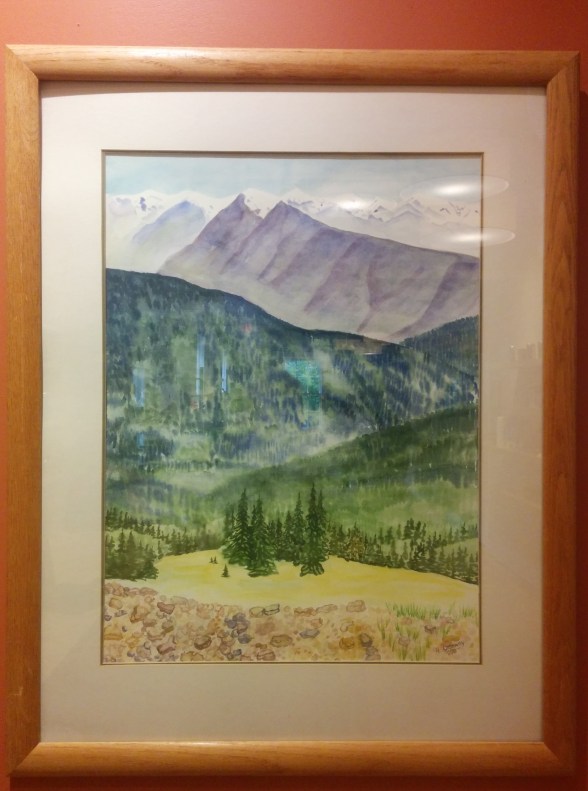
Today’s Ragtag Daily Prompt is anachronism. I guess that would be Helen Burling Ottaway’s watercolors, since an AI can do them, and my work as a physician. The American Academy of Family Practice (AAFP) wrote: “So, the AAFP looked into an AI assistant for clinical review that can “pull the data together in a problem-oriented manner and give you a snapshot of exactly what’s going on with your patient without having to search and click and find things.”
Um. Ok, I am thinking of a patient who was about to be transferred from our small hospital to a bigger one. His notes came across my desk. I called the hospitalist. No less then four physicians during the hospitalization, starting with the emergency room physician, had written that his abdomen was “flat, soft, non-tender, no masses”. What this told me was that 1. Not one of them had done an exam. 2. Not one of them had read my notes nor the surgeon’s notes. 3. The bigger hospital was going to laugh themselves silly if they did an exam. Why? He had an 8 by 8 inch enormous umbilical hernia present for 20+ years, which had not gotten fixed yet because of other medical issues.
Great. So let’s make it worse by having an AI pick out what is important from the patient record and have it make up exams, which people are too lazy to do. Physicians are too lazy to do. People, you had better read every single note your doctor or nurse practitioner or physician’s assistant writes, because you want to go on record in writing when they get it wrong. It is an absolute horror show. Read your notes, because your doctor is most likely not reading the notes from the specialists. I find it amazing, horrifying and sloppy.
I learned to paint watercolors from my mother. I am not primarily an artist, but I learned all sorts of techniques from her. We do not learn from plugging an idea into a computer. We learn from doing. And yes, it is work to learn techniques, but it is worth it!
BLIND WILDERNESS
in front of the garden gate - JezzieG
Discover and re-discover Mexico’s cuisine, culture and history through the recipes, backyard stories and other interesting findings of an expatriate in Canada
Or not, depending on my mood
All those moments will be lost in time, like tears in rain!
An onion has many layers. So have I!
Exploring the great outdoors one step at a time
Some of the creative paths that escaped from my brain!
Books, reading and more ... with an Australian focus ... written on Ngunnawal Country
Engaging in some lyrical athletics whilst painting pictures with words and pounding the pavement. I run; blog; write poetry; chase after my kids & drink coffee.
Coast-to-coast US bike tour
Generative AI
Climbing, Outdoors, Life!
imperfect pictures
Refugees welcome - Flüchtlinge willkommen I am teaching German to refugees. Ich unterrichte geflüchtete Menschen in der deutschen Sprache. I am writing this blog in English and German because my friends speak English and German. Ich schreibe auf Deutsch und Englisch, weil meine Freunde Deutsch und Englisch sprechen.
En fotoblogg
Books by author Diana Coombes
NEW FLOWERY JOURNEYS
in search of a better us
Personal Blog
Art from the Earth
𝖠𝗇𝗈𝗍𝗁𝖾𝗋 𝖶𝗈𝗋𝖽𝖯𝗋𝖾𝗌𝗌.𝖼𝗈𝗆 𝗌𝗂𝗍𝖾.
Taking the camera for a walk!!!
From the Existential to the Mundane - From Poetry to Prose
1 Man and His Bloody Dog
Homepage Engaging the World, Hearing the World and speaking for the World.
Anne M Bray's art blog, and then some.
My Personal Rants, Ravings, & Ruminations
 KO Rural Mad As Hell Blog
You must be logged in to post a comment.