Establishing a diagnosis

All of the Long Covid information is pretty confusing, isn’t it? I’ve read that most of it resolves at nine months. Another article says a year. The conference last week says that 96% are clear at two years if they are treated. What percentage are being treated? The US defined Long Covid as symptoms lasting over a month at first, while Europe said three months. I think they have now agreed on three months. This will continue to change and evolve.

When viagra first came on the market, women complained that there was not a drug for them. Pharmaceutical companies were working on it, but you cannot treat anything unless you establish a diagnosis first and women’s sexuality is more subtle then men’s. Anyhow, I wrote this silly poem making fun of the whole thing.

Little Blue Pill

Little blue pill
Little blue pill
Help me help me
I’m over the hill

Don’t wanna have sex
Nope nope nope
Little blue pill
Gives my husband hope

Can’t make a pill
Til we define the disease
Doctors would you
Hurry up please

Little blue pill
Little blue pill
Help me help me
I’m over the hill

Thought them hormones
Would make me hot
Doc was right
They did not

Hot flashes make me
Sweat and moan
No help from that
Testosterone

Little blue pill
Little blue pill
Help me help me
I’m over the hill

Doctor this
Is really no joke
My husband says
He’ll slit his throat

Can’t make a pill
Til we define a disease
They’re trying hard
Those drug companies

I think we’ll know
If they define a disease
Drug companies will plaster it
On tv

Doctor I found
Just the thing
A brand new stimulating
Clitoral ring

Don’t wanna have sex
Nope nope nope
Little blue pill
Gives my husband hope

____________________________

For the Ragtag Daily Prompt: establish.

I took the photograph of the old drug bottles today. I like that the potassium oxalate just says POISON on it and gives antidote instructions. Also, no guarantee on the clitoral ring, ok?

Passe

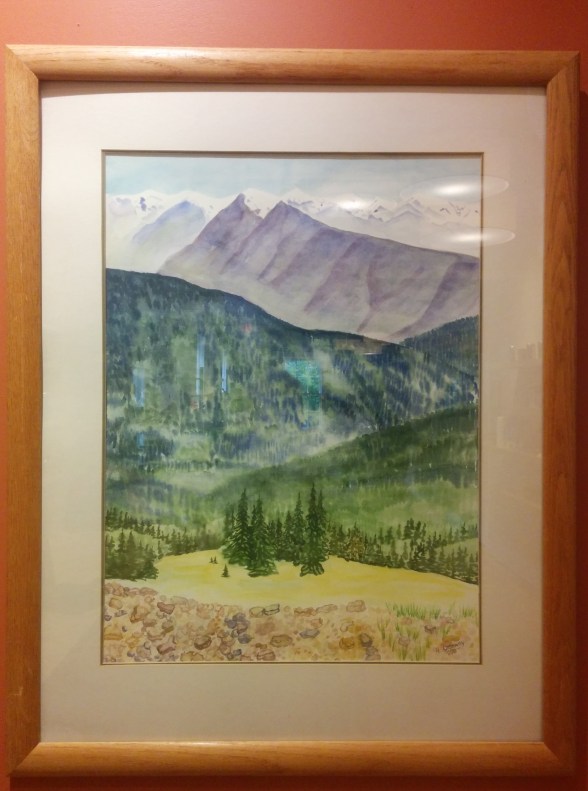
Today’s Ragtag Daily Prompt is anachronism. I guess that would be Helen Burling Ottaway’s watercolors, since an AI can do them, and my work as a physician. The American Academy of Family Practice (AAFP) wrote: “So, the AAFP looked into an AI assistant for clinical review that can “pull the data together in a problem-oriented manner and give you a snapshot of exactly what’s going on with your patient without having to search and click and find things.”

Um. Ok, I am thinking of a patient who was about to be transferred from our small hospital to a bigger one. His notes came across my desk. I called the hospitalist. No less then four physicians during the hospitalization, starting with the emergency room physician, had written that his abdomen was “flat, soft, non-tender, no masses”. What this told me was that 1. Not one of them had done an exam. 2. Not one of them had read my notes nor the surgeon’s notes. 3. The bigger hospital was going to laugh themselves silly if they did an exam. Why? He had an 8 by 8 inch enormous umbilical hernia present for 20+ years, which had not gotten fixed yet because of other medical issues.

Great. So let’s make it worse by having an AI pick out what is important from the patient record and have it make up exams, which people are too lazy to do. Physicians are too lazy to do. People, you had better read every single note your doctor or nurse practitioner or physician’s assistant writes, because you want to go on record in writing when they get it wrong. It is an absolute horror show. Read your notes, because your doctor is most likely not reading the notes from the specialists. I find it amazing, horrifying and sloppy.

I learned to paint watercolors from my mother. I am not primarily an artist, but I learned all sorts of techniques from her. We do not learn from plugging an idea into a computer. We learn from doing. And yes, it is work to learn techniques, but it is worth it!

Nerve ablation

Would I do this? A nerve ablation for chronic pain?

https://healthy.kaiserpermanente.org/health-wellness/health-encyclopedia/he.nerve-ablation-for-chronic-pain.zx3505

Two people mentioned nerve ablation to me this week: one in the back and one in the knee. Would I do this?

Holy denervation, Batman. I’d like to think that I wouldn’t, but pain does suck.

The problem is that pain is information, even chronic pain. The current thinking in medicine is that chronic pain is some sort of glitch in the wiring or the brain where something keeps hurting even if we can’t see much of an injury.

Like grief or a broken heart or the death of a loved one.

Those pains can soften, but do they entirely go away? The death of loved ones doesn’t. It’s been a decade since my sister died of cancer and I still think of things that would make her howl with laughter. She understood me in a way that no one in the world does: ok, except for my children. My children are adults now and out in the world and observing other parenting and non-parenting and disastrous young adult choices. My son now has a high school classmate dead of opioid overdose. A topic for another essay.

Back to chronic pain. Medicine in the United States does patients a terrible disservice by talking about the spinal discs all the time. 99 times out of 100, the pain is NOT a disc. The back is very complicated, with 6 layers of muscles, and some of those muscles are only an inch long. They all have to work together in a fluid way. Often, we forget this. Our muscles try to obey us and we lock them into a terrible position and they try and try and try: and then tear and hurt.

Lock them? Yes. We have three main types of muscle: fast twitch fatigable, fast twitch non-fatigable and slow twitch. Slow twitch don’t get much attention in the United States MORE AND FASTER dysfunctional ADHD culture. Slow twitch muscles are the posture muscles. If you lock them in one position, they will stay there. Even when you get up from the computer or desk or bent over picking strawberries.

When the muscles lock, remember that they are all attached to bones. Every muscle attaches to at least two sites. Picture a muscle that crosses the knee joint locking into a shortened position. Now, do you think the knee moves normally? NO, it doesn’t. And if the muscle is tight and locked, the knee joint can be damaged by not being able to move freely.

Now, think about your back. You have seven cervical vertebrae, 12 thoracic and five lumbar. So 24 separate bones, and then other bones, like ribs, attached by tendons and ligaments and muscles. You pull a muscle in your lower back playing pickleball. It hurts. When the muscle is injured, it tightens up to protect itself. The surrounding muscles can tighten as well, and then that area doesn’t move right. The other muscles and joints have to attempt to take up the slack! They can’t move normally either! All too often I ask what people did when their back started hurting and all they did was take something to mask the pain and keep going.

Pretty dysfunctional.

So what do I want you to do with a new injury? RICE. Rest, ice, compression, elevation. Rest the muscle. It’s hurt. Ice for ten minute intervals in the first 48 hours, not heat. Heat increases bleeding and swelling. Muscles can bleed if they are torn. You have had a bruise sometime in your life, right? You won’t see a deep muscle bruise, and personally I have trouble looking at my own back. You may add heat after the first 48 hours. Usually the peak of swelling and bleeding is by 48 hours. Compression: if it is an ankle or an elbow, an ace wrap holds the joint still and reduces swelling. You can press ice on your back, or lie on an ice pack. Go ahead and shower but not super hot at first. Elevation for arms and legs: gravity helps reduce swelling and pain.

What if it’s been hurting for a year? Your blog was too late!

Check your posture first. If you have been avoiding moving a part of your body, you need help. If your posture is terrible, you really need help. Take breaks at the computer! Get up and walk! And see your primary care person. Physical therapy, occupational therapy, massage therapy. Pay attention to what makes the pain worse and what makes it better. Alcohol or pot might make if hurt less, but that’s not fixing the problem and could make it worse. Muscle relaxants are not great either. The muscle tightened up to keep from tearing, remember? And scar tissue can form in muscle. You need to work with someone to gently break down that scar tissue without tearing the muscle again. So muscle memory is for injuries too. If a muscle has been traumatized, it has scarring and it remembers. It may tear more easily and will tighten up more easily. Listen to your muscles. They do not just tighten with trauma, they also tighten with stress and are more at risk for injury. Learn how to reduce your stress, go into a parasympathetic relaxed mode, and help your muscles.

For long term chronic pain, I think of present injury, old injury and then brain and emotional injury. We are often afraid of injury, that we will be hurt, that it will hurt forever, that we will be disabled and be alone and starve. Our culture for the most part celebrates the young and strong and the survivors. I don’t think we have a “chronic pain day” where the whole country thanks the people who have chronic pain and work anyhow, to take care of each other and their families. Maybe we should have that. The emotional part of chronic pain must be addressed too.

I would be very cautious about having a nerve cut, or ablated. The exception for me is the abnormal heart pathways that cause arrythmias. Yes, I think ablating them is a good treatment, but we still try other things first. There can be complications of any surgery.

___________________

The photograph is me and my ex dancing at our wedding in 1989. Swing dancing is a delight and you have to not injure your partner or yourself! We noticed that even one drink would affect our dancing and our favorite place to dance was at Cabin John Park, which had no alcohol at all. Posture is important. I think the photographer on this one was my ex’s uncle but we also had a dance friend who took wonderful photographs.

Integrated behavioral health

The buzzwords now in Family Medicine. Integrated behavioral health in primary care. I am finding it a bit annoying.

Integrated does not mean race in this context. It just means the clinic should have a behavioral health person.

I suppose that is a good idea maybe, or might seem like one. But what do they think I have been doing for thirty years? Ignoring behavioral health?

Really, primary care is half or more behavioral health, if a primary care doctor gives people time and pays attention. People have an average of 8 colds a year. Why do they come in for cold number 4 if it is no worse than all the others? Because the cold in not really why they are coming in. The cold is the excuse. Notice that the person is there, that they are not that sick, that they do not care that you are not going to prescribe antibiotics.

I have my hand reaching for the door when an older patient says, “May I ask you something?” She came in for something that she didn’t seem to care about, so I am not surprised. I turn back. “Yes.”

“I have friends, in another state. They had a baby. The baby is very disabled.”

I sit down. This is more than 15 years ago, so I do not remember what the baby had. Hydrocephalus. Cerebral palsy. Something that requires multiple doctors and physical therapy and the parents are grieving.

“What bothers me most is that they have to struggle so much for services. There is very little support and very little money set aside. One of the parents has quit their job. It is a full time job taking care of this child and they are frightened about the future. Is this really what it’s like?”

And that is the real reason for the visit. “Yes,” I say. “It can be very difficult to access services, you have to track down the best people in your area, some physicians won’t pay much attention and others are wonderful. And the same with physical therapists and everyone else. Tell them to find some of the other parents of these children. Get them to recommend people. And the parents have to be sure to take care of themselves and each other.”

She frowns. “It’s a nightmare. Their life completely changed from what they thought. First baby. And it is overwhelming.”

“I am sorry. You are welcome to come back and ask me questions or just talk.”

“Thank you. I might.”

“Do you need a counselor?”

“No, I’m fine. I am just worried about them and feel helpless.”

“It sounds like staying in touch is the best thing you can do.”

“Ok.”

The true reason for the visit is often something entirely different from what the schedule says. Sometimes people are there without even knowing why they came in. “Can I ask a question?” That is key. Saying to see people for one thing is criminal and terrible medicine and makes behavioral health worse. There is so much we can do in primary care just by listening for these questions and making time for them.

I have nothing against adding a behavioral health person to the clinic. They talked about “embedding” a behavioral health person in each group of soldiers back in 2010, when I worked at Madigan Army Hospital for three months. I always pictured digging a hole in my clinic floor, capturing a counselor, and then cementing them in the hole. I would have to feed them, though. I always thought that was sort of a barrier. One more mouth to feed. I found it more useful to contact counselors, ask what they wanted to work with, learn who knew addiction medicine, learn who was good with children or families or trauma. And ask patients to tell me who they liked and why. I integrated behavioral health in my community, not just in my clinic, because there is no one counselor who is right for everyone.

Rebel in clinic

Right before my hospital district informed me that they no longer wanted my services, I was rebelling. The fight from my perspective, was over good patient care. They had set a quota. 18 patients a day. One every 20 minutes and one 40 minute visit. 8 am to noon and 1 pm to 5. I argued and argued and argued. I knew finishing the note in the room took me 25 minutes on the hateful electronic medical record and I had averaged 16 patients a day my whole career. I was not fast but I was super thorough and had just gotten an excellent report on a chart review and had been told that I was a great diagnostician. Which was mostly due to my nearly OCD thoroughness. I was not diplomatic with the hospital administration.

One day I was feeling wicked, just wicked. I had a brainstorm and started whistling softly. The other two doctors and PA were all in the same small office.

One took the bait. “What is that? I know that song.”

“Oh, we are singing it in chorus. For some reason it is in my head today.” So I sang this song.

I did not have the words memorized. I swear that the temperature in the room dropped and the male doctors hunched in their chairs.

“Yeah, don’t know why that one keeps playing in my head.” I said. “I hope you can all come to the concert!”

But answer came there none.

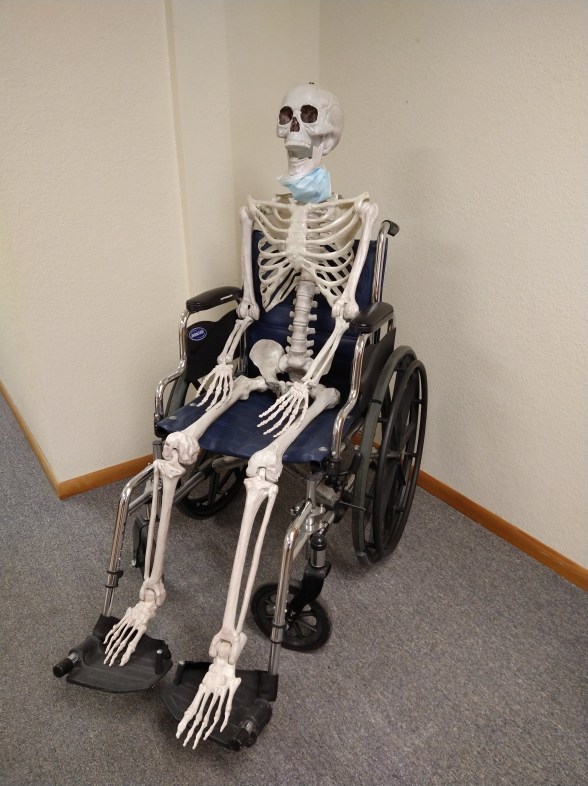
I took the photograph at Quimper Family Medicine, the clinic I opened after the hospital clinic kicked me out. The skeleton was named Mordechai in a contest. This is from 2014. Mordechai lived in our waiting room every October, with different outfits.

split

The pandemic splits the thin veneer of civilized behavior
like a heavy maul falling on delicate antique wood
and wild fear emerges and riots through the streets
while some hide, some stay calm
and try to sooth the selfish unleashed beast

For the Ragtag Daily Prompt: veneer.

Taken in 2015.

A good reaction

The last ten days sucked but the results are probably good.

What? Wait, why?

I saw the pulmonologist week before last on Wednesday. Her office does not give the new Covid-19 shot but does give flu shots. I got my flu shot. It didn’t seem to bother me much except that I felt a bit tired and grumpy.

I saw my family practitioner on Tuesday, after my pulmonary rehab. For the first time I did not improve in pulmonary rehabilitation (12 weeks, twice a week). I also seemed to have a faster heart rate, up to 140 beats per minute, on the treadmill. My doctor had me walked and even going around the block, my heart rate went to 115. Weird, I thought.

My family doctor did have the new Covid-19 vaccine so I got that. The next day I was more tired and grumpy. On Thursday I lost ground on the treadmill and felt awful and my heart rate just seemed high all the time.

Oh. This is an appropriate reaction for me to two vaccines one week apart. What? you say. Well, when I get pneumonia (four times), I have a fast heart rate response, shortness of breath, fatigue and I feel grumpy and wired. The theory is that I have antibodies to the dopamine receptors, that turn the receptors ON. Dopamine can raise your heart rate. At the same time, I have antibodies to tubulin. Those antibodies make my fast twitch muscles not work right, as well as lung cilia. So: fast heart rate, treadmill is much more difficult, and I started sleeping ten hours a day.

This means my immune system is working. It is making LOTS of antibodies, which is what I theoretically want it to do, though I would rather not have the dopamine and tubulin ones. Just antibodies to influenza and Covid-19. However, my immune system seems to have PTSD and when it makes antibodies, it makes them to EVERYTHING. This makes me very tired, grumpy, screws up exercise and gives me shortness of breath and a fast heart rate.

How long will it last? I am not entirely sure. With infections, antibodies rise and then fall over 3 to 6 or more months. The naturopaths say that food intolerance antibodies fall in three weeks if you stop eating the offending item. I want my Covid-19 antibodies to persist for 3-6 months or more, flu antibodies as well, but I’d like the ones that give me a fast heart rate and shortness of breath to drop right away!

I guess I will find out. At least my immune system works, however oddly.

Blessings and peace you.

I took the photograph of the Great Blue Heron just after she took off yesterday. I am trying to catch more birds in flight! Mostly I catch parts of birds, the tip of a wing, or feet. I am really pleased with this one.

Practicing Conflict II

Practicing conflict II

In Practicing conflict, I wrote about practicing conflict by arguing different sides of a topic inside my head. I wrote that I don’t fear conflict and have learned to enjoy arguing with myself. I am a physician and physicians argue all the time.

What? No they don’t. Well, the doctor persona does not argue with the patient much. Some doctors give orders to patients, others try to negotiate, some try to convince. But behind the scenes, doctors are more like the Whacky Racer Car with the Cave Guys, running with their feet and hitting each other with clubs.

In residency in Family Practice at OHSU in Portland, Oregon, I start on General Surgery during internship. This is in the early 1990s and there was not much in the way of “disruptive physician” rules. I have to cover Trauma and Plastic Surgery and General Surgery at night on call. The resident is present but I get paged first for patients on the floor. I learn that I should go to all Trauma pages in the emergency room. If I know what is happening with the new Trauma patient, it’s a lot easier to handle the phone calls for more drugs and so forth. Also, the resident is less mean to me.

We attend the Trauma “Grand Rounds”. These are unreassuring to a new intern. A resident presents a trauma patient, giving the history in the accepted formal order. The Faculty Trauma Surgeons interrupt, disagree with management of the patient and yell. They yell at the resident and at each other. The upper level residents yell too, being well trained. The Trauma Surgeons do not agree with each other. They are inflammatory and rude. I am shocked initially: medicine is not a cookbook, is not simple and it appears that it is a controversial mess. It turns out that medicine IS a controversial mess.

There is not as much yelling on the next rotation. At that time Trauma Surgeons yelled more than any other set of doctors that I ran across. They yelled in the ER, at each other, at the staff, at the nurses, at the residents. The culture has changed, I suspect, but that’s how it was then.

I take Advanced Trauma Life Support as a third year resident. The Trauma Surgeons at OHSU helped write the course. They don’t agree with it. On some questions the teaching Surgeon says, “The answer to this question is (c), “ followed by muttering loudly, “though I totally don’t agree with that and I would do (b).” Another Trauma resident or surgeon then might start arguing with him, but they moved on pretty quickly, to teach the current agreed best practices in the book. Which change every few years. Great.

Years later (2009) I join the Mad as Hell Doctors, to go across the US talking about single payer. They are a group from Oregon. Physicians for a National Healthcare Program are a bit cautious with us the first year: we might be whackos. We have an RV with our logo and we have a small fleet of cars and what do you think we do in the cars? We argue. Or discuss. Or whatever you want to call it. We spend the driving dissecting issues and how to present things best and tearing apart the last presentation and rebuilding our ideas. The group does 36 presentations in 24 days. Each presentation takes an hour to set up, two hours to do and another hour to break down and debrief. We get more and more exhausted and cranky and um, well, argumentative, as the trip proceeds. Even though I think of the Whacky Racer Cave Guys running with their feet and bonking each other with clubs, this is the most wonderful group of doctors I have ever been with. A common goal that we all want to get to, discussing and disagreeing on strategy all the way! I feel closer to those physicians in a week then I feel to any of the physicians that I’ve worked with for the last 9 years in my small town. Conflict with a common goal.

Doctors are TRAINED to argue, even with themselves, to document every decision in the chart with reasons why they have reached that decision. And that they have thought about all of the reasons for say, a low potassium, thought of every possible cause and worked their way through testing. The testing always has two strands. One strand is rule out the things that could kill the person NOW, even if rare. The other strand is what is common? You have to think about both at the same time, always. And argue with yourself about which tests should be done, in what order, what is most important, how do you treat the person while awaiting results, and have I missed anything? And if we aren’t sure, we call another doctor, run it by them, wait for them to shoot holes in our logic or to say, no, I can’t think of anything else.

We can deal with conflict. We must deal with conflict. The world is too small not to deal with conflict, with disagreements, with different viewpoints and positions and ideas. If doctors can do it every single day at work, then everyone else can too. Trying to see all the positions and possible diagnoses saves lives in medicine. We need to extrapolate that to everything else. Try to see other positions, try to understand them, to respect them. We can and we must.

Blessings.

Here are the Whacky Racers:

And Madashell Doctors blog: http://madashelldoctors.com/category/uncategorized/page/3/

For the Ragtag Daily Prompt: discuss.

The photograph is from my clinic once we had stopped seeing patients and were selling everything. Mordechai was our clinic skeleton, made of plastic, from China. This was in January 2021.

Why I hate insurance companies: 1

I had cobra from my job in 2009 and the insurance company refused my bills. Not one bill. Not once. EVERY BILL EVERY TIME: 1. my healthcare 2. my son’s healthcare 3. my daughter’s healthcare 4. my daughter’s orthodontia 5. my dentist 6. my son’s dentist. I had to call EVERY TIME to get them to pay. Calling an insurance company takes 25 or 30 minutes, right? Eventually I asked for customer service who first said it was my fault because “you probably paid the bill late”. I said, “No, I was on time every month.” Then customer service wouldn’t call me back. I finally called their COUNSELING HOTLINE, since it said I would be “paid” $30 to get counseled, and said, “MY LITTLE SISTER IS DYING OF BREAST CANCER AND THE THING THAT IS MOST STRESSING ME OUT IS YOUR INSURANCE COMPANY WON’T PAY THE COBRA BILLS AND I HAVE CALLED CUSTOMER SERVICE OVER AND OVER AND THEY WON’T CALL ME BACK. HOW ABOUT YOU COUNSEL ME HOW TO DEAL WITH THAT!” And I cried. I got a call back from the head of customer service saying “Oh, it’s a computer glitch and we had you misfiled. We have fixed it.” They “misfile” people all the time, or drop patients if they get sick, or say the person didn’t pay on time. I HATE INSURANCE COMPANIES. Anyhow, be warned that insurance companies are there to earn money and will try to avoid paying you in all sorts of ways, including ways that are illegal.

We need single payer healthcare, medicare for all. If we all have healthcare, think of how many small businesses would start up. And why don’t we have single payer healthcare? I think the big corporations don’t want it.

Physicians for a National Healthcare Program: https://pnhp.org/

Medicare for all: https://medicare4all.org/

And my dear friends not on the road any more: http://madashelldoctors.com/

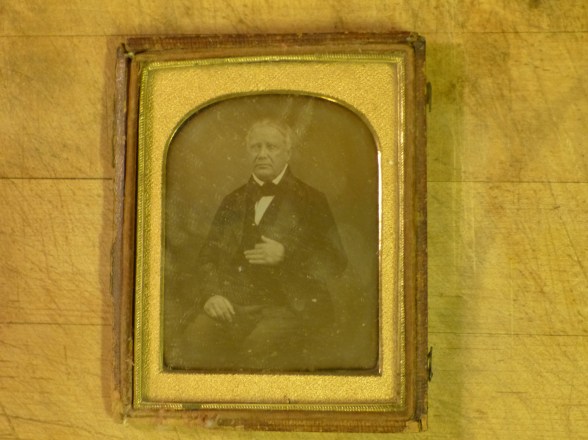
Who is the man in the photograph? I don’t know. This is an old tintype. They came from my Great Aunt, Esther White Parr, married to Russel Parr. Perhaps they are Parrs, because my Uncle Rob did not know any of the people in the four tintypes I have. My sister and I used them for portraits in our china doll houses. I hope he is not the CEO of an insurance corporation, but then, all the white collar white men tried to dress that way then.

skulls

I took this on my trip in March 2022. So far no one has guessed where I was correctly. There is a wonderful Zoology and Science Museum. A mystery for you to consider, where was I?

For the Ragtag Daily Prompt: ancient.