I am attending parts of the online Collective Trauma Healing Summit, led by Thomas Hubl. This morning I listened to two speakers, each about an hour long. The first was by Rev. angel Kyodo Williams, an African-American buddhist teacher and the second is by Tristan Harris, who is the co-founder of the Center for Humane Technology.
Mr. Harris gives me hope about humans learning to live with social media without continuing to be polarized and angry. He speaks about the way that many platforms work. We tend to click on things that worry us and that we are traumatized about, and the platform immediately starts feeding us more of that. In a way, Facebook and other platforms gas light us: the algorithm figures out what makes us upset and agitated and promptly feeds us more of it.
He advocates moving to more humane platforms, that aren’t built on feeding us trauma, and especially for schools and parents to do this collectively with children. He co-hosts the podcast “Your Undivided Attention” each week, so I will be looking in to that.
However, I have a second reason to be hopeful about social media. I am in more than one group now that has rules and that has administrators that enforce them. Kindness. An insect group that forbids people saying “squash it”, because it’s a group of people that are interested in insects. A physician mom group. A pacific northwest rock group and a women’s pacific northwest rock group. I am now one of the administrators for a local group and am fine with it.
Even though Facebook is still feeding us more trauma and horror if that is what we click on, people are starting to see through this and refuse. They are forming groups where insects and people aren’t squashed. Rural farm groups. Music groups. In these groups I feel that people are coming together and are working to be supportive and help each other, identifying rocks, discussing child behavior, singing together.
Each time that technology makes the world smaller and more connected, we have to relearn how to get along. With our family, then our small tribe, then a larger tribe, then cities, countries and now we can see each other the world over. If all we see is what we fear and what horrifies us in our feeds, then we need to turn it off, breathe, and look for something to calm us down. Knit. Silly cat pictures. Flowers. What gives you a feeling of peace and hope? Whatever it is, do more of it and share it.
Blessings and peace you.
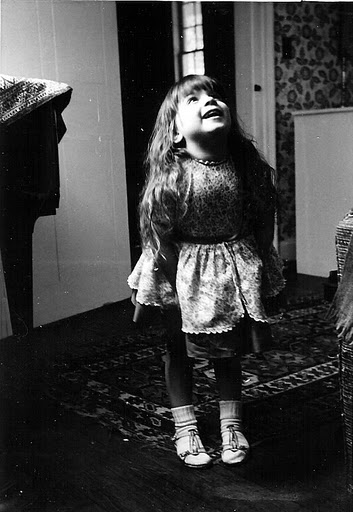
I don’t know who the person in the tintype is. I think that it came from a box from my Great Aunt Esther Parr, when I was in my early teens. My sister and I divided the tintypes and used them as portraits in our china doll houses.
it’s not really quiet down here whales the earth shuddering new mountains being born the ebb and flow as the earth makes love to the moon and small bubbles
I am quiet
when I let myself
go all the way down
the ocean is not quiet, but it is dark dark as a dungeon damper than dew I keep sinking
and my eyes slowly adjust
my lungs adjust too
it hurts like knives at first
but I adjust faster than i used to
like the sea lions
I can go down and get back up
no bends
I have learned from them
I hold the oxygen
and let the nitrogen out slowly
through my gut
my eyes adjust
and then they come
the glowing ones, slow and fast
like ghosts swimming towards me
maybe they are my dead
someday I will join them
I expect to return this time
maybe
or not
I don’t know if I will find pearls
or a leviathan
who will swallow me whole
and barely notice
this time I walked in myself I don’t blame you or family or past or circumstances it is time for me to go down I go down and down and down deep
In Practicing conflict, I wrote about practicing conflict by arguing different sides of a topic inside my head. I wrote that I don’t fear conflict and have learned to enjoy arguing with myself. I am a physician and physicians argue all the time.
What? No they don’t. Well, the doctor persona does not argue with the patient much. Some doctors give orders to patients, others try to negotiate, some try to convince. But behind the scenes, doctors are more like the Whacky Racer Car with the Cave Guys, running with their feet and hitting each other with clubs.
In residency in Family Practice at OHSU in Portland, Oregon, I start on General Surgery during internship. This is in the early 1990s and there was not much in the way of “disruptive physician” rules. I have to cover Trauma and Plastic Surgery and General Surgery at night on call. The resident is present but I get paged first for patients on the floor. I learn that I should go to all Trauma pages in the emergency room. If I know what is happening with the new Trauma patient, it’s a lot easier to handle the phone calls for more drugs and so forth. Also, the resident is less mean to me.
We attend the Trauma “Grand Rounds”. These are unreassuring to a new intern. A resident presents a trauma patient, giving the history in the accepted formal order. The Faculty Trauma Surgeons interrupt, disagree with management of the patient and yell. They yell at the resident and at each other. The upper level residents yell too, being well trained. The Trauma Surgeons do not agree with each other. They are inflammatory and rude. I am shocked initially: medicine is not a cookbook, is not simple and it appears that it is a controversial mess. It turns out that medicine IS a controversial mess.
There is not as much yelling on the next rotation. At that time Trauma Surgeons yelled more than any other set of doctors that I ran across. They yelled in the ER, at each other, at the staff, at the nurses, at the residents. The culture has changed, I suspect, but that’s how it was then.
I take Advanced Trauma Life Support as a third year resident. The Trauma Surgeons at OHSU helped write the course. They don’t agree with it. On some questions the teaching Surgeon says, “The answer to this question is (c), “ followed by muttering loudly, “though I totally don’t agree with that and I would do (b).” Another Trauma resident or surgeon then might start arguing with him, but they moved on pretty quickly, to teach the current agreed best practices in the book. Which change every few years. Great.
Years later (2009) I join the Mad as Hell Doctors, to go across the US talking about single payer. They are a group from Oregon. Physicians for a National Healthcare Program are a bit cautious with us the first year: we might be whackos. We have an RV with our logo and we have a small fleet of cars and what do you think we do in the cars? We argue. Or discuss. Or whatever you want to call it. We spend the driving dissecting issues and how to present things best and tearing apart the last presentation and rebuilding our ideas. The group does 36 presentations in 24 days. Each presentation takes an hour to set up, two hours to do and another hour to break down and debrief. We get more and more exhausted and cranky and um, well, argumentative, as the trip proceeds. Even though I think of the Whacky Racer Cave Guys running with their feet and bonking each other with clubs, this is the most wonderful group of doctors I have ever been with. A common goal that we all want to get to, discussing and disagreeing on strategy all the way! I feel closer to those physicians in a week then I feel to any of the physicians that I’ve worked with for the last 9 years in my small town. Conflict with a common goal.
Doctors are TRAINED to argue, even with themselves, to document every decision in the chart with reasons why they have reached that decision. And that they have thought about all of the reasons for say, a low potassium, thought of every possible cause and worked their way through testing. The testing always has two strands. One strand is rule out the things that could kill the person NOW, even if rare. The other strand is what is common? You have to think about both at the same time, always. And argue with yourself about which tests should be done, in what order, what is most important, how do you treat the person while awaiting results, and have I missed anything? And if we aren’t sure, we call another doctor, run it by them, wait for them to shoot holes in our logic or to say, no, I can’t think of anything else.
We can deal with conflict. We must deal with conflict. The world is too small not to deal with conflict, with disagreements, with different viewpoints and positions and ideas. If doctors can do it every single day at work, then everyone else can too. Trying to see all the positions and possible diagnoses saves lives in medicine. We need to extrapolate that to everything else. Try to see other positions, try to understand them, to respect them. We can and we must.
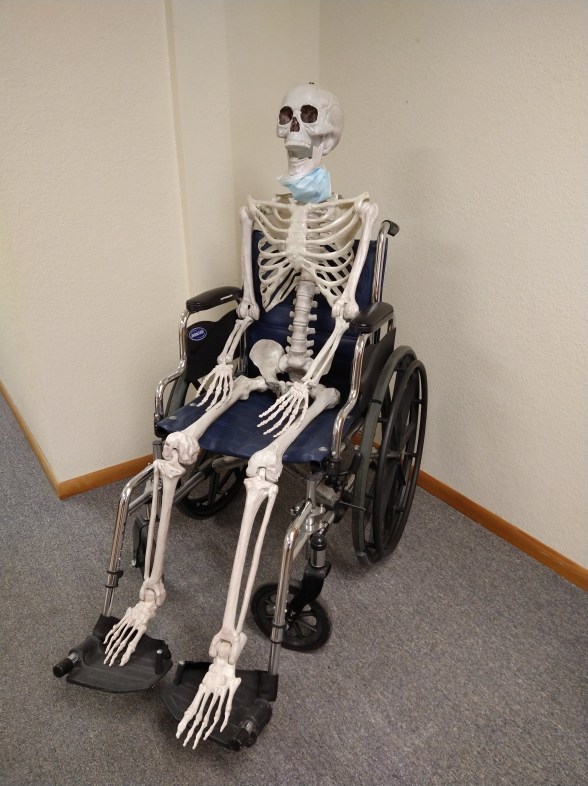
The photograph is from my clinic once we had stopped seeing patients and were selling everything. Mordechai was our clinic skeleton, made of plastic, from China. This was in January 2021.
WHY is this poor rose caged, you ask? I removed the top bit of cage to take the photograph. This is the only bloom this summer, because the rose keeps growing out of the cage. It’s in my backyard and the deer chomp down to the wires. I think they need vitamin C.
I tested this the other day. I trimmed a rose in the fenced front yard. I took the trimmings and spread them under the apple tree. This is not a great picture but I was happy to see this young visitor eating roses and fallen apples.
I am watching the service for Queen Elizabeth II. I wish every family who has lost someone recently or years ago, finds their way through stages of grief to a stage of peace. I fall out of it every so often and miss my mother, my father, my sister. Blessings all.
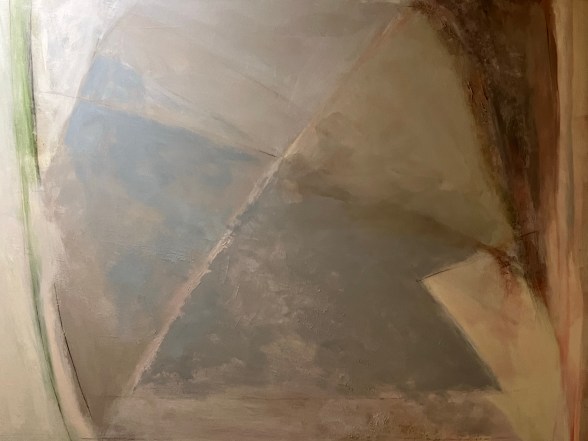
My friend Maline Robinson is an artist, paintings and silk screens. This one fits today’s “luminous” prompt, pale lit color and layers and texture.
Meanwhile my brain starts playing one of our choral pieces: Luminous night of the soul. It builds and builds, layers of sound and complexity. Here is another group doing the piece:
A long time ago, at least by a child’s time, he starts turning. He blocks things out. He locks his heart. He decides to be happy and do what he wants. His heart slowly turns to stone.
The blood roars through, pushed by each beat, how can a stone heart beat? Not normally, that is for sure. His brain controls it, cold, logical, no emotion, except happiness, that is what he says. He says it over and over, I am happy all the time, until he thinks he believes it. And then he believes it and his heart is stone.
But the blood flows and the body feels and emotions come anyhow. He refuse them, all but happiness, and blood lays down a wall of emotion inside his heart. Chalcedony, lining the chambers, coating the valves, coating the arteries that feed the heart. The heart doesn’t need the arteries open because it is not beating. It is stone. His brain is beating. Beating the emotions away, away, away, refusing the body and the heart.
The heart is hollow. Slowly it is lined with clear agate. At last his heart is full: no more chamber. Agatized, all the way through. When he is cracked open, far in the future, a chalcedony nodule will show the perfect interior of a stone heart.
And where does the blood go now? we wonder. Laying down the lining of agate, clear, colored lines of emotions rejected, all the colors of the rainbow, what he thinks of as impurities. That is how he thinks of his emotions: impurities, to be rejected.
What will be agatized next? His liver? His lungs? He says strokes are the end for his family. He calls it then, his brain is agatized. The part that controls the pumping, overriding his heart over and over, when that part turns to agate, he will be correct. A stroke. How long will it take, we wonder? One year, five years, ten? He says he won’t go past 80. That will be 13 years. How apropos.
Can nothing stop this? Chalcedony is hard, not hard as diamonds, but very very hard. Agates are common and we search for the clear ones, the lit ones on the beach. Almost nothing can wear them down: high pressure would kill him, high heat would kill him, what is left? Water. Water wears down rock.
Enter the sea. The sea of love, the sea of dreams, the sea of the unconscious. Seek help, before you turn yourself to full stone. Agatized and dead.
Maybe there are other treatments, I don’t know.
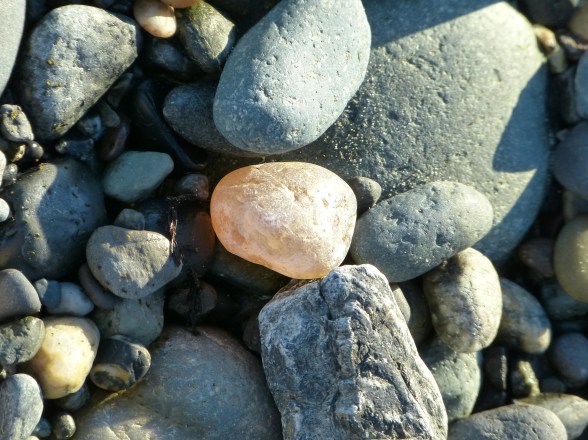
A stone shaped heart is rare, I hope. See how it catches the light. Beautiful and sad.
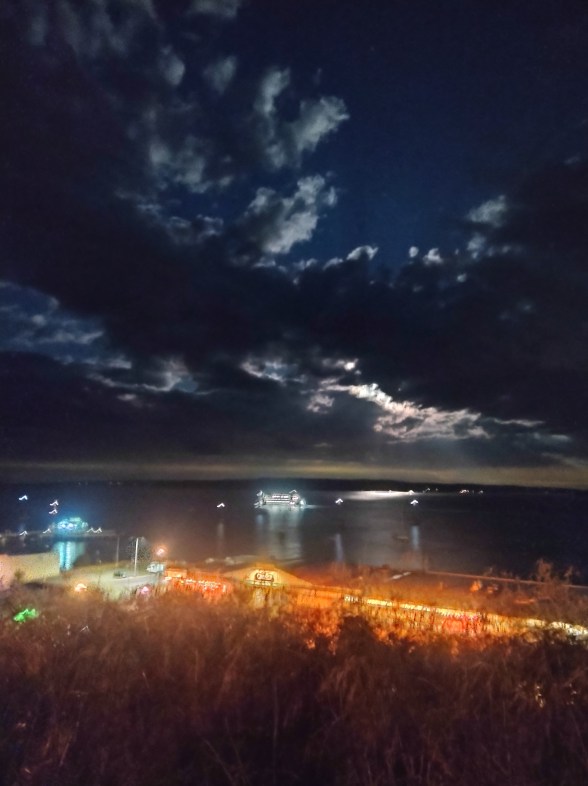
My mansion is the outdoors. What could be more beautiful than the sky and the sea and the outdoors? Not only does my mansion have more rooms than I can ever explore, all over the world, but it has every mood imaginable too.
Discover and re-discover Mexico’s cuisine, culture and history through the recipes, backyard stories and other interesting findings of an expatriate in Canada
Engaging in some lyrical athletics whilst painting pictures with words and pounding the pavement. I run; blog; write poetry; chase after my kids & drink coffee.
Refugees welcome - Flüchtlinge willkommen I am teaching German to refugees. Ich unterrichte geflüchtete Menschen in der deutschen Sprache. I am writing this blog in English and German because my friends speak English and German. Ich schreibe auf Deutsch und Englisch, weil meine Freunde Deutsch und Englisch sprechen.





 KO Rural Mad As Hell Blog
You must be logged in to post a comment.