Perspective: beneath the clouds

Beloved why?
I am glad for your love
and warmth
and connection
and my cat’s
and my adult children
friends
family
patients
work
and why? Beloved

A high Adverse Childhood Experience Score
Two alcoholic parents
One sick with tuberculosis through pregnancy
Letters from the hospital to her mother
After birth
Never mention me
As if I do not exist

She told a story that she dreamed
she gave birth to kittens
played with them
and gave them away

Not a dream of joyously welcoming her new baby
Me.
Yet I didn’t hate her or my father
My damaged parents
My damaged sister
Who followed their path, not mine
There was nothing I could do
Only three years old when she was born
Try to shield and mother her
As best I could

Why Beloved
I have tried so hard to grow
to love
to forgive
and yet I have no human lover

My cat jumps on my notebook
And interrupts this writing
She is happier to welcome me home
Than any man I’ve ever dated

My daughter’s boyfriend picks her up
at the airport and has made her dinner

If I am a failure at love with a partner
Or too smart or damaged or difficult
To love
For humans
At least my children have both found love
And if I were to choose me or them
Yes, I’d choose them

Is that why, Beloved?
Sacrifice to heal the next generation?
It is worth it.

And yet, that small child part of me
That even as a toddler thought the adults were unpredictable, dangerous, mean when drunk as they laughed.
She is angry at them, Beloved
She is angry at you, Beloved
Or at people
Or at the universe
She still believes in every cell, in her bone marrow, in the vast universe in her mind

that she too could be, should be

loved.

Adverse Childhood Experiences 15: Guidelines

I wrote Adverse Childhood Experiences 14: Hope quite a while ago.

The American Academy of Pediatrics has a guideline that physicians should introduce and screen for Adverse Childhood Experiences. The American Academy of Family Practice is skeptical, here: https://www.aafp.org/pubs/afp/issues/2014/1215/p822.html. Here are two more writeups: https://www.aafp.org/pubs/afp/issues/2020/0701/p55.html and https://www.aafp.org/pubs/fpm/blogs/inpractice/entry/screen_for_aces.html.

It is difficult to screen for ACE scores for the same reason that it is difficult to screen for domestic violence and to talk about end of life plans. These are difficult topics and everyone may be uncomfortable. Besides, what can we DO about it? If growing up in trauma wires someone’s brain differently, what do we do?

I don’t frame it as the person being “damaged”. Instead, I bring up the ACE score study and say that first I congratulate people for surviving their childhood. Good job! Congratulations! You have reached adulthood! Now what?

With a high ACE score comes increased risk of addictions (all of them), mental health diagnoses (same) and chronic disease. Is this a death sentence? Should we give up? No, I think there is a lot we can do. I frame this as having “survival” brain wiring instead of “Leave it to Beaver” brain wiring. The need to survive difficulties and untrustworthy adults during childhood can set up behavior patterns that extend into adulthood. Are there patterns that we want to change and that are not serving us as adults?

This week a person said that they blow up too easily. Ah, that is one that I had to work on for years. Medical training helps but also learning that anger often covers other feelings: grief, fear, shame. I had to work to uncover those feelings and learn to feel them instead of anger. Anger can function as a boundary in childhood homes where there are not adult role models, or where the adults behave one way when sober and an entirely different way when impaired and under the influence. There may be lip service to behave a certain way but if the adult doesn’t behave, it is pretty confusing. And then the adult may not remember or be in denial or try to blame someone else, including the child, for “causing” them to be impaired.

What if someone had a “normal” childhood but the trauma all hit as a young adult? I think adults can have trauma that changes the brain too. PTSD in non-military is most often caused by motor vehicle accidents. At least, that is what I was told in the last PTSD talk I went to. Now that overdose deaths have overtaken motor vehicle accidents as the top death by accident yearly in the US, I wonder if having a fentenyl death in the family causes PTSD. Certainly it causes trauma and grief and anger and shame.

I agree with the American Academy of Pediatrics that we should screen for Adverse Childhood Experiences. We need training in how to talk about it and how to respond. I have had people tell me that their childhood was fine and then later tell me that one or both parents were alcoholics. The “fine” childhood might not have been quite as fine as reported initially. One of the hallmarks of addiction families is denial: not happening, we don’t talk about it, everything is fine. Maybe it is not fine after all. If we can learn to talk to adults about the effects on children and help people to change even in small ways, I have hope that we will help children. We can’t prevent all trauma to children, but we can mitigate it. All the ACE scores rose during the Covid pandemic and we are still working on how to help each other and ourselves.

Here is another article: https://www.aafp.org/pubs/fpm/issues/2019/0300/p5.html.

Blessings.

For the Ragtag Daily Prompt: open wound.

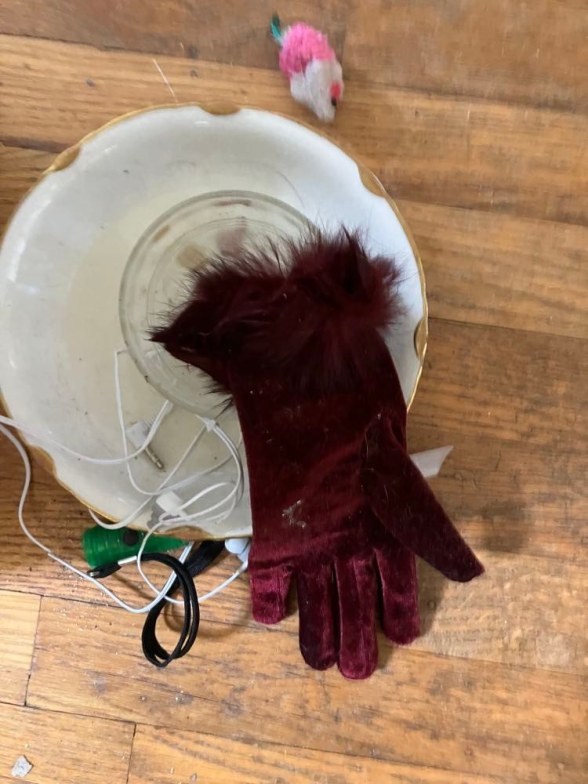
The photograph is one of Elwha’s cat art installations. He would pile toys on his bowl. Two bowels because I need to keep out the little ants. Sol Duc would do it too but not as often. I fed them in separate rooms. They would pile things on the bowl whether there was food left or not.

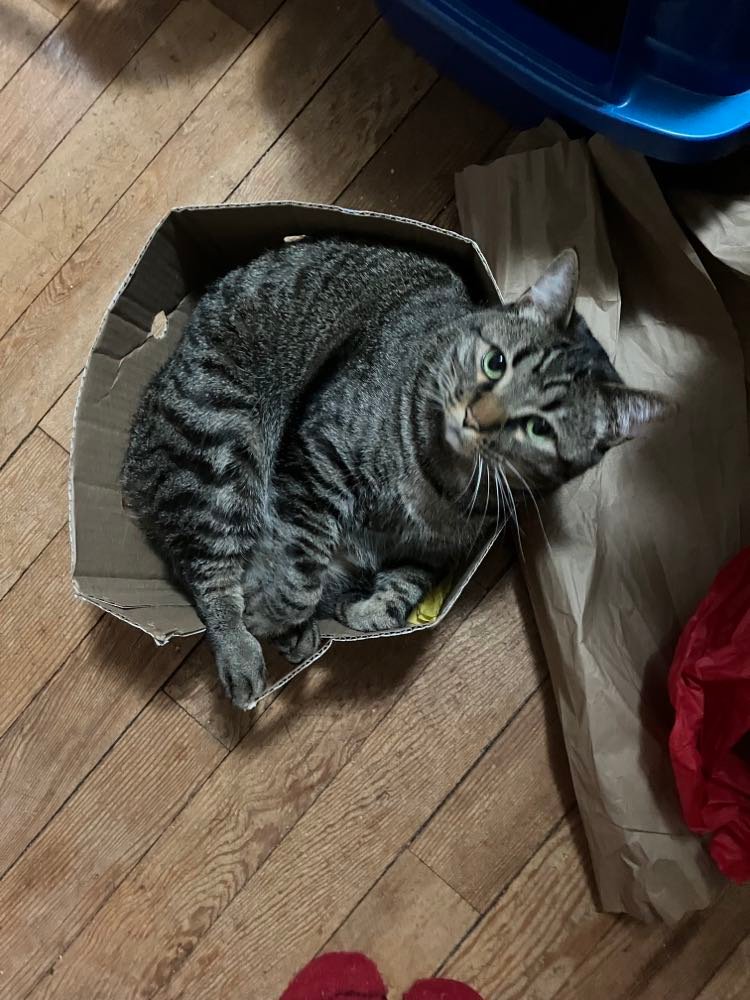
Elwha is still missing, sigh. That is a wound. The photographs are from March 2023.

Qia and the monsters

Qia is three. She is scared.

“Don’t be scared or go to your room.”

Qia wants help. She is scared of the monster, FEAR, the giant monster, but her father won’t listen. She sniffles and tries, but she can’t stop crying. She goes to her room, because her father has turned his back. Her mother is drawing. They are busy. They don’t like it when she is scared.

FEAR is enormous and pushes into the room with her. She cries harder in her room with the door closed. No one can hear her now except FEAR. FEAR is large and has horrible drippy teeth and too many arms and keeps swatting at her. Qia gives up and lets FEAR swat her. She sits on the bed with her knees up and puts her head on her arms.

FEAR rages around her room.

After a while Qia is tired of crying. She lifts her head off her arms.

FEAR is smaller. Still bigger than her father, bigger than her mother, but just standing and looking at her. FEAR looks tired too.

Qia pats the bed beside her. FEAR hesitates and looks scared. Qia waits. FEAR shuffles over and sits beside her on the bed.

The room is very quiet. Qia finds a scrap of tissue and blows her nose. She looks sideways at FEAR.

FEAR’s head is down and FEAR seems to be crying. Qia reaches out and takes FEAR’s paw. One of the paws. There are a lot.

FEAR holds her hand tightly and then leans against her. Qia wiggles over a bit more to give FEAR room. FEAR sighs and then snuggles down onto the bed, massive drippy toothy head in Qia’s lap.

Qia strokes FEAR’s fur. It is very soft and dark purple.

FEAR is the first monster that Qia makes friends with. There are many more.

_________________

I was thinking about this story even before the Ragtag Daily Prompt: bugbear.

Negotiating peace

I spend a long day wrestling with love
arguing with myself back and forth
I am no angel descended from above
Those undeserving of my love make me wroth
yet my core argues that it still loves them
and agrees their cruelty’s beyond the pale
I snarl and cough and choke on bitter phlegm
Defend my self staying far away and hale
My core agrees I shall not tolerate abuse
Forgive yet we despair we’ll ever reconcile
They show no guilt nor shame for their misuse
My core says let them be: she is so mild
Negotiation done: Agreed. I may love those who I love
But I leave contact with them to the angels and Beloved.

_____________________

Sonnet 10

Embodying a dream

I wrote about the two dreams I had one night, with seven people. Two babies, a boy and a girl. Two professionals, a woman physician and a male policeman. Two rebels, a woman and a man, the man lying or at least misleading the rebel woman. The rebel woman trying to do something that she suddenly realizes is not important and is, in fact, foolish and dangerous. And a quiet woman.

I have been thinking about the quiet woman ever since. My Meyers-Briggs type in medical school came out INTJ, but we are not one thing or another. We have preferences, but we all have to use all the skills. I can be extroverted. I had to work on feeling, that was the really difficult one for me after a frightening childhood. I can pay attention to facts though I sweep them into the intuition very quickly. Medical school is facts and facts and facts, except then there are parts that turn out to change as science changes.

The eighth person is a quiet man. He is not present in the dream. I am thinking about him. I wonder if I will have another dream when I am ready.

I am attending some workshops on line for treating trauma. It is quite fascinating. They talk about working with clients who have aspects like my dream: a small child with trauma. A “fake adult”, aka “adaptive child”, with the tools that the child develops to survive in their childhood. Helping the “fake adult” recognize that some of coping tools may not be helpful or necessary any longer. First, they thank the “fake adult”, for protecting the traumatized child and for surviving at all and for not giving up. I think this is so important, to acknowledge that we have to thank that part of ourselves that did what it had to, that did what it could, to survive. And this can include things that we are ashamed of or fear that others would hate us for if found out. We had a temporary doctor at the hospital who described being a boat person escaping Vietnam at age 8. They were picked up by pirates. “We were glad to see the pirates, because we had run out of water. If the pirates had not picked us up, we would have died.” So there is perspective: death by dehydration or pirates? And she went from a refugee camp and then through medical school and became a physician. Survival and success and I hope that she is thriving.

I like it when a dream has such recognizable symbols. My now retired Unitarian Universalist minister says that we can sit with dreams for a time. What do the symbols mean to me? What is the dream telling me? My dream is in part telling me that I do not need to have the rebel woman lead: she can rest and let the quiet woman take over. And that I am very tired of rebel men who mislead me or run away. I woke up and thought, oh, yes, I see! I am tired of that and ready for change.

Change and transformation can happen throughout our lives, at any age. I welcome it.

Blessings and peace you.

___________________

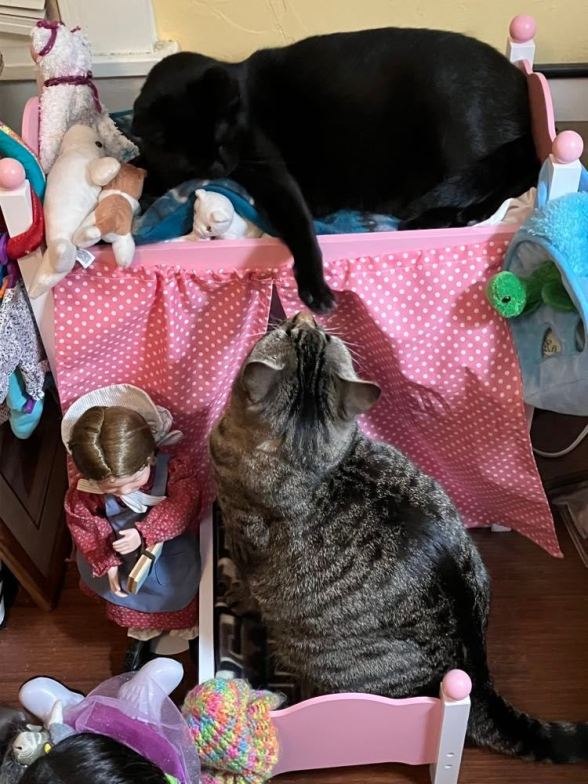
The photograph is Sol Duc and Elwha enjoying doll bunkbeds. And acting like siblings do sometimes. And then they curl up together.

Practicing Conflict

An essay from my church talks about the writer avoiding conflict, fearing conflict and disliking conflict. This interests me, because I do not avoid conflict, I don’t fear conflict and actually, I like it. Our emeritus minister once did a sermon in which he said that when you are thinking about two conflicting things at once, that is grace. I have thought about his words many times, especially when I am not in agreement about something.

Does this interest in conflict mean I fight all the time? Well, sort of, but not in the way you think. I don’t fight with other people much. I fight myself.

What? No, really. Most topics have multiple sides. Not one, not two, but many. Like a dodecahedron or a cut gem. Hold it up to the light, twelve sides, each different. I argue the different sides with myself.

I learned this from my parents. My parents would disagree about something, they would discuss or argue about it, and then they would bet. Sometimes they bet a penny, sometimes a quarter, sometimes one million dollars. Then one of them would get up and get the Oxford English Dictionary, or the World Atlas, or some other reference and look it up. This was pre-internet, ok? 1970s and 1980s.

Sometimes my parents would even pay each other. The penny or quarter. My father spoke terrible French and my mother had lived in Paris for a year after high school, so he could get her going by insisting that his French was correct. It wasn’t. Ever.

There were other arguments in the middle of the night that were not friendly and involved yelling, but the daytime disagreements were funny and they would both laugh.

Once my sister is visiting after my mother has died. My father is present. My father, sister and I get in a three way disagreement about physics. I’m a physician, my sister was a Landscape Architect and my father was a mathematician/engineer, so we are all three talking through our hats. However, we happily argue our positions. Afterwards, my gentleman friend says, β€œThat was weird.” β€œWhat?” I ask. β€œThat was competitive and you were all arguing.” β€œIt was a discussion and we disagreed.” β€œI won’t compete.” β€œWe let my dad win, because it makes him happy.” β€œThat was weird.” β€œOk, whatever.”

My gentleman friend is also shocked when my teen son challenges me at dinner. My son says, β€œI am researching marijuana and driving for school and there isn’t much evidence that it impairs driving.”  I reply, β€œWell, there is not as easy a test as an alcohol test and it was illegal, so it has not been studied.” We were off and having a discussion.

Afterwards my gentleman friend says, β€œI am amazed by your son bringing that up. We weren’t allowed to discuss anything like that at dinner.” I say, β€œWe pretty much discuss anything at dinner and both my kids are allowed to try to change my mind. About going to a party or whatever.” He shakes his head. β€œThat is really different.” β€œOk,” I say.

This habit of challenging authority, including adults, did not go over well when my son was an exchange student to Thailand. It did not occur to me to talk to him about it. He figured it out pretty quickly.

Back to my internal arguments. If I take a position, I almost immediately challenge it. I think of it as the old cartoons, with the angel on one shoulder and the devil on the other. The devil will make fun of things and suggest revenges and generally behave really badly. The angel will rouse and say, β€œHey, you aren’t being nice.” Then they fight. The internal battle very quickly becomes comic with the two of them trading insults and bringing up past fights and fighting unfairly. When it makes me laugh inside, I can also be over the driver who cut me off, or someone who spoke nastily, or whatever. My devil is very very creative about suggested revenges. When the angel says, β€œYou are meaner than the person who cut you off!” I am over it.

When I was little and disagreeing with my family, my sister could tell. β€œYou have your stone face on!” That meant I was attempting to hide a feeling, especially fear or anger or grief. Siblings and family are the most difficult because they can read us and see through us like glass. My physician training also teaches control of feelings. I have sometimes wanted to grab a patient and scream β€œWhy are you doing this to yourself?” but that really is not part of the doctor persona. I am doing it inside, but I can put it aside until later. Then the devil goes to town! And the angel tries to calm the devil down.

Maybe we all need more of this skill. Pick a mildly controversial topic. Argue one side of it. Then switch positions and argue the other side. Go back and forth until it gets ridiculous. Let each side get unreasonable and inflammatory and annoying. This can play in your head and not on your face. Once you can do a mild topic, move on to something a bit more difficult. If you only know the arguments on your side, read. You can find the other side, the internet is huge. Start gently.

A friend says, β€œYou always argue about things.” I say, β€œI prefer to think of it as a discussion.” β€œYou always take the other side.” β€œWell, it interests me. And if there is no one to discuss something with, I discuss it with myself!” β€œWeirdo,” says the friend. I think he’s jealous, really I do. Don’t you?
Family

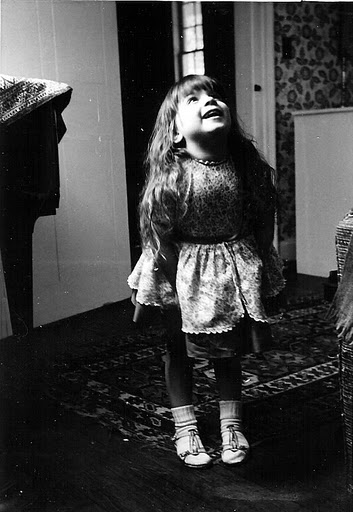
The photograph is from left to right, my sister Christine Robbins Ottaway, my (sort of but not blood) cousin Katy, and me. This is a fourth of July. We wanted to DO something. We were at my maternal grandparents’ in Trumansburg, New York. My mother suggested that we dress up and do a presentation. We wore her 1950s prom dresses, held a small parade involving three dogs and a cat who were also in costume, and read the Declaration of Independance and the Preamble to the Constitution to a group of adults in lawn chairs. This was in lieu of fireworks. We had fun but we still missed fireworks.

I am thinking about asking. I could not ask my mother for specific things I wanted as a child. She would get me a different and cheaper alternative. If I was disappointed, I would be guilt tripped or humiliated. I did not ask my father for things either. He would make and break promises, too sick from alcohol or he would have forgotten. I stopped asking because I did not like being disappointed and I did not like being shamed. Once I really really wanted something for Christmas. My sister and I made a quiet deal, showing each other exactly which toy we longed for. Then we each shopped with our mother and insisted on the toy the other wanted. Our mother did try to talk each of us out of the toy. We had arranged it so that we were spending the same amount of money: $20. She thought that was outrageous and that something cheaper would do just as well. We both stood our ground on the other’s behalf and then open the presents on Christmas day with faked surprise and real joy. We did NOT tell our mother.

On an earlier Christmas I sewed my sister a toy stuffed snake. My mother was discouraging, but she let me have cloth and needle and thread. “Why do you want to make her a snake? A snake?” I couldn’t really explain well. We had gone to a county fair and my sister and I both longed for the velvet snakes, six feet long and deep red. The snake I made for my sister was only a foot and a half long and I had flowered fabric, not velvet. I coiled it in a circle and wrapped it. My sister was delighted with it and held it all Christmas morning. My mother just shook her head. “A snake.” she muttered.

The things that I could ask for were books and music. I was the kid that the teacher would hand the scholastic book box to after she handed out one or two books to the other kids. I would order 20 books. My father said I could have as many as I wanted as long as I read them all. The only books I avoided were about television or movies. I loved a non fiction book about WWI Flying Aces. The technology of the airplanes and the problem of bullets ricocheting off the propeller were amazing. I also liked that it talked about the ACEs on both sides: German, English, French, American.

For the Ragtag Daily Prompt: ask.

I don’t know who took the photograph. I think it was one of my grandparents. Oh, I think “cousin” Adam is in the picture too, though he is nearly hidden behind the flag.

Adverse Childhood Experiences 14: Hope

I keep reading bits about despair and about how a generation of children is being “ruined” by the pandemic.

Not so, I say. There is hope. We need to support each other to survive and then to thrive.

This generation WILL have a higher than average ACE score. If the Adverse Childhood Experience scale is from zero to eight, children in this time period will have at least one higher point than average and many will have three or four or more. Loss of a parent, a sibling, beloved grandparents during covid. Increases in domestic violence, child abuse and addiction. These are all part of the ACE score.

What does this do to children? They have survival brain wiring. They will do their best to survive what is happening. A friend and I both have high ACE scores, 5 or more, and we are both oppositional defiant. We showed this in different ways. He grew up in the same community. He escaped from home and knew all the neighbors. He walked to the local church and attended at age 3 or 4. He has lived in this community all his life.

His oppositional defiance showed up at home, where he consistently refused to obey. And in school, where he confounded and disobeyed teachers and passed anyhow.

My family moved every 1-5 years. I hated moving. I wouldn’t talk to kids in a new school for a year. It was very difficult. So my oppositional defiance was very very internal. I hid in books and in my head. In 6th grade I got in trouble for hiding novels inside the school book I’d already read. I also would just not listen and my respect for the teacher got even lower when she would be angry that I knew the answer to the question once she’d repeated it. I wasn’t listening because I was bored. She was the first teacher that I thought, well, she is not very bright. The next year they stuck me in the honors class and I stopped being bored, though I still questioned practically every opinion every teacher had. I wanted evidence and I did not believe it just because the teacher said it.

I am not saying that oppositional defiance is in every high ACE score. I don’t know that. Why oppositional defiance? Imagine you are a small child and you are beaten. There isn’t rhyme or reason. You can’t predict when the adult will be out of control. Why would you behave “well” if it makes no difference? You might as well do what you want, because nothing you do will change the adult. Or imagine you are a small child who is with one person, passed to another, then to another. You may not exactly trust adults after two or three repetitions. And you want to survive.

There is an increase in addictions, behavioral health diagnoses, and chronic illness in adults with a high ACE score. A researcher when I first heard a lecture about it said, “We think perhaps that addiction is a form of self medication.” I thought, oh, my gosh, how are we ever going to treat THIS? Well, we have to figure that out now, and we’ve had 30 years to work on it.

I was very comfortable with the oppositional defiant patients in clinic. I got very good at not arguing with them and not taking their behavior personally. They might show up all spiky and hostile and I might be a little spiky and gruff back: sometimes that was enough. I think the high ACE score people often recognize each other at some level, though not always a conscious one. With some people I might bring up ACE scores and ask about their childhood. Sometimes they wanted to discuss it. Sometimes they didn’t. Either was ok.

One thing we should NOT do is insist that everyone be “nice”. We had a temporary doctor who told us her story. Her family escaped Southeast Asia in a boat. They had run out of water and were going to die when they were found by pirates. The pirates gave them water. They made it to land and were in a refugee camp for eight years or so. She eventually made it to the US. She was deemed too “undiplomatic” for our rural hospital. I wondered if people would have said that if they knew her history and what she had been through. It’s not exactly a Leave it to Beaver childhood, is it? When she was telling us about nearly dying of thirst in the boat, my daughter left her chair and climbed on my lap. She was under ten and understood that this was a true and very frightening story.

We can support this generation of children. This has been and is still being Adverse Experiences for adults as well. Family deaths, job loss, failure of jobs to support people, inflation. Remember the 1920s, after World War I and the last pandemic, of influenza. “On October 28, 1919, Congress passed the National Prohibition Act, also known as the Volstead Act, which provided enabling legislation to implement the 18th Amendment.” (wikipedia). There were forces trying to legislate behavior, as there are now. The result in 1920s of making alcohol illegal was speakeasies, illegal alcohol, and violence. Some people acted wild after WWI and the influenza pandemic and some people tried to lock down control, by controlling other peoples’ behavior. It did not work then and it will not work now. The wildness is out of control grief, I think, grief dysfunctional and drinking and shooting and doing anything and everything, legal or not. We remember how the 1920s ended too. Let us not repeat that. Let us mourn and grieve and support each other and support each other’s decisions and autonomy.

Blessings.

Adverse Childhood Experiences 13: on gratitude

I saw a meme today about gratitude. It is saying that some people look at a garden and see thorns and weeds, but others see the roses. That we need to have gratitude. I think this is simplistic and papers over the trauma and grief that some people have. If they have endured a highly traumatic childhood, who am I to say they should focus on the roses? They may have a very good reason to see if there is something like a thorn that can hurt them before enjoying the roses.

I work with many patients with high Adverse Childhood Experience scores and mine is high too. I don’t tell my patients that they should have gratitude. I tell them “You survived your childhood. You have crisis wiring. Good for you. Some of your learned crisis survival wiring may not serve you as well now as it did when you were a child.” Then we discuss whether they want to work on any aspects and the many many different approaches. One example: a man who sleeps very lightly. He said that it was lifelong. When asked about his childhood he says, “We would have to leave in the night when there was shooting in my neighborhood. It was a very dangerous area.” I said, “I am not surprised you sleep lightly. You HAD to in childhood to survive. Is this something you want to try and change?” He thought about it and decided, no. Once it was framed as learned in childhood to survive, he stopped worrying about “normal”. He was satisfied that the way he slept was “normal” for him and he wanted to wake up if he heard shooting.

I think we have to ask why a person sees thorns and weeds in a garden before we judge them. My first thought with a new and angry or hostile patient is always, oh, they have been badly hurt in the past. What happened? I don’t worry that the anger is at me. I know it’s not at me, it’s at the system or a past physician or a past event. Under the anger there are other emotions, usually fear or humiliation or grief. I have brought up Adverse Childhood Experience scores on the first visit sometimes. One person replies, “I am a 10 out of 10.” The score only goes up to 8 but I agree. He was a 10. He stated once, “The military loved me because I could go from zero to 60 in one minute.” Very very defensive and very quick to respond. The response may seem extreme and inappropriate to other people: but it may feel like the only safe way to be to my patient.

I grew up hiding any grief or fear in my family, under anger, because grief or fear would be made into a story told for laughs. In college, a boyfriend told me I was an ogre when I was angry. I started working on it then and it was difficult to tame that. The person who took the longest was my sister: she could make me explode until I was in my residency. Medical training was excellent for learning emotional control, at least, on the surface. After my mother died, I had to do the next piece of emotional work: open the Pandora’s Box of stuffed emotions, mostly fear and grief, and let them out. It was such hard work that my day where I saw the counselor for an hour was harder than my ten hour clinic day. I did the work, for two long years. Blessings on the counselors who stood by me while I worked through it.

I do not think we are ever done with that sort of work. I think, what do I need to learn next? What is this friend teaching me? Why is this behavior frustrating me and I have to look in my inner mirror. Why, why, why?

Blessing on your healing path and may you not be judged.

Link about ACE scores: https://www.cdc.gov/violenceprevention/aces/about.html

Sometimes I do feel like a fossil, now that I am middle aged. For the Ragtag Daily Prompt: fossil.

playing telephone

If they whisper from one end to the other, does it get garbled before it reaches the other end?

Isn’t gossip a sin?

For the Ragtag Daily Prompt: chaos.