within normal limits

I think doctoring makes one cynical. Or at least messes up the scale of normal.

Maybe there are Marcus Welby docs out there, but I don’t know any. Doctoring messes up one’s scale. A wound is compared to black horrifying gangrene to the knee, pain is compared to screaming delirium tremens or full thickness burns or heroin withdrawal, one in four adults can be diagnosed with a psychiatric disorder at some time in their life…. so then, what is normal?

What is normal for relationships? How many deeply happy marriages do you know? If half end in divorce, what are the odds?

Where is the line in love? Where is the line between loving the other person no matter what and wait, that is domestic violence. Where is the line for abuse? Do people agree on it?

No. They do not. What I think is behavior that is frightening may be normal behavior to my partner. Is it ok to drink until one is drunk? I don’t want to be around it. I saw enough of that shit at work. I deal with addiction daily. If someone wants to get drunk, they can choose to do that. But not around me. And no, I don’t want to date them. And if they are working themselves to death, is that ok? Well, I might be a tad hypersensitive to that, since I nearly managed that myself. So I don’t want to be around that either. That might be viewed as noble self-sacrifice. But at work, I see the caregiver die before the recipient of the care, all too often. Especially in older couples, where neither one wants to let anyone in the house to help….

….but then, some people do hear me. A woman thanked me last year for saying she should quit covering for her husband. She was afraid, but backed off. He is able to do more than she expected and he also is more respectful and kind to her. She thanked me and I got all shy and tongue-tied.

My definition of love is listening. Someone who listens and hears and lets me listen and hear. When each person can say what they are thinking and feeling and wanting and worried about…. because if only one person is speaking, if only one person is determining what the relationship is, it is not a relationship.

wearing sunglasses in the rain

Trigger warning: this is about dementia. I wrote this over ten years ago.

wearing sunglasses in the rain

I am weeping for you both

you have cared for her
for better or worse, for richer or poorer, in sickness and health

and she has lost her memory

you told me on the phone
that it’s not that bad

you say it again in the room

I knew before I saw her
that it was bad, very bad, much worse
she is only 60

she becomes agitated when we try to weigh her
old style doctor’s scale
frightens her to try to step up.
gentle caregiver that you have hired
pushes her, until I say stop, stop, stop
her weight does not matter

shuffling gait
she is frightened to be in a new place
I ask her questions gently
she does not want to sit in the chair in the exam room
“No!” she says “No!”
I leave the room until she’s calmer

when I return
I give her choices
“Shall I examine you first with my stethoscope
or shall I talk to your husband?”
I choose for her, the latter
she relaxes, a little
later, I tell her each step before I do it
she is slightly tense when I lay the stethoscope
on her thin shoulders, but she doesn’t fight

she tenses as I ask her husband questions
about the memory loss
ten years now, a steady course
I ask him what he understands about the prognosis
he shifts uncomfortably
and I ask her if she would like to wait in the waiting room
while I talk to him
Firm and clear: “Yes, I would.”

She is not in the room now
he says that she is not too bad
the picture comes slowly in to focus
mild memory loss, is what he thinks

there are three stages of memory loss, I say
mild, the short fibers, where short term memory is affected
we forget what someone just said
moderate, the medium axons
we forget the recipe that we’ve know for 50 years
we forget how to do math
we forget names and how to get to the store
we forget how to operate the car
severe, the long axons
executive function
we do not initiate things
we forget to get dressed
we forget how to speak
we forget our potty training

his eyes grow sadder and sadder

at last, we return to being a baby
we forget everything
at last, we remember the womb
we no longer want to eat

is she forgetting to eat?

he is not ready to answer

as we leave the room
he says that she is not sleeping well
she seems to be awake at night
eyes closed
but her fingers are moving, as in play
he doesn’t speak to her
he needs to sleep and thinks she should too

should he give her a sleeping pill?

maybe she is happy, I say
maybe in bed in the dark
you are there and it is safe
no one is making her get dressed
no one is making her bathe
maybe that is where she wants to be awake
I would not give her a sleeping pill

the dogs are in the room
he says
and the tv is on just a little
maybe she is happy

he is wearing sun glasses
as they cajole and help her in to the van

he is wearing sun glasses
though it is overcast, low clouds and raining

sometimes it is so hard
to say what I see
to try to say the truth

sometimes the truth is not gentle
but sometimes the truth is love

I am weeping for you both

written 2010

Avoid death by fentanyl

Some of the West Point Cadets overdosed on March 12, 2022 are still on ventilators. They took what they thought was cocaine. It was laced with fentanyl and they all nearly died.

Not only that, but two of the bystanders who did not use the drug, but did cardiopulmonary resuscitation, CPR, also succumbed. They stopped breathing because they got a heavy dose of fentanyl giving CPR.

Fentanyl is being laced into ANY illegal drug, and being 50 times stronger than morphine, it can kill you by making you stop breathing. Also, fake pills are made. Do not buy pills on the street. And I don’t care if it is your friend. Remember that when someone is really addicted, the addiction is running the show. They need the drug more than your friendship. People will lie, steal and sell drugs. Protect yourself:

Please read the website at

https://www.cdc.gov/stopoverdose/

If you or a family member uses illegal drugs, please get naloxone to have at home. If the shot is given in time, very soon after the person stops breathing, it can save their life.

Here: https://www.cdc.gov/stopoverdose/naloxone/index.html

If you give someone a dose of naloxone CALL AN AMBULANCE. Because it is short acting and the opioid may take back over. The person may need to be on naloxone iv! You must get them to an emergency room as fast as possible.

Our local Health Department was giving out naloxone shot kits in the last few years for free. Our local police carry naloxone. If you are on prescription opioids, you should be offered a prescription for naloxone and your family should be instructed on how to use it.

And teach your children well. I interviewed my patients for years on the age they started smoking. Most of my patients started at age nine. One woman said age seven. We have to start talking to children about drugs and risk and not smoking anything by third grade. That is the horrific reality.

And Bless the punk band The Offspring for reaching out to opioid overuse people and saying, “Get help. You can do it. Please do not die.”

The Opioid diaries live by the Offspring.

And they too are inimitable.

Playlist: Inimitable

This for the Ragtag Daily Prompt: Inimitable and for the website that threw me out because I “did not explicitly violate the rules”. Yep, that’s right. I am thrown out for or in spite of not breaking the rules. Can you say witch hunt? Or scapegoat?

Oh, man, do I have a song list for the website. And will I name it? Nope. Why would I ever do that? I do have friends there and a mentor. This is not about them. This is about the witch hunters. I curse their tiny brains. And I miss my friends, who outnumber the whiners.

So let’s start with songs by the boys. I’ll do songs by the girls next.

Denial

Hank Williams III: Country Heroes

Bargaining

The Offspring: The kids aren’t allright

Anger

The Offspring: Get a Job

Acting Out

Hank Williams III: Pills I Took

Revenge

The Devil Makes Three: Ten Foot Tall

Grief

The Devil Makes Three: Old number 7

Acceptance

The Devil Makes Three: All Hail

Stages of Grief Playlist 2

Wait, another? We don’t go through the stages of grief once. We go around and around, like a spiral. Some days we want to lie down in the driveway and just not move. Others it seems like the there might be a tiny bit of sun in the world after all. A mourning handout from the American Academy of Family Practice writes about a culture where one is considered “legitimately crazy” for a year after the death of someone loved. The person is allowed to be emotional, complain, wear their bathrobe all day and call people at 3 am.

Maybe we are all in that stage right now.

Stages of Grief Playlist 2

Denial

The Offspring: Pretty Fly for a White Guy

Bargaining

Kate and Anna McGarrigle: Hard Times Come Again No More

Anger

The Offspring: The opioid diaries

Acting Out

Nathanial Ratcliff and the Night Sweats: SOB

Revenge

Bessie Smith: Young Woman’s Blues

Grief

Over the Rhine: Let it Fall

Acceptance

Sweet Honey in the Rock: Run, Mourner, Run

Stages of grief playlist

Stages of grief playlist

My sister had breast cancer for 7 years. She said that the five stages of grief missed two. She adds “Acting Out” and “Revenge”. I am planning a series of stages of grief playlists, because we are coming up on one million US citizens dead of Covid-19 and we are at six million world wide and counting. We need help grieving. I have other stuff going on to, so my go to is music.

Denial

Eagle Mountain String Band

Bargaining

Lake Street Dive: I want you back

Anger

Over the Rhine: oh yeah by the way

Acting out

Lily Allen: Smile

Revenge

Lily Allen: Fuck you

Grief

Citizen Cope: Sideways

Acceptance

Over the Rhine: All of My Favorite People

The AntiDating Patch II

Gosh, again? Once again I am giving up on dating, because, well…. I just cannot even IMAGINE beginning to share my past life. Heh. I suppose I could do one of those “We never talk about the past” relationships, but BLEAGH. Sorry, boring.

So, I quit. As I wrote in The AntiDating Patch, people are contrary beasts and nothing makes them more interested then being engaged/and/or/quitting dating. How do I get around this? Wearing the PATCH(Tm) is not enough. (I chose itsy bitsy country of origin of my choice, just FYI, not the boxers and ick, not the speedo).

Quitting won’t work. I will be hounded. My microbiome will start howling and send out pheromones to the other microbiomes and people will gather round. No! I say, No!

Better to date. Hmmm. I think I will date the birds in my yard. The male deer are a bit spiky for my taste, a little scary to get close to. I like the raccoons, they are VERY good at growling and protect their young. The coyotes are shy but I’ve seen them within a block and by my former clinic. Also one on three legs by the hospital. I wonder if he was considering the ER? I find great blue herons fascinating and wish that I could fly and land in trees. I could date a tree, right? Be anything you want to be? At one point I was so fed up with people that I decided to be a tree.

There. I will peel the AntiDating Patch off in a week and date the local flora and fauna. A week of the patch will reinforce my resolve and then I can go moon at trees, or a blue heron, or a coyote.

Phew, problem solved and plan laid. I won’t have to explain my life at all, at least not in English. I have had a blue heron circle back to land in a tree when I was trying to talk blue heron. The heron looked pretty fierce, I am afraid that what I am saying is probably an insult. It’s easy to pick up the nasty slang in another language. Maybe they will teach me if they sense my deep and positive intentions. I hope so, don’t you?

Update on Addiction 2022: Mouse Cocaine Addict Studies

Recent experiments on mice are giving us interesting information on addiction, and suggesting that l-dopa may be able to control/mitigate addiction. This lecture about how dopamine works in addiction using a mouse model (poor mice) blew me away. The mice fell into two categories: maintenance users and vulnerable addict rats. The study of the dopamine postulates a reason for the difference.

20th Annual Drug Conference Washington State from 2019

Notes from lecture 3: Paul Phillips PhD
Dopamine Neurotransmission in Substance Use Disorders: from Preclinical studies

For a long time there were no agreed upon animal models: rats don’t steal money from other rats to buy drugs. However, rats do get addicted and this can be studied.

There are features in rats, rat behavior and rat brains that might translate to humans.

1. Basic discoveries about dopamine neurotransmission in substance use disorders is discussed.
A neurotransmitter study checking every ten minutes in brain examines two areas: dorsal and ventral striatum. Dopamine is increased in the area between cells from the administration of substances “first time use” in animal models: cocaine, alcohol, methadone, cannabinoids, nicotine, amphetamine, morphine. This is the first clue re addictive drugs, whether there is an increase in dopamine intraneuronally. The endpoint is that direct effect on dopamine receptors, which has a different brain mechanism for each drug. Cocaine blocks the receptor that reuptakes the drug into the neuron. Methamphetamines and amphetamines reverse the reuptake pump, makes the receptor spit it out. Gaba neurons act to inhibit dopamine neurons, normally mu receptors on the gaba interneurons and the opioids block those. Ethanol has another mechanism of action. It changes inhibitory activity, lowering the inhibition of the gaba interneurons. Nicotine REALLY messes with multiple receptors and multiple cells, but main effect is increase of dopamine in the striatum.
Increased dopamine in human brain relates to the feeling of being high: brain PET scans show amphetamine and dopamine bound less, reduction in the binding. Subjects were substance abusers. Subjective questioning of how high they felt correlated with the amount of dopamine released on the PET scan. Methylphenidate was used in that study. Canada study: cocaine increases dopamine in human brain by PET scan.
Addiction does lead to changes in the brain, on both PET scans and functional MRIs.
PET scans measuring dopamine binding in the brain show that the baseline in brains of substance abusers differs from non-abusers. The levels of dopamine receptors is lower in the substance overuses and there is lower binding than controls: heroin, alcohol, meth, cocaine (and obesity and ADHD…..). (This has been known for opioid overuse and chronic use for a while: the brain cells withdraw receptors, so the same dose does not reduce pain because there are less receptors. The change in receptors appears to vary in different subjects. Recovery is very slow.)
The role of dopamine has been confusing. It is known that it is involved in the cue evoking cocaine “craving”, but is also involved with — satiety. This has been confusing and contradictory — what does dopamine do but also the dynamic structural signaling.

2. The animal studies demonstrate that the dopamine signals are phasic.
Rat studies measure changes in dopamine minute to minute electrochemistry for sub-second dopamine detection in vivo, which means we can measure changes in dopamine in real time. There is an identified output signature for dopamine levels, measure in 8.5 millisecond, ten measures per second.
The rats were voluntarily taking cocaine. The cocaine was available in a liquid with a light that would come on when it was available, for two hours daily. The animal presses a lever when the light cue is on and gets an infusion of drug. With the ten measures per second, the first and smaller dopamine response in the brain is before the lever is pressed. That is, there is a rise in dopamine BEFORE the rat presses the lever. If stimulated dopamine, the animal would go press the lever. Then there is a larger reward dopamine signal when the drug hits.
Dopamine is the chicken and the egg: signal to USE and signal that has ARRIVED.

3. Changes that take place with drug use
There is a signal change over time that correlation with features of addiction.
The mice had an implanted brain electrode, tinier than human hair, 7 microns, biocompatability — don’t make the brain attack it as a foreign object so rat brain keeps working. The study involves tyrosine hydroxylase, a precursor of dopamine. A food pellet response of the tyrosine remains the same at 1, 2, 6 months so can monitor substance abuse brain changes. These are cocaine addicted rats. They get cocaine via a nose poke of a button when it lights up. Pellets, not iv (they learn that faster). There are 2 ports to nose poke: active and inactive. The signal that cocaine is available and the pellet is active: a light comes on for 20s and then drug arrives. Can take again after 20sec. The rats titrate cocaine use: not continuous. They pace cocaine use, wait for it to wear off. Over time, drug use 1 hour access daily… slow increase, relatively stable.
When the access is bumped up to 6 hours access daily… rats do increase use — first of 6 hours, escalation of drug use faster — in humans development of tolerance.
With 1 hour cocaine availability, the dopamine response to the cocaine in the rat brain is lower by the 2nd and 3rd week, slowly decreases, then with 6 hours of access the loss of dopamine is very robust, happens faster, dopamine signal gets smaller every time.
Rats long access: were there individual differences? Yes, metric, nonescalated vs escalated groups so like humans. 60 escalated 40 didn’t and stayed stable. So essentially I named these “Vulnerable addict rats” and “Maintenance rats”.
Which group most motivated to take cocaine? The study ups the price of cocaine for rats, how many times are you willing to receive the drug? The escalating animals made more responses, “worked harder” for the drug. The escalator brains, Vulnerable Addict Rats, had just about a complete loss of dopamine signal by three weeks.
The nonescalators had more stable dopamine responses, retained some dopamine brain function.
The greater the loss of dopamine, the more the animal escalates the drug use.
The Vulnerable Addict rats would use cocaine to the exclusion of food, water, sex and sleep and died early.
This is a feedback loop. The rats get a success signal when the drug is taken — but over time don’t get the success signal because dopamine receptors are gone — so take more. In the Vulnerable Addict escalators, the dopamine signal of anticipation goes down in response to the cue, the drug effect takes a little longer but the pharmacological response to drug actually remains.
They tried giving l-dopa, a parkinson’s drug and if treat, the rats get a restoration of the dopamine cue — pharmacological response didn’t change — how does this affect behavior? A daily shot of l-dopa and the animals on the l-dopa have less escalation. (wow!) The l-dopa didn’t affect the nonescalators/maintenance rats. When they remove the l-dopa in the vulnerable addict rats, the animals jump to higher use and so the brain changes are happening even when it is masked by the l-dopa but does not stop the brain changes.
They ask the question: can you reverse escalation? With the the l-dopa, they use less.
Dopamine signaling to take drugs (the anticipation cue when the light goes on) decreases in animals that escalate drug taking, but does not change in animals with stable drug taking.
Restoring dopamine signaling with l-dopa can prevent or reverse escalated drug taking.
This dopamine signaling….

4. Mechanisms — drug cue elicits dopamine.
So this is about triggers. This is a paired drug cue: the light signals that the drug is available. If a non-contingent drug given to animal, the light still elicits drug seeking. Using a naive animal: pair reward with cue, over time the cue will increase dopamine.
(hmm. Facebook. blogging. Instagram. “You have mail”. )
The initial addiction has a short access time. One hour out of 24. When this is changed to long access, some animals escalate vs non escalation — as take more and more drug, the response to the drug taking cue gets larger in the escalators/Vulnerable Addicts. Presentation of cue — by investigator vs animal:
If elicits drug seeking than the dopamine response gets larger to the cue over time.
If the cue is given but other choices of liquid, then the dopamine response gets smaller in some rats — so terminating drug seeking. The Vulnerable Addict Rats had a larger and larger dopamine craving cue spike, the longer they were off the drug. The the increase in the cue drives craving and decrease drives seeking — so both bad.
The conclusion in the rats is that craving for drug, related to cues, is dependent to length of time off drug. The longer the rats were off the drug, the larger the dopamine spike when the cue light comes on. The measure of cue behavior gets worse …. 60 day study in rats, this is not physiological withdrawal, is prolonged way beyond the withdrawal.
1. noncontingent
wait a day or wait a month
work harder to get drug, harder a month out
reaction to drug cue presentation, enhanced over time
at start of drug small signal to drug cue
long access then cue gets bigger
same a day after stop drug
but huge in a month after no drug — huge dopamine response

(my thought was then swearing. how do we treat this?)
In chronic drug use the cue signal shrinks which reinforces drug use AND stopping increases the cue response which ALSO reinforces.

5. Implications for treatment
treating rats
They discuss a virus with promotor that affects dopamine cells, light activated ion channel, cells release dopamine when light stimulated
only activates release of dopamine, to understand mechanisms.
For the self administered nose cue …. In the nonescalator maintenence rats, dopamine cue response stays fairly robust, stimulate those cells and no change.
In the escalator/vulnerable addict rats… if do a virus stimulation of dopamine in the brain, more dopamine to cue boosted, so they use less cocaine and look like the non-escalators.
5th cue less dopamine than 1st cue: if put dopamine back then maintains the drug seeking.

What underlies the decrease in dopamine release?
When the animals use cocaine, dynorphin goes up (kappa antagonist).
They injected a kappa receptor blocker — animal no longer escalate (not in humans at this time, don’t understand well enough) treating animals that are escalating, so the bad addict/vulnerable rats.
Most animals don’t escalate — but pretty serious amounts of drug cocaine so not abstinent.

For future
Dopamine diametric changes: dopamine may reduce consumption but might increase craving, so it is difficult to treat.
l-dopa — treatment — some studies, looking for abstinence, does NOT produce abstinence. Does not make abstinence worse. Says that promise seen relates to the status of the subject — helps with people who are still using (some) but doesn’t help increase or prolong abstinence. So could reduce harm but not abstinent….politically unpopular. Happier with turning alcoholic into a social alcohol user, but that idea is less popular/politically ok with cocaine/opioids (and especially meth).

They are studying mouse nosepokes for alcohol — reduced intake when the rats are on l-dopa.

There is a functional agonist for kappa receptors == buprenorphine, might have effects on drug consumption, speculation across different drugs.

Dynorphin is a stress related peptide, so does that signaling produce escalation of drug taking? So other stress drugs — like corisol, CRF, plan for more studies.

Question: Stress related hormones– babies in stress in utero and in stressful childhood have less dopamine receptors and need more dopamine for pleasure, susceptibility to drug addiction (ACE scores) so is still really early studying neurotransmitters.

Dr. Question: why do people do better with agonist therapy than abstinence in opioids vs other drugs? Answer: we don’t know….. yet.

further information:
https://www.ncbi.nlm.nih.gov/pmc/articles/PMC1920543/
https://www.ncbi.nlm.nih.gov/pmc/articles/PMC80880/
https://archives.drugabuse.gov/news-events/nida-notes/2017/03/impacts-drugs-neurotransmission
https://nida.nih.gov/
Illusion

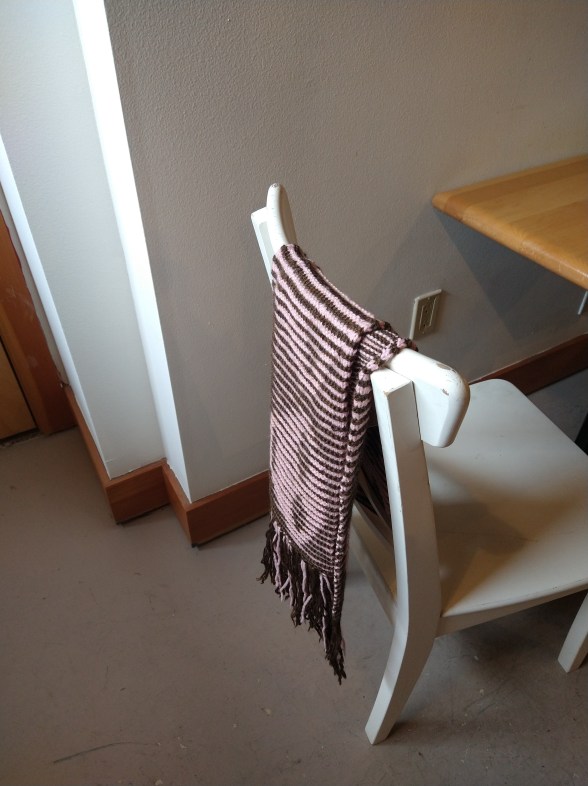
I knit this lovely striped scarf. It is just brown and pink stripes. No tricks, right? Two rows of pink and two rows of brown.

For the Ragtag Daily Prompt: wool.

Chaos

I wrote this poem a long time ago. I was thinking about how being a physician and taking care of other people let me avoid my own feelings. Doctors are trained to hide their feelings. When I was an intern, a patient died on my day off. I came back to find the person gone. No one on the team said anything. I was afraid I’d done something wrong. Was it my fault? Finally I screwed up my courage and spoke the the attending physician. “Oh!” he said, “I meant to talk to you about that patient. They had a lethal pulmonary embolus from the clot in their leg. They were appropriately anticoagulated. You did nothing wrong. This happens.”

I think the war is more of the same. Chaos, to avoid feeling. Let’s not do that. Let us grieve as a world. Let us not melt down in a conflagration. That is my prayer.

Chaos

So familiar

If there’s a mess And chaos
Home that’s home
Busy busy
Run around
Fire fire
Fix it
Crisis
Now what
Deal with it

No time for feelings

No no

No time

I don’t want chaos
Liar liar

Chaos is so safe

Hero hero
Put out the fire
Catch the baby
Confront
Not a hero really
Scared
Hiding

If I stop the chaos
I will have to feel


Maybe it’s ok
To feel a little

I forgive myself
I understand the chaos
I can let go of it      by degrees

I feel so vulnerable
In the quiet clean
     safe place
Take your time
sweet self

____________________________________

For the Ragtag Daily Prompt: WAR.

____________________________________