If eggs aren’t available, why can we still buy chicken?

I note this article this week: https://apnews.com/article/usda-firings-doge-bird-flu-trump-fdd6495cbe44c96d471ae8c6cf4dd0a8. That version says that the Trump Administration is trying to rehire bird flu experts that got fired. Most of the news outlets frame it differently: https://www.nbcnews.com/politics/doge/usda-accidentally-fired-officials-bird-flu-rehire-rcna192716. Suddenly it is the USDA at fault not the Trump administration’s chainsaw fool.

Should we worry about bird flu? Oh, yes, I think so. I have been wondering why we still have chicken to eat and chicken in the stores, if millions of chickens are being wiped out to try to prevent H5N1 bird influenza from moving into humans. This article explains in unreassuring detail how factory farms, packing chickens together, and killing them at 6 weeks old for meat, puts pressure on the virus to become more deadly and kill the host. In wild birds the influenza virus wants to spread, so it’s better not to kill the host fast. That is not true on our national and international big factory farms.

Firing the people working the track the H5N1 bird influenza and trying to stop it if it starts going human to human, well. Is that injustice or arrogance or stupidity? Or all three? And who wants to work for the government now? It is being treated as a corporation, but it isn’t a corporation. Public service often pays less. Good luck hiring the best and brightest who want to serve our country and humanity.

This is the worst year in the US for influenza since 2017-2018 so far. That is without the H5N1 bird influenza really getting in to people. Here is the graph for the week ending February 15th from the CDC. I keep an eye on it all through influenza season.
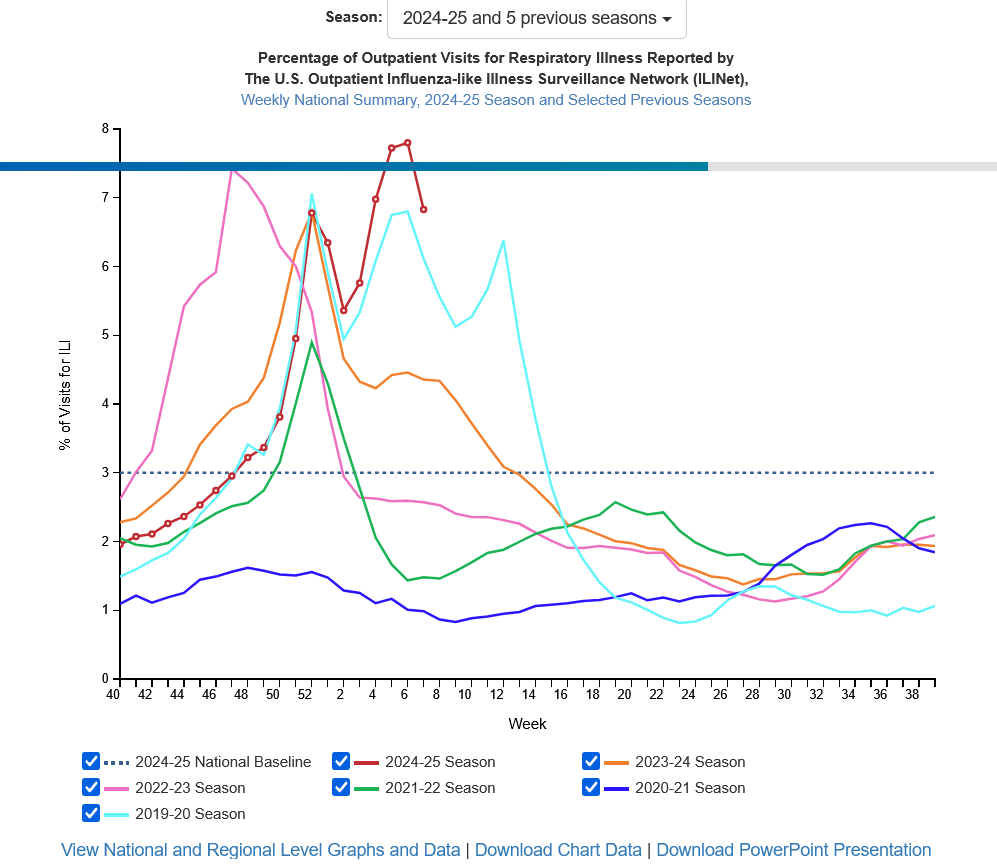
The article on H5N1 bird influenza is the best argument I’ve ever read for choosing not to eat meat. I like meat, but the factory farming is going to more countries. It may produce more eggs and more chickens, but if it is also the perfect breeding ground for lethal influenza, that changes my viewpoint. We cannot go on. We will have another pandemic.

Why are humans such fools?

For the Ragtag Daily Prompt: injustice.

Safe/Not Safe

I think safety is an illusion. BUT it is also nice to feel safe and embrace the illusion.

I sleep best in tents, because as a child, I felt safest at our families “shacks on a lake” in Ontario. Cabins, but pretty much one room cabins. No electricity, outhouses, and my family lived in tents. I loved it. I was more afraid of people than bears.

The pandemic, or this pandemic, has made people feel less safe. But that safety was an illusion too. I had influenza in 2003 and was out sick for two months. I had a racing heart and it hurt to breathe. No asthma. Only rest seemed to help. My doctor and I had no idea when it would resolve. It resolved after two months. My partners accused me of malingering and lying.

A fast heart rate can come from a panic attack, but it works the other way too. If your heart rate is very fast, you may feel panicky. When I nebulize people with albuterol for the first time, I warn them that it may feel like adrenaline, it may speed their heart and they might feel panicky. A friend with Long Covid kept saying that maybe they were just anxious. I got them to have an Urgent Care test them: a resting and a walking heart rate. At rest 72 beats per minute. Normal. Walking, their heart rate jumped to 165, very abnormal! Normal is 70-100 beats per minute, though if one is out of shape, 110 or 120 can result from unaccustomed exercise. But there is no way an athlete in their 20s should jump to 165. The Long Covid heart rate was driving the anxiety, not the other way around.

After I had the 2003 influenza, I read a book of essays about the 1918-1921 influenza pandemic. And I realized that we would probably have a pandemic in my lifetime. I thought it would be influenza, not coronavirus! Hopefully the world will learn a little from this one and change a little over time and be a little more sane if (ok, when) there is another pandemic.

I saw this video today. Wow, what costumes (all 1970s) and dancing! Wonderful! And such a sad song about a broken friendship that used to feel safe.

I hope that you have places or people that you feel safe with. Elwha sometimes likes to sit in the cat tent, even if it is partly open. It feels safe.

For the Ragtag Daily Prompt: safe.

Feed the birds

I fill the bird feeder, a day late, because I had to go buy more birdseed. I also buy suet and fill that feeder. I walk both cats, harness and leash, one at a time. I put both of them in the outdoor screened animal container and they crouch, riveted watching the birdfeeder. I put four peanuts along the top of the fence.

I hold a fifth peanut in my hand over my head and wait. It starts snowing, just a little.

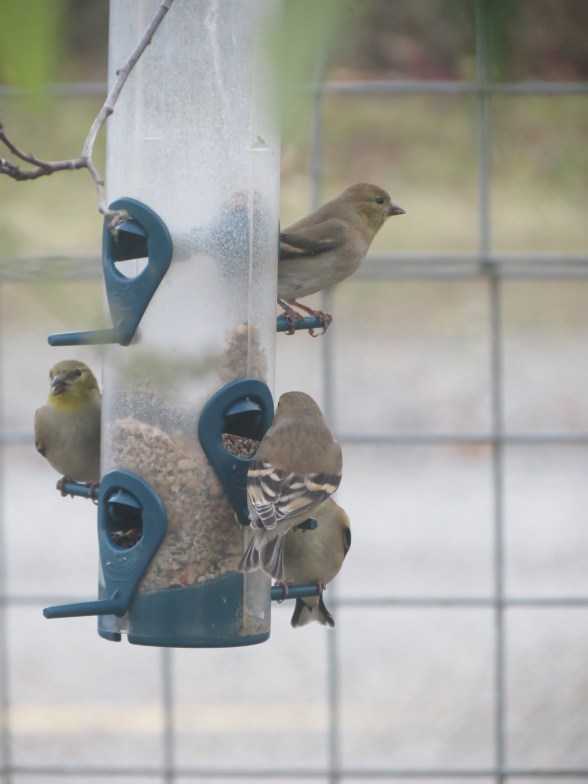
The flock of goldfinches, in their winter more subtle coloring, shows up. I count nine. The feeder can hold 6 at a time. They ignore my hand. A stellar jay comes by, but stays high in the tree. Chickadees pop in between the goldfinches. They are rounder and a little bigger and talk to me. No one comes to my hand. Juncos come to the ground beneath the feeder. The cats would REALLY like to catch them.

And then a bird does come. A hummingbird comes to my hand and hovers right by it! It does not land. It doesn’t like the peanut. It then goes and buzzes the glass, where I used to have a hummingbird feeder up, until the ants find it.

I laugh and get the other hummingbird feeder. I make food and wait for it to cool. I fill both feeders. The Anna’s hummingbird finds it within 15 minutes and eats a lot. The other feeder is on a different window, right outside my desk window. It is soon occupied by a second hummingbird.

I hope to have more photographs soon.

I took this out my desk window yesterday.

There is avian influenza around. I have two feeders and wash one very thoroughly in hot water and soap each time. I change the feeder out every time, to try to reduce the chance of the feeder passing on infection. And wash my hands very well too.

Though it’s rather more than tuppence a bag!

A Good Reaction 2

I am still working my way through my immune response to an influenza shot and six days later, my Covid-19 booster.

I am kicking myself a bit for having them that close together, but at least my immune system responds. I think my immune system takes a shotgun approach and raises ALL the antibodies, and since I most probably have some antibodies that attack my own tissues, it’s not terribly much fun. I’ve had to put pulmonary rehab on hold until my fast twitch muscles work again. They aren’t working and my slow twitch muscles are very pissed off and stiff at having to do double duty. If I do aerobic things, my rib muscles hurt for two days. THAT feels awful.

The good thing (ha.) is that I am having the antibody response but I do not have pneumonia. The working theory is that I have PANS and antibodies to tubulin. Tubulin powers muscles, including lung cilia. Their job is to clean any trash out that gets breathed in. I am at much higher risk for getting pneumonia while the lung cilia are on auto-immune vacation. I am mostly staying home and masking when I go out. A friend got exposed to Covid-19 and refused to test at day five. Well, ok for him, but he could be asymptomatic. So he’s not allowed anywhere near me for at least another ten days. I disapprove of his callousness towards me and others.

Tobacco also paralyzes lung cilia. When I was working I would warn smokers that they might cough more when they stopped smoking, because the cilia would wake up and clean house. “Hey! No one has swept here in years!” A year after quitting smoking, the lung cancer risk drops almost to that of a non-smoker, because those cilia clean house. Isn’t THAT cool?

I don’t know how long my fast twitch muscles will be screwed up. With the last pneumonia, it was nearly a year before the antibodies finally went down. I woke one morning with my slow twitch muscles insanely stiff and my fast twitch back but weak as a newborn kitten. My slow twitch muscles were yelling at my fast twitch: “Where have you BEEN? We’ve been doing YOUR WORK!!” My fast twitch were confused, weak and surprised. I could barely walk down my stairs that day.

Even so, I am lucky. I have a version of chronic fatigue, but because only my fast twitch muscles are affected, I can still do stuff while sick. The people who can barely get out of bed, my working theory is that it is both the fast twitch and the slow twitch muscles that are affected.

And then there are the brain antibodies. Ugh. The silver lining is that the antibodies make me a bit OCD and a bit ADHD, so I am organizing the house. I vacuumed the stairs. That sounds trivial except that I HATE the vacuum. I usually use this peculiar cat hair sponge thing on the stairs, but this time I got the vacuum out. I think organizing and vacuuming are hella funny symptoms of autoantibodies.

Here is a blog post by another physician, also about brain antibodies and encephalopathy. Brain inflammation.

https://www.potomacpsychiatry.com/blog/infectious-diseases-and-psychiatric-illness

Great blog post. And the NIH paper on multiple studies of encephalopathy:

https://www.ncbi.nlm.nih.gov/pmc/articles/PMC6455066/

If I have the energy today, I may try to look up the trajectory of antibody rise and fall after immunization. My brain tells me somewhere between 6 weeks and 6 months, pulling old data from somewhere, but I took immunology classes when I was working at the National Institutes of Health (late 1980s) and in medical school (early 1990s), so there may be new information. Science changes. I am hoping for less than six months really, and meanwhile trying not to get pneumonia.

Blessings and peace you.

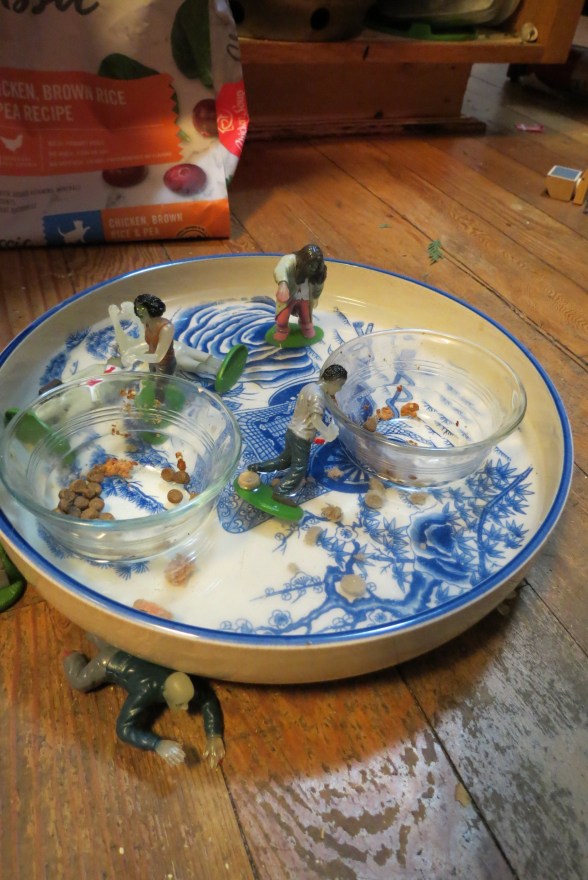
I took the photograph in 2021, while I was REALLY sick. Glow in the dark Zombies stealing the cat food. I have to entertain myself somehow when I have pneumonia.

how to protect codgers

A friend calls me yesterday, complaining that the new Covid-19 vaccine doesn’t prevent infection nearly enough for him to want to get it. He is in his 70s and says darn it, he’d still have a 60% chance of getting infected.

I thought about it and wrote back this morning:

Re the new vaccine the POINT is NOT to prevent infection, though it lessens it in codgers like me and you.

The point is that the vaccinated younger people shed a s–tload less virus if they get it, because their immune system kills it fast. This reduces the amount of circulating virus so that the codgers stop dying like flies. Also the codgers get less sick if their immune system recognizes B4 and B5.

Got it? Get the vaccine.

I am waiting for the top ten causes of death for 2021 to come out. Over one million US people have died of Covid-19. In 2020, there were between 300-400,000 deaths from Covid. That means that we lost 600-700,000 in 2021. If we lost close to 700,000 people, then Covid-19 would beat out heart disease as the number one cause of death in the US. When did that last happen? During the 1918-1920 influenza, the “Spanish” flu that has been traced to a chicken farm in the US midwest.

Here is a provisional and not final list: https://www.cdc.gov/nchs/data/health_policy/provisional-leading-causes-of-death-for-2021.pdf. Hmmm. The numbers are not adding up unless a lot of US people died of Covid-19 in early 2022. And cancer is higher than it’s ever been and creeping up on heart disease. But these are not the final numbers, sigh.

Here is a fascinating chart: https://www.cdc.gov/nchs/data/dvs/lead1900_98.pdf. If you scroll to the end, the top two causes of death in 1900 were pneumonia first and tuberculosis. Heart was fourth. Heart rises to first in 1910 but then pneumonia is back at the top in 1918-1920. I think that the heart has been number one ever since, in the US. World top ten is not the same.

This is not the first pandemic and it won’t be the last. It is horrible. I think that everyone is doing the best they can, though some responses seem saner than others. Remember the old doctor joke about what to do in a code (when someone’s heart has stopped). First: check your own pulse. It’s a corollary that if the patient is dead, you can try to bring them back, but you can’t make them more dead. Also, my latest Advanced Cardiac Life Support class, on line, told me that sometimes I do not have to do cardiac life support. Their example was a decapitated patient. Really? Ouch, doctor humor. But truly, if you are freaking out or want to scream at someone or feel like the world is nuts and you have to do something, first check your own pulse. Slow it down. Breath in four and out four. I can drop my pulse from 101 to 71 in 20 seconds, just by slowing my breathing. You can learn to too.

My recommendation is that if you are due for the booster, get it. And thank you for protecting me and my friend and the other codgers.

No, it is not snowing here yet. But codger seems to be a word for an old GUY. Humph. Would a grumpy hummingbird be a grummer? What is a female codger? I am using codger for any gender, to heck with it.

Covid-19: Long Haul III

The CDC has guidelines for Long Covid and it can qualify for disability in the United States.

Here: https://www.cdc.gov/coronavirus/2019-ncov/long-term-effects/index.html

And here: “As of July 2021, β€œlong COVID,” also known as post-COVID conditions, can be considered a disability under the Americans with Disabilities Act (ADA). Learn more: Guidance on β€œLong COVID” as a Disability Under the ADA, Section

Here is the list of “most common” symptoms from the CDC:

General symptoms

  • Tiredness or fatigue that interferes with daily life
  • Symptoms that get worse after physical or mental effort (also known as β€œpost-exertional malaise”)
  • Fever

Respiratory and heart symptoms

  • Difficulty breathing or shortness of breath
  • Cough
  • Chest pain
  • Fast-beating or pounding heart (also known as heart palpitations)

Neurological symptoms

  • Difficulty thinking or concentrating (sometimes referred to as β€œbrain fog”)
  • Headache
  • Sleep problems
  • Dizziness when you stand up (lightheadedness)
  • Pins-and-needles feelings
  • Change in smell or taste
  • Depression or anxiety

Digestive symptoms

  • Diarrhea
  • Stomach pain

Other symptoms

  • Joint or muscle pain
  • Rash
  • Changes in menstrual cycles

There are recommendations for a work up by physicians. Depending on symptoms, this may include labs, ECG, echocardiogram (heart ultrasound), CT scan and other tests.

A friend has just gone through those four tests . They are “normal” except for her heart rate. At rest her heart rate is 70 with a normal oxygen level. Walking, her heart rate jumps to 135. Over 100 is abnormal in this athlete who is NOT exerting heavily.

So WHAT is going on with NORMAL testing? I think this is “Covid-19 Viral Pneumonia”, a complication of Covid-19, just as “Influenza Viral Pneumonia” is a complication of influenza. Ralph Netter MD has an illustration of lungs from a person who died of influenza viral pneumonia: the lungs are swollen and inflamed and bruised. WHY is the testing “normal” then? The swelling is throughout the lungs, so a chest x-ray sees it as all the same density and a CT scan also sees it as all the same density. The lungs may have mildly decreased breath sounds, but the sounds are even throughout the lungs. The useful TEST is a walk test. I have tested patients with “walking pneumonia” in clinic for years: get a resting heart rate and oxygen level. Then have my patient walk up and down the hall three times and sit back down. Watch the heart rate and oxygen level. If the heart rate jumps 30 beats up or is over 100, the person needs to continue rest until the heart rate stays under 100 or jumps less than 30 beats. It is important to observe the heart rate until they recover. Sometimes the oxygen saturation will drop as the heart rate comes down, and some people qualify for oxygen. Steroids do not seem to work for this. The length of time to healing is not totally surprising, because a lobar pneumonia that is visible on chest xray takes 6-8 weeks to fully clear. It is not too amazing that a bad walking pneumonia could also take 6 weeks or more to clear. If the person returns to work too soon, they prolong the lung inflammation and they are at risk for exhaustion and for a secondary pneumonia. The treatment is REST REST REST and support.

Do they need oxygen? Currently oxygen is covered only if the person’s oxygen saturation drops down to 88%. However, I think that oxygen would help recovery and make them less exhausted. With my first walking pneumonia, which was influenza, my walking heart rate was 135 and my resting heart rate was 100. Both were abnormal for me. Neither I nor my physician could figure it out. This was in 2003. I did look in my Netter book: I took one look at the painting of the influenza lungs and shut the book. “Oh.” I thought. “That’s why I can’t breathe.” The image is here, though I wish it were bigger.

It took two months for my heart rate to come down, the lung swelling to improve, and me to return to work. I read the text of Dr. Netter’s image a year later and then I read an entire book about the 1918-1919 influenza. Since then I have walked people who come in complaining of exhaustion after a “cold” or “bad cough”. Viruses can cause this and so can bacteria: mycoplasma pneumonia, chlamydia pneumonia, pneumococcal pneumonia, legionella and strep A. If the fever is gone, the infection has probably resolved, but it still can take days or weeks for the lung tissue to recover.

For Covid-19, I would add a third test: walking with weights. We test cardiac patients by asking if they can carry two bags of groceries up a flight of stairs. That is 3 Mets, a measure of the heart load. We need to measure the lung load as well. If the lung tissue is swollen, the amount of airspace is cut down and can be half normal. The heart attempts to take up the slack. The person may tolerate a heart rate of 135 for a while, but it is like running a marathon. If they are older or have heart disease, this can trigger a heart attack. I would walk the person carrying hand weights, and see the recovery.

Also, brain fog is unsurprising. If your oxygen level is borderline, it is darn hard to think. I write really strange songs when I am hypoxic. I get goofy and feel weird. The fast heart rate also feels like anxiety: I think that the body is trying to tell me to rest.

The definition of Long Covid is symptoms after 30 days. Please see your physician if you are still ill and continue to have symptoms.

Blessings.

Here is a recent article about T-cells and inflammation in the lungs of Covid-19 patients: https://www.ncbi.nlm.nih.gov/pmc/articles/PMC8460308/

and this: https://www.frontiersin.org/articles/10.3389/fimmu.2020.589380/full

Lung swelling and long covid

I wrote this in 2017, about influenza. However, I think covid-19 can do the same thing. Part of long covid is letting the lungs really heal, which means infuriating amounts of rest and learning to watch your own pulse. Watching the pulse is easier then messing around with a pulse oximeter. The very basics of pulse is that normal beats per minute is 60 to 100. If your pulse is 70 in bed and 120 after you do the dishes, you need to go back to bed or the couch and REST.

From 2017: Influenza is different from a cold virus and different from bacterial pneumonia, because it can cause lung tissue swelling.

Think of the lungs as having a certain amount of air space. Now, think of the walls between the air spaces getting swollen and inflamed: the air space can be cut in half. What is the result?

When the air space is cut down, in half or more, the heart has to work harder. The person may be ok when they are sitting at rest, but when they get up to walk, they cannot take a deeper breath. Their heart rate will rise to make up the difference, to try to get enough oxygen from the decreased lung space to give to the active muscles.

For example, I saw a person last week who had been sick for 5 days. No fever. Her heart rate at rest was 111. Normal is 60 to 100. Her oxygen level was fine at rest. Her oxygen level would start dropping as soon as she stood up. She had also dropped 9 pounds since I had seen her last and she couldn’t afford that. I sent her to the emergency room and she was admitted, with influenza A.

I have seen more people since and taken two off work. Why? Their heart rate, the number of beats in one minute, was under 100 and their oxygen level was fine. But when I had them walk up and down a short hall three times, their heart rates jumped: to 110, 120. Tachycardia. I put them off from work, to return in a week. If they rest, the lung swelling will have a chance to go down. If they return to work and activity, it’s like running a marathon all day, heart rate of 120. The lungs won’t heal and they are liable to get a bacterial infection or another viral infection and be hospitalized or die.

I had influenza in the early 2000s. My resting heart rate went from the 60s to 100. When I returned to clinic after a week, I felt like I was dying. I put the pulse ox on my finger. My heart rate standing was 130! I had seen my physician in the hospital that morning and he’d gotten a prescription pad and wrote: GO TO BED! He said I was too sick to work and he was right. I went home. It took two months for the swelling to go down and I worried for a while that it never would. I dropped 10 pounds the first week I was sick and it stayed down for six months.

Since the problem in influenza is tissue swelling, albuterol doesn’t work. Albuterol relaxes bronchospasm, lung muscle tightness. Cough medicine doesn’t work very well either: there is not fluid to cough up. The lungs are like road rash, bruised, swollen, air spaces smaller. Steroids and prednisone don’t work. Antiviral flu medicine helps if you get it within the first 72 hours!

You can check your pulse at home. Count the number of beats in one minute. That is your heart rate. Then get up and walk until you are a little short of breath (or a lot) or your heart is going fast. Then count the rate again. If your heart rate is jumping 20-30 beats faster per minute or if it’s over 100, you need to rest until it is better. Hopefully it will only be a week, and not two months like me!


Feel free to take this to your doctor. I was not taught this: I learned it on the job.

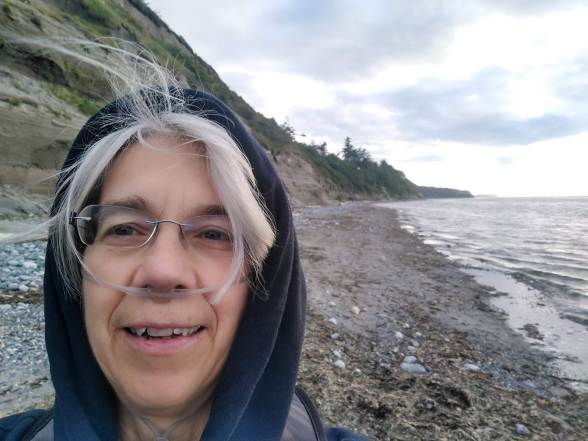
I took the photograph, a stealthie, in June 2021, when I was still on oxygen continuously.

Covid-19: in flew Enza

Survey shows 6 in 10 Americans will delay or skip flu shots this year.

Oh, dear. Not going to get your influenza shot? I am. Well, you say, YOU are on oxygen and have tricky lungs and keep yammering about imaginary Pandas.

Yes, and you should get your vaccine anyhow, even if you are healthy as a hoss.

If not for yourself, for everyone else. Because usually influenza kills 12,000 to 61,000 US citizens a year and gosh, guess what it will do to post-Covid long haulers. Um, kill, I would expect. And with a very low influenza winter last winter, because covid and masks and social distancing, immunity is down and the infectious disease folks are anticipating that it could be a worse than usual influenza year. How many people have long covid? This just in: More than half of covid survivors experience post acute sequelae to covid 19 (PASC) at 6 months after. “β€œThe most common PASC involved functional mobility impairments, pulmonary abnormalities, and mental health disorders,” wrote Destin Groff, Penn State College of Medicine and Milton S Hershey Medical Center, Hershey, Pennsylvania, and colleagues. ”These long-term PASC effects occur on a scale that could overwhelm existing health care capacity, particularly in low- and middle-income countries.”

AND not only that, even if you or your friend or mother or grandmother don’t die of influenza, far more people clog up emergency rooms and doctor’s offices. The “CDC estimates that influenza has resulted in between 9 million – 45 million illnesses, between 140,000 – 810,000 hospitalizations and between 12,000 – 61,000 deaths annually since 2010.”* And the doctors and nurses and emergency people and nursing home employees and first responders are already short staffed and tired. So if you won’t get your flu vaccine for the general public, get it for the first responders.

AND before you tell me that “the vaccine gave me flu”, hello, it takes up to two weeks for the flu vaccine to confer immunity, and so if you got influenza two days later, you didn’t get it from the vaccine, you got it because you got the vaccine too late. Vaccine complications, well, I have seen one complication in my 30 years of Family Medicine, and it was someone I knew, not a patient. And half the people who tell me that “the vaccine gave me flu”, stomach flu with diarrhea and barfing is not influenza. It’s more likely to be a hangover than anything else. I see a lot more post alcohol “stomach flus” than true food poisoning. Quit drinking so much alcohol, ok?

And while you are at it, you’d better get the Covid-19 vaccine while it is still available free. And before you get on an airplane for Thanksgiving or go Trick or Treating with all those little germ spreaders or fly off to see family at Christmas/Kwanza/Winter break/whatever. Two weeks before, at least. Like, NOW. Or don’t, whatever, just don’t whine to ME about more deaths.

This public service message has been brought to you by a beneficent alien lizard. Feel free to send money.

*https://www.cdc.gov/flu/about/burden/index.html

Mask refusal in the 1918-1919 influenza pandemic

This is from an article about the history of medicine, about people refusing to wear masks in the 1918-1919 influenza pandemic:

“Adherence is based on three concepts: individualism versus collectivism; trust versus fear; and willingness to obey social distance rules. Jay Van Bavel opines that some countries tend to be more individualistic,16 and therefore more likely to reject rules and ignore attempts by public health authorities to β€œnudge” behavior change with risk messages or appeals for altruism. InΒ collectivist cultures, people are more likely to do what is deemed best for society. Trust and fear are also significant influences on human behavior.17 In countries with political division, people are less likely to trust advice from one side or the other and are more likely to form pro- and anti- camps. This may also undermine advice issued by public health professionals. The last and most difficult to attain is social distancing. Human beings are social animals with bodies and brains designed and wired for connection. A pandemic, in many ways, goes against our instinct to connect. Behavioral psychologist Michael Sanders argues that if everybody breaks the rules a little bit, the results are not dissimilar to many people not following the rules at all.18

From another article:

“It was the worst pandemic in modern history.

The 1918 influenza virus swept the globe, killing at least 50 million people worldwide.

In the US, the disease devastated cities, forcing law enforcement to ban public meetings, shut down schools, churches, and theaters, and even stop funerals.

In total,Β 675,000 Americans died from the Spanish flu, named after the disease’s early presence in Spain.”

I read a book on the 1918-1919 influenza. It started in the U.S. The photograph that haunts me is the bodies stacked five deep in the hallways of San Francisco Hospitals.

And in a third article:

“The scenes in Philadelphia appeared to be straight out of the plague-infested Middle Ages. Throughout the day and night, horse-drawn wagons kept a constant parade through the streets of Philadelphia as priests joined the police in collecting corpses draped in sackcloths and blood-stained sheets that were left on porches and sidewalks. The bodies were piled on top of each other in the wagons with limbs protruding from underneath the sheets. The parents of one small boy who succumbed to the flu begged the authorities to allow him the dignity of being buried in a wooden box that had been used to ship macaroni instead of wrapping him a sheet and having him taken away in a patrol wagon.”

A CDC article about the history of the 1918-1919 influenza says this:

“The fully reconstructed 1918 virus was striking in terms of its ability to quickly replicate, i.e., make copies of itself and spread infection in the lungs of infected mice. For example, four days after infection, the amount of 1918 virus found in the lung tissue of infected mice was 39,000 times higher than that produced by one of the comparison recombinant flu viruses.14

Furthermore, the 1918 virus was highly lethal in the mice. Some mice died within three days of infection with the 1918 virus, and the mice lost up to 13% of their body weight within two days of infection with the 1918 virus. The 1918 virus was at least 100 times more lethal than one of the other recombinant viruses tested.14 Experiments indicated that 1918 virus’ HA gene played a large role in its severity. When the HA gene of the 1918 virus was swapped with that of a contemporary human seasonal influenza A (H1N1) flu virus known as β€œA/Texas/36/91” or Tx/91 for short, and combined with the remaining seven genes of the 1918 virus, the resulting recombinant virus notably did not kill infected mice and did not result in significant weight loss.14

The 1918-1919 influenza virus was sequenced and studied in 2005. We did not have the tools before that. Frozen bodies were exhumed with the permission of Inuit tribes to find the virus.

Later, that same article talks about future pandemics:

“When considering the potential for a modern era high severity pandemic, it is important; however, to reflect on the considerable medical, scientific and societal advancements that have occurred since 1918, while recognizing that there are a number of ways that global preparations for the next pandemic still warrant improvement.”

Let us now travel back to a worse epidemic: the plague in the Middle Ages:

“Did you know? Between 1347 and 1350, a mysterious disease known as the “Black Death” (the bubonic plague) killed some 20 million people in Europeβ€”30 percent of the continent’s population. It was especially deadly in cities, where it was impossible to prevent the transmission of the disease from one person to another.”

I am hoping that people will awaken, get their vaccines, wear their masks and stop Covid-19 in its’ tracks, so that our death rate resembles the 1918-1919 Influenza. Not the Middle Ages plague.

Top ten causes of death: US 2020

Top ten causes of death US 2020, according to JAMA, here.

Total deaths: 3,358.814
Contrast total deaths in 2019, at 2,854,838. That number had been on a very slow rise since 2015 (2,712,630) to 2019 (2,854,838). That increase over four years is 142,208 people. Then the death rate suddenly jumps 503,976 people in one year. Ouch. I cannot say that I understand vaccine refusal.

1. Coronary artery disease: 690,882
Heart disease still wins. And it went up 4.8%. It is suspected that people were afraid to go to doctors and hospitals. I saw one man early on in the pandemic for “constipation”. He had acute appendicitis. I sent him to the ER and his appendix was removed that day. He thanked me for seeing him in person. Might have missed that one over zoom.

2. Cancer deaths: 598,932
This is cancer deaths, not all of the cancers.

3. Covid-19: 345,342
I have had various people complain that covid-19 is listed as the cause of death when the person has a lot of other problems: heart disease, cancer, heart failure. The death certificate allows for more than one cause but we are supposed to list the final straw first. I cannot list old age, for example. I have to list: renal failure (kidneys stopped working) due to anorexia (stopped eating) due to dementia. That patient was 104 and had had dementia for years. But dementia is not listed as the final cause. So if the person is 92, in a nursing home for dementia and congestive heart failure, gets covid-19 and dies, covid-19 is listed first, and then the others.

4. Unintentional injuries: 192,176
Accidents went up, not down, which is interesting since lots of people were not in their cars. However, remember that the top of the list for unintentional injuries is overdose death, more by legal than illicit drugs. If there is no note, it’s considered unintentional. Well, unless there is a really high blood level of opioids and benzos and alcohol. Then it becomes intentional. They do not always check, especially if the person is elderly. The number rose 11.1%, which seems like a lot of people.

5. Stroke: 159,050
This rose too.

6. Chronic lower respiratory diseases: 151,637
This went down a little. This is mostly COPD and emphysema. So why would it go down? Well, I think bad lung disease people were dying of covid-19, right?

7. Alzheimer’s: 133,182
This seems to belie me putting renal failure due to anorexia due to Alzheimer’s. I think they actually read the forms and would put that as Alzheimer’s rather than renal failure, because it is not chronic renal disease.

8. Diabetes: 101,106
This rose too. 15.4%, again, probably partly because people avoided going to clinic visits. Also perhaps some stress eating. Carbohydrate comfort.

9. Influenza and pneumonia: 53,495
So this went up too in spite of a lot less influenza. Other pneumonias, presumably.

10. Kidney disease: 52,260
This went up.

And what fell out of the top ten, to be replaced by covid-19?

11. Suicide: 44,834
This actually went down a little. What will it do in 2021?

So what will 2021 look like? I don’t know. It depends what the variants of covid-19 do, depends on what sort of influenza year we have, depends on whether we are open or closed, depends if we bloody well help the rest of the world get vaccinated so that there is not a huge continuing wave of variants.

Today the Johns Hopkins covid-19 map says that deaths in the US stand at 608,818 from covid-19. If we subtract the 2020 covid-19 deaths, we stand at 263,495 deaths from covid-19 so far this year. Will we have more deaths in the US from covid-19 than in 2020? It is looking like yes, unless more people get immunized fast.

Take care.