The Ragtag Daily Prompt today is memorize, and oh, what I have memorized! I saw a t-shirt at the Nowhereelse Festival in Ohio that said, “My memory is 80% lyrics.” Yes, me too, a mix of songs, poetry and books that I have read. My sister Chris and I were busily memorizing songs as soon as we could. Here are three very educational songs for young girls. The last one we learned from our cousin, who was a girl scout and a girl scout leader. She was in the calendar one year, making cookies. I was very very impressed and a little jealous.
I bought a four hour recording session at a silent auction and the recordings are me and my sister and my father. We did them in two sessions. We made a list of songs and lost it immediately so we all took turns suggesting songs. My mother had already died of cancer. My sister died in 2012 and my father in 2013. I am so glad to have these recordings. We called it Mocoko for Malcolm Ottaway, Chris Ottaway and Katherine Ottaway. We sang most of them just once and so they are not polished, but I still am happy to have them.
Bridget O’Flynn
I sang Bridget O’Flynn to my daughter when she called me about dancing. “Mom! I love to twirl!” Um, well, yes, your parents met at a contra dance at Glenn Echo Park in Maryland. We love to twirl too.
Late in the evening
A cautionary song, an old barbershop quartet song, that we sang.
Fascinating Lady
I wonder if the girl scouts still sing this.
The photograph is my son scaring me. Ok, that boulder is sitting there balanced BUT! GET OUT OF THERE! Taken in Palm Springs in 2011 up on the mesa. Beautiful.
This is my beloved cat who died in February 2020. She was named Boa Black or Feather Boa, depending on the situation. We got her as a tiny kitten at the pound. She had the softest fur and purred the instant I picked her up. She was 17 when she died.
I am attending parts of the online Collective Trauma Healing Summit, led by Thomas Hubl. This morning I listened to two speakers, each about an hour long. The first was by Rev. angel Kyodo Williams, an African-American buddhist teacher and the second is by Tristan Harris, who is the co-founder of the Center for Humane Technology.
Mr. Harris gives me hope about humans learning to live with social media without continuing to be polarized and angry. He speaks about the way that many platforms work. We tend to click on things that worry us and that we are traumatized about, and the platform immediately starts feeding us more of that. In a way, Facebook and other platforms gas light us: the algorithm figures out what makes us upset and agitated and promptly feeds us more of it.
He advocates moving to more humane platforms, that aren’t built on feeding us trauma, and especially for schools and parents to do this collectively with children. He co-hosts the podcast “Your Undivided Attention” each week, so I will be looking in to that.
However, I have a second reason to be hopeful about social media. I am in more than one group now that has rules and that has administrators that enforce them. Kindness. An insect group that forbids people saying “squash it”, because it’s a group of people that are interested in insects. A physician mom group. A pacific northwest rock group and a women’s pacific northwest rock group. I am now one of the administrators for a local group and am fine with it.
Even though Facebook is still feeding us more trauma and horror if that is what we click on, people are starting to see through this and refuse. They are forming groups where insects and people aren’t squashed. Rural farm groups. Music groups. In these groups I feel that people are coming together and are working to be supportive and help each other, identifying rocks, discussing child behavior, singing together.
Each time that technology makes the world smaller and more connected, we have to relearn how to get along. With our family, then our small tribe, then a larger tribe, then cities, countries and now we can see each other the world over. If all we see is what we fear and what horrifies us in our feeds, then we need to turn it off, breathe, and look for something to calm us down. Knit. Silly cat pictures. Flowers. What gives you a feeling of peace and hope? Whatever it is, do more of it and share it.
Blessings and peace you.
I don’t know who the person in the tintype is. I think that it came from a box from my Great Aunt Esther Parr, when I was in my early teens. My sister and I divided the tintypes and used them as portraits in our china doll houses.
In Practicing conflict, I wrote about practicing conflict by arguing different sides of a topic inside my head. I wrote that I don’t fear conflict and have learned to enjoy arguing with myself. I am a physician and physicians argue all the time.
What? No they don’t. Well, the doctor persona does not argue with the patient much. Some doctors give orders to patients, others try to negotiate, some try to convince. But behind the scenes, doctors are more like the Whacky Racer Car with the Cave Guys, running with their feet and hitting each other with clubs.
In residency in Family Practice at OHSU in Portland, Oregon, I start on General Surgery during internship. This is in the early 1990s and there was not much in the way of “disruptive physician” rules. I have to cover Trauma and Plastic Surgery and General Surgery at night on call. The resident is present but I get paged first for patients on the floor. I learn that I should go to all Trauma pages in the emergency room. If I know what is happening with the new Trauma patient, it’s a lot easier to handle the phone calls for more drugs and so forth. Also, the resident is less mean to me.
We attend the Trauma “Grand Rounds”. These are unreassuring to a new intern. A resident presents a trauma patient, giving the history in the accepted formal order. The Faculty Trauma Surgeons interrupt, disagree with management of the patient and yell. They yell at the resident and at each other. The upper level residents yell too, being well trained. The Trauma Surgeons do not agree with each other. They are inflammatory and rude. I am shocked initially: medicine is not a cookbook, is not simple and it appears that it is a controversial mess. It turns out that medicine IS a controversial mess.
There is not as much yelling on the next rotation. At that time Trauma Surgeons yelled more than any other set of doctors that I ran across. They yelled in the ER, at each other, at the staff, at the nurses, at the residents. The culture has changed, I suspect, but that’s how it was then.
I take Advanced Trauma Life Support as a third year resident. The Trauma Surgeons at OHSU helped write the course. They don’t agree with it. On some questions the teaching Surgeon says, “The answer to this question is (c), “ followed by muttering loudly, “though I totally don’t agree with that and I would do (b).” Another Trauma resident or surgeon then might start arguing with him, but they moved on pretty quickly, to teach the current agreed best practices in the book. Which change every few years. Great.
Years later (2009) I join the Mad as Hell Doctors, to go across the US talking about single payer. They are a group from Oregon. Physicians for a National Healthcare Program are a bit cautious with us the first year: we might be whackos. We have an RV with our logo and we have a small fleet of cars and what do you think we do in the cars? We argue. Or discuss. Or whatever you want to call it. We spend the driving dissecting issues and how to present things best and tearing apart the last presentation and rebuilding our ideas. The group does 36 presentations in 24 days. Each presentation takes an hour to set up, two hours to do and another hour to break down and debrief. We get more and more exhausted and cranky and um, well, argumentative, as the trip proceeds. Even though I think of the Whacky Racer Cave Guys running with their feet and bonking each other with clubs, this is the most wonderful group of doctors I have ever been with. A common goal that we all want to get to, discussing and disagreeing on strategy all the way! I feel closer to those physicians in a week then I feel to any of the physicians that I’ve worked with for the last 9 years in my small town. Conflict with a common goal.
Doctors are TRAINED to argue, even with themselves, to document every decision in the chart with reasons why they have reached that decision. And that they have thought about all of the reasons for say, a low potassium, thought of every possible cause and worked their way through testing. The testing always has two strands. One strand is rule out the things that could kill the person NOW, even if rare. The other strand is what is common? You have to think about both at the same time, always. And argue with yourself about which tests should be done, in what order, what is most important, how do you treat the person while awaiting results, and have I missed anything? And if we aren’t sure, we call another doctor, run it by them, wait for them to shoot holes in our logic or to say, no, I can’t think of anything else.
We can deal with conflict. We must deal with conflict. The world is too small not to deal with conflict, with disagreements, with different viewpoints and positions and ideas. If doctors can do it every single day at work, then everyone else can too. Trying to see all the positions and possible diagnoses saves lives in medicine. We need to extrapolate that to everything else. Try to see other positions, try to understand them, to respect them. We can and we must.
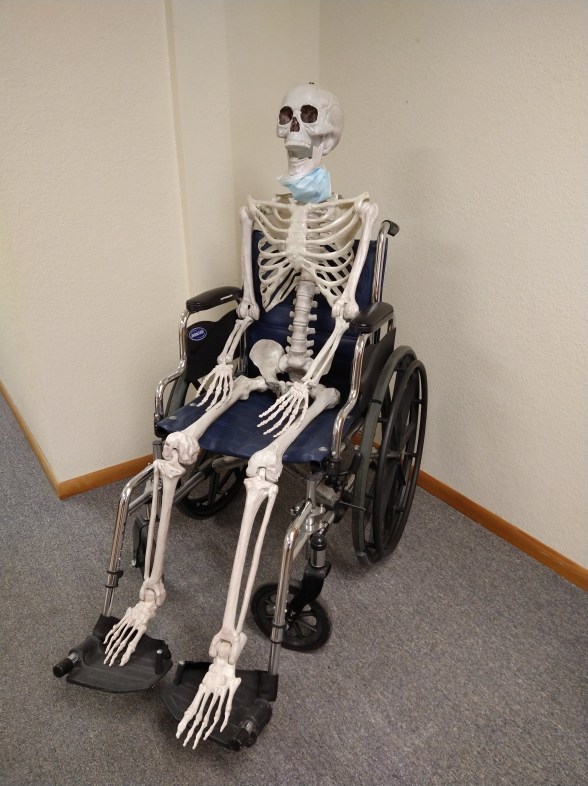
The photograph is from my clinic once we had stopped seeing patients and were selling everything. Mordechai was our clinic skeleton, made of plastic, from China. This was in January 2021.
Thank you, Queen Elizabeth II, for choosing this time to pass, to die.
The world can use public mourning now, a formal ceremony. I tear up every time I look at the lines of people watching, standing, waiting, filing past your coffin.
Perhaps we should set up a coffin for all the dead, a field of coffins, doll coffins, hundreds, thousands, a million for the United States alone, and millions for the world, for all the dead from Covid-19.
And then we need more coffins, for those who died because care was delayed during the pandemic, screening for cancer, treatment for cancer or heart disease or lung disease. Let us set them up as well.
And then we need doll chairs, hundreds and thousands and millions of doll chairs, for the people with long haul Covid, to acknowledge that we don’t know if they will get well, will rise from their beds and chairs.
And white coats, hundreds and thousands and millions of white coats, some neatly on hangers, other bloody, others thrown on the floor, for the first responders, some dead, some quitting, some ill, some deciding that they can’t do medicine or fire fighting or policing any more, some stubbornly continuing in their jobs.
And job advertisements, on tiny doll computers, doll newspapers, doll signs in windows, saying help wanted, help, help, people are quitting, people are too sick to work, people have died, people are wondering why they should work in public, people are afraid and angry and hurt, help wanted.
I tear up when I watch the public mourning. I remember my mother, my father, my sister, all dead before the pandemic. I remember other dead, family and friends. I think of all the dead that I know, starting to outnumber the living that I know.
Thank you Queen Elizabeth II, for this formal and public mourning in this time of confusion and grief. Your last public service, for which I and many others, tear up and thank you.
A friend calls me yesterday, complaining that the new Covid-19 vaccine doesn’t prevent infection nearly enough for him to want to get it. He is in his 70s and says darn it, he’d still have a 60% chance of getting infected.
I thought about it and wrote back this morning:
Re the new vaccine the POINT is NOT to prevent infection, though it lessens it in codgers like me and you.
The point is that the vaccinated younger people shed a s–tload less virus if they get it, because their immune system kills it fast. This reduces the amount of circulating virus so that the codgers stop dying like flies. Also the codgers get less sick if their immune system recognizes B4 and B5.
Got it? Get the vaccine.
I am waiting for the top ten causes of death for 2021 to come out. Over one million US people have died of Covid-19. In 2020, there were between 300-400,000 deaths from Covid. That means that we lost 600-700,000 in 2021. If we lost close to 700,000 people, then Covid-19 would beat out heart disease as the number one cause of death in the US. When did that last happen? During the 1918-1920 influenza, the “Spanish” flu that has been traced to a chicken farm in the US midwest.
Here is a fascinating chart: https://www.cdc.gov/nchs/data/dvs/lead1900_98.pdf. If you scroll to the end, the top two causes of death in 1900 were pneumonia first and tuberculosis. Heart was fourth. Heart rises to first in 1910 but then pneumonia is back at the top in 1918-1920. I think that the heart has been number one ever since, in the US. World top ten is not the same.
This is not the first pandemic and it won’t be the last. It is horrible. I think that everyone is doing the best they can, though some responses seem saner than others. Remember the old doctor joke about what to do in a code (when someone’s heart has stopped). First: check your own pulse. It’s a corollary that if the patient is dead, you can try to bring them back, but you can’t make them more dead. Also, my latest Advanced Cardiac Life Support class, on line, told me that sometimes I do not have to do cardiac life support. Their example was a decapitated patient. Really? Ouch, doctor humor. But truly, if you are freaking out or want to scream at someone or feel like the world is nuts and you have to do something, first check your own pulse. Slow it down. Breath in four and out four. I can drop my pulse from 101 to 71 in 20 seconds, just by slowing my breathing. You can learn to too.
My recommendation is that if you are due for the booster, get it. And thank you for protecting me and my friend and the other codgers.
No, it is not snowing here yet. But codger seems to be a word for an old GUY. Humph. Would a grumpy hummingbird be a grummer? What is a female codger? I am using codger for any gender, to heck with it.
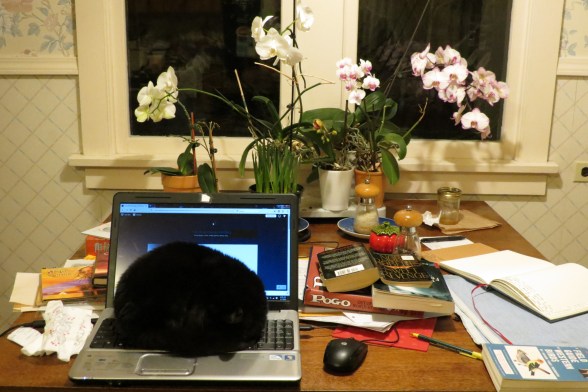
I try to close my laptop when I am not using it. This photograph is Boa, my cat who died in 2019 at age almost 18. I miss her, even though I love Elwha and Sol Duc.
Discover and re-discover Mexico’s cuisine, culture and history through the recipes, backyard stories and other interesting findings of an expatriate in Canada
Engaging in some lyrical athletics whilst painting pictures with words and pounding the pavement. I run; blog; write poetry; chase after my kids & drink coffee.
Refugees welcome - Flüchtlinge willkommen I am teaching German to refugees. Ich unterrichte geflüchtete Menschen in der deutschen Sprache. I am writing this blog in English and German because my friends speak English and German. Ich schreibe auf Deutsch und Englisch, weil meine Freunde Deutsch und Englisch sprechen.










You must be logged in to post a comment.