Beading memory

Both I and my sister have done some beading.

She gave me this necklace one of the last three times I saw her. She was at home with breast cancer and referred to hospice. I flew down to visit three times in the last three months. I was expecting it before then but she was very very strong and fought it all the way to the end.

We were both born in March, so this has amethysts. She liked silver more than gold and we both liked the irregularly shaped pearls. I am not sure what the dark round beads are. They could be bloodstones, which were the March birthstone before amethyst took over. I like the clasp in the front and that it is not symmetric. My sister died in 2012 and of course I still miss her.

For the Ragtag Daily Prompt: beading.

Seat in the sun

For XingfuMamaโ€™s Pull up a Seat Photo Challenge 2024: Week 16.

Yesterday was gorgeous. I took a friend to her second round of radiation therapy. It takes about two and a half hours, since we have to drive to another town. She was very tired and wanted to sleep when she got back. I went to lunch, seating overlooking Port Townsend Bay, in the sun. It was one of those days that makes people want to move here, not realizing that low clouds are more frequent than this glorious warm sun.

Forever or not?

Once someone has cancer, do they have it forever?

I think that is a complex question. But one example comes to mind.

An older woman, in her early eighties, is seeing me. She wants to go back on hormone replacement.

“But you have a history of breast cancer.” I say.

“That was six years ago. And I took that horrible tamoxifen for 5 years and I still am having hot flushes after a year off it and I am sick of it. Give me hormones.”

“Hmmm.” I say. “Let me do some research.”

I call the oncology group south of us. This is over ten years ago when we had no oncologists in our county.

“How old is she?” Her oncologist is digging up her records. “Ok, got her. Hmmm. Well, she had a stage one cancer and a lumpectomy and five years of tamoxifen. THAT cancer is gone, for sure. If she wants hormone replacement, it puts her at a bit more risk for a new breast cancer, but the old one is gone. As long as she understands the risk.”

My patient is back and we negotiate. “Ok, the oncologist says your previous cancer is truly gone, but hormones put you at risk for a new breast cancer. At least, raise your risk a little.” Age is the biggest risk in women, if they do not have the abnormal BRCA I or II genes. “Also, if we have you on hormones, you have to do your mammogram, because I’d want to catch any cancer early. That’s the deal.”

“Fine, I want the hormones.” She signs a consent that I’ve prepared and we put her back on her hormone replacement.

“I want to hear from you, ok? Whether it works?”

She calls in a week, delighted. “No more hot flushes! I feel great!”

__________

I took the photograph at Mats Mats Bay last week. There is a sign about osprey nests. I look up and think, oh, yes! Pretty obvious if you look up!

__________

I don’t remember her exact age and I don’t remember if the five years was tamoxifen or one of the other hormone blockers. She could have been in her seventies. At first I thought, no way back on hormones! Then I thought, quality of life is important. Maybe I choose this photograph because the nest is out on a limb.

Some cancers ARE currently forever, especially those that are stage III or IV and metastatic. Maybe they won’t always be forever.

Tea with a friend

I have a friend over for tea on Thursday.

I make Katy B’s fruit torte, recipe here. Katherine Burling was my maternal grandmother.

The friend worked with me for five years and is surviving lung cancer. She has one of the new treatments. She gets an infusion every three weeks. “For the rest of my life.” she says, but they may come up with something new eventually. She feels pretty terrible after the infusion for a few days.

I use this tea set. I love this set. It says Rose China, Japan, on the bottom. What I like best is that the lid of the teapot has the roof of the pagoda, to line up before I pour. There are six plates, but only three cups and saucers. The sugar bowl and creamer are intact.

For the Ragtag Daily Prompt: tea.

Daily Evil: Z is for Zzzzz

Sleep is not evil. Nor is snoring, though you might think someone is evil at 2 am if their snoring is keeping you up.

This is a small watercolor, 9 by 6 inches. Again, no date, but it is a view near my parent’s house in Chimacum. They loved that house and the views. They moved there in 1996 and my mother was diagnosed with cancer a year later. I want to end with this painting because they were so happy there, even with the cancer. They had wanted to move to the northwest for years, but waited until my grandmother died. She was in her 90s and they were afraid to move her. After she died, it took three years to find a place and sort things and move.

So let’s end with them sleeping and waking to morning and the sun coming over the mountains and the farms around them and the views.

Diagnostic quest

Some diagnoses take months or even years. How can that be?

A patient comes to me with right shoulder pain. His pain is “out of proportion to the exam”. His shoulder exam does not fit with a rotator cuff tear, he has good range of motion, it is weird. I hospitalize him and ask orthopedics to see him.

The orthopedic surgeon agrees with me. It is not a musculoskeletal shoulder problem. We do xrays and labs. We do a chest xray as well as a shoulder xray because on the right side of the body, the recurrent laryngeal nerve goes down to the diaphragm and then returns to the shoulder and neck. So sometimes shoulder pain on the right is referred pain from a problem or tumor or pneumonia at the base of the lung.

His chest xray is normal.

We are having trouble controlling his pain even with morphine.

I call the general surgeon. My patient has some small lymph nodes in his supraclavicular spaces. We actually have lymph nodes all over, but many are hidden deep in muscles or under bone. We can feel them in the neck, the supraclavicular space, under each arm and in the groin.

The surgeon says there isn’t anything large enough to biopsy.

I call the oncologist in the next county. We are too small a rural hospital and do not have an oncologist at that time. I say, “I think he has cancer, but I can’t find it.” The oncologist listens to the story. He agrees. We do a chest and abdominal CT scan and some blood tests. The patient has had his colonoscopy. Nothing.

I send the patient to the oncologist’s bigger hospital. They can do some tests that I can’t. A bone scan and a PET scan.

The oncologist calls me. “I think you are right, but we can’t find it yet. Send him back when there is something to test.”

My patient goes home with pain medicine.

He then calls me every week or two. “It still hurts,” he says. “Please come in and let me do another exam,” I say. “No,” he says and hangs up. I am a Family Practice physician so his partner is also my patient. She comes in and rolls her eyes. “He complains, but he won’t come in!”

At last he shows up in the emergency room and now he has enlarged supraclavicular lymph nodes. The general surgeon biopsies them. It is an undifferentiated carcinoma. That means we don’t know where it is from. We don’t know the primary.

The oncologist says, “Send him down, so we can do the tests again.”

The patient is at home and refuses.

I call the oncologist back. “He’s refusing.”

“Oh.” says the oncologist. “Well, we can treat it with chemo blindly. We can try to figure out the primary and treat it more exactly. Or he can choose hospice.”

Ok, yes, three choices. I call and leave a message to go over the choices with him.

He comes up with a fourth choice: he refuses to talk to me at all.

I call his partner. “Yes,” she says, “He’s grumpy.”

“We are happy to help with whatever choice he makes.” I say.

“I’ll tell him.”

He continues to refuse to talk to me or the oncologist. Eventually he goes back to the emergency room and goes to hospice at the local nursing home.

I tell the oncologist. He comforts me. “Yes, sometimes we are pretty sure there is a cancer, but it has to get big enough to find.”

I am not comfortable with that but medicine is way more complex and messier than people realize. Sometimes it is really nice to have a patient with something where I know what it is AND it can be treated. Appendicitis. Gallstones. Strep throat.

But sometimes it is complicated and can take months or even years. Stay present and keep checking in.

Diagnostic quest.

_____________________

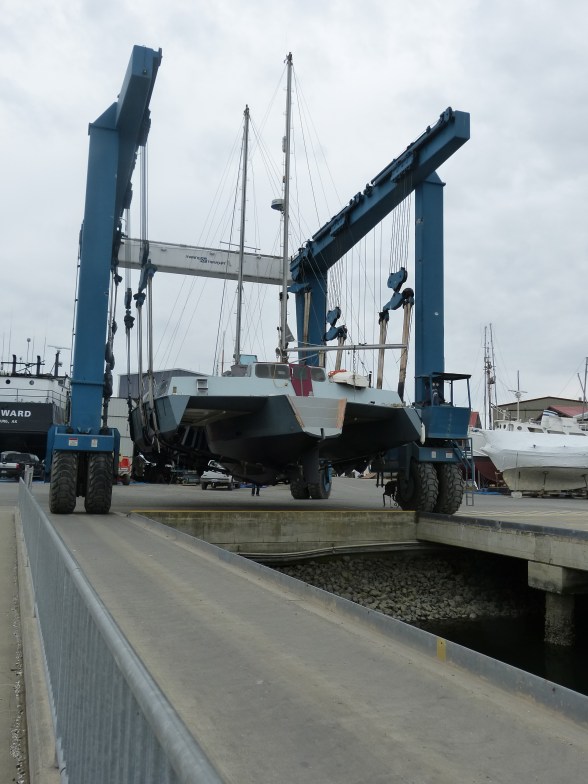
The boat is returning to the water after work in our boatyard. Healed and seaworthy.

For the Ragtag Daily Prompt: quest.
We want to believe

My cousin said to me once: “We want to believe what we want to believe.”

This was right before Mr. Trump was elected President.

After my cousin said that, I was unsurprised that Mr. Trump was elected. He was elected out of fear and anger and shame and grief. He was elected by people who are afraid that people rising out of discrimination will take things from them. Lower their standard of living. They are afraid that they will have to give things up.

A friend was working on my boat. He said that if I paid in cash, it would be less. Because, unspoken, he would not report the income. I thought about it. I said, “My medical practice is mostly medicare and state insurance. That is paid for out of our taxes: yours and mine. Therefore I am giving you a check and I don’t care if it costs more.”

There is a big culture here of not paying taxes. Cheat the government. Pay cash to each other, nod, nod, wink. It is tempting, takes a percentage off what I pay. But…. the people who I know are doing this are mostly conservative. They say drain the swamp. They say the government is cheating us. But THEY are cheating all of us.

I asked my cousin why he and my maternal family believed a story masterminded by my sister. That my father and my neice’s father and I were villains. One of the villainies was the our grandmother’s money had paid for MY graduate school but not my sister’s graduate school.

But that is not true. My grandmother paid four years of medical school tuition. 21K. I paid my own loans.

After my grandmother died, and then my mother died, my father used “my grandmother’s money” to pay off my sister’s graduate school loans. 36K. My parents also cosigned on a house, that my sister walked away from. They wrote 30K off thier taxes that year selling it. My father bailed her out of 7K on a work credit card. My father called me crying when she bullied him out of another 30K for another house. And that is when I said to her ENOUGH. I refused to visit for a year: until she went into hospice for her cancer. I visited three times while she was in hospice. We made peace. But she did not tell anyone else the truth.

I said to my cousin that I could send the bank statements showing that my father paid for my sister’s graduate school. That is when he said, “No. We want to believe what we want to believe.”

I thought really? So you want to believe my sister because she is dead. We will not speak ill of the dead, so you are ok with me and my father and my niece’s father being villainized and you will not even look at the lies.

VOTE and VOTE against FEAR, SHAME, DISCRIMINATION, ANGER AND GRIEF. We have to stand up. I loved my sister even when she was dishonest and bounced 1000$ worth of checks in my small town with people I knew. My father got threatening phone calls and he paid. That was the last straw for me.

So guess which politician stirs up fear and hate and discrimination and anger and grief? Well, honestly, both sides are guilty of that, but I stand against discrimination. We all shall rise up.

Love and Blessings and Peace you.

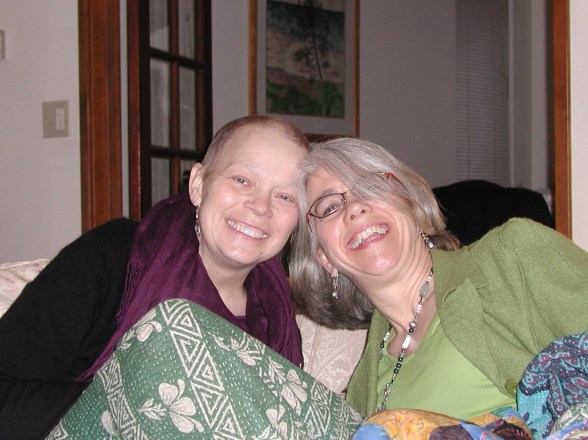
The photograph is on one of the last three visits to my sister. She died in March 2012.

My mom loved me

I struggled after my mother died of ovarian cancer in 2000. She was 61 and our love was complicated. Two years after she died I hit an emotional wall and had to go find help. My marriage was showing cracks too. I have written about Adverse Childhood Experiences, but there can be love too, even in a difficult household. I wrote this poem during that time.

My mom loved me

It’s herself she didn’t love
She didn’t love her anger
She didn’t love her fear
She didn’t love her sorrow
She didn’t love her shadows

She packed all her troubles in her saddlebags
and rode forth singing

When I was angry
she felt her anger
When I was scared
she felt her fear
When I was sad
she felt her sorrow
When I felt my shadows
she felt hers
I hid my shadows

I hid my shadows for many years
and then my saddlebags were full
They called me

I dove in the sea
I rescued my anger
I rescued my fear
I rescued my sorrows
I rescued my shadows

At first I couldn’t love them
My mom didn’t; how could I?

But I loved my mom
I loved all of her
Her anger
Her fear
Her sorrow
Her shadows
Her singing and courage

I thought if I could love her shadows
I could love my own

It was hard
It took months
I looked in the mirror at my own face
And slowly I was able to have
Compassion for myself

I am sad that my mom is not
where I can touch her warmth
and tell her I love all of her

I tell her anyway

I’m finding many things as I surface from my dive
Sometimes I feel the presence of angels
I was looking for something else
I found a valentine
that she made me
No date
Many hearts cut out and glued
to red paper

I am so surprised

My mom loves me
shadows and all
now and forever.

__________________________

My mother used to quote “Pack all your troubles in your saddlebags and ride forth singing.” Does anyone know where this if from? I have not found the source. It could be her mother or her mother’s parents.

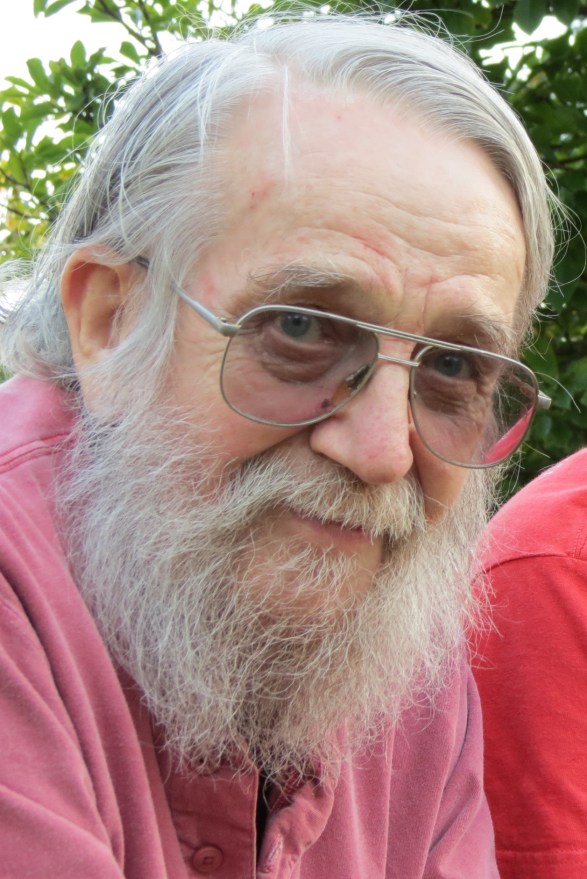
The photograph is my father, the year my sister died of cancer, 2012. He died in 2013.

Is this a tree?

Is this a tree?

I would not call this a tree. I would call it a cone. It contains seeds. It is not a tree.

A pregnancy is called an embryo until 8 weeks after conception and then a fetus until birth. It is not a baby, any more than a seed is a tree. Here is a link to a picture of the embryo developing:

https://en.wikipedia.org/wiki/Human_embryonic_development#/media/File:HumanEmbryogenesis.svg

It’s a bit difficult to call the embryo a baby.

After 8 weeks (10 weeks from the last menstrual period) the developing pregnancy is called a fetus. It cannot survive outside the womb. A term pregnancy is 37 weeks, and the due date is at 40 weeks. The earliest survival, certainly not natural, is around 24 weeks. This takes heavy intervention and technology, a premature infant on a ventilator for months. There is risk of damage to the eyes from high oxygen and risk of spontaneous brain bleed and cerebral palsy, because the newborn can weigh half a pound. Once born, the fetus is termed a baby.

This is important from a medical standpoint and pounded into us as physicians. WHY? Because in a trauma situation, the life of the mother comes first. In Obstetrics and Family Medicine, the life of the mother comes first. In Oncology, the life of the mother comes first. My sister was diagnosed with stage IIIB ductal breast cancer at age 41. She was engaged and it turned out that she was pregnant. She wrote this essay on her blog, Butterfly Soup:

The hardest loss of breast cancer.

She had an abortion and chose chemotherapy, because it was her or the fetus. If she had chemotherapy pregnant, at that time she was told that it would probably kill the fetus or cause terrible birth defects. If she held off on chemotherapy for seven months, her oncologist thought she would die. She had a very very aggressive cancer and she already had a daughter who needed her.

She lived until age 49, with multiple rounds of chemotherapy, radiation, gamma knife radiation, whole brain radiation. And she lived until her daughter was 13. Without the abortion, her physicians thought she would have died when her daughter was 7.

My ethics in medicine are that patients have autonomy. I would NOT have wanted my sister to choose to refuse chemo and try to bring a baby to term while dying of breast cancer. However, it was HER CHOICE, not mine. It was private and no one else’s business and how dare people make moral judgements about another person’s medical choices. I give my patients CHOICES. They can choose not to treat cancer and go into hospice. They can choose surgery or refuse it. They can choose to treat opioid addiction or refuse. They may die of a heroin overdose and I grieve. I try to convince them to go to treatment and I give them nalaxone to try to reverse overdoses. I refuse a medication or treatment that I think will harm my patients, but my patients have autonomy and choices. That extends to women and pregnancy as well.

It is NOT a baby in the womb, however emotionally attached people are to this image. It is an embryo first and then a fetus. And in a car wreck, the woman comes first and the fetus second.

For the Ragtag Daily Prompt: explain.

behavioral health, cancer, and the immune system

There are more and more articles about immune causes of “behavioral health” diagnoses.

The latest I’ve read is about schizophrenia:

https://www.nature.com/articles/s41598-020-63776-0

Auto-antibodies are antibodies that we make against something else that then attack a part of ourselves. The most well know version of an auto-antibody is Rheumatic Fever, where an antibody to streptococcus A attacks the joints or skin or heart. I had a patient in Colorado who needed a new heart valve at age 10 or 11 because of Rheumatic Fever.

I have written a lot about PANDAS and PANS (respectively Pediatric Autoimmune Neuropsychiatric Disorders Associated with Strep A and Pediatric Acute Neuropsychiatric Syndrome) because an older psychiatrist was suspicious that I have PANS. I have had pneumonia four times and it is accompanied by anxiety and fear, part of which turns out to be hypoxia and tachycardia. I think a heart rate of 135 makes just about ANYONE feel anxious. It feels awful.

But what about other Behavioral Health Diagnoses? Remember, we are on the DSM V, the fifth manual of psychiatric diagnoses. We have not had markers or a clear cause. That is, we are aware that serotonin is low in the intracellular spaces in the brain with depression but we don’t know what the mechanism is, what the cause is and what exactly is happening in the neuron or brain cells. A paper on a particular rat neuron said that there were 300 different types of serotonin receptors on that neuron. Blocking one type caused rats to act in an obsessive compulsive manner. But there are 299 others and then combinations. Whew, there is a lot to be learned about the brain.

Fibromyalgia can be caused by autoantibodies, at least some of the cases: https://www.sciencedaily.com/releases/2021/07/210701120703.htm

Chronic fatigue: https://pubmed.ncbi.nlm.nih.gov/34441971/

Lupus and fibromyalgia overlap: https://pubmed.ncbi.nlm.nih.gov/9207710/

Autoimmune disorders are more common in women. We think this is because of pregnancy. The woman’s immune system has to tolerate a pregnancy where half the genetic material is from the father. Yet the immune system also has to recognize “not me, infection” and be able to distinguish that from the pregnancy. This is tricky. The most common autoimmune disorder currently is believed to be Hashimoto’s Thyroiditis, where there are self antibodies to the thyroid. Post covid could potentially beat this out.

Chronic fatigue and fibromyalgia have been orphan diseases in that we do not have an inflammation marker that defines them. The ESR (erythrocyte sedimentation rate) and CRP (um) are usually normal. These are often elevated in rheumatological disorders. Not having a marker doesn’t mean that the muscles are not painful and doesn’t mean that the fatigue is not real.

I am hopeful that we are on the cusp of a true revolution in medicine, with more understanding of the immune system and behavioral health disorders, as well as post covid, fibromyalgia and chronic fatigue. I worked at the National Cancer Institute in the 1980s before medical school, with Steve Rosenberg, MD. He was trying to get the immune system to fight cancer.

Now there has been a cancer treatment with 100% success: an immune treatment for people with rectal cancer with a particular immune profile. This is AMAZING! https://www.zmescience.com/science/experimental-trial-cancer-complete-remission-02725735/

Only 18 patients, but 100% success! No surgery.

The patch for the National Cancer Institute shows a man fighting a crab: Cancer, the crab. Dr. Rosenberg talked about Sysiphus, who was rolling a stone up a mountain eternally while it rolled back on him. From here: Later legend related that when Death came to fetch him, Sisyphus chained Death up so that no one died. Finally, Ares came to aid Death, and Sisyphus had to submit. In the meantime, Sisyphus had told his wife, Merope, not to perform the usual sacrifices and to leave his body unburied. Thus, when he reached the underworld, he was permitted to return to punish her for the omission. Once back at home, Sisyphus continued to live to a ripe old age before dying a second time.

Maybe the stone has reached a resting place. Blessings and peace you. Please peace me.