speaking up

A friend says he does whatever he wants. He refuses to answer questions about how he makes his money. He doesn’t care if this annoys people. I suspect he may enjoy it.

I have one of those public jobs. Well, had. I have now been disabled from Family Medicine for a year. My lungs are much better than a year ago but they are not normal. And I have now seen 17 specialists and 3 primary care doctors since 2012. The consensus is “We don’t know.” Though many specialists are not willing to say that. What they say instead is, MY testing is NORMAL, go to someone else. My lungs are not normal, but I am on my fourth pulmonologist. I saw a cardiologist this year and the first thing he says is, “It’s your lungs, not your heart.” Well, yeah, I know that.

I miss my patients, but there is something freeing about not working. Ok, more money would be nice, but I am doing ok. Meanwhile, I am thinking about what to do now. I can write full time. Write, make music, travel (on a budget) and sing. And speak up.

Doctors have interesting portrayals on television. We went from Dr. Kildare to Dr. House, working our way through the shows with an emergency room and medical residents. ER drove me nuts. No one EVER dictated a chart so at the end of each show I hyperventilated at the hours of paperwork/computer/dictating they had left. House interests me because it’s always the thing that the patient is hiding or lying about that is the key. “Go search his apartment.” says House. I have figured out cases by getting permission to call family or a group home. More than once.

But a physician is a public figure. I had been here for less than a year when a woman comes up to me in the grocery store and says “What are my lab results?” I look at her blankly. I can’t remember if I really did the snappy comeback that comes to mind: “Take off your clothes and I will see if I remember.” I respond politely and she says, “Oh. I should call the office, right?” “Yes, I try to leave the work there,” I say. If a particularly difficult person was bearing down on me, I would whisper “cry” to my kids. That worked. They would act out on cue and I would be the harassed mother. The person would back off.

I am in a small town. We have three grocery stores. I see patients everywhere, now that it has been 22 years. If I remember every detail, that means they are or were really sick. And we have the layers of relationships: someone might have kids the same age or work with boats or be in chorus with me. Once I take my daughter to a party. The mom introduces me to two other mothers. “She’s my doctor,” says the introducing mom. “Well, me too.” says the second. “And me,” says the third. We all laugh.

Once I am visiting my brother outlaw’s bicycle shop. He has a customer. The customer starts talking to me too. Brother outlaw says, “Do you two know each other?” The customer eyes me. I have my neutral doc face on. “She’s seen me NAKED!” says the customer and I howl with laughter. What a great reply. And my brother outlaw gets it.

Docs have to pay attention to HIPAA. When three women say that I am their doctor, I reply, “Yeah and I left my brain at work, so I can’t remember a thing.” Those three were healthy, so I really do not remember labs or the results of a pap smear. Once I was in cut off shorts and waved at an older woman who was at the ophthalmologist’s. She sniffs and looks away. I get the giggles: I think she did not recognize me. My town is only 10,000 people, so after 22 years I have taken care of many of them. Though sometimes people thank me for taking care of their mother, and after it sounds unfamiliar I ask if they mean Dr. Parkman? Oh. Yes. People get me mixed up with two other small Caucasian woman doctors.

I started the “outfits inappropriate for work” category last year when I was still very sick and short of breath and on oxygen. I did not go out much, partly to avoid covid. My pneumonia was something other than covid and it was my fourth pneumonia and I should not need oxygen. Now I’ve had mild covid and the oxygen is only part time. I sang at my son’s wedding, off oxygen, so I can sing off oxygen for a short time. I danced off oxygen too and did get QUITE short of breath. Since I am no longer a public figure, I can speak out and speak up more. I am thinking about that, particularly with the recent Supreme Court news. I do not agree with what they seem to be planning.

Patient Satisfaction Score

The latest issue of Family Practice Medicine has an article on patient satisfaction scores.

I remember my first patient satisfaction score VIVIDLY.

I am in my first family medicine job in Alamosa, Colorado. I receive a 21 page handout with multiple graphs about my patient satisfaction scores. I am horrified because I score 30% overall. I am more horrified by the score than the information that I will not receive the bonus.

I go to my PA (physician’s assistant). He too has scored 30%. We are clearly complete failures as medical providers.

Then I go to my partner who has been there for over 20 years.

She snorts. “Look at the number of patients.”

“What?” I say. I look.

My score is based on interviews with three patients. Yes, you read that correctly. THREE PEOPLE.

And I have 21 pages of graphs in color based on three people.

I am annoyed and creative. I talk to the Physicians Assistant and we plan. I call the CFO.

“My PA and I think we should resign.”

“What? Why?”

“We scored 30% on the patient satisfaction. We have never scored that low on anything in our lives before. We are failures as medical people. We are going to go work for the post office.”

“NO! It’s not that important! It is only three patients! You are not failures!”

“Three patients?” I ask.

“Yes, just three.”

“And you based a bonus on three patients? And sent me 21 pages of colored graphs based on three patients?”

“Um…”

“I think we should discuss the bonus further….”

I did not get the bonus. It was a total set up and I am not sure that ANYONE got that bonus. Much of the maximum “earning potential” advertised was impossible for any one person to get. You would have to work around the clock. They got out of paying us by having multiple bonuses that each required a lot of extra work…. They were experts in cheating the employed physicians. That became pretty clear and I was 5th senior physician out of 15 in two years, because ten physicians got right out of there. I lasted three years, barely. I knew I would not last when an excellent partner refused her second year of $50,000 in federal rural underserved loan repayment to quit AND stayed in the Valley working in the emergency room. I called the CEO: “Doesn’t this get your attention?”

“She just didn’t fit in.”

“Yes, well, I don’t think anyone will.” I asked my senior partner how she stayed. “You pick your turf and you guard it!” said my partner. I thought, you know, I hope that medicine is not that grim everywhere.

Unfortunately I think that it IS that grim and getting grimmer. Remember that in the end, it is we the people who vote who control the US medical system. If we vote to privatize Medicare, we will destroy it. Right now 1 in 5 doctors and 1 in 4 nurses want to leave medicine. Covid-19 has accelerated the destruction of the US medical non-system, as my fellow Mad as Hell Doctor calls it. We need Medicare for all, a shut down of US health insurance companies, and to have money going to healthcare rather than to paying employees $100,000 or more per year to try to get prior authorizations from over 500 different insurance companies all with different rules, multiple insurance plans and different computer websites. Right now I have specialists in four different local systems. The only person who has read everyone’s clinic notes is ME because it is nearly impossible to get them to communicate with each other. Two of them use the EPIC electronic medical record but consider the patient information “proprietary” and I have to call to get them to release the notes to each other. Is this something that we think helps people’s health? I don’t think so. I have trouble with the system in spite of being a physician and I HATE going to my local healthcare organization. Vote the system down and tell your congresspeople that you too want Medicare For All and single payer.

Physicians for a National Healthcare Program: https://pnhp.org/

Healthcare Now: https://www.healthcare-now.org/

I have had people say, but think of all the people out of work when we shut down insurance companies. Yes AND think of the freedom to start small businesses if we no longer have to fear the huge cost of insurance: Medicare for all!

Y is for Yellow

I am blogging A to Z about artists, particularly women artists and mostly about my mother, Helen Burling Ottaway.

My parents both loved puns and my mother loved gardening. Cowslips is an etching that is then painted with watercolors. She has a whole series of pun flower etchings.

ATOZBLOGGINGCHALLENGE2022 #art #Women artists #Helen Burling Ottaway #ATOZCHALLENGE #Christine Robbins Ottaway #APRILATOZ

For more information about the #AtoZChallenge, check out this link.

Stages of Peace Playlist I

Dang, I’ve got a lot of stages. So it is a long playlist! I can’t complain (yes I can), after all, I wrote the stages. Hmm, to work, to work, to play, to PEACE.

Twisting words- The Grass is Blue – Dolly Parton

Confusion- Get it Worked On -Delbert McClinton

Denial- Old Number 7- The Devil Makes Three

Bargaining – Gallows Pole- Alvin Youngblood Hart

Anger- Joanne Little- Sweet Honey in the Rock

Bitterness -The Wound That Never Heals – Jim White

Revenge -Silver Dagger- Dolly Parton

Acting Out – Pills I Took- Hank Williams III

Oppositional Defiance- All Hail- The Devil Makes Three

Grief -Days Like These – Over the Rhine

Acceptance- In my time of dying – Alvin Youngblood Hart

Forgiveness -Jesus on the Mainline – Mississippi Fred McDowell

Healing- I be your water- Sweet Honey in the Rock

Hope – So Glad I’m Here- Sweet Honey in the Rock

Reconciliation – You are loved, Victoria Williams

Peace – Everybody Ought to Know (and) Redemption Song- Sweet Honey in the Rock

Stages of PEACE

We have stages of grief. Now if we are going to make peace, we need to break it down into the stages that we need to go through. I think this incorporates and embodies the stages of grief. We need to plan peace. We need a map to get there, and it is not a simple road. We can’t just say I am peaceful. We must do the work. Here are the stages I can think of and I have certainly gotten stuck in some of these stages. What about you? No…or are you in denial? And if not you, I would bet money that you can name someone who you think or feel is stuck in one of these. Takes one to know one though, right? No, maybe that’s wrong. Stop confusing me!

And maybe we don’t all go through all of these stages. Or go through them in the same order. When I watch families grieve after a death, they often fight. They fight about how to grieve. The family members may be in very different stages, or the family may have stages or roles assigned to certain people, who may or may not accept the assigned role. My maternal family has anger assigned to me. I don’t really care any more. Since I am not angry, presumably they can’t handle anger and need to outsource it. I got tired of saying “I am not angry” and being told that yes, you are angry until I would get angry… you see the problem, right? It got ridiculous. My sense of the absurd kicked in and then I would try to really enjoy being angry. You are supposed to give things your best effort, right? Snort.

Message me if you think of some stages that I’ve missed! Then we can all get to work, on working through these. MAKE PEACE, PEACE OUT, PEACE ME, PEACE YOU, PEACE THE WORLD! Might take a while. Get on it, get to work.

Twisting words

Confusion

Denial

Bargaining

Anger

Bitterness

Revenge

Acting Out

Oppositional Defiance

Acceptance

Forgiveness

Healing

Hope

Reconciliation

Peace

_____________

What does the helmet have to do with this? Nothing… I just like the helmet. I keep thinking that it could be a breastplate instead of a helmet. And it is a clue to my May blogging… where am I? Where is this helmet?

wearing sunglasses in the rain

Trigger warning: this is about dementia. I wrote this over ten years ago.

wearing sunglasses in the rain

I am weeping for you both

you have cared for her
for better or worse, for richer or poorer, in sickness and health

and she has lost her memory

you told me on the phone
that it’s not that bad

you say it again in the room

I knew before I saw her
that it was bad, very bad, much worse
she is only 60

she becomes agitated when we try to weigh her
old style doctor’s scale
frightens her to try to step up.
gentle caregiver that you have hired
pushes her, until I say stop, stop, stop
her weight does not matter

shuffling gait
she is frightened to be in a new place
I ask her questions gently
she does not want to sit in the chair in the exam room
“No!” she says “No!”
I leave the room until she’s calmer

when I return
I give her choices
“Shall I examine you first with my stethoscope
or shall I talk to your husband?”
I choose for her, the latter
she relaxes, a little
later, I tell her each step before I do it
she is slightly tense when I lay the stethoscope
on her thin shoulders, but she doesn’t fight

she tenses as I ask her husband questions
about the memory loss
ten years now, a steady course
I ask him what he understands about the prognosis
he shifts uncomfortably
and I ask her if she would like to wait in the waiting room
while I talk to him
Firm and clear: “Yes, I would.”

She is not in the room now
he says that she is not too bad
the picture comes slowly in to focus
mild memory loss, is what he thinks

there are three stages of memory loss, I say
mild, the short fibers, where short term memory is affected
we forget what someone just said
moderate, the medium axons
we forget the recipe that we’ve know for 50 years
we forget how to do math
we forget names and how to get to the store
we forget how to operate the car
severe, the long axons
executive function
we do not initiate things
we forget to get dressed
we forget how to speak
we forget our potty training

his eyes grow sadder and sadder

at last, we return to being a baby
we forget everything
at last, we remember the womb
we no longer want to eat

is she forgetting to eat?

he is not ready to answer

as we leave the room
he says that she is not sleeping well
she seems to be awake at night
eyes closed
but her fingers are moving, as in play
he doesn’t speak to her
he needs to sleep and thinks she should too

should he give her a sleeping pill?

maybe she is happy, I say
maybe in bed in the dark
you are there and it is safe
no one is making her get dressed
no one is making her bathe
maybe that is where she wants to be awake
I would not give her a sleeping pill

the dogs are in the room
he says
and the tv is on just a little
maybe she is happy

he is wearing sun glasses
as they cajole and help her in to the van

he is wearing sun glasses
though it is overcast, low clouds and raining

sometimes it is so hard
to say what I see
to try to say the truth

sometimes the truth is not gentle
but sometimes the truth is love

I am weeping for you both

written 2010

Take down

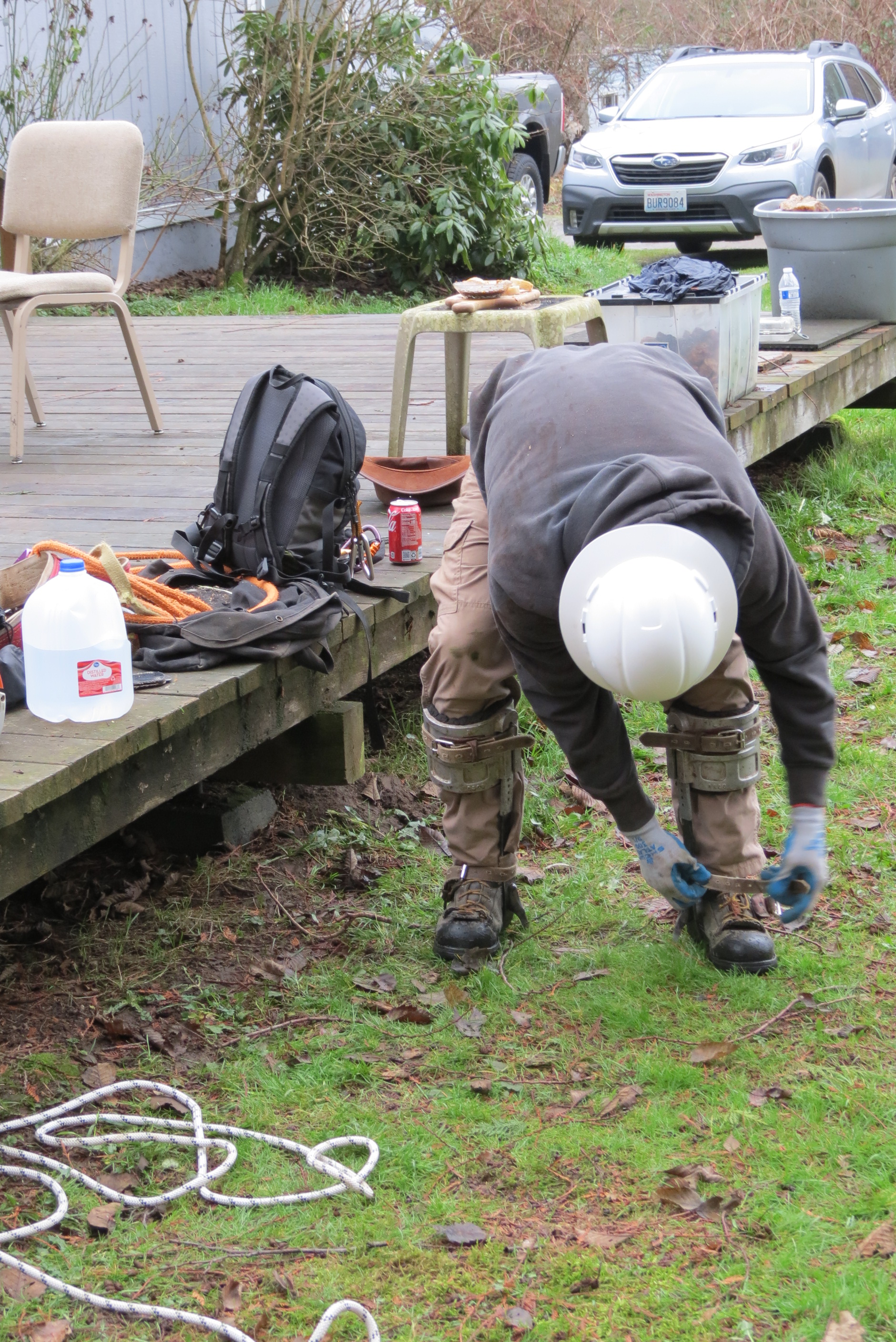
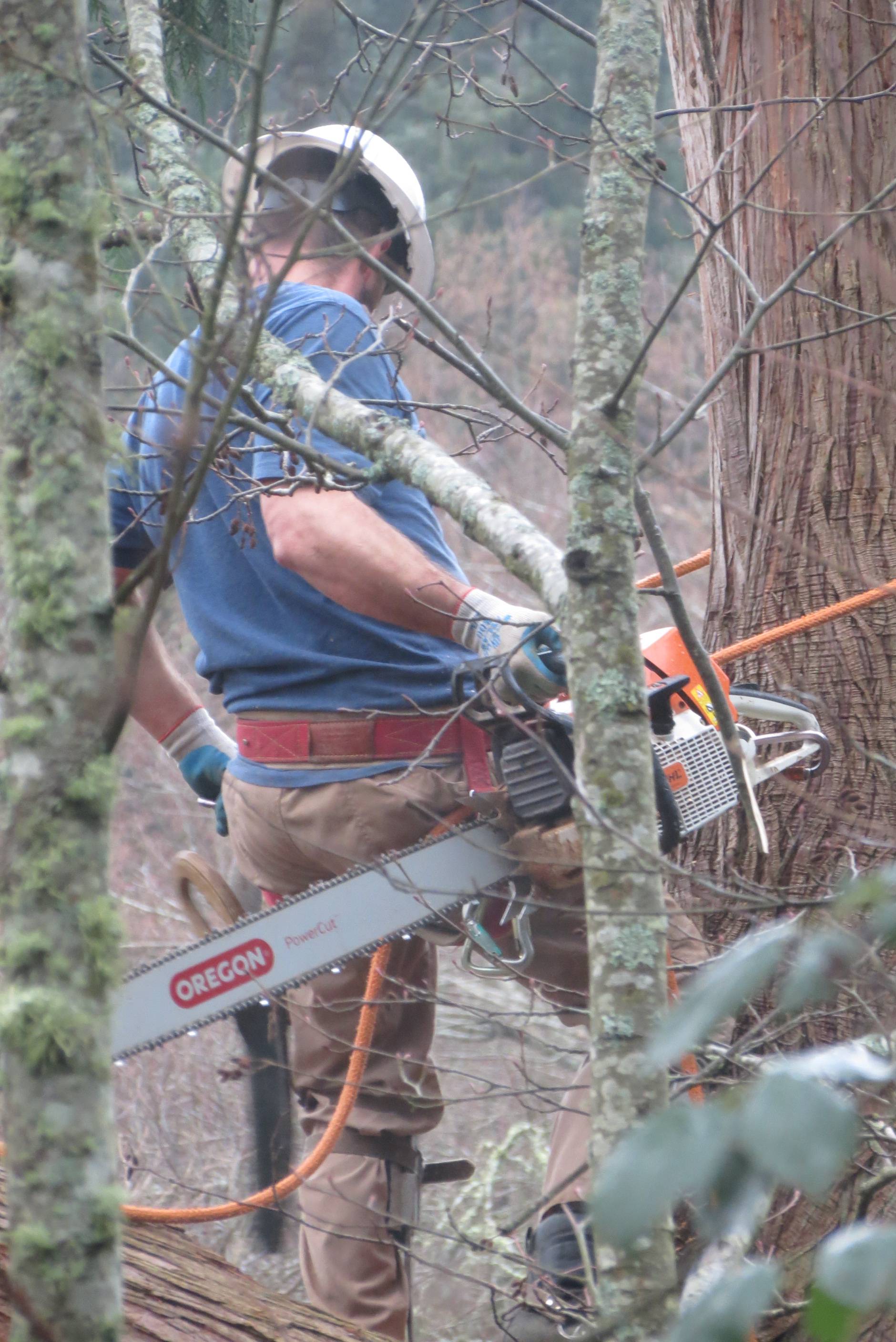
This is a beautiful living cedar.

Unfortunately, the trunk, twenty feet high, had split in half in high winds. So now it was a very dangerous very tall living cedar that is going to come down and is right next to a house.

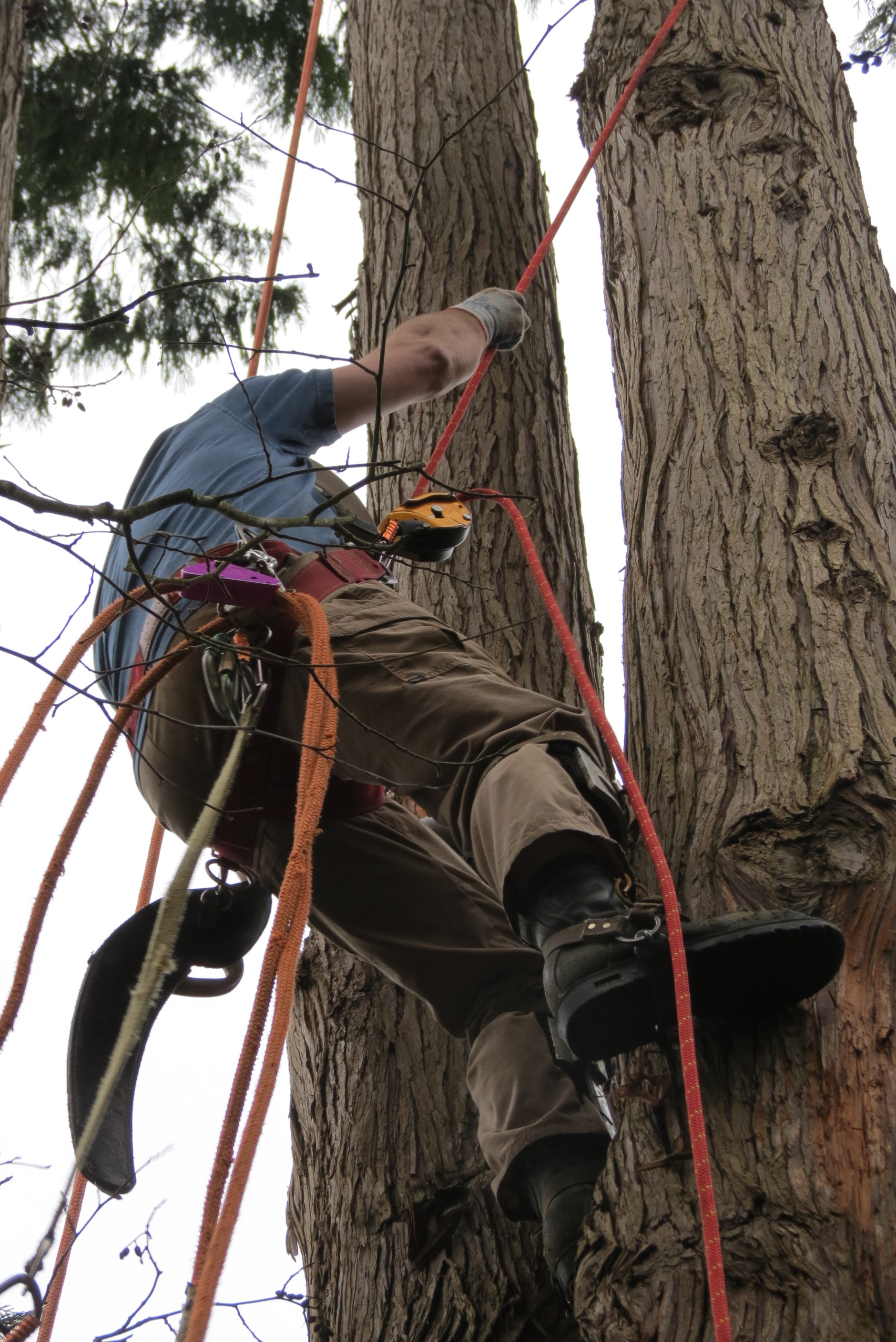
An expert was consulted. He said the tree could not be taken down intact. Each of the four tall trunks would have to come down individually. This is terribly dangerous, because felling trees is dangerous enough, but when you are up IN the tree, it is worse.

Gear for the take down.

There are four men and me. I am there with a camera. I do not help at all, I just try to stay well out of the way.

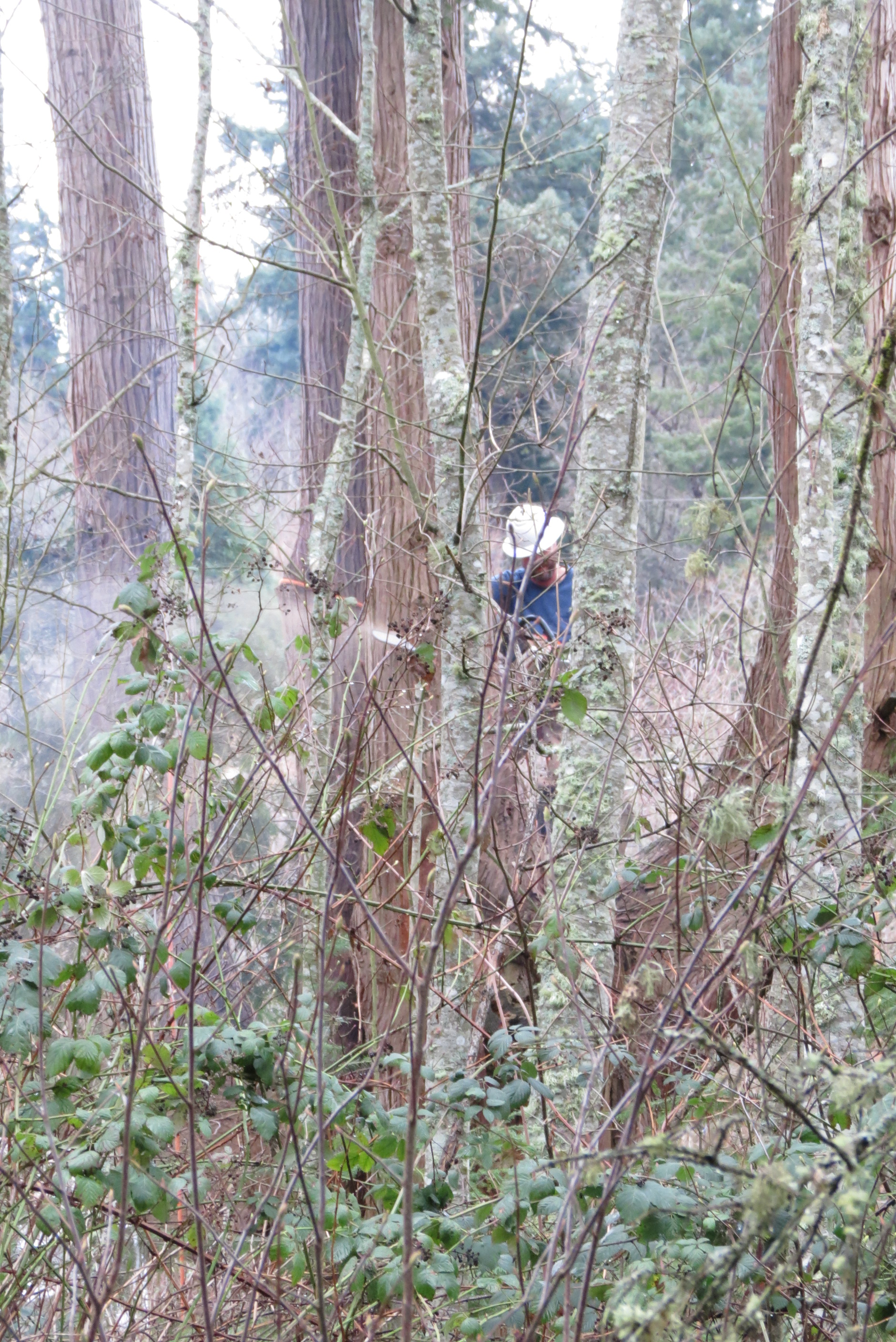
I am filming with a zoom lens from a nearby hill. They are trying to control the direction of the fall. Not on me or the house or any of them.
One down, three to go. When the top starts falling, it accelerates very quickly and crashes. He is trying to stay out of the way.
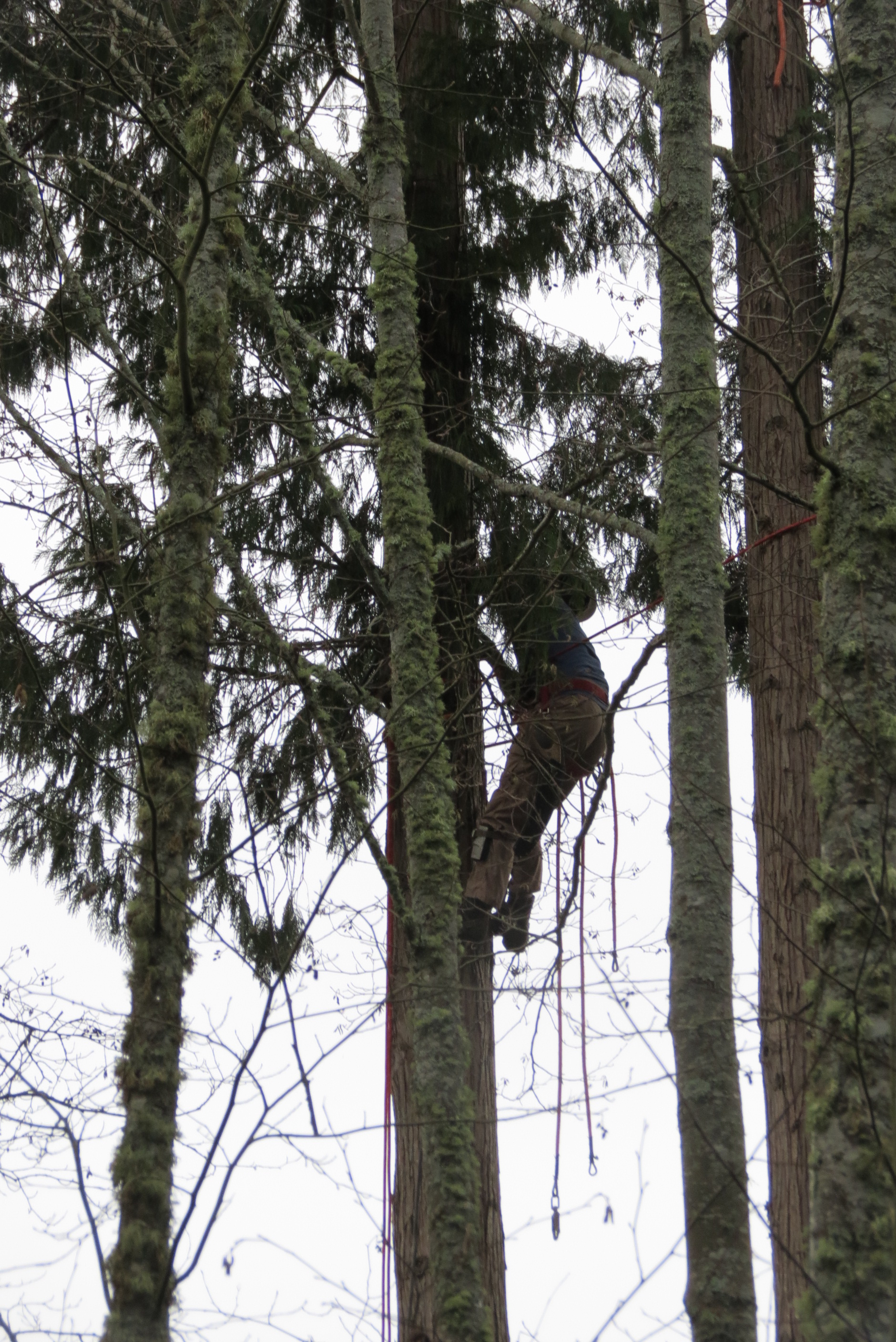
Going up to attach the cable high up to guide the fall direction.
Way up.
The falls take out smaller trees, but are controlled. It is raining.
Two trunks left.
Studying trunk three.
One left.
The last one is down. The trunk is still alive, with the split.
A closer view of the split trunk.

When the last trunk fell, it swung towards me and they shouted “Run!” It had slipped of the trunk and can’t be controlled as well even though there was a cable and a machine pulling in the desired direction. I ran and I am still here, thankfully.

Clean up on another day and the cedar goes to the sawmill.

For the Ragtag Daily Prompt: WAR. I wish we were all just working and there was no war.

No names or faces, because you know, those loggers are shy and wild, right?

Covid-19: Approach to Long Haul

Covid-19: Approach to Long Haul

This is written primarily for physicians, but is for anyone to read. This is a working theory.

I am very interested in Long Haul because I was diagnosed with PANS by an older psychiatrist who worked exclusively with physicians in 2012. That was during my third flare. The evidence is mounting that Long Haul is an autoimmune disorder like PANS. I am sharing my approach to Long Haul based on both my clinic and personal experience.

Step 1. Validate the patient. Patients are terrified, understandably, to have something “like” chronic fatigue, fibromyalgia, or are worrying that they are “crazy”. Evidence is appearing that Long Haul, chronic fatigue and fibromyalgia are all complex autoimmune disorders with multiple antibodies. We do not yet have vast antibody tests. So the first step is to say that we believe patients and also that we can help. This is a very new and evolving field. I tell patients that it will change fast over the next few years. What I tell them today may change within a year as we get new information. If this makes them anxious, remind them of the Women’s Health Initiative and how that changed hormone therapy, and that cancer treatments keep improving.

Step 2. Lower stress and antibody levels. When we are high stress, cortisol and adrenaline go up and impair the immune system. The immune system is fired up and looking for something to do. Bacteria like strep A have evolved with us and have surface proteins that “look like us”. Our bodies make antibodies to the Strep A or Covid-19 and sometimes those antibodies attack us too, because our own proteins look the same. One way of lowering the antibody level is sweating. Hot bath or shower, sauna, hot tub, exercise. Support these and explain. A second way to lower the antibody level is to quiet the sympathetic nervous system and activate the parasympathetic nervous system. The parasympathetic is the quiet, relaxed and laughing one. Where does the patient feel safe, relaxed, quiet? After my father died, leaving a complicated and messy estate with an out of date will, I did a Sudoku daily for a year. I realized that the Sudoku relaxed me because I could not solve the estate quickly, but I could nearly always solve the Sudoku. Stupid cat videos, rocking chairs, knitting, gentle walk in the neighborhood if it feels safe, a walk in a mall (without one’s purse if overspending is an issue) — how does this particular person relax? Teach the slow breathing: in for a slow count of five and out for a slow count of five. Or square breathing: in for five, hold five, out five, in five. Twenty minutes of slow breathing supposedly moves almost everyone from sympathetic to parasympathetic. It may take practice and feel unfamiliar: I have had a veteran say that it felt very very weird to relax and he was not used to it. He kept at it.

Step 3. Symptom picture. At present I am basing this on my own experience with PANS. This is my working theory. Antibodies can block receptors or “turn the key” and activate receptors. Buprenorphine does BOTH (though it is not an antibody): at lower levels it turns the key and at higher levels it blocks. I would ask specifically about five fields. You many well be able to come up with more.

a. Brain function. In my PANS, I have antibodies to dopamine that turn dopamine on very high. Other physicians assume that I am manic. I am not quite manic, but it certainly feels awful. I feel like I have been shot out of a cannon when I wake up, with the morning cortisol rise. For me, the caffeine in coffee calms me, and my assumption is that it displaces the anti-dopamine antibodies. Tea does not work. I quit coffee for seven years until the latest flare. Albuterol doesn’t work. Terbutaline does work. I don’t know about theophylline or adderall, I have not tried them. If someone has “brain fog”, I assume that they have blocker antibodies OR be sure to ask if they were different in the first 4-6 months of the illness. For me, the antibodies rise for about 2-3 months and then take 2-3 months to drop. I have a lot of fatigue when they finally leave and this time I could tell the day that the last antibodies “fell off” or dropped to my “normal” level.
For blocked people, does caffeine help? How about albuterol? Adderall, theophylline, SSRIs. Every person will have different antibodies. Treatment needs to be tailored.

b. Muscle function. My anti-tubulin antibody (I have PANS, remember?) shuts down my “fast twitch” but not my “slow twitch” muscles. Tubulin is what makes the lung cilia function, so presumably mine are paralyzed during a flare and that is why I get pneumonia. I am tachycardic, resting heart rate 100 and walking slowly or talking heart rate 135, so I get very short of breath. Both the lung dysfunction and antibodies that upregulate my dopamine receptors make me tachycardic. I think that the people who can barely get out of bed with chronic fatigue have both fast and slow twitch muscles blocked. They need validation and lower stress. With support, perhaps the antibody level can be lowered enough that they can function again. I also found that my muscles hurt when my blood sugar was up and that if I keep it low, I have minimal muscle pain. I do not know if this is true for other people.

c. Gut function. In PANS, there appears to be an antibody to lysoganglioside. I don’t understand it but when I am sick, I cut carbohydrates way back or I am horribly ill. I tolerate lactose but not fructose, sucrose or gluten. One year after getting my last flare, I can eat everything except gluten. With this round I figured out that rising blood sugar when I am sick makes me acidic. This in turn worsens lung function more, as my body automatically slows my breathing to balance the acidity. I found that taking bicarb before a meal helped tremendously. In the worst/highest antibody part of the flare, I eat fats, because anything else makes me ill. SO: what can the patient eat or not eat and support them. Food intolerances are on the rise. Ask if there are foods that they cannot eat and support them not eating them. They can go to a very restricted diet that works for them and wait three weeks. After three weeks, food antibody levels are supposed to drop. They can start adding foods back in, one every three days. I do not know if this will work in a bad flare, the antibodies may be too high.

d. Lungs: do a resting heart rate and oxygen saturation. Do a walking heart rate and sat. Then do a LOADED heart rate and sat, with the person carrying the equivalent of two bags of groceries or their toddler. If they are young, they may hold their sats, but if their heart rate jumps to 135, that is like running a continuous marathon. Try oxygen and see if the heart rate comes down. Sleep apnea testing is also highly recommended. If they are tachycardic with daily activities, of course they have fatigue! Rest. Patients can learn to check a pulse or have a pulse ox, but fingers and second hand are cheap.

d. Other. I am reading that the main complaints in Long Haul are fatigue, brain issues, tachycardia and shortness of breath. What else really bothers the person? Sound sensitivity, loss of the sense of smell. The first step in helping with this is to listen and validate.

What I learned from my first doctor job

When I started my first job, I had a nurse and a receptionist within a bigger clinic, all primary care. Fresh out of residency. One month in I asked to meet with my nurse and the receptionist.

The receptionist brought the office manager. I was surprised, but ok.

I started the meeting. “I am having trouble keeping up with 18-20 patients with fat charts that I have never seen before, but I think I am getting a little better at it. What sort of complaints are you hearing and how can we make it smoother?”

The office manager and the receptionist exchanged a look. Then the office manager excused herself.

Weird, I thought.

The three of us talked about the patients and the flow and me trying to keep up. About one third were Spanish speaking only and I needed my nurse to translate. That tended to gum things up a bit, because she could not be rooming another patient or giving a child vaccinations.

I thanked them both and the meeting broke up.

Later I found that the office manager had been brought in because another doctor tended to manage by yelling and throwing things. And another doctor had tantrums. So the receptionist was afraid of me and had asked the office manager to stay. The moment they realized that it was collaborative and I was asking for feedback and help, the receptionist was fine without the office manager.

That was an interesting lesson on working with people. I had been very collaborative with the nurses and unit secretaries in residency. As a chief resident, I told my Family Practice residents to treat the nurses and unit secretaries and in fact everyone, like gold. “They know more than you do and if you take care of them, they will save your ass!” The unit secretaries would go out of their way to call me in residency. “Mr. Smith is not getting that ultrasound today.”

“Shit. Why not? What the hell?” I would go roaring off to radiology to see what the hold up was.

The unit secretaries did not help the arrogant residents who treated them like dirt.

I thought it takes a team. I can’t do my work without the nurse, the pharmacist, the unit secretary, the laundry, the cafeteria workers, the administration. It takes the whole team. I value all of them.