Honey

Work is being a bit of a difficult place. I think that if a clinic is has two new providers with one new medical assistant, there should be some formal support in place. Not the manager of multiple offices sticking their head in the room with the three of us at computers and saying, “Everyone happy?” Um, no. This came to a head two days ago. Then yesterday I am asked to write up what I said to the manager.

No. I don’t think that is appropriate. If they have formal evaluation forms, fine. If they want a biweekly formal meeting, fine. If I ran the zoo, I would be sitting down biweekly with the job description to say, “This area is going well, this part needs some more attention. What is going well from your perspective and how can we communicate better to help each other and the patients?”

In fact, in my very first practice in 1996, I asked for a meeting with my receptionist. They had one for each pod of 2-3 providers. She was so freaked out by it that she brought the office manager, much to my surprise. I didn’t care and just said, “What is going well, what isn’t, where are the communication gaps, how do we fix them?” The receptionist looked at the office manager, said she had been scared that I was going to yell at her, but since I wasn’t, she let the office manager leave. We were fine after that. I just want a well functioning team and I am happy to help build it.

So, after thought, I am going to refuse this write up and ask what their HR process is and say that I am not satisfied with the office support and that it is quite unreasonable to leave two providers new to the clinic to guide and train a new medical assistant.

The Ragtag Daily Prompt is honey pot. That bring up this delicious and quite naughty Taj Mahal song, ooooooo. As my mother would say, you catch more flies with honey than vinegar.

Useful

I admire this orange sculpture outside the local library and then realize that it’s useful. Bike tools and a pump, in a central location and orange too! Very nice! I like it up against the darker orange of the building.

I’ve been haunting the library about twice a week, taking out piles of books. A new friend has also lent me a kindle, to read all of Lois McMaster Bujold’s Penric and Desdemona series. And what else will I find in it? It is like exploring someone’s bookshelves!

I have managed to acquire a few books and I am now watching for Little Free Libraries to pass the ones that I have read on to someone else.

For the Ragtag Daily Prompt: sculpture.

Keyboard supervisor

Elwha supervising me at the keyboard.

In high school I took typing for dummies. I was terrible at it and slow. Many women were avoiding typing classes in the late 1970s because they did not want to be secretaries. I wanted to be a writer and knew that I was a terrible typist. I also could not spell my way out of a paper bag. My mother was quite dyslexic and did not care. Once I had to sound out a word at the store from her grocery list: “LETIS”. Oh. Got it. Her letters are wonderful, not only interesting and creative spelling, but also wandering tenses and subjects.

We got our first electronic medical record in the early 2000s. We went from looking up labs on a computer and using a computer for maybe an hour total per day to full on eight hours a day. My shoulders and the nurses’ shoulders all locked up and we all filed for Workman’s Comp. I had to work with physical therapy to get my shoulders to unlock. My nurse pointed out that all problems were treated as “User Problems”. That is, WE were the problem, not the program. I realized that having the doctors who love computers pick out the program, learn about it for a year, and then teach us in two days and go live was a massive mistake. None of us understood it nor did we understand any of the computer lovers’ terminology. We rapidly quit asking questions because we didn’t like being treated as morons. Every person who was not a computer lover figured out their own work arounds. Two years later, the computer lovers tried to get us to standardize what we were doing. It’s not very surprising that we resisted and hated them. We had had to figure it out on our own with no help and we were very cynical and disbelieving that they would now “Make it easier.” Nope, they didn’t.

If I were to do it over again, the team picking the electronic medical records would include a couple of older doctors who hate computers. One of the selling points to the computer lovers was “you can write your own templates”. Our response was “We would rather be boiled in oil.” Three years after we got the system I asked the head computer lover doctor to write me a template. It was generic. Patient is complaining of (a problem) (more than one problem). The (problem) has been present for (a day, two days, a week, a month, a year, too long). The problem is (getting worse, the same, getting better). And so forth. Because we had all sorts of problems that did not have a template. My computer lover doc rolled his eyes, but set it up for me.

I also asked the clinic CFO WHY they didn’t set up typing lessons for the doctors who couldn’t type. I watched one of our group hunt and peck with two fingers. “You want them faster, right? You’ve said we could do the whole note in the room. How can they if they can’t type?”

“We are not giving them typing lessons.”

“Well, I think that’s misguided.” Ok, what I meant was that I thought it was STUPID.

Another selling point was that we could finish the note in the room. It turned out that I could do the note in the room after I had fought with the program for two years. It consistently took me 25 minutes. Then they ramped up the schedule and set us all at 20 minute visits. I started running late all the time. I told the front desk, “I’ve been told I should get the note done so I am. And if it takes me 25 minutes, that is what it takes.” Once the hospital kicked me out, I started my own clinic and did 30 minute visits. This did not make me rich but it made me a heck of a lot happier.

_________________

For the Ragtag Daily Prompt: keyboard.

All of my patients are smart 2

I did a porch call a bit over a year ago. It’s like a house call except on a porch.

A friend/patient asks me to see a long time friend of his. The friend has multiple chemical sensitivities. We meet, the three of us, on his porch.

My friend has had me as a physician but he has not seen me at work with someone else.

I ask a lot of questions and then launch into an explanation of the immune system and how antibodies work.

My friend states, “He can’t understand that.’

I smile at his friend. “Oh yes he can. And you followed what I said, didn’t you?”

His friend grins back and said, “Yes, I did. Most of it. Or enough.”

All of my patients are smart. One day in clinic I think how blessed I am, that ALL of my patients are smart and fascinating people. Then I think, how could that be? And, how lucky am I?

And then I think: everyone is smart.

They are not all educated in the same way I am. They may not be well read. They may not have my science background or my geeky fiction and poetry and song brain. But they ALL are smart.

Some are brilliant at mechanical things. I have a patient who is an expert in restoring church organs and is working 3000 miles away in New York City. “They are driving me crazy.” he says. “You have to have the approval signed off on over 20 groups, historic preservation, the fire fighters, etc, etc, to remove one board from the church. The organ was covered over by bad repairs over the years. We’re trying to get it back. After this I will put in new organs, but this is my last restoration.”

Veterans, teachers, attorneys, physicians, retired computer engineers, car mechanics, marine engineers, parents, grandparents. They are all smart, men and women.

We finish the porch visit with some options and the friend of my friend says he will think about what I said and try some things.

A few days later my friend calls. “I couldn’t believe he was following your science talk, but he was. He got it. He remembers it and understood it.”

“Of course he did,” I say.

“I am actually impressed,” says my friend. “It was really interesting watching you do that.”

That may be one of my weird skills. To be able to listen to the person thoroughly and then respond in language that they understand and a bit more. An assumption, always, that they can follow a complex and intricate idea.

I do not know if they always follow what I say. But they always respond to the assumption that they are smart and that they can understand and that they are an equal. I am explaining from my expertise, but I know they can understand when I explain it correctly.

And I have not seen this in the physicians that I have seen. Out of 22 physicians since 2012, four were excellent and met me and explained as an equal.

The rest did not. They dismiss me. They talk down or avoid me once they realize that they do not understand why I keep getting pneumonia. They are afraid to say “I don’t know.” Four are not afraid and recognize that it’s something weird and say, “We do not understand this and we don’t know how to fix it.”

Four out of 22 have my respect. And that is a sad number. Medical training needs to change and physicians need time to listen and need to learn how to listen.

Meanwhile, all of my patients are smart. And I am so blessed.

Reblog: Desertification

I don’t want to argue about global warming. Let’s talk about deserts instead. Overgrazing, cutting down all the trees and losing topsoil: we have seen this in the United States, with the dust bowl. We have a lot of people in the world to feed, even after all the deaths from Covid-19. We need to take care of land.

Ok, I am lame, that is embedded, not a reblog. I will have to figure out the difference. Feel free to laugh at me. My problem with technology is that it is NOT intuitive. I was horrible with computers until I realized that they are linear and stupid. That is, they only follow the exact right command and they have very little capacity to guess what I mean. I decided that computers were glorified hammers and very very annoying and that the manuals are usually written by people who speak computer, not English. That made it much easier for me to work with computers.

Anyhow, plant a tree. Blessings and peace you.

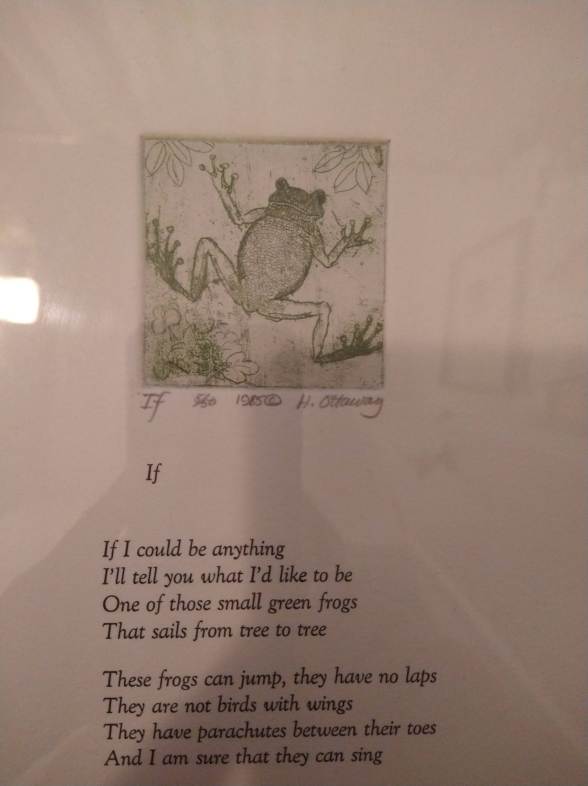
If

This is one of the ten poems that my mother made etchings for, the year I was just done with college. 1983-4. I wanted to write, but had no idea what to do with the poems that I was writing. My mother Helen Burling Ottaway had done a series of etchings with a family friend’s poems, so I asked if she would do the same with me. She said, “Yes, on one condition.” “What is that?” “They have to rhyme.” She did not like the free verse. Almost all of the poems were about animals, except for one about my sister. Another friend printed the poems on a lead type press and then my mother worked on editions numbered 1-50 of each, inking the plate separately for each one. This one is number 5/50. You can see the imprint of the plate on the paper in the photograph.

If I could be anything
I’ll tell you what I’d like to be
One of those small green frogs
That sails from tree to tree

These frogs can jump, they have no laps
They are not birds with wings
the have parachutes between their toes
And I am sure that they can sing

They spread their toes and jump so high
To float like snowflakes in the air
Frogs fall like rain from clear blue skies
It must be nice up there

Why they jump I do not know
Maybe escaping hungry eyes
Perhaps to catch a tender bug
Or they just like to fly

If I could be anything
I’ll tell you what I’d like to be
One of those small green frogs
That sails from tree to tree.

What I learned from my first doctor job

When I started my first job, I had a nurse and a receptionist within a bigger clinic, all primary care. Fresh out of residency. One month in I asked to meet with my nurse and the receptionist.

The receptionist brought the office manager. I was surprised, but ok.

I started the meeting. “I am having trouble keeping up with 18-20 patients with fat charts that I have never seen before, but I think I am getting a little better at it. What sort of complaints are you hearing and how can we make it smoother?”

The office manager and the receptionist exchanged a look. Then the office manager excused herself.

Weird, I thought.

The three of us talked about the patients and the flow and me trying to keep up. About one third were Spanish speaking only and I needed my nurse to translate. That tended to gum things up a bit, because she could not be rooming another patient or giving a child vaccinations.

I thanked them both and the meeting broke up.

Later I found that the office manager had been brought in because another doctor tended to manage by yelling and throwing things. And another doctor had tantrums. So the receptionist was afraid of me and had asked the office manager to stay. The moment they realized that it was collaborative and I was asking for feedback and help, the receptionist was fine without the office manager.

That was an interesting lesson on working with people. I had been very collaborative with the nurses and unit secretaries in residency. As a chief resident, I told my Family Practice residents to treat the nurses and unit secretaries and in fact everyone, like gold. “They know more than you do and if you take care of them, they will save your ass!” The unit secretaries would go out of their way to call me in residency. “Mr. Smith is not getting that ultrasound today.”

“Shit. Why not? What the hell?” I would go roaring off to radiology to see what the hold up was.

The unit secretaries did not help the arrogant residents who treated them like dirt.

I thought it takes a team. I can’t do my work without the nurse, the pharmacist, the unit secretary, the laundry, the cafeteria workers, the administration. It takes the whole team. I value all of them.