Forever or not?

Once someone has cancer, do they have it forever?

I think that is a complex question. But one example comes to mind.

An older woman, in her early eighties, is seeing me. She wants to go back on hormone replacement.

“But you have a history of breast cancer.” I say.

“That was six years ago. And I took that horrible tamoxifen for 5 years and I still am having hot flushes after a year off it and I am sick of it. Give me hormones.”

“Hmmm.” I say. “Let me do some research.”

I call the oncology group south of us. This is over ten years ago when we had no oncologists in our county.

“How old is she?” Her oncologist is digging up her records. “Ok, got her. Hmmm. Well, she had a stage one cancer and a lumpectomy and five years of tamoxifen. THAT cancer is gone, for sure. If she wants hormone replacement, it puts her at a bit more risk for a new breast cancer, but the old one is gone. As long as she understands the risk.”

My patient is back and we negotiate. “Ok, the oncologist says your previous cancer is truly gone, but hormones put you at risk for a new breast cancer. At least, raise your risk a little.” Age is the biggest risk in women, if they do not have the abnormal BRCA I or II genes. “Also, if we have you on hormones, you have to do your mammogram, because I’d want to catch any cancer early. That’s the deal.”

“Fine, I want the hormones.” She signs a consent that I’ve prepared and we put her back on her hormone replacement.

“I want to hear from you, ok? Whether it works?”

She calls in a week, delighted. “No more hot flushes! I feel great!”

__________

I took the photograph at Mats Mats Bay last week. There is a sign about osprey nests. I look up and think, oh, yes! Pretty obvious if you look up!

__________

I don’t remember her exact age and I don’t remember if the five years was tamoxifen or one of the other hormone blockers. She could have been in her seventies. At first I thought, no way back on hormones! Then I thought, quality of life is important. Maybe I choose this photograph because the nest is out on a limb.

Some cancers ARE currently forever, especially those that are stage III or IV and metastatic. Maybe they won’t always be forever.

Establishing a diagnosis

All of the Long Covid information is pretty confusing, isn’t it? I’ve read that most of it resolves at nine months. Another article says a year. The conference last week says that 96% are clear at two years if they are treated. What percentage are being treated? The US defined Long Covid as symptoms lasting over a month at first, while Europe said three months. I think they have now agreed on three months. This will continue to change and evolve.

When viagra first came on the market, women complained that there was not a drug for them. Pharmaceutical companies were working on it, but you cannot treat anything unless you establish a diagnosis first and women’s sexuality is more subtle then men’s. Anyhow, I wrote this silly poem making fun of the whole thing.

Little Blue Pill

Little blue pill
Little blue pill
Help me help me
I’m over the hill

Don’t wanna have sex
Nope nope nope
Little blue pill
Gives my husband hope

Can’t make a pill
Til we define the disease
Doctors would you
Hurry up please

Little blue pill
Little blue pill
Help me help me
I’m over the hill

Thought them hormones
Would make me hot
Doc was right
They did not

Hot flashes make me
Sweat and moan
No help from that
Testosterone

Little blue pill
Little blue pill
Help me help me
I’m over the hill

Doctor this
Is really no joke
My husband says
He’ll slit his throat

Can’t make a pill
Til we define a disease
They’re trying hard
Those drug companies

I think we’ll know
If they define a disease
Drug companies will plaster it
On tv

Doctor I found
Just the thing
A brand new stimulating
Clitoral ring

Don’t wanna have sex
Nope nope nope
Little blue pill
Gives my husband hope

____________________________

For the Ragtag Daily Prompt: establish.

I took the photograph of the old drug bottles today. I like that the potassium oxalate just says POISON on it and gives antidote instructions. Also, no guarantee on the clitoral ring, ok?

Medical conditions

I am reading the list of medical conditions that put people at high risk from Covid-19.

I can nearly say that being a live human “bean”, as Walk Kelly would say, puts one at high risk from Covid-19.

My intuition studies medical conditions
alcohol, overweight, diabetes, drugs
it doesn’t say much about auto emissions
or the healthy power of genuine hugs
hypertension, asthma, bad livers or hearts
Covid could get you if you don’t watch out
I wonder if risks include noxious farts
I’m in denial and not a bit stout
dementia, disability, HIV or depression
check off the ones you don’t have, think positive!
I eat an ice cream bar while secretly confessing
that eating and drinking might be causative
Happy or sad or pie in the sky
There is a daily risk that I could die

__________________________________

https://www.cdc.gov/coronavirus/2019-ncov/need-extra-precautions/people-with-medical-conditions.html

Really, that list contains nearly everyone.

What the body wants

My lungs are much much better than a year ago, shown by no problem at altitude at rest. Of course, I did not exercise heavily above 5000 feet, but walked a lot.

The last three days I have been waking up very very stiff, knees hurting when I walk downstairs, and throat closed again.

I think it’s about work. I am contemplating going back to work. I am getting a clear “not yet” message from my body. I was sick for two years and it’s only been a month that my muscles have been working normally. Same with lungs. So I think the stiffness is the body resisting.

In clinic sometimes I would have people draw two charts. A pie chart of a day. The first chart is how they are spending their days now. The second chart is what they want. In order to do more of what you want, you have to do less of something you are presently doing. What are you going to cut out? Not food or sleep or baths or maintaining the home. How about television?

Anyhow, I added a third chart, to do a few days after the first two. Draw a pie chart of what your body wants. I had one person say, “But my body just wants to sit and do nothing!” I said, “So when are you going to do that?” At first she said, I can’t, I can’t, I can’t. After a while she said maybe. Then she rearranged work and took a two week vacation. She said, “After a week, one day I had a book, a cup of tea, the cat on my lap, the dog on my feet, and suddenly my body just entirely relaxed. And then it stayed relaxed.”

She went back to work. “Are you still relaxed?” I asked. “Not all the time, but when I start tightening up, it’s often because I am taking on someone else’s problem. I am learning to let it be their problem, not mine.”

I am listening to my body too. What does it want? Not yet, for work. I have some work at home, or some jobs to do there first.

Wise body, I am listening.

Xeno or infection phobic?

So is Xenophobia a pathological fear of strangers or foreigners? Like agoraphobia or arachnophobia? The Mayo Clinic site has a listing for agoraphobia but not for arachnophobia or xenophobia. Perhaps agoraphobia is more disabling. Though with our world having more and more people, xenophobia might be terribly dangerous as well.

Current world population: https://www.worldometers.info/world-population/.

Number of people with Long Covid: at least 65,000,000, though the talk I attended yesterday say that’s a low estimate. Nearly one percent of the world population.

This article in Nature: https://www.nature.com/articles/s41579-022-00846-2 is about Long Covid, the research to date and the areas that need research. This is a very fast moving target with information exploding from multiple labs.

I attended an on line continuing medical education about Long Covid yesterday: https://hsc.unm.edu/echo/partner-portal/echos-initiatives/long-covid-fatiguing-illness-recovery/. This is a global monthly teaching session about Long Covid and current research and diagnosis and treatment. Yesterday’s talk was about immune cell abnormalities that persist and evidence is showing up that they are causing some of the problems. However, as one researcher said, the problems are multifactorial and any system in the body can be affected in more than one way.

Essentially some of the immune cells are puffy, sticky and enlarged. The suspicion is that the postexertional malaise is related to these puffy sticky cells. During exercise, or for some people normal activity, the muscles need more blood flow and more oxygen. The puffy sticky cells are stiff and won’t slide through capillaries easily. The muscles send a panic “I need oxygen!” message to the brain and the muscles do not work. The recovery can take a day or two days because of the food/oxygen deprivation. The researcher said that the same mechanism is suspected in ME-CFS (myalgic encephalopathy-chronic fatigue syndrome).

My muscles are feeling normal. My chronic fatigue is comparatively mild and happens with bad infections or with a vaccine that raises antibody levels, as it is supposed to. That’s how immunizations work. Do I have antibodies that shut down my muscles or do I have puffy cells? I would postulate the former but I can’t be sure right now. My home science kit is not quite up to that study.

When my fast twitch muscles are not working, are affected, it is very weird. They DO NOT WORK RIGHT. It is hard to describe: it is sort of pain, but it’s more of a very very strong STOP EXERCISING NOW message. And then I am exhausted for 1-2 days. In contrast, my muscles are a bit sore after a four mile beach walk 2 days ago and then an intense physical therapy session, but I am not exhausted. No naps the last two days. I have returned to my normal sleep patterns, less hours.

One of the researchers presented new technology that can make a movie of the microscopic cells going though a space with a narrowing like a capillary. Video electron microscopy. They are describing the cell shapes and whether they go through a capillary diameter normally or stick, for people with no Covid, diabetics, acute Covid and Long Covid. All are different. It is fascinating new technology.

I think I am more infection phobic than xenophobic. People all have the same basic blood cells inside, even with lots of different genetic patterns. So far infection phobia has not led me to agoraphobia, but the talk yesterday sure makes me want to keep my mask on.

There were over 350 attendees yesterday from all over the world. Lay people can sign up as well and the videos are stored for anyone to watch. I will watch yesterday’s a second time because five different scientists presented in 30 minutes and I ignored the chat which was going full speed with references to look up. Homework. And progress is being made.

Blessings.

______________

For the Ragtag Daily Prompt: xenophobia.

______________

I took the photograph two days ago from East Beach on Marrowstone Island. The distance between the sea lions and the container ship is much further than it appears, and this is taken with a Canon PowerShot SX40HS zoomed most of the way out.

You will be labeled

If you get sick
with something the doctors don’t understand
you will be labeled
unstable
mental
bipolar
crazy.

They will try to drug you.

How do you tell
when they are right
and you are crazy
brain on fire
and when you aren’t?

Don’t ask me.
I’m a Family Practice doc
and I’m rural
and I’m a girl.

I’m the one they make fun of
in the medical schools.
“The rural doctor
transferred this patient.”

Yes we did.
Because we knew it was something
different
that needed more
than we had
in our small town
in our small hospital.

Once a neurosurgeon says,
“You are transferring the patient
because it’s Friday
and you don’t want to work
on the weekend.”
“She needs an MRI,” I say
“and we don’t have one.”
and transfer her anyway.
I call two days later.
After the MRI, she is in
the operating room
for a tumor in her spine.
He doesn’t call me back
but I hope he remembers.
I certainly do, after years
and years.

If you get sick
with something the doctors don’t understand
you will be labeled
unstable
mental
bipolar
crazy.

Passe

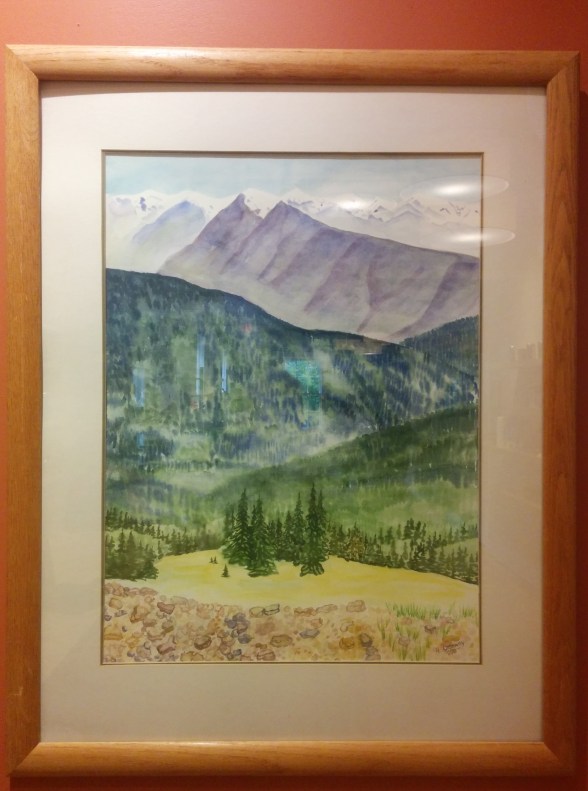
Today’s Ragtag Daily Prompt is anachronism. I guess that would be Helen Burling Ottaway’s watercolors, since an AI can do them, and my work as a physician. The American Academy of Family Practice (AAFP) wrote: “So, the AAFP looked into an AI assistant for clinical review that can “pull the data together in a problem-oriented manner and give you a snapshot of exactly what’s going on with your patient without having to search and click and find things.”

Um. Ok, I am thinking of a patient who was about to be transferred from our small hospital to a bigger one. His notes came across my desk. I called the hospitalist. No less then four physicians during the hospitalization, starting with the emergency room physician, had written that his abdomen was “flat, soft, non-tender, no masses”. What this told me was that 1. Not one of them had done an exam. 2. Not one of them had read my notes nor the surgeon’s notes. 3. The bigger hospital was going to laugh themselves silly if they did an exam. Why? He had an 8 by 8 inch enormous umbilical hernia present for 20+ years, which had not gotten fixed yet because of other medical issues.

Great. So let’s make it worse by having an AI pick out what is important from the patient record and have it make up exams, which people are too lazy to do. Physicians are too lazy to do. People, you had better read every single note your doctor or nurse practitioner or physician’s assistant writes, because you want to go on record in writing when they get it wrong. It is an absolute horror show. Read your notes, because your doctor is most likely not reading the notes from the specialists. I find it amazing, horrifying and sloppy.

I learned to paint watercolors from my mother. I am not primarily an artist, but I learned all sorts of techniques from her. We do not learn from plugging an idea into a computer. We learn from doing. And yes, it is work to learn techniques, but it is worth it!

As I was going to Washington, DC

As I was going to Washington, DC

I met insurance CEOs who said “Whee”!

500 Insurance CEOs said Weeee!

Have ten insurance plans EEEEEach!

Every plan has it’s own website!

Every plan is different, password for each site!

Every plan refuses coverage for different treatments, right?

Every plan demands prior authorization, doctor’s office up all night

If they refuse chemotherapy the doctor has to fight?

Prior auths, treatments, passwords, plans

Insurance companies, all those demands

As I was going to DC

How many passwords will I need?

______________________

For the Ragtag Daily Prompt: snail.

I was pricing health insurance in case I get well enough to work more. I can get an $800 a month with a $8000 deductible or a $1435 a month with a $2000 deductible. I would very much like to work part time treating Long Covid. But, ironically enough, looks like I can’t afford health insurance. It costs more than the malpractice would. Ironic, huh? It’s not like we need doctors. (I do not have a medical release yet anyhow, but time to do research. It’s making me gloomy.)

You know, if we do get Artificial Intelligence, it will take one look at the United States Medical non-system, decide we are insane, and wipe us out.

And honestly, when I was working for the hospital clinics, I thought the most brilliant person in our office was the woman who could extract a prior authorization from so many insurance companies. I would send the referral to print and half the time she would have it authorized by the time the patient got to the front desk. And why do we waste all that brilliance on giving health insurance companies a profit of 20 cents out of every dollar? That is $20,000,000 out of $100,000,000. Looks worse with bigger numbers, doesn’t it?

Physicians for a National Healthcare Program: https://pnhp.org/.

Shame and anger in overuse illnesses

“amongst those who treat addicts of any kind generally agree that anger and shame help no one and is actively counter-productive.”*

Wait.

I have to think about that statement.

I do not agree at all.

Ok, for the physician/ARNP/PAC, anger at the patient and shaming the patient are not good practice, don’t work, and could make them worse. BUT anger and shame come up.

In many patients.

Sometimes it goes like this with opioid overuse: the person shows up, gets on buprenorphine, and is clean.

It may be a long time since they have been “clean”.

One young man wants to know WHY I am treating him as an opioid overuse patient. “Why are you treating me like an addict?”

I try to be patient. I recommended that he go inpatient, because I don’t think we will cut through the denial outpatient. Very high risk of relapse. “You have been buying oxycodone on the street for more than ten years.”

“I’ve been buying it for back pain, not to party.”

“Did you ever see a doctor about the back pain?”

“Well, no.”

“Buying it illegally is one of the criteria of opiate overuse.”

“But I’m not an addict! I’ve never tried heroin! I have never used needles!”

“We can go through the criteria again.”

He shakes his head.

He is in denial. He is fine. He doesn’t need inpatient. He is super confident, gets work again, is super proud.

And then angry. “My family still won’t talk to me!”

“Um, yes.”

“I’m clean. I’m going to the stupid AA/NA groups! Though I don’t need to. I’m fine!”

“What have you noticed at the groups?”

“What a bunch of liars!” he says, angry. “There are people court ordered there and they are still using! I can tell. They are lying through their teeth!”

“Obvious, huh?”

“Yeah!”

“Did you ever lie while you were taking the oxycodone?”

Now he ducks his head and looks down. “Well, maybe. A little.”

“Do you think your family and friends could tell?”

He glances up at me and away. “Maybe.”

“Your family may be angry and may have trouble trusting you for a while.”

“But I’ve been clean for four months!”

“How many years did you tell untruths?”

“Well.”

Shame and anger. Anger from the family and old friends, who have heard the story before, who are not inclined to trust, who are hurt and sad. The first hurdle is getting clean, but that is only the first one. Repairing relationships takes time and some people may refuse and they have that right! Sometimes patients are shocked that now that they are clean, a relationship can’t be repaired. Or that it may take years to repair. My overuse folks are not exactly used to being patient. And sometimes as they realize how upset the family and friends are, they are very ashamed. And some are very sad, at years lost, and friendships, and loved ones. I have had at least one person disappear, to relapse, after describing introducing someone else to heroin. He died about two years later, in his forties.

Shame and anger definitely come up in overuse illness.

The above is not a single patient, but cobbled together from more than one.

______________________

*from an essay titled “F—ing yes, I’m a fatphobe” on everything2.com. Today there are two with that title. The quotation is from the second essay.

If it don’t fit, don’t force it

Templates in primary care medicine suck.

Why? The problem with templates in primary care medicine is they focus on getting a specific list of questions answered for something like ear pain or back pain. They miss the weird stuff. They miss the outliers.

I hated the templates when we got our first electronic record in the early 2000s. The doctors who liked computers spent a year picking the system. Then they trained all the clinics for one week and we all went live. One of the biggest problems was that they liked computers and talked the language. We didn’t. We quit asking questions within a week, because when we asked a question it 1. Was a user problem and 2. They treated us like we were stupid and 3. They answered in Geek, which we did not understand.

We quit asking questions. The nurses and I all filed for workman’s comp because our shoulders locked up. Our shoulders hurt. We figured out how to get the stupid thing to work. Every doctor and nurse and PAC and nurse practitioner worked to figure it out on our own.

Two years later, they set up some standards for use. We resisted again, because they gave us orders in Geek and anyhow, we had no respect for them and we didn’t care. Change what we were doing? After no support for two years? Good luck!

It took me two years and three months to get the system to write what I considered a good clinic note. I had contacted an outside specialist three months in and asked how our notes were.

“You want me to be honest?” he said.

“Yes.”

“They suck. They are useless.”

“That’s what I thought.” I went on fighting the system and hating it. I won, eventually. Parts of my note continued to suck, but I figured out how to work around the stupid templates and put in some REAL information.

Now wait, you say, is the template totally useless?

In some situations, like emergency rooms, it may be very useful. It helps keep a harried ER team with four people from a car wreck from missing something. And if you are an ENT, otolaryngologist, you do see a lot of ear and mouth and throat things, so templates may help. But I think they are terrible for primary care.

They are good for billing, though. If you have all the boxes checked, the insurance company pays, and you can move on to the next victim. The insurance companies pay more if you see more people in a day. That is why our administration said, “See people for one thing per visit.”

However, that is not ethical. Say it is a 70 year old diabetic with atrial fibrillation on coumadin with a bladder infection. You cannot just say bladder infection and slap them on sulfa. For one thing sulfa screws up the coumadin and puts them at risk for bleeding. For a second, diabetes can affect kidney function and so can age and you have to adjust antibiotic dose for lower kidney function. For a third, if their glucose levels are out of control, the infection may not be controlled by an antibiotic. It’s not one thing. And the average patient has 4 chronic disorders in a study way back in the early 2000s. That means some people have none, some people have eight or more and most people have 3-5. Hypertension, diabetes, toe fungus, chronic shoulder pain, heart disease, the list goes on and on.

In any visit, I am alert for the things the DON’T fit. One time I am doing a new patient visit for back pain and note that she is hoarse. I bug her about the hoarseness. She admits it is continuous and has been there for two months. I do two referrals, because continuous hoarseness can be laryngeal cancer.

When she returns, she thanks me. She has vocal cord polyps, not cancer, but needs laser surgery. “You didn’t have to do that but you did.” she says. And do I feel good about not ignoring it? The visit went over time, but I’d rather go over time than miss laryngeal cancer, right?

We were taught to let the patient talk. Open ended questions. They’ve done studies that doctors cut people off from telling their stories very very quickly. If you let people talk, sometimes they say something that doesn’t fit the template, and we have to pay attention. Sometimes a comment or a couple comments are the clue, the key, the thing that doesn’t fit. Don’t force it into the template. Pay attention instead.

_______________________

The very serious group of people is a county medical meeting, 2014.