Lie low and flow

We have fight or flight for the sympathetic nervous system state, when we are ramped up, aggressive, go getters, all that stuff. We need a term for the parasympathetic nervous system state, the relaxed one. So far I’ve come up with lie low and flow. Other suggestions? I welcome them! We need more lie low and flow and glow and say no and ho, ho, ho in the world. What puts you in that state? Knitting? Stupid cat videos? Bugs Bunny? A bubblebath? Watching toddlers? What makes you laugh and yawn and relax and lets all the tension flow out and sink or float away?

In clinic I am seeing a wide age range. Most of the younger ones, say, under 60, look a bit shell shocked. I think this is still from the pandemic and wars and political nastiness. The over 60 crowd seems to not care as much. They’ve been through it, they know people die, they know bad stuff happens.

A friend and I were talking about pandemics and he pointed out that HIV and AIDS was a pandemic too. So we are on track for two pandemics per century. The younger folk do not remember the HIV and AIDS pandemic and how frightening it was. Right before that started, some doctors proclaimed that infectious disease had been conquered by medicine. Um, RONG RONG RONG! Boy did they eat THOSE words. And early in that pandemic, no one knew what to believe, what was happening, how to stay safe, and the communication from the medical establishment changed very fast. I wonder if the people who were young adults and older in the 1980s were less surprised by the Covid-19 Pandemic and all the rumors and confusion. Yep, seen it before.

I am not sure how to help the younger shell shocked looking folks. Colorado is a bit tough and manly and consequently there is not a huge amount of resources for emotional health. Yesterday I asked if we have anyone who does neuropsychiatric testing and the answer I got was “I don’t know.” I will dig around today but did not find it on the internet. I have found neuropsych testing hugely helpful for traumatic brain injuries, post brain surgery, and to sort out unusual learning and memory styles. One woman had a brain tumor removed. Her memory was affected. She could remember things that she wrote down and read, but not things that she only heard. No one had given her the report to read. They only told her, so she did not remember it. At least, that was the story. I gave her the report and said, “Read it. And tell your family. And if you are on the phone, take notes.”

Ok, now I should get ready for work, though I want to lie low and watch a silly cat video.

For the Ragtag Daily Prompt: yawn.

Safe/Not Safe

I think safety is an illusion. BUT it is also nice to feel safe and embrace the illusion.

I sleep best in tents, because as a child, I felt safest at our families “shacks on a lake” in Ontario. Cabins, but pretty much one room cabins. No electricity, outhouses, and my family lived in tents. I loved it. I was more afraid of people than bears.

The pandemic, or this pandemic, has made people feel less safe. But that safety was an illusion too. I had influenza in 2003 and was out sick for two months. I had a racing heart and it hurt to breathe. No asthma. Only rest seemed to help. My doctor and I had no idea when it would resolve. It resolved after two months. My partners accused me of malingering and lying.

A fast heart rate can come from a panic attack, but it works the other way too. If your heart rate is very fast, you may feel panicky. When I nebulize people with albuterol for the first time, I warn them that it may feel like adrenaline, it may speed their heart and they might feel panicky. A friend with Long Covid kept saying that maybe they were just anxious. I got them to have an Urgent Care test them: a resting and a walking heart rate. At rest 72 beats per minute. Normal. Walking, their heart rate jumped to 165, very abnormal! Normal is 70-100 beats per minute, though if one is out of shape, 110 or 120 can result from unaccustomed exercise. But there is no way an athlete in their 20s should jump to 165. The Long Covid heart rate was driving the anxiety, not the other way around.

After I had the 2003 influenza, I read a book of essays about the 1918-1921 influenza pandemic. And I realized that we would probably have a pandemic in my lifetime. I thought it would be influenza, not coronavirus! Hopefully the world will learn a little from this one and change a little over time and be a little more sane if (ok, when) there is another pandemic.

I saw this video today. Wow, what costumes (all 1970s) and dancing! Wonderful! And such a sad song about a broken friendship that used to feel safe.

I hope that you have places or people that you feel safe with. Elwha sometimes likes to sit in the cat tent, even if it is partly open. It feels safe.

For the Ragtag Daily Prompt: safe.

Black and white

Pandas are black and white, clarity
between the parts, yet both are present together
Pandemic has lessened humans charity
Stress rises, fights and a turn to war weather.
It’s hard to fight a virus way smaller than a bee
And as they change and attack birds and us anew
Frustration rises and we attack the humans that we see
We take sides, black or white, and don’t see that we’re a stew
Perspective changes, white to black and back
The pandas eat their daily bamboo pounds
Unworried which parts are white or black
I hope they are far from the crying bombing rounds
I hope every person has the charity
to give all others love and parity.

We are singing Frostiana, poems by Robert Frost, set to music by Randall Thompson, in chorus. The ending of this makes me cry:
“So when at times the mob is swayed
To carry praise or blame too far
We may choose something like a star
To stay our minds on and be staid.”

I took the photograph in Oregon this month, on a Pandasonic (ha, ha).

For the Ragtag Daily Prompt: clarity.

Breathe

I was trying to think of a debacle. Oh. Getting my fourth pneumonia, March 21, 2021, Covid-19. This is the first pneumonia that put me on oxygen. The fast heart rate, dropping ten pounds, and feeling anxious were familiar from the other three. This photograph was from December 2021, visiting Maryland. We did a bike ride. I was pretty happy that I was able to do it, though the last mile had a sloping uphill that made me think I was not very strong. Oxygen helped.

And Covid-19 is a debacle that we are still trying to understand and absorb and avoid and heal and recover from. I am reading an article that entirely denies viruses existing. I guess it’s like porn on the internet: they say if there is a story, there is a porn version. Every possible idea of what has happened over the last three years is out there, though this article doesn’t make any sense at all.

I don’t remember who took the photograph of me. It may be a steathie. I needed oxygen at night and whenever I was being active, but not at rest. Ok, at rest talking.

Things and people were lost and found and lost during Covid-19. I spent a lot of time on our beaches. I am so grateful for the beaches.

For the Ragtag Daily Prompt: debacle.

Working theory

I attended two Zoom one hour programs on Long Covid this week.

Thursday from the University of Arizona, 330 people logged on, hard science with thirty minutes of information about Mast Cell Activation Syndrome. They said 17% of the population, which is huge, if it’s correct. This is not mastocytosis, the cancer. This is the immune system going rather batshit. Though I would frame it differently, as the immune system fighting a really difficult battle.

Friday from the University of Washington. I don’t know how many were logged on. This was at a much more aimed right at the physicians level. People sent in questions and they collated and gave answers. They promised to answer some of the questions later on. My question was whether a high Adverse Childhood Experience Score predisposed to Mast Cell Activation and they did not address that.

So mast cells apparently can produce over 1000 different signals: cytokines, histamines, proteases and I don’t know what all. They are all over our bodies (are you creeped out? I am a little.) near the boundaries: skin, nose, gastrointestinal tract, genitals. They produce different signals depending on what is happening. The Thursday researcher basically said that they could affect nearly any system in the body.

I’ve heard of mastocytosis and even had a patient with it, but Mast Cell Activation Syndrome was barely on my radar. I am not sure if 17% of the population is at risk or has it. It is tricky to diagnose, because the best lab test is a rather tricky and rare one, and it is sort of an orphan illness: few doctors know about it and it does not fit neatly into any specialties. Patients have seen an average of ten specialists before they get diagnosed. Hmmm. Sounds familiar.

This researcher has a ton of papers out, that I have not started reading yet. MCAS is implicated in Ehlers-Danlos, a connective tissue disease and in ME/CFS (myalgic encephalomyelitis/chronic fatigue syndrome) as well as POTS (postural orthostatic tachycardia syndrome) and can get triggered by Covid-19. Well.

The good thing is that treatment is quieting the sympathetic nervous system to let the parasympathetic take over. The sympathetic is the fight or flight hyper one. Parasympathetic is the rest, relax, mellow out, slow heart rate, blood pressure down, digestion and quiet one. I think United States culture is crazy fight or flight most of the time (We’re number one!– so what?) and the pandemic has put the whole world into fight or flight mode. Crazy.

Back in Family Medicine residency, 1993-96, I had a number of ME/CFS, chronic fatigue patients. They tended to be hyper sensitive to medicines and have all sorts of symptoms which were fluid and changable and difficult to pin down. What I noticed though is that many of them had been super high acheivers or working multiple jobs or crazy high stress, until they hit some sort of wall. Often an infection but not always. The ones I saw wanted to go back to working 18 hours a day. I said, “Um, that’s how you got this, I do not think that is a good goal.” This often pissed people off. Even back then, I thought that chronic fatigue was a body reset, where the body rebels, some sort of switch is thrown, and people rest whether they want to or not. Some do recover but it can take ages. The Thursday speaker seems to think it’s the mast cells doing this.

The UW speakers were careful. They said we do not know how long Long Covid lasts. One said they do not like to diagnose POTS, because POTS is usually permanent and the Long Covid tachycardia usually resolves. They are seeing people who got sick 2-3 years ago and are still sick, but they also have people who have recovered in 9-12 months. They do not know if patients are entirely recovered or whether there will be other problems later. They also aren’t sure that the chronic fatigue like symptoms are the same as the rest of the ME/CFS. Remember when dementia was Alzheimer’s? Now there are all sorts of different dementia diagnoses, Lewy body, frontotemporal, Huntington’s, stroke dementia, alcoholic dementia, Parkinson’s, Alzheimer’s, and others. When I was in residency, we had hepatitis A, hepatitis B and non A non B. Now we are up to G or beyond. Medicine changes and it’s moving as fast as possible for both acute Covid-19 and Long Covid.

The mast cell reasearcher talked about getting the sympathetic and parasympathetic nervous systems back in balance. I think maybe we ALL need that. Every person in the whole world. One way to quiet the sympathetic nervous system is to slow your breathing. Try it. For five minutes, or three minutes. Slow breath in for a count of four or five and slow breath out for a count of five. Let your brain roam around and fuss, but let go of each thought as it passes by and return to counting and breathing.

Slow in, slow out.

Practice and heal.

_____________________

The musicians are Johnathan Doyle and a friend. They were fabulous, last Tuesday at the Bishop Hotel.

.

Who would I be?

If I have had PANS since birth, who would I be if I had not contracted it?

No one knows. We are still arguing about whether PANDAS and PANS exist. But, my daughter says, we make up all the words. The definitions of illnesses CHANGE over time, and what an illness MEANS. Tuberculosis was an illness of poets and people too noble for this world, until microscopes became advanced enough to see the tiny bacterium, and then it became an illness of the crowded unclean poor. Medicine and science continued to study it. Once we recognized that it is an airborne illness, tuberculosis sanatoriums were set up, to quarantine people. My mother was diagnosed with tuberculosis when she coughed blood 8 months pregnant, so I was born in a sanatorium and avoided contracting tuberculosis as a newborn.

Antibodies cross the placenta, even though the tuberculosis bacterium does not. Usually infants contract tuberculosis and die, at least when I was born. The antibodies can trigger PANS or PANDAS.

The antibodies prime the fetus’s immune system. This makes sense, right? The fetus has a sick mother and best if its’ immune system is ready to fight.

Did my younger sister have it? I do not know. Not as badly, would be my guess. My mother said that as kids, we’d both get sick, but I got sicker. We both had strep A many times. My sister got mumps, off from school for three weeks, and I did not get it. But I got everything else.

Now the estimate for children with PANS or PANDAS is 1 in 200. This is enormous. A high prevalence. Antibodies, that I suspect are adaptive and lie in readiness for a pandemic or a crisis. And now we have had another pandemic, with the last really world wide bad respiratory one 100 years ago. Is the prevalence rising because of the pandemic or are we figuring out some of the cause of behavioral health illness or is the definition of illness changing or all three? I think all of them.

My cousin’s mother had polio either during her pregnancy or very soon after. My anthropologist uncle took his family to Bangladesh, where he was doing linguistics. So does my cousin have PANS or PANDAS? I do not know.

And what of my children? My pregnancy with my older child was fourth year medical school and went well. My pregnancy with my second was very complicated. I was in my first year of work as a rural Family Practice doctor and working too hard. I ended up on bed rest for three months and on a medicine. Is labor at 23 weeks an illness? Does it affect the fetus? I was on medicine from 23 weeks to 37 weeks. What effect does it have?

Medicine is still changing and changing quickly. We don’t know. There is so much we do not know.

_______________

PANS/PANDAS: https://www.pandasppn.org/guidelines/

_______________

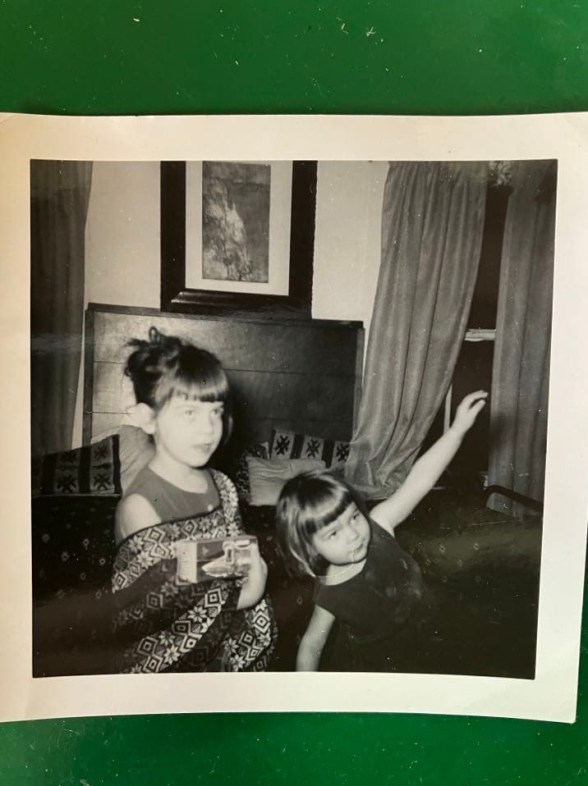
The photograph is me and my sister, in about 1967ish. I do not know who took it.

split

The pandemic splits the thin veneer of civilized behavior
like a heavy maul falling on delicate antique wood
and wild fear emerges and riots through the streets
while some hide, some stay calm
and try to sooth the selfish unleashed beast

For the Ragtag Daily Prompt: veneer.

Taken in 2015.

how to protect codgers

A friend calls me yesterday, complaining that the new Covid-19 vaccine doesn’t prevent infection nearly enough for him to want to get it. He is in his 70s and says darn it, he’d still have a 60% chance of getting infected.

I thought about it and wrote back this morning:

Re the new vaccine the POINT is NOT to prevent infection, though it lessens it in codgers like me and you.

The point is that the vaccinated younger people shed a s–tload less virus if they get it, because their immune system kills it fast. This reduces the amount of circulating virus so that the codgers stop dying like flies. Also the codgers get less sick if their immune system recognizes B4 and B5.

Got it? Get the vaccine.

I am waiting for the top ten causes of death for 2021 to come out. Over one million US people have died of Covid-19. In 2020, there were between 300-400,000 deaths from Covid. That means that we lost 600-700,000 in 2021. If we lost close to 700,000 people, then Covid-19 would beat out heart disease as the number one cause of death in the US. When did that last happen? During the 1918-1920 influenza, the “Spanish” flu that has been traced to a chicken farm in the US midwest.

Here is a provisional and not final list: https://www.cdc.gov/nchs/data/health_policy/provisional-leading-causes-of-death-for-2021.pdf. Hmmm. The numbers are not adding up unless a lot of US people died of Covid-19 in early 2022. And cancer is higher than it’s ever been and creeping up on heart disease. But these are not the final numbers, sigh.

Here is a fascinating chart: https://www.cdc.gov/nchs/data/dvs/lead1900_98.pdf. If you scroll to the end, the top two causes of death in 1900 were pneumonia first and tuberculosis. Heart was fourth. Heart rises to first in 1910 but then pneumonia is back at the top in 1918-1920. I think that the heart has been number one ever since, in the US. World top ten is not the same.

This is not the first pandemic and it won’t be the last. It is horrible. I think that everyone is doing the best they can, though some responses seem saner than others. Remember the old doctor joke about what to do in a code (when someone’s heart has stopped). First: check your own pulse. It’s a corollary that if the patient is dead, you can try to bring them back, but you can’t make them more dead. Also, my latest Advanced Cardiac Life Support class, on line, told me that sometimes I do not have to do cardiac life support. Their example was a decapitated patient. Really? Ouch, doctor humor. But truly, if you are freaking out or want to scream at someone or feel like the world is nuts and you have to do something, first check your own pulse. Slow it down. Breath in four and out four. I can drop my pulse from 101 to 71 in 20 seconds, just by slowing my breathing. You can learn to too.

My recommendation is that if you are due for the booster, get it. And thank you for protecting me and my friend and the other codgers.

No, it is not snowing here yet. But codger seems to be a word for an old GUY. Humph. Would a grumpy hummingbird be a grummer? What is a female codger? I am using codger for any gender, to heck with it.

Parasympathy

In 2013, Catherine Hodes, director of the Safe Homes Project (a domestic-violence program), started a workshop called “Is it Conflict or Abuse?” An abusive dynamic, she argues, requires one person to have power over the other, whereas conflict involves two people struggling for power. The distinction can be confusing, and in some cases “both people feel like they’re being abused, because they’re not getting their needs met or they’re not getting their way.”

From the Atlantic Monthly article: That’s it, you’re dead to me. September 2022 p. 14.

I think this is a fascinating idea, in the article that questions the internet wisdom of getting rid of “toxic people” in one’s life. When we cut off someone we consider “toxic”, we aren’t peaceing them, are we? Peace me, peace you, how do we actively peace people instead of being afraid, on guard, at war. I think everyone is more afraid after the two years of Covid 19 pandemic and all of the deaths and the Long Haul Covid and war. Everyone has a shorter fuse, everyone is stressed.

Remember that stress activates the sympathetic nervous system, the fight or flight system. The body makes less thyroid and less sex hormones and makes more adrenaline and cortisol. Cortisol is a steroid and great for short term, but bad for long term. If we are continually stressed, cortisol messes up the immune system and we get auto-immune disorders, the body attacking its’ own cells. The adrenaline raises our heart rate and blood pressure, neither of which are good for the heart long term. When the thyroid hormone is on the low side, we feel tired. The adrenaline makes us feel wired and we have trouble sleeping. The cortisol makes us more likely to get sick and raises blood sugar too. The low sex hormones, well, women can stop menses and men start asking for viagra.

So we as a world, need to learn to downregulate the sympathetic nervous system and go back to parasympathetic. The relaxed one. The one where we have less adrenaline and less high cortisol and more thyroid and our gut works and sex works again. How do we get there?

Breathing is one way. Slow breathing: 5 seconds in and 5 seconds out. Work up to 20 minutes. One of my veterans said he was not used to feeling relaxed, it felt weird. Ok, it may feel weird, but maybe we need to practice it. He did. There is circular breathing too, 5 seconds in, 5 hold, 5 out, 5 hold. Zen meditation, facing a wall for 40 minutes, works too. We try not to follow the thoughts. The thoughts pop up anyhow, but not following them down the rabbit hole is interesting and challenging. Mindful mediation and Jon Kabat Zinn’s books and tapes work as well. It takes practice. Practice peace, practice relaxing. Doesn’t that sound like a lovely practice?

Stupid cat videos work for me too. Laughter works. What makes you laugh? I like the silly animal videos, the moose playing with the wind chimes, three baby bears rescued (with care) from a dumpster, with the truck driving off to avoid momma bear. Rocking, knitting, sewing, fishing, walking the beach, cuddling a baby, dancing, listening to music, playing music. Which works for you? Silly movies. I don’t like horror movies, and I love cartoons and animation. Engage the child at heart for the parasympathetic nervous system.

In high school my daughter said that most fights were stupid. “One person says something without thinking. The other person goes off and gets upset. She stops talking to person one, who has no idea what is going on, and they often talk to their friends. So there is this big fight over some dumb comment.”

I don’t think it ends with high school, sadly enough. And before we label someone “toxic”, maybe we need to wander off and breathe, or watch a silly cat video. Whatever works for you that doesn’t hurt others.

We need more parasympathy in the world. Yep, I just made that word up. Relax and if you can’t or won’t, consider practicing.

Peace you and please peace me.

https://my.clevelandclinic.org/health/body/23266-parasympathetic-nervous-system-psns

https://healthnews.com/family-health/healthy-living/how-to-activate-the-parasympathetic-nervous-system/

August 19, 2022

Adverse Childhood Experiences 14: Hope

I keep reading bits about despair and about how a generation of children is being “ruined” by the pandemic.

Not so, I say. There is hope. We need to support each other to survive and then to thrive.

This generation WILL have a higher than average ACE score. If the Adverse Childhood Experience scale is from zero to eight, children in this time period will have at least one higher point than average and many will have three or four or more. Loss of a parent, a sibling, beloved grandparents during covid. Increases in domestic violence, child abuse and addiction. These are all part of the ACE score.

What does this do to children? They have survival brain wiring. They will do their best to survive what is happening. A friend and I both have high ACE scores, 5 or more, and we are both oppositional defiant. We showed this in different ways. He grew up in the same community. He escaped from home and knew all the neighbors. He walked to the local church and attended at age 3 or 4. He has lived in this community all his life.

His oppositional defiance showed up at home, where he consistently refused to obey. And in school, where he confounded and disobeyed teachers and passed anyhow.

My family moved every 1-5 years. I hated moving. I wouldn’t talk to kids in a new school for a year. It was very difficult. So my oppositional defiance was very very internal. I hid in books and in my head. In 6th grade I got in trouble for hiding novels inside the school book I’d already read. I also would just not listen and my respect for the teacher got even lower when she would be angry that I knew the answer to the question once she’d repeated it. I wasn’t listening because I was bored. She was the first teacher that I thought, well, she is not very bright. The next year they stuck me in the honors class and I stopped being bored, though I still questioned practically every opinion every teacher had. I wanted evidence and I did not believe it just because the teacher said it.

I am not saying that oppositional defiance is in every high ACE score. I don’t know that. Why oppositional defiance? Imagine you are a small child and you are beaten. There isn’t rhyme or reason. You can’t predict when the adult will be out of control. Why would you behave “well” if it makes no difference? You might as well do what you want, because nothing you do will change the adult. Or imagine you are a small child who is with one person, passed to another, then to another. You may not exactly trust adults after two or three repetitions. And you want to survive.

There is an increase in addictions, behavioral health diagnoses, and chronic illness in adults with a high ACE score. A researcher when I first heard a lecture about it said, “We think perhaps that addiction is a form of self medication.” I thought, oh, my gosh, how are we ever going to treat THIS? Well, we have to figure that out now, and we’ve had 30 years to work on it.

I was very comfortable with the oppositional defiant patients in clinic. I got very good at not arguing with them and not taking their behavior personally. They might show up all spiky and hostile and I might be a little spiky and gruff back: sometimes that was enough. I think the high ACE score people often recognize each other at some level, though not always a conscious one. With some people I might bring up ACE scores and ask about their childhood. Sometimes they wanted to discuss it. Sometimes they didn’t. Either was ok.

One thing we should NOT do is insist that everyone be “nice”. We had a temporary doctor who told us her story. Her family escaped Southeast Asia in a boat. They had run out of water and were going to die when they were found by pirates. The pirates gave them water. They made it to land and were in a refugee camp for eight years or so. She eventually made it to the US. She was deemed too “undiplomatic” for our rural hospital. I wondered if people would have said that if they knew her history and what she had been through. It’s not exactly a Leave it to Beaver childhood, is it? When she was telling us about nearly dying of thirst in the boat, my daughter left her chair and climbed on my lap. She was under ten and understood that this was a true and very frightening story.

We can support this generation of children. This has been and is still being Adverse Experiences for adults as well. Family deaths, job loss, failure of jobs to support people, inflation. Remember the 1920s, after World War I and the last pandemic, of influenza. “On October 28, 1919, Congress passed the National Prohibition Act, also known as the Volstead Act, which provided enabling legislation to implement the 18th Amendment.” (wikipedia). There were forces trying to legislate behavior, as there are now. The result in 1920s of making alcohol illegal was speakeasies, illegal alcohol, and violence. Some people acted wild after WWI and the influenza pandemic and some people tried to lock down control, by controlling other peoples’ behavior. It did not work then and it will not work now. The wildness is out of control grief, I think, grief dysfunctional and drinking and shooting and doing anything and everything, legal or not. We remember how the 1920s ended too. Let us not repeat that. Let us mourn and grieve and support each other and support each other’s decisions and autonomy.

Blessings.