Child memories

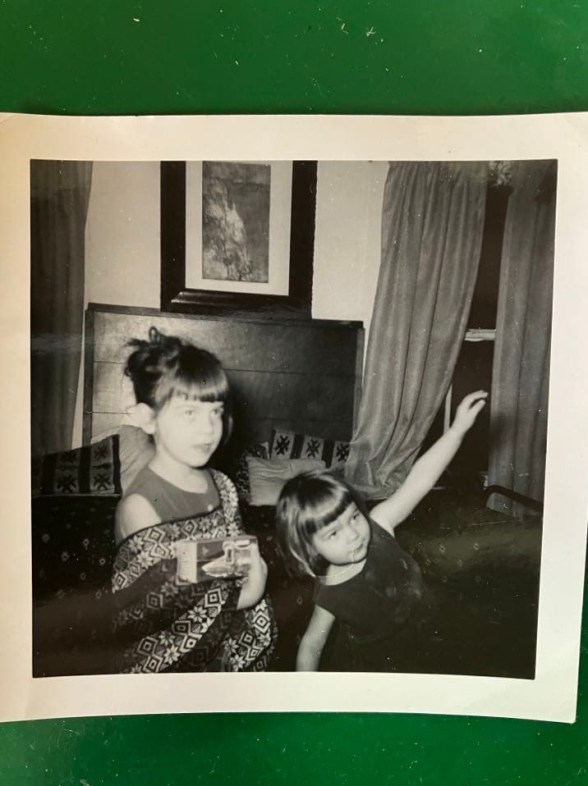
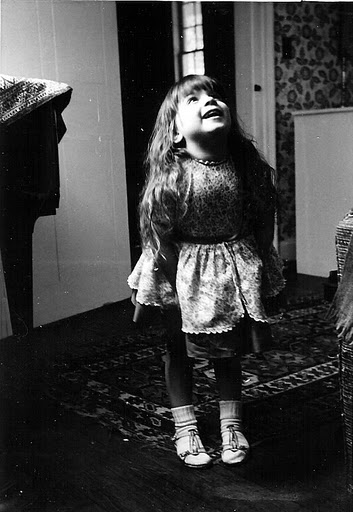
This photograph is from a box sent by my cousin. My sister Chris and my mother Helen. On the back it says “pear tree”. My mother would try to assemble the parts of the Twelve Days of Christmas. When I was in my teens, she would hang glittery pears on her avocado tree that she had grown from a seed. One partridge, two calling birds. She had seven tiny glass swans that she would set swimming on a mirror lake, with white fluff around it for snow. I don’t think she got past seven. My mother had wonderful traditions that she developed for Christmas. She loved the old carols and wouldn’t sing the modern ones at all.

I think my grandfather or grandmother took this photograph. I thought, why isn’t it square? But it isn’t: it was cut from a page and is a bit of a trapezoid.

My sister is about four, so this would be from around 1968.

For the Ragtag Daily Prompt: children.

Keeper

Here is my lovely momento.

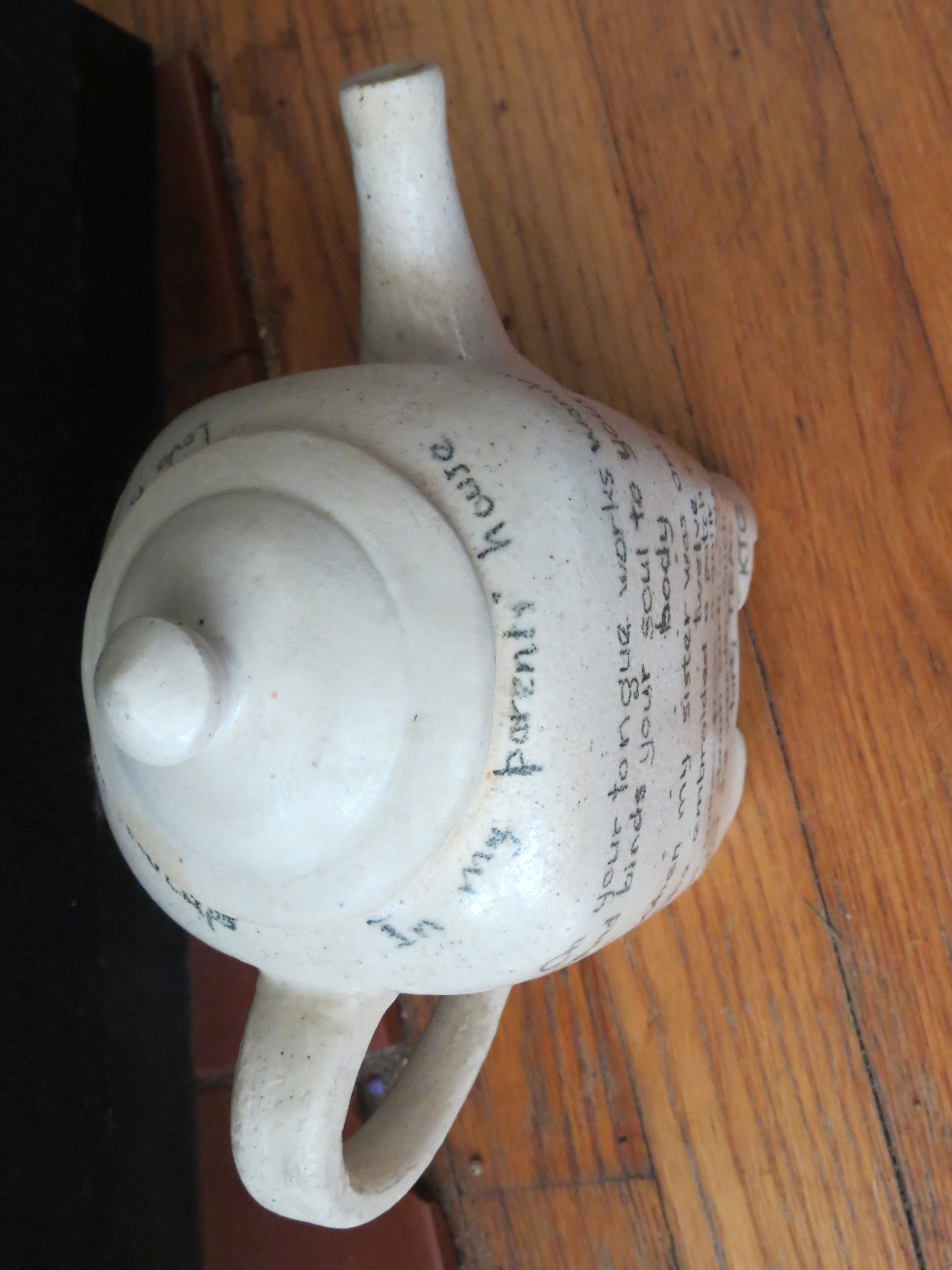
I write a poem called “In my parents’ house”.

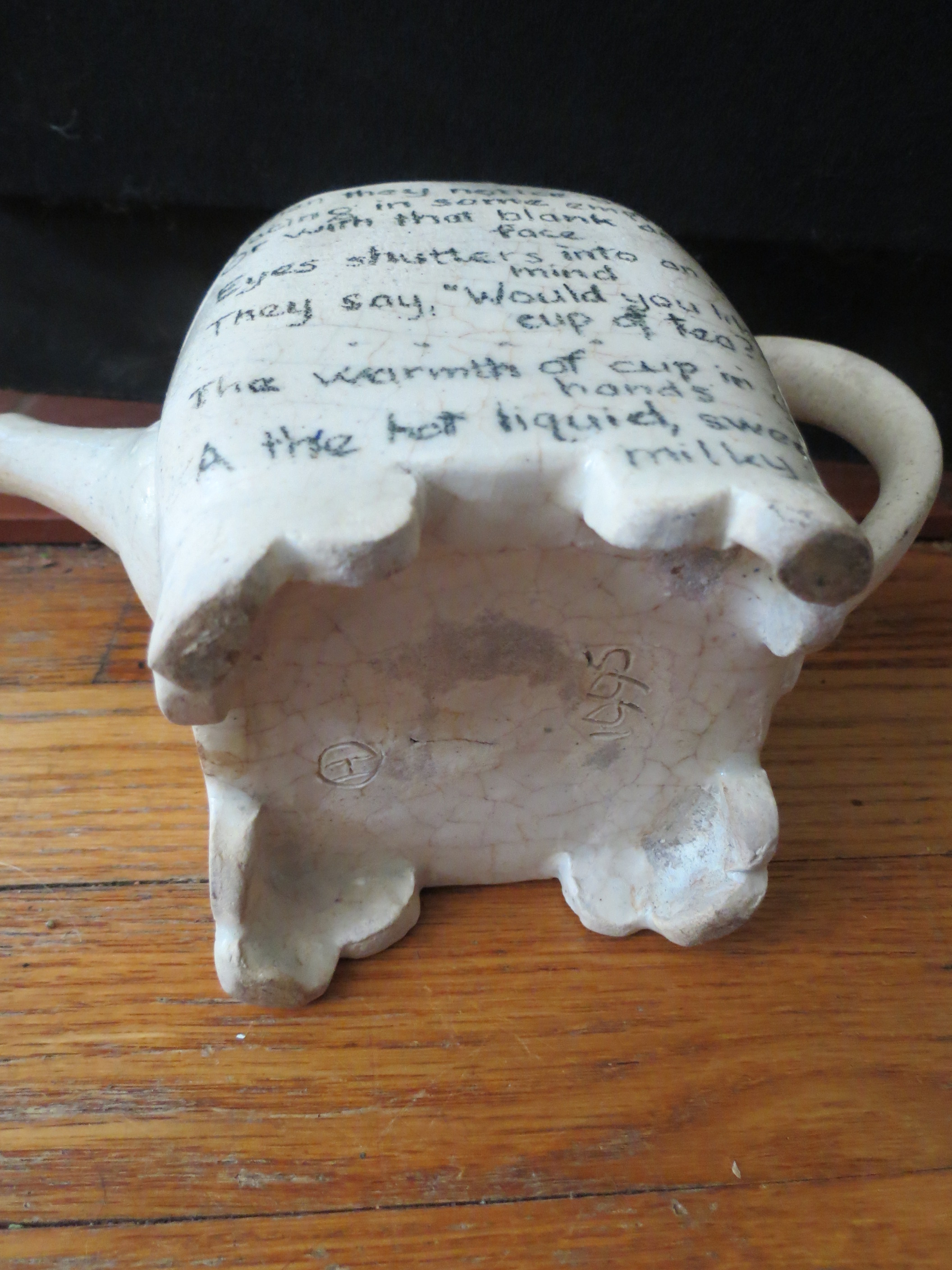
In 1995 my mother, Helen Burling Ottaway, makes teapots with the poem on the pot. She gives me one for Christmas.

She dies of cancer in 2000. My sister chooses my poem to read at her memorial.

A friend then reads the poem at my sister’s memorial in 2012 (also cancer), because I missed the California memorial. I was sick at home with pneumonia #2.

After she dies, I am sent a box of a few things from her house. Yarn and a second teapot. My sister had one.

I give the teapot to my niece, my sister’s daughter, telling her her grandmother made it.

My mother signed things with an H inside an O.

Here is the poem:

In my parents’ house
love is dispensed in teacups

When they notice you
Pacing in some empty mood
Or with that blank deserted face
Eyes shutters into an empty mind
They say, “Would you like a cup of tea?”

The warmth of the cup in your hands
And the hot liquid, sweet and milky
On your tongue works wonders
And binds your soul to your body

When my sister is twelve
She embroiders a patch for a quilt
In yellow flosses, a cup
with steam curling upwards
And the words, “Such a comfort. TEA.”

____________________

I think my maternal family still has the quilt, with jeans patches. My grandmother Katy B handed out squares to everyone at the cabins in Ontario and we all made squares. She and my cousin sewed them together and tied the quilt.

For the Ragtag Daily Prompt: momento.

Neurogognitive effects of Long Covid I

Here is the first part of my notes from this lecture: May 24, 2023 Neurocognitive effects of Long Covid (International) part 2, by Dr. Struminger PhD, neuropsychologist.

I am trying to make this fairly clear to almost anyone. Some words may be unfamiliar to start with, but I will bet that you can sort it out. I would be happy to try to clarify any part if needed. These are my notes from the first half of this lecture, fleshed out to be clearer.

This is the Schmidt Initiative for Long Covid Global in English with real time translation into Arabic, French, Spanish, Portuguese and closed captions. Session recordings: https://app.box.com/s/onh1ma57ttjpi2c19qqxvmdao0kd2nsr

Dr. Struminger said that 1/4 to 1/3 of Long Covid patients have cognitive symptoms. A study comparing Long Covid patients with people who never got Covid-19 shows the Long Covid people to be three times more likely to have attention deficits or confusion. Part of the barrier to treatments is to define the problem, figure out the mechanisms and then start studying treatments. She said that she would share a few proposed mechanisms for cognitive impairment in Long Covid, but that it is probably multifactorial and it’s a rat’s nest. (Ok, I said rat’s nest. Dr. Struminger did not use that term.)

There are two main phenotypes of Long Covid brain problems: Hypoxic/anoxic and Frontal/subcortical. In hypoxic/anoxic certain brain functions are intact: Attention, visuospatial, cognitive fluency and memory encoding. There is impairment in problem solving and memory retention. This pattern is associated with the people who were hospitalized, deathly ill, on ventilators, or heart/lung bypass machines.

Frontal/subcortical is more common in the people who were never hospitalized and were not on a ventilator or ECMO machine. It can show up even in people who seemed to have mild Covid-19. The impairment is in attention, cognitive fluency and memory encoding, while the intact functions are visuospatial, memory retention and problem-solving.

Here are those lists in a table, HA for hypoxic/anoxic and FS for Frontal/subcortical.

Attention: HA intact, FS impaired
Visuospatial skills: HA intact, FS intact
Cognitive fluency: HA Intact, FS impaired
Memory Encoding: HA intact, FS impaired
Memory retention: HA impaired, FS intact
Problem-Solving: HA impaired, FS intact

The two types probably have different mechanisms and the super sick are more often the hypoxic anoxic. And there can be a mixed or both presentation.

Neuropsychologists test people to see what parts of the brain are working. Testing locally usually takes about four hours or more. Some brain functions have been mapped to parts of the brain but others are still mysterious. Efforts continue to match function to neuroanatomy. Going through each of the brain functions, some are mapped and others are not.

Attention is mapped and mediated by the frontal lobes. Attention is impacted by physical fatigue, dysautonomia, pain, shortness of breath, further impacted by emotional symptoms. It is REALLY easy to get stuck in a vicious cycle where physical symptoms or pain or hypoxia decrease attention function, which in turn makes physical symptoms worse. For example, hypoxia can decrease attention, which makes the person anxious and tachycardic, which in turn affects attention more.

The frontal lobes are very sensitive to hypoxic damage and to inflammation. Any inflammation in the body messes with them. The frontal lobes need oxygen and glucose. If a person can’t breathe, this messes up attention; if they are dizzy, it messes up attention.

Cognitive fluency. The anatomical correlates are less clear. Probably frontal and temporal, vulnerable to hypoxia and broad networks in the brain, vulnerable to physiological and mood disturbance. So vulnerable to the same things as the frontal lobes.

Learning and memory: Map to the hippocampi – sensitive to hypoxia and can be injured while the rest of the brain is comparatively unscathed. People have difficulty with retention of new information and not just attention/encoding problems. Neuropsychology distinguishes between attention/encoding and retention/recall problems. Those are different. In alzheimer’s, there is trouble retaining new information, even though people can encode it. In the frontal/subcortical long covid brain fog, there is more difficulty with attention/encoding. That is, if the person is tachycardic or in pain or dizzy or short of breath, it is more difficult to pay attention and encode information into memory.

Executive functioning. Frontal lobe: sensitive to hypoxia and metabolic dysregulation, significantly impacted by physical symptoms and mood disturbance.

The hypoxic/anoxic pattern has effects more like Alzheimer’s or a dementia. The frontal/subcortical is more like a concussion or traumatic brain injury. Neither sounds great, but there is more healing from the second than the first. Treatments for now are coming from the Alzheimer’s/dementia established treatments or from the concussion/traumatic brain injury established treatments. The first part of treatment is rest, rest, rest, and try to keep the brain from getting overwhelmed. I will write more about the ongoing changing recommendations.

More at: https://hsc.unm.edu/echo/partner-portal/echos-initiatives/long-covid-global-echo.html

The photograph is a screen shot of the brain from below from one of the conferences. There were over 300 people attending this zoom lecture, which is encouraging and hopeful.

For the Ragtag Daily Prompt: covert. The covert damage from Covid-19 is being sorted out.
Memory trip

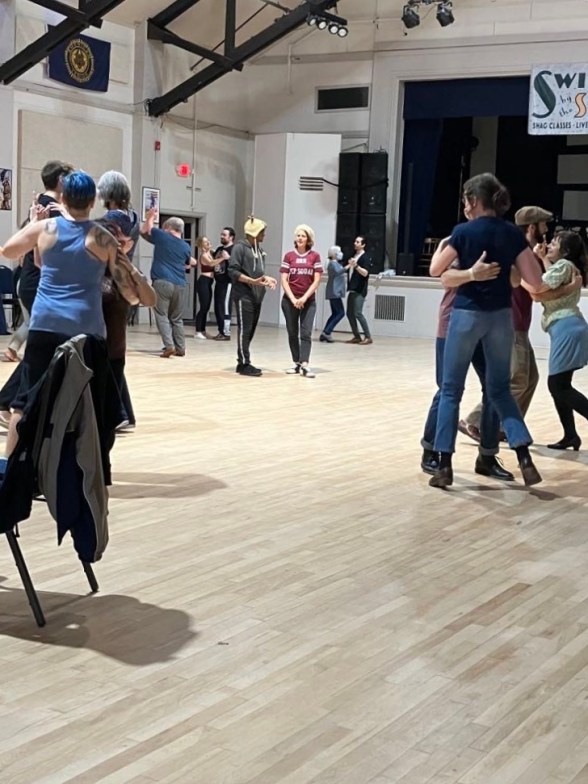
The Swinging by the Sound dance weekend was a memory trip for me.

I met my future husband dancing, back in 1986. We met contra dancing, but he was already learning Lindy Hop. We took a class together and met people that I am still in touch with. We went to dances at the Spanish Ballroom, in Cabin John, Maryland, with 400+ people. We had an hour of teaching and three hours of dancing, in the old park which did not allow alcohol. The Ballroom was not heated in the winter and would be in the upper 90s in the summer. I remember winter dances with the band needing space heaters. The dancers did not need heat: we were generating it.

I took this photograph at a Swinging by the Sound class. People choose Lead or Follow and the instructors have the Leads rotate every few dances. I am happy seeing so many people learning both, because it makes you a much better dancer.

We loved our bands too, and Daryl Davis and his band played at our wedding.

For the Ragtag Daily Prompt: trip.

Who would I be?

If I have had PANS since birth, who would I be if I had not contracted it?

No one knows. We are still arguing about whether PANDAS and PANS exist. But, my daughter says, we make up all the words. The definitions of illnesses CHANGE over time, and what an illness MEANS. Tuberculosis was an illness of poets and people too noble for this world, until microscopes became advanced enough to see the tiny bacterium, and then it became an illness of the crowded unclean poor. Medicine and science continued to study it. Once we recognized that it is an airborne illness, tuberculosis sanatoriums were set up, to quarantine people. My mother was diagnosed with tuberculosis when she coughed blood 8 months pregnant, so I was born in a sanatorium and avoided contracting tuberculosis as a newborn.

Antibodies cross the placenta, even though the tuberculosis bacterium does not. Usually infants contract tuberculosis and die, at least when I was born. The antibodies can trigger PANS or PANDAS.

The antibodies prime the fetus’s immune system. This makes sense, right? The fetus has a sick mother and best if its’ immune system is ready to fight.

Did my younger sister have it? I do not know. Not as badly, would be my guess. My mother said that as kids, we’d both get sick, but I got sicker. We both had strep A many times. My sister got mumps, off from school for three weeks, and I did not get it. But I got everything else.

Now the estimate for children with PANS or PANDAS is 1 in 200. This is enormous. A high prevalence. Antibodies, that I suspect are adaptive and lie in readiness for a pandemic or a crisis. And now we have had another pandemic, with the last really world wide bad respiratory one 100 years ago. Is the prevalence rising because of the pandemic or are we figuring out some of the cause of behavioral health illness or is the definition of illness changing or all three? I think all of them.

My cousin’s mother had polio either during her pregnancy or very soon after. My anthropologist uncle took his family to Bangladesh, where he was doing linguistics. So does my cousin have PANS or PANDAS? I do not know.

And what of my children? My pregnancy with my older child was fourth year medical school and went well. My pregnancy with my second was very complicated. I was in my first year of work as a rural Family Practice doctor and working too hard. I ended up on bed rest for three months and on a medicine. Is labor at 23 weeks an illness? Does it affect the fetus? I was on medicine from 23 weeks to 37 weeks. What effect does it have?

Medicine is still changing and changing quickly. We don’t know. There is so much we do not know.

_______________

PANS/PANDAS: https://www.pandasppn.org/guidelines/

_______________

The photograph is me and my sister, in about 1967ish. I do not know who took it.

Food needs two

Ok, so what menu did I choose for my friends with food needs, as listed in the previous post.

First course: Sweet Pea soup. The color is vivid and almost lurid. My guests look worried until they taste it. It tastes like spring! Butter, onions, broth and frozen sweet peas, just cooked. My guests go from worried to asking for seconds.

Second course:

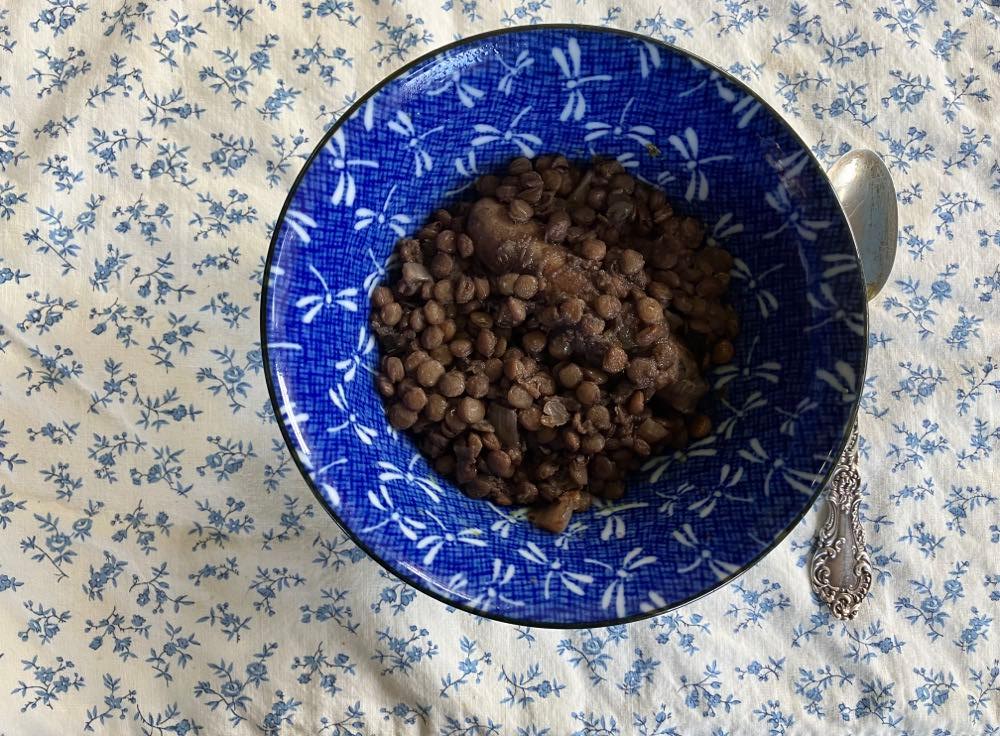
Lentils baked with sausages. This is also not a gloriously pretty dish. Again, my guests love the taste. Lentils, a little red wine, butter, onions, bay leaf, sausages, thyme and baked. Yum.

As well as:

Roasted Ronde de Nice Squash with California rice and Early Girl tomatoes. Except I did not make the rice, I couldn’t get farmer cheese and the tomatoes were varied and from the store. And a different kind of squash! This is from a cookbook new to me: Community Table, Recipes for an Ecological Future. The sweet pea soup is from a cookbook that I’ve had for forty years and the lentils are from memory, a recipe a friend taught me in the 1980s.

Dessert is fruit salad and chocolate. With tea.

No liver, gluten, shellfish, giant rubbery cooked mushrooms, anchovies, dried fishies or grubs.

Voila! Food needs satisfied!

puppets

My sister Christine Ottaway died in 2012 of breast cancer.

I took this photograph at Christmas in Alexandria, Virginia in the late 1970s. I am three years older and made her stuffed toys and puppets for years. The first one was a stuffed snake that I sewed by hand, of brown flowered fabric. My mother was very unconvinced about it, but Chris and I had both longed for the giant velvet snakes at the County Fair. We failed to win one. The snake I made her was only two feet long, but she loved it.

I made the puppet on the left and bought her the one on the right.

It’s lovely to still have the photographs and memories.

Old men never die, they just spout poetry

I wrote this in 2009. I don’t know why this gentleman comes to mind today. Partly because I have a friend in the hospital. She is in her 80s. When the doctors ask how she is, she says, “Fine.” I want to yell “Liar! She is NOT fine!” Luckily she has her daughter-in-law and me and her sons saying “She is NOT fine!” Sometimes people are very stoic and will not tell you that they are not fine.

When I was in residency we rotated through the Veterans Hospital in Portland, Oregon. Most of our patients were either very elderly or they were alcoholics or addicts in their 50s, starting to really go downhill medically.

One elderly patient is particular vivid in my memory. He was in his 80s and black. He was weak and had various problems. I was not doing a very good job of sorting him out.

He wouldn’t answer questions. Or rather, he would give a reply, but it was not yes or no and I couldn’t figure out how the answer related to the question.

On the third day he gave a long reply to a question and I recognized it.

“That’s Longfellow,” I said. He nearly smiled. “We did a bike trip around Nova Scotia and read Evangeline aloud in the tents at night. The mosquitos tried to eat us alive. That’s Longfellow, isn’t it?”

He wouldn’t answer but the twinkle in his eye indicated yes.

So our visits were cryptic but fun. I would try to guess the author. He knew acres of poetry, all stored in his brain, no effort. I tried to relate the poems to my questions to see if he was answering indirectly. I wondered if he had schizophrenia and these were answers, but I didn’t think so. I thought he was just stubborn and refusing to answer.

I challenged him. “Ok, you are the right age. Come up with a song with my first name that is from early in the century. My father used to sing it to me when I was little. Can you?”

The next day he sang to me: “K-k-k-katy, beautiful Katy, you’re the only beautiful girl that I adore. When the m-moon shines, over the cow shed, I’ll be waiting by the k-k-k-kitchen door.”

We sat and grinned at each other. Soon afterward I moved on to the next rotation. I don’t remember his medical problems. But I remember him and remember wondering what he had done in his life to have a memory and a store of poetry in his head. A teacher? A professor? A man who loved poetry? I started matching him with my own store of poems, the Walrus and the Carpenter, songs, bits and pieces. I felt blessed and approved of when his eyes twinkled at me, when I recognized an author or even recognized the poem itself. I looked forward to seeing him daily on rounds. And he seemed to look forward to my visits. I was sad when I had to say goodbye and the next rotation was out of town. And since he had never told us his name, no way to stay in touch. Farewell, poetry man, fare thee well.

____________________

We were not doing nothing. He would not tell us his name, so we were awaiting an opinion from neurology. Waiting.

The photograph is not as old as the song. The young man holding the ball is my father, in the 1950s. My Aunt and I think this was at Williston in around 1956.