Conserving energy

I was out of clinic for two years and then very part time for a year and now not quite full time as a temp. I bargained to not quite be full time.

The electronic medical record is having a consequence, along with the pressure to see more people faster. The primary care doctors, at least the younger ones, do not seem to call their peer specialists any more. (Family Medicine is a specialty, just as Internal Medicine and Obstetrics/Gynecology are.) I called a gastroenterologist and left a message last week about a difficult and complex patient. The patient had cried three times during our visit. The gastroenterologist was very pleased I had called, was helpful, agreed with my plan of using the side effects of an antidepressant to try to help our patient, and thanked me three times for calling her. Wow. I am used to calling because during my first decade in Washington State, our rural hospital had Family Practice, General Surgery, a Urologist, Orthopedics and a Neurologist. For anything else, we called. I knew specialists on the phone for a one hundred mile radius and some knew me well enough that they’d say a cheery hi.

Now communication is by electronic medical record and email on the medical record and by (HORRORS) TEXT. Ugh. I think that there is quite a lot of handing the patient off by referring them to the Rheumatologist or Cardiologist or whatever, but the local Rheumatologist is booked out until February for new patients. That leaves the patient in a sort of despair if we don’t keep checking in on the problem. If I am worried, I call the Rheumatologist and say, “What can I do now?” I’ve had two people dropping into kidney failure and both times a call to the Nephrologist was very very helpful. I ordered the next tests that they wanted and got things rolling. One patient just got the renal ultrasound about three months after it was ordered. Sigh.

I have one patient who is booked in February for a specialist. I called that specialist too, they did not want any further tests. I told the patient, “You aren’t that sick so you won’t be seen for a while. It isn’t first come first serve: it is sickest first. We all have to save room for the emergencies and sometimes those are overwhelming.” The specialist agreed and the patient is fine with that and I think pleased to know that we do not think she’s that sick. She feels better. If things get worse, she is to come see me and might get moved up. Neither I nor the specialist think that will happen.

Is this conservation of energy, to communicate by email and text? I don’t think so. I think sometimes a phone call is much more helpful, because the other physician knows exactly what I am worrying about and they can tell me their thoughts swiftly. Sometimes they want me to start or change a medicine. Things can get lost in the overwhelming piles of data and the emails and labs and xrays and specialist notes all flowing in.

My Uncle Jim (known as AHU for Ancient Honorable Uncle Jim) used to sing part of this:

Yeah, that’s just how I call my fellow specialists.

For the Ragtag Daily Prompt: conservation. Don’t cats win at conservation of energy?
Strep A and Covid

In clinic we are seeing Strep A and Covid in the last two months, quite a lot.

Covid is all over the map with symptoms. One person had been traveling, did not feel well, but the main symptom was dry lips. Positive covid. Another was vomiting, with no upper respiratory symptoms. Some have diarrhea and upper respiratory symptoms. It interests me that flying home to Washington last month, only about three of us on the planes wore masks. I was one of them. I know people who have taken flights knowing that they have Covid, a day or two after diagnosed, so I can’t say that I trust the other people on airplanes. We are testing for Covid for almost any symptom or just feeling sick.

We are seeing Strep A as well. I saw a small child vomiting. I asked if her nose hurt: no. Throat: yes. Tummy: yes. Toes: no. She had strep A. The oldest person with strep A this week was ninety. She said, “How did I GET it?” Streptococcus is in the environment, including our throats. We may just carry it around, but then if we get overtired or stressed (good or bad stress) or have something happen, the strep can invade. We treat strep A mostly to prevent rheumatic fever, which is where our own antibodies to strep A attack us. I have seen three cases of rheumatic fever in my career. That is called a “pseudo autoimmune” disease. The strep A has cell surface markers that sometimes are close enough to ours that our own antibodies attack our body parts.

One person in the last month has a positive strep A. I write for penicillin and send her home. We call her later because the Covid/influenza/RSV test takes longer. She also has Covid! That seems like a bit much, rather unfair, but we can have two things. An initial infection can lower our immune defenses and another virus or bacteria gets hold.

Another person had tested negative for Covid, but that was four days before. Friday afternoon, so I would not get the results at home. I asked her to retest at home. Positive.

Here is the CDC page about Strep A. https://www.cdc.gov/group-a-strep/index.html

There are Strep B and C and D and so forth. Sometimes we pick them up on throat cultures. I treat if the person is still sick and symptomatic while the culture is in the laboratory.

I am wearing a mask in airports and on airplanes. I just don’t want to pick anything up, or at least do what I can to avoid it.

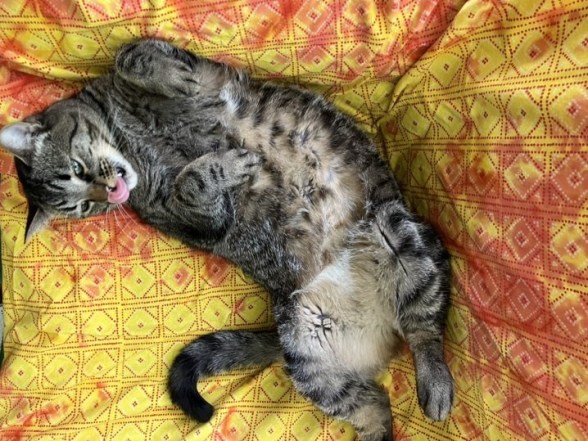
The photograph is Elwha in May 2023. I figure that you would rather see his tongue than mine.

For the Ragtag Daily Prompt: strep.

I think the song might be off topic. I don’t care. Beautiful.

Weighing in

No nightmares about clinic since the one I wrote about two days ago. I do feel like a bit of a dinosaur in clinic, though. Most of my older patients seem to really be fond of dinosaurs.

I’ve heard from other docs that they don’t have time to talk to each other in clinic either. Patient time but primary care we read all the notes from everyone: specialists, PT, OT, xrays, CT, MRI, ultrasound, lab, lab, lab, lab, prescription refills, phone calls. I read that people are trying to insert Artificial Intelligence into this. I am fine with a computer learning to read mammograms, but condensing information from notes? The AIs currently can “hallucinate”, and make things up. Is that worrisome or am I being silly? Notes are often wrong ANYHOW, way more than I would like. I saw a patient yesterday who has a neurological disorder. The hospital discharge note lists the wrong one! The patient caught the error, I didn’t. I am very glad he corrected me, but the hospital note is still sitting there wrong. Having been labeled with wrong diagnoses myself, I think it is a big deal. In order to fix it, he would have to fill out a form and the form would go to the physician, who is supposed to respond and add an addendum to the note. How often do you think THAT happens?

The discharging physician suggests he see a specialist for testing. I call that specialist and they agree with me: that testing is not indicated, it won’t make one bit of difference in his treatment. The discharging physician also suggests lung testing. I don’t think it works or is useful with a serious neurological disorder that affects muscles! Think, people.

My patient is grumpy and asks how we know the medicine is working. I reply, “You’re not dead.” Which is true. Undiplomatic, but he does not mind, because he is already saying, “What is the point of this?” To explain more about the medicine working, I ask, “Is your breathing better than when you went to the emergency room?”

“Yes,” he says.

“That is because the medicine is working.” I explain how it works and what happens if he stops it.

Sometimes it makes me feel heavy, heavy, like a dinosaur.

But I think I will try discussing my clinic day with my cat. I think she might enjoy it and I can clear the grumps out. And it’s not a hipaa violation! She doesn’t like other cats and won’t tell them anything.

For the Ragtag Daily Prompt: dinosaur.

This is new to me:

I’ve never seen these cartoons. The animation is, well, not the best. The guitar work is fun though!

Honey and the ants again

The next two times Honey feels the ants biting from the inside feeling are also on obstetrics.

Both times it is a VBAC. Vaginal birth after cesarean. The woman has has a cesarean section in the past and is trying for a vaginal birth.

Both times, Honey gets the biting ant feeling. There doesn’t seem to be anything wrong with the woman in labor, the nurse is relaxed, the fetal heart monitor looks ok.

With the first one it is the younger male obstetrician who is on call. He is a big man. He sits and peruses the monitor strip outside the room, taking his time. “There were some decelerations back here, but the heart rate looks fine now. Do you really want me to consult?”

Honey can’t stand still, the ants feel so bad. She tries to sound professional and calm. “Yes, this is a VBAC. I would like you to go in and meet her.” She is trying not to shoo him towards the room. He shrugs and gets up, not quite slouching towards the room, Honey trying not to jump up and down in impatience behind him.

In the room, he introduces himself. Again, Honey has not told her patient. The obstetrician says, “Dr. B. asked me to stop by since you have previously had a cesarean section, but everything looks fine.” Two minutes later she and the nurse and the obstetrician all alert as the the fetal heart rate monitor chirp slows, dropping from the 120s down to 60. THERE IT IS! thinks Honey. It stays down, they have the mother roll on her side and pop oxygen on her. It comes back up, but that is that. Off to the operating room. Again, they don’t have to do a crash cesarean. This time it is not clear what was wrong, but everything comes out well.

On the third round, it is the older male obstetrician. He looks at the strip and is calm and goes right into the room. He introduces himself and everything looks fine. Honey is wanting to dance from foot to foot from the ants. Again the fetal heart rate drops, right as the obstetrician gets up to leave the room. The nurse has the woman roll to her side and adds oxygen. The calm obstetrician gives Honey a look and has the nurse get the surgical consent. The heart rate is back up and off they go.

Honey wonders. Ants? Little voices? She knows that we all pick up information from body language and information that is not conscious. That could be a scientific explanation. Information that is not quite conscious. Honey decides that she really does not care what the ants are. When those voices speak, she listens. Who cares what it is, as long as it works.

______________________

What is the word? “Fictionalized”, from fallible, friable memory.

You will be labeled

If you get sick
with something the doctors don’t understand
you will be labeled
unstable
mental
bipolar
crazy.

They will try to drug you.

How do you tell
when they are right
and you are crazy
brain on fire
and when you aren’t?

Don’t ask me.
I’m a Family Practice doc
and I’m rural
and I’m a girl.

I’m the one they make fun of
in the medical schools.
“The rural doctor
transferred this patient.”

Yes we did.
Because we knew it was something
different
that needed more
than we had
in our small town
in our small hospital.

Once a neurosurgeon says,
“You are transferring the patient
because it’s Friday
and you don’t want to work
on the weekend.”
“She needs an MRI,” I say
“and we don’t have one.”
and transfer her anyway.
I call two days later.
After the MRI, she is in
the operating room
for a tumor in her spine.
He doesn’t call me back
but I hope he remembers.
I certainly do, after years
and years.

If you get sick
with something the doctors don’t understand
you will be labeled
unstable
mental
bipolar
crazy.

Doing the best with what you have

Medicare doesn’t cover everything.

It can’t. There are new things being thought up all the time. Some are legitimate and some are scams. There are tons of quack medicine videos and supplements and stuff on line.

But there is also a matter of personnel and resources. Sometimes we do not have enough. Then we have to do the best we can with what we have.

There is a particularly difficult case from my second year of rural Family Medicine with Obstetrics. Things went right but just barely. This is from memory and over 25 years ago, in the 1990s, so I can’t violate hipaa because I can’t remember names from then. Mostly.

I had a pregnant woman whose pregnancy had gotten complicated. Her ultrasound showed an abnormal placenta. Very rarely, the placenta can grow into the uterus too far, and form a placenta increta. Even more rarely it can grow THROUGH the wall of the uterus and into another body part. That is called a placenta percreta.

In this case we thought that the placenta had grown into the bladder. We were not certain. The obstetricians were aware. Our patient was aware. A cesarean section was planned for when the fetus was mature.

Then she developed a second pregnancy complication. Preeclampsia. This is a complication where blood pressure rises, there is protein in the urine and many things can go wrong. It can progress to eclampsia, which means seizures. This is Very Bad, which means the mother and fetus can die.

She developed HELLP syndrome. This is an acronym. The P is what I worried about, platelets. Platelets help your blood clot. Her platelet count was dropping out of sight. We were rural, 180 miles from the nearest high risk obstetrician. We did have blood for transfusion but NO PLATELETS.

The treatment for preeclampsia with HELLP syndrome is to deliver the baby. I called our obstetrician the minute I got the lab result. “No platelets — can I fly her out?”

“YES! FLY HER OUT!”

Transfer to a bigger hospital with facilities for a premature infant and with platelets, because she needs a cesearean section and she could need a hysterectomy if that darn placenta has grown through. Messy.

Problem number three: weather. We are in Alamosa, Colorado, at 7500 feet, which is the valley floor. We are surrounded by 14,000 foot peaks with passes in four directions. That nearest hospital with platelets is 180 miles and over a 10,000 foot pass and it is snowing.

I call Denver first. 250 miles. Fixed wing life flight. Nope, the weather is too bad to the east and north.

I call Albuquerque. 250 miles. Nope, the pass is socked in, the plane can’t get through.

I call Grand Junction. About the same distance. They say “WHERE are you?” I’ve never tried to send anyone there before. They demur and I cajole and beg. “Okay, okay!” The high risk obstetrics doctor can’t be looking forward to meeting this patient, but they accept.

From the start of calling to the arrival of a plane and crew usually takes about four hours. I want to chew my nails.At last I hug my patient goodbye and they go.

I get the call about 6 hours later. Delivered and they did have to do a hysterectomy, but mother and baby are fine. Her bladder was untouched. They had platelets.

Whew! I was so happy, and mom and baby too. Let’s give credit to my patient too: she got prenatal care. She paid attention. She knew she was high risk. I had told her to come in if anything changed and she did, so we caught the preeclampsia on time.

But it could have gone wrong in all sorts of ways. We were both careful and we were lucky. If the storm had been over Alamosa we would have done the best we could then, too, but it could have turned out quite differently. And thanks to the high risk obstetrics doctors who accept complex patients that they have never seen from rural doctors like me!

Blessings. Blessings on all the nurses and doctors and midlevels and hospital housecleaners and security and lab workers and the Life Flight personnel and First Responders and everyone who has worked and worked and worked through the pandemic.

________________________________________

I took the photograph in Maryland in December: abstract and complicated water, ice and reflections.

Is this a tree?

Is this a tree?

I would not call this a tree. I would call it a cone. It contains seeds. It is not a tree.

A pregnancy is called an embryo until 8 weeks after conception and then a fetus until birth. It is not a baby, any more than a seed is a tree. Here is a link to a picture of the embryo developing:

https://en.wikipedia.org/wiki/Human_embryonic_development#/media/File:HumanEmbryogenesis.svg

It’s a bit difficult to call the embryo a baby.

After 8 weeks (10 weeks from the last menstrual period) the developing pregnancy is called a fetus. It cannot survive outside the womb. A term pregnancy is 37 weeks, and the due date is at 40 weeks. The earliest survival, certainly not natural, is around 24 weeks. This takes heavy intervention and technology, a premature infant on a ventilator for months. There is risk of damage to the eyes from high oxygen and risk of spontaneous brain bleed and cerebral palsy, because the newborn can weigh half a pound. Once born, the fetus is termed a baby.

This is important from a medical standpoint and pounded into us as physicians. WHY? Because in a trauma situation, the life of the mother comes first. In Obstetrics and Family Medicine, the life of the mother comes first. In Oncology, the life of the mother comes first. My sister was diagnosed with stage IIIB ductal breast cancer at age 41. She was engaged and it turned out that she was pregnant. She wrote this essay on her blog, Butterfly Soup:

The hardest loss of breast cancer.

She had an abortion and chose chemotherapy, because it was her or the fetus. If she had chemotherapy pregnant, at that time she was told that it would probably kill the fetus or cause terrible birth defects. If she held off on chemotherapy for seven months, her oncologist thought she would die. She had a very very aggressive cancer and she already had a daughter who needed her.

She lived until age 49, with multiple rounds of chemotherapy, radiation, gamma knife radiation, whole brain radiation. And she lived until her daughter was 13. Without the abortion, her physicians thought she would have died when her daughter was 7.

My ethics in medicine are that patients have autonomy. I would NOT have wanted my sister to choose to refuse chemo and try to bring a baby to term while dying of breast cancer. However, it was HER CHOICE, not mine. It was private and no one else’s business and how dare people make moral judgements about another person’s medical choices. I give my patients CHOICES. They can choose not to treat cancer and go into hospice. They can choose surgery or refuse it. They can choose to treat opioid addiction or refuse. They may die of a heroin overdose and I grieve. I try to convince them to go to treatment and I give them nalaxone to try to reverse overdoses. I refuse a medication or treatment that I think will harm my patients, but my patients have autonomy and choices. That extends to women and pregnancy as well.

It is NOT a baby in the womb, however emotionally attached people are to this image. It is an embryo first and then a fetus. And in a car wreck, the woman comes first and the fetus second.

For the Ragtag Daily Prompt: explain.

from blue to breathe

I attended a medical conference on line yesterday and today and it made me very blue. At first it just frustrated me, because it is about increasing behavioral health access. Isn’t that a good thing? Yes, but they completely missed the biggest barrier for primary care: TIME.

With the current US medical corporate money extracting insurance non-caring system, primary care is increasingly forced into 20 or 15 or 10 minute visits. I fought my hospital district when they said “See patients for one thing only.” I replied “That is unethical and dangerous: if it is a diabetic with an infected toe, I HAVE to check their kidney function, because antibiotic dose must be adjusted if their kidney function is reduced.” And there are at least two and maybe three problems there: infection, and if the diabetes is out of control that worsens the infection, and then kidney function. And actually I have to be sure anyone going on antibiotics has good kidney function or adjust my dose. I am very very good at this, but it takes time. I can work with complex patients, with veterans, with opiate overuse, with depression: but none of this is a simple template slam dunk. A study more than a decade ago says that the “average” primary care patient had 5 chronic illnesses. My patients don’t want to come in for each one separately and anyhow, if they have kidney problems I have to pay attention when I pick medicines for their high blood pressure. None of it can be separated out. That is why medicine is complicated.

Someone asked why can’t I just post the price of a “simple” visit for a sore throat. But a sore throat can be viral, can be strep A, can be a paralyzed vocal cord, can be a throat abscess, can be vocal cord cancer. I can’t tell ahead of time. I can’t. Early on during covid, a patient called and wanted a Zoom visit for abdominal pain that he said was constipation. I said “No, I can’t do abdominal pain over Zoom safely.” I can’t ASSUME it is constipation. It was appendicitis and he had his appendix out that evening. He called from his hospital bed the next day to thank me for making him come in.

The conference made me blue because they ignored my questions about why they were not advocating for primary care to have more time with patients. They claim to be all about change, but changing the US medical system? Nope. Do not want to talk about that. But I do want to talk about it. You can help by letting Congress know: single payer or medicare for all. That insurance company gets 20 cents of every dollar to profit and wastes tons of money forcing doctors’ offices to call for prior authorization. And if we have single payer, think of all the small businesses that will start because the terror about health insurance will disappear! I think it would reduce everyone’s stress, except the insurance CEOs. And they have earned more than enough, goodbye greed.

I am also tired of specialists telling me that primary care needs to do MORE. When I get told that I am not doing enough about hypertension, bladder leakage, depression and stopping smoking, and then 20 other specialists lecture me. Ok, so one minute per topic to fulfill what all of them think I should do? I want a primary care conference where primary care doctors are celebrated: cases are presented where the specialist says what a brilliant job the primary care doctor did.

I received a consult letter from a cancer doctor a few years ago. He wrote that I had diagnosed the earliest case of chronic leukemia that he had ever seen and that he was impressed and the patient would do fine. That’s the conference that I want to go to: where primary care and specialists talk about that and we inspire more doctors to do primary care.

You can learn more and how to talk to your congressperson here: HealthCare Now: https://www.healthcare-now.org/

or at Physicians for a National Healthcare Program: https://pnhp.org

And put your vote and your money towards healthcare, not health insurance.

covid 19 two

From November 20th, 2020:

My ex called Saturday. Early, which unusual. I thought he was calling to say his mother died.

Nope.

He is an RN at a nursing home. “We’ve gone from one Covid 19 patient to 55 in the nursing home in one week. And they installed a new computer program on Tuesday that makes everything take twice as long. I quit.”

Actually he gave two weeks notice.

He called our kids yesterday. He has Covid 19. However, they are so short of staff that he is working. On the Covid 19 ward of the nursing home.

____________________

In my clinic, we are struggling with watching people travel for Thanksgiving. We have decided. If someone travels or has Thanksgiving with other households, we will offer a zoom visit or a reschedule in two weeks. We do not want them to expose others in clinic. And if we get it or are exposed, we are closed for a minimum of two weeks.

____________________

He called me. Today 60 out of the 70 nursing home patients have it. All of the staff have it. The staff are working anyhow because there is no one else.

Why is she really here?

For the Ragtag Daily Prompt: object. I strenuously and loudly object to medicine meaning pills.

During my three months temp job at a nearby Army Hospital in 2010, I wanted to work with residents, Family Practice doctors in training. I finished residency in 1996 and have worked in rural clinics and hospitals for 14 years. I want more rural family practice doctors and I agitated to work with the residents in training.

The Family Practice Department had actually hired me to do clinic. They are swamped and trying to hire temporary and permanent providers as quickly as they can. Six different temp companies called me about the same job, so the word is definitely out.

Initially the department head explained that I was there to do clinic, but she changed her mind. I was cheerful about the electronic medical records. Learning a new electronic medical record is awful, but I was happy to be there, excited about working with residents and in a hospital more than 16 times as big as my usual small town hospital. Most importantly, I was patient with the computer. I have finally realized that computers don’t actually speak English. They speak computer and they are dumb as rocks and they make no effort to understand what I am saying. They don’t care. So it is no use getting mad at the dumb thing when it crashes or when it doesn’t do what I want: I have to go find someone who knows the exact language that the stupid machine will understand.

Since I was cheerful, my department head let me do what I want. I was on the clinic schedule every day, but it was empty. I would arrive and see walk-in active duty people from 6:30 to 8:00. At the same time, I would email the department head and ask what I was doing that day. Half the time, a physician was sick or had a family crisis, so she would move people around and put me with the residents. If not, I would open clinic.

I enjoyed the “Attending Room” duty. Family Practice Residents have their MD but then go through three years of training. The first year residents must precept every clinic patient. That is, they see the person and then come discuss the case with the faculty. Second year residents were required to precept two patients per half day and third year residents had to do one; and all obstetric cases were precepted.

Back when I was in residency and the dinosaurs roamed the earth, no one ever read any of my notes. This has changed. Every note that is precepted must be read by the attending and co-signed. After three years hating the electronic medical record that my small hospital bought, it was very interesting to see a different system. In some ways it was better and in some worse.

We had one or two “Attendings” in the faculty room, no more than three residents per attending. One case stands out, more because of the resident than the patient. He was a first year.

He described an elderly woman in her 80s, there for headaches. Two weeks of headaches, getting a bit worse. History of present illness, past medical history, medicines, allergies, family history, social history and the physical exam. He said, “She’s tried tylonol and ibuprofen, but they aren’t helping that much.” He frowned. “She doesn’t seem to want another medicine.”

“No?” I said.

“No.” he said. “I started to talk about medicines. It doesn’t sound like migraines and she doesn’t have anything that’s really worrisome for a tumor……but she doesn’t seem to want a headache medicine.”

“Why is she really here?”

He looked more confused. “What do you mean?”

“Why is she really here?”

“I don’t know.”

“You already said why. Think about the history.” He frowned. I said, “Ok, you said that she was worried that she was going to have a stroke. Are these headaches likely to be a precursor of a stroke?”

“No.”

“Right. But that is why she’s here, because that is what she’s worried about. Look at her blood pressure, see what her last cholesterol was, talk to her about what symptoms ARE worrisome for strokes. Find out if a family member or friend has had a recent stroke. She doesn’t need a medicine. She is here for reassurance.”

“Oh.” he said. He left and came back.

“How did it go?”

“She was happy. She didn’t want a medicine. Her blood pressure is great, her cholesterol is great, we talked about strokes and she left.”

“That’s real medicine. Forget the diagnosis if the visit seems confusing. Ask yourself what is your patient worried about? What are they afraid of? Don’t focus on giving people medicine all the time. Ask yourself, why are they really here?”

And that is why I wanted to work with residents. It’s not all diagnosis and treatment. It is people and thinking about what they want and what they are worried about.

Why is she really here?

__________________________________

previously published on everything2.com
According to dictionary.com, precept is a noun. Medical school and residency have verbed it. Hey, get updated, dictionary.com!