Dissolution

I am sorting, Beloved.

I dream that my sister has drowned
in the ocean. A sailboat went down.
There were others on board.
Two friends ready me to dive and find her.
I don’t want to scuba dive, I am not trained.
I don’t know how to use the equipment.
I am afraid I will drown too.
I see her daughter, who is four.
Her daughter knows from my face that her mother is lost.
My friends say, “You will be able to find her.
You can find your sister.”
“But she is dead,” I say.
“I don’t want to find her.”
I know that they are right, I could find her.
But I might be separated and lost, in the depths.
I don’t want to die too.

I wake up.
The dream sticks.
My friends wanting me to wear a borrowed wetsuit
and scuba gear and go down untrained.
My sister floating in the depths, dead eyes open.
But she has been dead for years, I think.
And this is the sea of dreams
my unconscious
the greater unconscious
everything.
So why isn’t my sister’s body dissolving?
Changing to a skeleton.
A skeleton coming apart over the years.

I don’t need a wetsuit
or scuba gear
to dive in the sea of dreams
I can breathe in the unconscious
I have been to the bottom of the sea
many times before.

My niece is four in the dream.
She was thirteen when her mother died.
I think she was lost to me long before that.
The dream knows.
Her mother was lost to me
when my niece was four.
Drowned.

When the dream returns
I will say yes to the dive
I love the sea and the ocean and going deep
I don’t need a wetsuit
I don’t need scuba gear
I don’t need to find my sister’s body
She is gone
Dissolved
I let my past go.

I have not dreamed of the ocean

since.

__________________________________

I really don’t know where my sister is, because of the family schism after she died. Are her ashes somewhere?

This poem wanted to be born. For the Ragtag Daily Prompt: Who knew?

Pathos

Beloved, what is my path?

I remember. You are gone and dead
I lie on my side, close my eyes
I feel your body behind mine
your arm tucked under me
your breath on my hair
your body warmth against me
your arm lying across my side
thighs and knees relaxed against mine
you are not gone and dead
as long as I can remember

Beloved, what is my path?

I remember. A path alone
so that I can see
so that I can hear
so that I can feel
so that I can write
Beloved, you set the path before me
a brief elaboration of a tube
Beloved, sometimes I want
Beloved, sometimes I say why
Beloved, sometimes I forget

And then I remember

_______________________________

For the Ragtag Daily Prompt: March.

New scar and whale songs

My receptionist of 6 years at Quimper Family Medicine, Pat McKinney, died on February 6th. The photograph is from October, when I was in Port Townsend again for two weeks. She and I went for a walk. Well, I was walking and she was in a wheelchair. She was in hospice for over a year.

We had fun working together. Pat played music at her desk because the patient rooms were not quite sound proof enough. One day she was playing whale songs. I hear her on the phone with a patient. “The noise? Those are whale songs.” Pause. “Oh, Dr. Ottaway insists on whale songs.” I started laughing, because she was the one that picked them. So much for MY reputation.

When the covid vaccine came out, I got mine as a first responder. A few days later we had a lull between patients. I was standing in the hall near Pat’s desk. I said, “I don’t know why people are fussing about the vaccine, it seems fine to me,” and I gave a big twitch. Pat started laughing. I could set her off all day by twitching at her.

Patricia McKinney, 2/17/1943 – 2/5/2025.

For the Ragtag Daily Prompt scars.

Love and grief

I got a letter from a family member, talking about happy memories of my father, mother and sister, who are all dead. How much fun they were and my mother’s influence taking them to museums, art museums and the Smithsonian.

It’s a bit difficult to answer, since my memories are much more complicated and tangled.

I wrote a poem called Butterfly Girl Comes to Visit a long time ago. It is about my sister. My mother could charm a room full of people and enthrall them with stories. Sometimes the stories were about me and my sister and actually making fun of our feelings: fear or grief. However, my mother was so good with an audience that I didn’t break the stories down until after she died. She was 61. That involved exploring a lot of really dark feelings. My sister and I even asked my father what our mother was really like: his reply was “Morose”.

I inherited my mother’s journals. My sister told me not to read them because they were “too depressing”. I don’t agree. They explain some things. My parents often fought, screaming at each other at 2 am while I was in high school. The family story was that my father was an alcoholic. As an adult, I wondered why she would fight with someone who was drunk. Her journal says “I drank too much last night,” over and over. Well, that would explain it, right? It takes two to tango. Or fight.

My sister could also charm a room. That is the sparkle in the Butterfly Girl poem. There was a period where she would tell me that I couldn’t talk about certain things, that she was fragile, that I was hurting her. This is after I gained control my feelings and had actual boundaries: I could refuse to fight with her. Before that, she could set me off like dry tinder. Her first husband called me once, saying, “I can’t not fight with her when she wants to fight. What do I do?” I replied, “I can’t either. I don’t know. I am so sorry!” I think it took until I was in my early 30s to refuse to fight with her and took a lot of conscious work. A fiance that broke up with me right after college told me I was an ogre when I was angry. I took that seriously and worked on it. My parents were not good role models for dealing with anger or grief or fear.

I am not much in contact with my maternal family. One person said that we could be in contact if we only said nice things about my mother, father and sister. I suggested we never mention them at all. We did not reach an agreement. I realize that our society wants to speak well of the dead, but to really be someone’s true friend, I think we have to accept that people may be angry at the dead as well. I gave this handout, Mourner’s Rights, to a patient on Friday. He is in the midst of grief and we talked about it. He thanked me and said, “I am grateful to talk to someone who knows about grief.”

My parents moved to Washington State in 1996. My mother was diagnosed with stage III ovarian cancer in 1997. I moved to be near them when her cancer recurred, arriving on Y2K. My mother died on May 15, 2000, four and a half months after we arrived.

My mother was only in that area of Washington for four years. She made such a charming impression that I had people tell me how wonderful and charming she was for a full decade. I was working though the complex feelings about her and tried very hard to thank people, even though I did not feel thankful.

I have not answered the letter yet. I want to return a gentle replay but I will not play the “only happy memories game”. I don’t mind my dark feelings. The family member would mind my dark feelings, I think. It is nice to be a physician and to be allowed to let patients talk about their dark feelings. Our culture wants to deny them, remove them, be positive. That is a disservice to love and to grief.

People are astoundingly complicated.

For the Ragtag Daily Prompt: astound.

The photograph is of my friend Maline, me, and two of her husband’s family members. Maline was one of my alternate mothers, a friend of my parents. She died within the last few years.

Surreal failure

I am still thinking about Friday’s Ragtag Daily Prompt: failure. Now that I am middle aged (by my clinic definition, which put over 90 as older), I think the biggest failure of my generation is a peaceful world. For me, a peaceful extended family. I am good friends with my father’s family and my ex-husband’s family. But the maternal family, well. I have thought about that for the last two days: could I have changed that?

Yes, but at what cost? My sister followed the “family rules” on that side. She is dead from cancer. My mother also followed the rules and died younger than me from cancer. I can’t say that the rules cause cancer. But doesn’t our culture say over and over, be yourself? To fit in the family diaspora, I would have to play the triangulation game and gossip about others as they have gossiped about me. No, thank you, no. I don’t want to. They seem to need a family member to hate and have chosen me and labelled me and call me angry. I think they are silly and emotionally immature. At the very least, I would have had to keep my mouth shut and accept them gossiping about me.

The family failure and untrue gossip, with no one ever asking for my viewpoint, mirrors the US culture. Split and needing someone to hate. At this rate, we’ll need the hippies back, with flowers and joy and counter culture and dropping out. Someone fun, at least until the drugs wear off. Someone to say, we need joy back, we need friends, we need love.

It’s not just my failure though. The family failed. They make cruel choices and target people. It happened in my generation, my mother’s, my grandparents. I wonder if it is happening in my adult children’s generation. Who is the next target? Who will refuse to counter-gossip and fight with each source? My adult children are not part of it at all, because I had less and less interest in spending time with mean gossips and I did not want to expose my children.

Lies and drama and meanness and gossip. I hope my adult children’s generation does better. We went to Wicked on Thursday. I did not like it much. Too much drama. Why do we want drama? The world seems more and more surreal. Give me the lovely hike we did on Friday instead, Echo Canyon.

For the Ragtag Daily Prompts: failure and surreal.

Dance the night away

I chose the word hospice for the Ragtag Daily Prompt today. Last weekend I traveled back to Port Townsend to see my friend who is in hospice. She is doing well, but I wish she had more visitors. She has a brother in Alaska, but has always been a fairly solitary person. Maybe I mind more than she does. She said that I was too far away, but no other complaints.

Last night I went to a dance and danced my socks off. This was a fundraiser for the plane in the photograph and the Commemorative Air Force that flies it and takes care of it. And I can’t credit the photographer, one of the gentlemen of the Commemorative Air Force, many thanks!

Isn’t it a fabulous poster? And a live band in a hanger at the airport, two food trucks, classic car and the plane and dancing.

It is nice to be alive.

For the Ragtag Daily Prompt: hospice.

On the road

My friend is still on the road, but moving closer to the end. Referral to hospice, now, though nothing is imminent. She is not home yet, though we hope to get her there. Yesterday another friend and I took her to see her cat. The cat is being cared for and is more social with everyone.

For the Ragtag Daily Prompt: end of the road.

Clementine

If I lose my memory, at least, if it’s Alzheimer’s, it’s like a trip back through time. People seem to lose recent memory and then they are in past memories, which burn out like small fires. Like matches, taking the neuron with it.

I have joked that if I was in memory care, I would be singing. I know 9 verses of Clementine and I would sing and sing and sing, because my earliest happy memories are singing.

I know the silly add on verses.

“Now all ye boy scouts, learn a lesson
from this dreadful tale of mine
Artificial respiration
would have saved my Clementine.”

“How I missed her, how I missed her,
how I missed my Clementine
‘Til I kissed her little sister
And forgot my Clementine.”

“In my dreams she still doth haunt me
dressed in garments soaked in brine
In my life I would have kissed her
Now she’s dead, I draw the line.”

Here is Pete Seeger, banjo and all.

The words change. Second verse for me is “Light she was and like a feather”. His version is “like a fairy”. It’s lovely to see how the versions change over time. I did not learn the churchyard verse, and he does not sing the three verses that I add above.

Meanwhile, Steeleye Span did not do Clementine, at least not on Youtube. But this is my favorite moral song from their albums. Would you run as, well, you’ll have to listen to the ending to hear the three seven year penance punishments.

Anyhow, I learned to sing at the same time that I learned to talk. Singing was the happy and safe part. That is where I will go if my memory fails me.

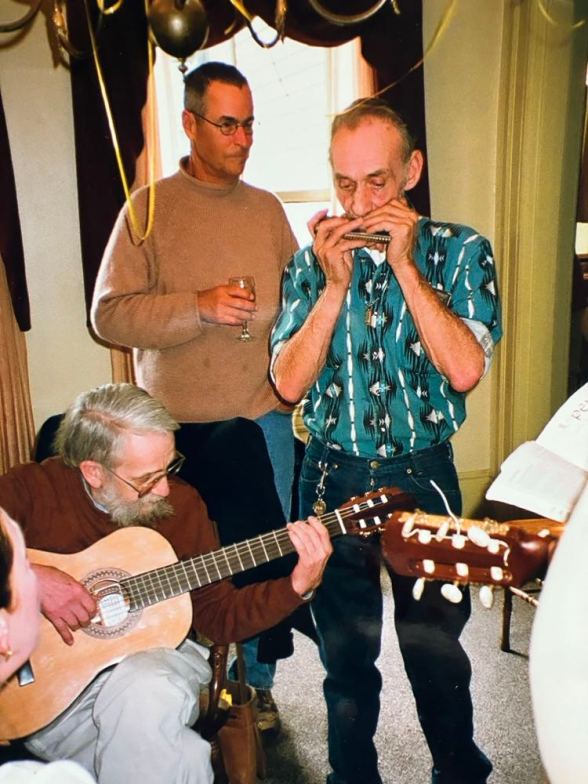
The photograph is from my father’s 70th birthday, in 2008. He is the one with the guitar. Andy Makie is on harmonica and CF is in the back. I don’t know what song this was, not Clementine. My friend Maline took this photograph. She died in 2023. My father died in 2013 at age 75. He was not confused when he wore his oxygen. Without it, he sounded drunk.

For the Ragtag Daily Prompt: dementia.

Elder Care: Goals

I really enjoy elder care in Family Medicine. Mostly. Even some of the very difficult or very complicated people.

One thing I would try to figure out is what is the person’s goal? This can be quite funny at times.

“Can we talk about what you would want if you got really sick? If you were too sick to talk to us?”

“I don’t want to talk about death.” Ok, this person is in their 90s.

“That is fine, but if we don’t talk about it, your daughter and I have to guess what you want. And we tend to do more when we don’t know.”

That person glares at me. “Oh, all right.”

Sometimes a person says, “I don’t want to die of cancer.”

It turns out that this is an opening. “Ok, what DO you want to die of?”

“I don’t want to die!”

“Well, me either, but I can’t fix that. There are at least three “ideal” deaths that the Veterans Administration talks to people about. Maybe we could go over them. You could put your request in with your higher power.” I have written about the three here: https://drkottaway.com/2023/10/06/an-ideal-death/. The “Hallmark” or hospice death, sudden death and fight it all the way.

But, other than not dying, what is the goal? To stay in one’s home? To move to a retirement organization that has a nursing home and care until death? Home care insurance to stay home? I do have people imply that they will go into the woods or crash their car or something if they get very sick, but not very often. They are usually aware that I have to respond to any suicide threat. How much care do they want? People often say, “I wouldn’t want to be disabled,” but it turns out that life is often worth living even when very challenging. Most people want to be treated for cancer, for heart disease, for congestive heart failure, to go on.

Sometimes death comes from a cumulative load of chronic problems. We had a gentleman in his 80s in the hospital ICU many years ago. He had pneumonia, congestive heart failure and bad kidneys as well as a host of other problems. I sat down with him. “We are treating you, but when we give you enough medicine to help you breathe, your kidneys are getting worse. This is a small rural hospital. I could transfer you to the Seattle hospital, 2 hours away. You would have a cardiologist, a kidney doctor, a lung doctor. Here you just have me and the nurses. Either way, I do not know if you will live through this. What do you want to do?”

He chose to stay. “My family can visit me here.” His family was visiting daily. “I do not want a breathing tube. I do not want dialysis. If my kidneys go, let me go.” We discussed this with the family.

Four days later it was clear that without dialysis, he was dying. Dialysis might have slowed it, but he may still have died. He was no longer waking up. We withdrew the antibiotics and removed most of the monitoring and switched him to hospice. His family continued to visit and he died a few days later.

He did die in the hospital, and yes, we used some machines up until care was withdrawn, but this still seems like he got to make choices and his family understood. It can be much harder with memory loss when the person really can’t make choices any more.

He was complicated. To keep him breathing well without a machine, we had to give him diuretics, that were eventually too much for his kidneys. A bad heart, lungs with emphysema and pneumonia, and bad kidneys. Sometimes the liver is not working either, and then what is there left to work with? Nearly all drugs are broken down by either the liver or kidneys. Simethicone is not absorbed, so that’s the exception.

Sometimes people get along until too many things accumulate and then they end up in the hospital and on multiple new medicines. It can be very confusing. Regular maintenance is a good idea.

Sometimes the family wants something different from the patient. Or there is an elder parent and three adult children, who all disagree. My job is advocate for the patient. But this is Family Medicine, so I have a responsibility to the patient but also to the family. The person, the family, the community, how is it all fitting together? Sometimes functional, sometimes not.

I had one person who called me when he had been flown to a Seattle hospital. “I have to get home.” he says, “Can you release me? I have to take care of my wife!” I panicked for a moment. “Is your wife bedridden? Where is she? Why are you in the hospital?” She was not bedridden and she was fine. He was being more and more behaviorally squirrelly. He could no longer drive, but drove anyhow. His wife disabled the car, because he would disappear. I sent him to a neurologist for memory testing. The neurologist said, “Hmmm.” and sent him for neuropsych testing. The neuropsych report said dryly that his memory was fine, but he had certain long standing behaviors related to past heavy alcohol use. Oh. He was quite proud of not drinking and going to AA, but he also triangulated with his family and me. I sat him down and said, “Ok, I am not going to talk to a different one of your five children every time you see me in the clinic, because you’ve said, “Don’t tell mom I called you.” Pick ONE person for me to talk to and now you have to have a family member with you when you come to clinic.” He grinned and chose his wife. He had certainly fooled me about his memory, because he blamed his behavior on his memory. The neurologist was not quite fooled. The family calmed down and he did not drive any more, thank goodness. He was not an easy patient, but he was entertaining and educational too. And I felt that I had helped both him and the family.

Sometimes families fight. Sometimes a dysfunctional family will get way worse when someone is sick or dies. Sometimes families go on fighting. Other families are so kind and so good to each other and their elders. Every family is different.

For the Ragtag Daily Prompt: concentration.

Delicate

I think of what is delicate in all our wide wild world
Our world itself? Yes, but more. Peace among people? No, peace
is strong as war, peace lifts my heart and roars, hoping others hear.
Most delicate is the human heart, all humans. Covid has damaged
the human hearts, we fear, we grieve, we stress and lash out
and so we go to war and wars and argue with each other.
Human hearts turn outward, we cannot see the virus and feel helpless
as the subtle battle is fought and doctors and nurses and scientists
research and die. Human hearts want an enemy they can see, they can fight
and what is better than another human? Every human is different
so there are many choices, to fight over the differences. Let us stop.
Gather our wounded, clear the rubble, find the dead and bury them.
Let us stop and cry and weep and tear our hair.
Let us mourn as a world our dead and the damage to the human heart.

___________________________________

For the Ragtag Daily Prompt: delicate.