peace me

peace me, loves
peace me, strangers
peace me, Beloved
free us from dangers

peace as a river
peace as a wave
peace as a verb
peace saves

peace my heart
peace all of ours
peace all the friends
peace the wars

peace a gift
peace a joy
peace fearless always
no war toys

peace apparent
peace dove
peace triumphant
peace love

peace me, loves
peace me, strangers
peace me, Beloved
free us from danger

I kept the paper cup in the picture, because the cup is animals and plants, but the cup also is a pair of lungs. Breathe peace. And breathe for all the people recovering from covid-19, short haul and long haul. And breathe love and shelter and support to all those grieving for our dead and let us grieve too.

For the Ragtag Daily Prompt: apparent. And for peace.

Covid-19: Hope for Long Haul

I want to offer hope to the people with Long Covid-19. Having been through four bad pneumonias, with increasingly long recovery times, and now disabled for doing Family Medicine, I have experience to share. First I want to talk about chronic fatigue and fibromyalgia.

I am a piler, not a filer. Including in my brain. I have been adding to the chronic fatigue and fibromyalgia pile since I was in medical school.

In residency a new patient questions me. “Do you believe in chronic fatigue?” he says, nearly hostile.

“Yes,” I reply, “but I don’t know what it is or what causes it or how to fix it.”

For years different causes were suggested. Often infections: EBV, mononucleosis, lyme disease. Some people didn’t have any infection. I did note even in residency that my chronic fatigue patients all had one thing in common: they were exhausting.

Does that sound terrible? They were all type A, high achievers, often super high energy. Often they got sick or crashed when they were working three jobs, or working 20 hours a day on their own business, or doing something that sounded insanely exhausting and unsustainable. And most of them wanted that back. “Ok, wait. You were working 20 hours a day, seven days a week, got sick and THAT is what you want to get back to?”

None of the chronic fatigue people seemed to be type B.

Eventually I read that one in ten people with ANY severe infection can get chronic fatigue.

Then I work with the U of Washington Telepain Clinic, on zoom. They start studying functional MRIs of the brains of people with fibromyalgia.

They use a thumbscrew. They put a measurable amount of pressure on a person with no fibromyalgia. The person reports 3-4 out of 10 pain. The brain lights up a certain amount in the pain centers on the MRI. The doctors can SEE it. Then they test the fibromyalgia people with the same amount of thumbscrew pressure. The fibromyalgia people report 8-9/10 pressure and they are not lying. The pain centers in the brain light up correspondingly more. So they ARE feeling 8-9/10 pain.

Is this a muscle problem? A brain problem? Or both?

It appears to be both. Chronic fatigue and fibromyalgia and other disorders with pain out of proportion to the physical findings were being called “central pain processing disorders”.

I thought of chronic fatigue as a sort of switch. As if at a certain level of stress or exhaustion or infection the body would throw a switch. And force the person to rest.

I wondered if the type B people just rested and got over it, while the type A people fought it like tigers. Which seemed to make it worse.

And now we have Covid-19. The study getting my attention is saying that 20%, or 1 in five people age 18-64, have Long Haul symptoms. Over 65 it is 25%, one in four. And it can happen in people with no preexisting conditions. Preexisting conditions or not, this sucks. The two biggest complaints are lung related and muscle related.

I have chronic fatigue following my third pneumonia in 2014. I might be just a little type A. I went back to work too soon (6 months after the pneumonia) and after a half day would crash asleep at 3 pm. For another 6 months. Now that I have had the fourth pneumonia and have been off for a year and been on oxygen, I feel better than I have since before 2014, even though I still need oxygen part time. Guess I was in denial about the chronic fatigue. NOT ME!

So, dear reader, learn from me and don’t be like me. The biggest thing that I have had to get through my thick type A skull is that when my body wants rest, I need to rest. This can be hella annoying, as my son would say. I have to pay attention to my energy level and decide what to do. And some of my precious energy has to go to things like laundry and paying bills! How very frustrating. My markers are energy level and also pulse. My pulse tells me when I need oxygen and when I am really sick. With the first pneumonia back in 2003, influenza, my resting pulse stayed at 100. My normal then was about 65. When I stood up, my pulse went to 135. It was EXHAUSTING to stand up. I had to rest half way up one flight of stairs. It was hard to walk two blocks to pick my daughter up from primary school. And I looked fine. Neither my doctor nor I could figure it out. I finally guessed that it was lung tissue swelling and hoped it would go down eventually. It did, but it was a full two months and my doctor partners thought I was malingering. I tried not to wish it on them. It sucked and I felt awful back at work, but my pulse had finally come down. We even did a heart ultrasound, but all it showed was a fast heart rate. My chest film looked “normal”, because the tissue swelling is throughout the lungs, so it cannot be seen on a chest xray. It was very weird, but I recovered. And all the descriptions of Long Covid sound like my lung swelling. Fast heart rate, difficulty breathing, muscle pain and terrible fatigue. Go back to the couch.

Go back to the couch and wait. Do what you have to but if your heart rate is over 100 when you get up, you have to rest. Otherwise you will prolong it. Seriously.

More later. Peace me and sending love and peace.

Anna’s hummingbirds can survive below freezing temperatures by slowing their metabolism at night, until it warms up in the morning. Talk about resting!

Lung swelling and long covid

I wrote this in 2017, about influenza. However, I think covid-19 can do the same thing. Part of long covid is letting the lungs really heal, which means infuriating amounts of rest and learning to watch your own pulse. Watching the pulse is easier then messing around with a pulse oximeter. The very basics of pulse is that normal beats per minute is 60 to 100. If your pulse is 70 in bed and 120 after you do the dishes, you need to go back to bed or the couch and REST.

From 2017: Influenza is different from a cold virus and different from bacterial pneumonia, because it can cause lung tissue swelling.

Think of the lungs as having a certain amount of air space. Now, think of the walls between the air spaces getting swollen and inflamed: the air space can be cut in half. What is the result?

When the air space is cut down, in half or more, the heart has to work harder. The person may be ok when they are sitting at rest, but when they get up to walk, they cannot take a deeper breath. Their heart rate will rise to make up the difference, to try to get enough oxygen from the decreased lung space to give to the active muscles.

For example, I saw a person last week who had been sick for 5 days. No fever. Her heart rate at rest was 111. Normal is 60 to 100. Her oxygen level was fine at rest. Her oxygen level would start dropping as soon as she stood up. She had also dropped 9 pounds since I had seen her last and she couldn’t afford that. I sent her to the emergency room and she was admitted, with influenza A.

I have seen more people since and taken two off work. Why? Their heart rate, the number of beats in one minute, was under 100 and their oxygen level was fine. But when I had them walk up and down a short hall three times, their heart rates jumped: to 110, 120. Tachycardia. I put them off from work, to return in a week. If they rest, the lung swelling will have a chance to go down. If they return to work and activity, it’s like running a marathon all day, heart rate of 120. The lungs won’t heal and they are liable to get a bacterial infection or another viral infection and be hospitalized or die.

I had influenza in the early 2000s. My resting heart rate went from the 60s to 100. When I returned to clinic after a week, I felt like I was dying. I put the pulse ox on my finger. My heart rate standing was 130! I had seen my physician in the hospital that morning and he’d gotten a prescription pad and wrote: GO TO BED! He said I was too sick to work and he was right. I went home. It took two months for the swelling to go down and I worried for a while that it never would. I dropped 10 pounds the first week I was sick and it stayed down for six months.

Since the problem in influenza is tissue swelling, albuterol doesn’t work. Albuterol relaxes bronchospasm, lung muscle tightness. Cough medicine doesn’t work very well either: there is not fluid to cough up. The lungs are like road rash, bruised, swollen, air spaces smaller. Steroids and prednisone don’t work. Antiviral flu medicine helps if you get it within the first 72 hours!

You can check your pulse at home. Count the number of beats in one minute. That is your heart rate. Then get up and walk until you are a little short of breath (or a lot) or your heart is going fast. Then count the rate again. If your heart rate is jumping 20-30 beats faster per minute or if it’s over 100, you need to rest until it is better. Hopefully it will only be a week, and not two months like me!


Feel free to take this to your doctor. I was not taught this: I learned it on the job.

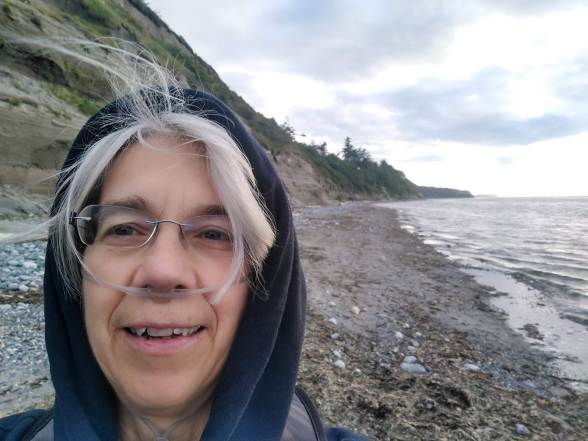
I took the photograph, a stealthie, in June 2021, when I was still on oxygen continuously.

from blue to breathe

I attended a medical conference on line yesterday and today and it made me very blue. At first it just frustrated me, because it is about increasing behavioral health access. Isn’t that a good thing? Yes, but they completely missed the biggest barrier for primary care: TIME.

With the current US medical corporate money extracting insurance non-caring system, primary care is increasingly forced into 20 or 15 or 10 minute visits. I fought my hospital district when they said “See patients for one thing only.” I replied “That is unethical and dangerous: if it is a diabetic with an infected toe, I HAVE to check their kidney function, because antibiotic dose must be adjusted if their kidney function is reduced.” And there are at least two and maybe three problems there: infection, and if the diabetes is out of control that worsens the infection, and then kidney function. And actually I have to be sure anyone going on antibiotics has good kidney function or adjust my dose. I am very very good at this, but it takes time. I can work with complex patients, with veterans, with opiate overuse, with depression: but none of this is a simple template slam dunk. A study more than a decade ago says that the “average” primary care patient had 5 chronic illnesses. My patients don’t want to come in for each one separately and anyhow, if they have kidney problems I have to pay attention when I pick medicines for their high blood pressure. None of it can be separated out. That is why medicine is complicated.

Someone asked why can’t I just post the price of a “simple” visit for a sore throat. But a sore throat can be viral, can be strep A, can be a paralyzed vocal cord, can be a throat abscess, can be vocal cord cancer. I can’t tell ahead of time. I can’t. Early on during covid, a patient called and wanted a Zoom visit for abdominal pain that he said was constipation. I said “No, I can’t do abdominal pain over Zoom safely.” I can’t ASSUME it is constipation. It was appendicitis and he had his appendix out that evening. He called from his hospital bed the next day to thank me for making him come in.

The conference made me blue because they ignored my questions about why they were not advocating for primary care to have more time with patients. They claim to be all about change, but changing the US medical system? Nope. Do not want to talk about that. But I do want to talk about it. You can help by letting Congress know: single payer or medicare for all. That insurance company gets 20 cents of every dollar to profit and wastes tons of money forcing doctors’ offices to call for prior authorization. And if we have single payer, think of all the small businesses that will start because the terror about health insurance will disappear! I think it would reduce everyone’s stress, except the insurance CEOs. And they have earned more than enough, goodbye greed.

I am also tired of specialists telling me that primary care needs to do MORE. When I get told that I am not doing enough about hypertension, bladder leakage, depression and stopping smoking, and then 20 other specialists lecture me. Ok, so one minute per topic to fulfill what all of them think I should do? I want a primary care conference where primary care doctors are celebrated: cases are presented where the specialist says what a brilliant job the primary care doctor did.

I received a consult letter from a cancer doctor a few years ago. He wrote that I had diagnosed the earliest case of chronic leukemia that he had ever seen and that he was impressed and the patient would do fine. That’s the conference that I want to go to: where primary care and specialists talk about that and we inspire more doctors to do primary care.

You can learn more and how to talk to your congressperson here: HealthCare Now: https://www.healthcare-now.org/

or at Physicians for a National Healthcare Program: https://pnhp.org

And put your vote and your money towards healthcare, not health insurance.

speaking up

A friend says he does whatever he wants. He refuses to answer questions about how he makes his money. He doesn’t care if this annoys people. I suspect he may enjoy it.

I have one of those public jobs. Well, had. I have now been disabled from Family Medicine for a year. My lungs are much better than a year ago but they are not normal. And I have now seen 17 specialists and 3 primary care doctors since 2012. The consensus is “We don’t know.” Though many specialists are not willing to say that. What they say instead is, MY testing is NORMAL, go to someone else. My lungs are not normal, but I am on my fourth pulmonologist. I saw a cardiologist this year and the first thing he says is, “It’s your lungs, not your heart.” Well, yeah, I know that.

I miss my patients, but there is something freeing about not working. Ok, more money would be nice, but I am doing ok. Meanwhile, I am thinking about what to do now. I can write full time. Write, make music, travel (on a budget) and sing. And speak up.

Doctors have interesting portrayals on television. We went from Dr. Kildare to Dr. House, working our way through the shows with an emergency room and medical residents. ER drove me nuts. No one EVER dictated a chart so at the end of each show I hyperventilated at the hours of paperwork/computer/dictating they had left. House interests me because it’s always the thing that the patient is hiding or lying about that is the key. “Go search his apartment.” says House. I have figured out cases by getting permission to call family or a group home. More than once.

But a physician is a public figure. I had been here for less than a year when a woman comes up to me in the grocery store and says “What are my lab results?” I look at her blankly. I can’t remember if I really did the snappy comeback that comes to mind: “Take off your clothes and I will see if I remember.” I respond politely and she says, “Oh. I should call the office, right?” “Yes, I try to leave the work there,” I say. If a particularly difficult person was bearing down on me, I would whisper “cry” to my kids. That worked. They would act out on cue and I would be the harassed mother. The person would back off.

I am in a small town. We have three grocery stores. I see patients everywhere, now that it has been 22 years. If I remember every detail, that means they are or were really sick. And we have the layers of relationships: someone might have kids the same age or work with boats or be in chorus with me. Once I take my daughter to a party. The mom introduces me to two other mothers. “She’s my doctor,” says the introducing mom. “Well, me too.” says the second. “And me,” says the third. We all laugh.

Once I am visiting my brother outlaw’s bicycle shop. He has a customer. The customer starts talking to me too. Brother outlaw says, “Do you two know each other?” The customer eyes me. I have my neutral doc face on. “She’s seen me NAKED!” says the customer and I howl with laughter. What a great reply. And my brother outlaw gets it.

Docs have to pay attention to HIPAA. When three women say that I am their doctor, I reply, “Yeah and I left my brain at work, so I can’t remember a thing.” Those three were healthy, so I really do not remember labs or the results of a pap smear. Once I was in cut off shorts and waved at an older woman who was at the ophthalmologist’s. She sniffs and looks away. I get the giggles: I think she did not recognize me. My town is only 10,000 people, so after 22 years I have taken care of many of them. Though sometimes people thank me for taking care of their mother, and after it sounds unfamiliar I ask if they mean Dr. Parkman? Oh. Yes. People get me mixed up with two other small Caucasian woman doctors.

I started the “outfits inappropriate for work” category last year when I was still very sick and short of breath and on oxygen. I did not go out much, partly to avoid covid. My pneumonia was something other than covid and it was my fourth pneumonia and I should not need oxygen. Now I’ve had mild covid and the oxygen is only part time. I sang at my son’s wedding, off oxygen, so I can sing off oxygen for a short time. I danced off oxygen too and did get QUITE short of breath. Since I am no longer a public figure, I can speak out and speak up more. I am thinking about that, particularly with the recent Supreme Court news. I do not agree with what they seem to be planning.

stranded mermaid, cilia and tubulin

I took this photograph last summer at North Beach. I thought she looks like a stranded mermaid, thrown up on shore. I couldn’t move her, she was twice my length. The rock attachment had come too, up from our sea beds.

Happy solstice. Today marks the one year day from when I realized that I was having my fourth round of pneumonia, with hypoxia, agitation, fast twitch muscle dysfuntion and felt sick as could be. I am way better but not well. That is, I still need oxygen to play flute, to sing, to do heavy exercise and to carry anything heavy. Which is WAY better then having to wear oxygen all the time. Today I find a connection between the lungs and the brain, in quanta magazine. This video talks about a new found connection between cilia and the brain. We were taught that cilia and flagella are for locomotion, powered by tubulin. However, this shows that cilia behave like neurons and there is a connection. Since my peculiar illness seems to involve cilia dysfunction in my muscles and lungs, so that I get pneumonia, and the brain, because I am wired when it hits, this is a fascinating connection. If neurons developed from cilia, the dual illness makes a lot more sense. Hooray for quantum mechanics! We use it in medicine every single day.

Happy solstice! Here comes the sun!

Covid-19: Approach to Long Haul

Covid-19: Approach to Long Haul

This is written primarily for physicians, but is for anyone to read. This is a working theory.

I am very interested in Long Haul because I was diagnosed with PANS by an older psychiatrist who worked exclusively with physicians in 2012. That was during my third flare. The evidence is mounting that Long Haul is an autoimmune disorder like PANS. I am sharing my approach to Long Haul based on both my clinic and personal experience.

Step 1. Validate the patient. Patients are terrified, understandably, to have something “like” chronic fatigue, fibromyalgia, or are worrying that they are “crazy”. Evidence is appearing that Long Haul, chronic fatigue and fibromyalgia are all complex autoimmune disorders with multiple antibodies. We do not yet have vast antibody tests. So the first step is to say that we believe patients and also that we can help. This is a very new and evolving field. I tell patients that it will change fast over the next few years. What I tell them today may change within a year as we get new information. If this makes them anxious, remind them of the Women’s Health Initiative and how that changed hormone therapy, and that cancer treatments keep improving.

Step 2. Lower stress and antibody levels. When we are high stress, cortisol and adrenaline go up and impair the immune system. The immune system is fired up and looking for something to do. Bacteria like strep A have evolved with us and have surface proteins that “look like us”. Our bodies make antibodies to the Strep A or Covid-19 and sometimes those antibodies attack us too, because our own proteins look the same. One way of lowering the antibody level is sweating. Hot bath or shower, sauna, hot tub, exercise. Support these and explain. A second way to lower the antibody level is to quiet the sympathetic nervous system and activate the parasympathetic nervous system. The parasympathetic is the quiet, relaxed and laughing one. Where does the patient feel safe, relaxed, quiet? After my father died, leaving a complicated and messy estate with an out of date will, I did a Sudoku daily for a year. I realized that the Sudoku relaxed me because I could not solve the estate quickly, but I could nearly always solve the Sudoku. Stupid cat videos, rocking chairs, knitting, gentle walk in the neighborhood if it feels safe, a walk in a mall (without one’s purse if overspending is an issue) — how does this particular person relax? Teach the slow breathing: in for a slow count of five and out for a slow count of five. Or square breathing: in for five, hold five, out five, in five. Twenty minutes of slow breathing supposedly moves almost everyone from sympathetic to parasympathetic. It may take practice and feel unfamiliar: I have had a veteran say that it felt very very weird to relax and he was not used to it. He kept at it.

Step 3. Symptom picture. At present I am basing this on my own experience with PANS. This is my working theory. Antibodies can block receptors or “turn the key” and activate receptors. Buprenorphine does BOTH (though it is not an antibody): at lower levels it turns the key and at higher levels it blocks. I would ask specifically about five fields. You many well be able to come up with more.

a. Brain function. In my PANS, I have antibodies to dopamine that turn dopamine on very high. Other physicians assume that I am manic. I am not quite manic, but it certainly feels awful. I feel like I have been shot out of a cannon when I wake up, with the morning cortisol rise. For me, the caffeine in coffee calms me, and my assumption is that it displaces the anti-dopamine antibodies. Tea does not work. I quit coffee for seven years until the latest flare. Albuterol doesn’t work. Terbutaline does work. I don’t know about theophylline or adderall, I have not tried them. If someone has “brain fog”, I assume that they have blocker antibodies OR be sure to ask if they were different in the first 4-6 months of the illness. For me, the antibodies rise for about 2-3 months and then take 2-3 months to drop. I have a lot of fatigue when they finally leave and this time I could tell the day that the last antibodies “fell off” or dropped to my “normal” level.
For blocked people, does caffeine help? How about albuterol? Adderall, theophylline, SSRIs. Every person will have different antibodies. Treatment needs to be tailored.

b. Muscle function. My anti-tubulin antibody (I have PANS, remember?) shuts down my “fast twitch” but not my “slow twitch” muscles. Tubulin is what makes the lung cilia function, so presumably mine are paralyzed during a flare and that is why I get pneumonia. I am tachycardic, resting heart rate 100 and walking slowly or talking heart rate 135, so I get very short of breath. Both the lung dysfunction and antibodies that upregulate my dopamine receptors make me tachycardic. I think that the people who can barely get out of bed with chronic fatigue have both fast and slow twitch muscles blocked. They need validation and lower stress. With support, perhaps the antibody level can be lowered enough that they can function again. I also found that my muscles hurt when my blood sugar was up and that if I keep it low, I have minimal muscle pain. I do not know if this is true for other people.

c. Gut function. In PANS, there appears to be an antibody to lysoganglioside. I don’t understand it but when I am sick, I cut carbohydrates way back or I am horribly ill. I tolerate lactose but not fructose, sucrose or gluten. One year after getting my last flare, I can eat everything except gluten. With this round I figured out that rising blood sugar when I am sick makes me acidic. This in turn worsens lung function more, as my body automatically slows my breathing to balance the acidity. I found that taking bicarb before a meal helped tremendously. In the worst/highest antibody part of the flare, I eat fats, because anything else makes me ill. SO: what can the patient eat or not eat and support them. Food intolerances are on the rise. Ask if there are foods that they cannot eat and support them not eating them. They can go to a very restricted diet that works for them and wait three weeks. After three weeks, food antibody levels are supposed to drop. They can start adding foods back in, one every three days. I do not know if this will work in a bad flare, the antibodies may be too high.

d. Lungs: do a resting heart rate and oxygen saturation. Do a walking heart rate and sat. Then do a LOADED heart rate and sat, with the person carrying the equivalent of two bags of groceries or their toddler. If they are young, they may hold their sats, but if their heart rate jumps to 135, that is like running a continuous marathon. Try oxygen and see if the heart rate comes down. Sleep apnea testing is also highly recommended. If they are tachycardic with daily activities, of course they have fatigue! Rest. Patients can learn to check a pulse or have a pulse ox, but fingers and second hand are cheap.

d. Other. I am reading that the main complaints in Long Haul are fatigue, brain issues, tachycardia and shortness of breath. What else really bothers the person? Sound sensitivity, loss of the sense of smell. The first step in helping with this is to listen and validate.

Covid-19: long haul II

A few days ago my primary care doctor texts that she wonders if I have the autoimmune form of fibromyalgia.

Red alert. I have not heard about this.

I did a search last night and find this: https://www.sciencedaily.com/releases/2021/07/210701120703.htm.

Now, if you have been paying attention, you know that I was diagnosed with PANDAS in 2012, though Isuspect that it is really PANS. Both are autoimmune disorders. I also think that long haul covid is the same thing or something similar.

Meanwhile, they are now saying Covid-19 Long Haul may ALSO be an autoimmune disorder. Multiple sites below.

There is a paper in Nature that I don’t have access to, annoyingly enough. The fibromyalgia story in the above story is that they have spun antibodies down from human serum of affected and unaffected people and then injected them into mice. The mice get fibromyalgia symptoms from the affected antibodies but not from the unaffected ones. The symptoms in the mice go away when the antibodies fade out, in a few weeks. Aha.

The long haul story says that death from Covid-19 may be an autoimmune response, the antibodies going really nuts and making people bleed or their lungs close down. That is, swell shut. They have been drawing blood to study at different stages of Covid-19 and also checking autopsy patients. Usually autoimmune diseases are more prevalent in women then men but Covid-19 seems to be worse in men. This: “The mechanisms behind the production of such autoantibodies aren’t yet clear. Widespread and long-term inflammation during severe COVID-19 may cause the immune system to produce antibodies to pieces of the virus it wouldn’t normally recognize. Some of those pieces might resemble human proteins enough to trigger the production of autoantibodies.

Excessive inflammation could also boost production of autoantibodies that had previously only existed in the body at very low levels. Vaccination against COVID-19 is much less inflammatory than infection with the virus. In a separate study that looked at COVID vaccination, none of the healthy volunteers developed autoantibodies.” (2)(*)

Here is another fibromyalgia paper: https://www.verywellhealth.com/autoimmunity-neuroinflammation-in-fibromyalgia-5197944. That paper lists the autoantibodies that they are finding in fibromyalgia including gangliosides. The fourth antibody in PANDAS/PANS is anti-lysoganglioside. Aha! So this is sparking a serious revolution in medicine: it is looking like many of the mysterious and difficult to describe and quantify diseases may be autoantibody disorders. The anti-ganglioside antibodies were found in 71% of fibromyalgia patients. There are seven antibodies listed, including one to serotonin. In PANS, they are blaming two anti-dopamine antibodies. None of the fibromyalgia patients had ALL seven, but all of them had some of them. A different pattern in every patient, because we all make different antibodies. Fascinating.

One more: https://pubmed.ncbi.nlm.nih.gov/28339361/. People with lupus are more likely to have fibromyalgia and visa versa. “Increasing evidence indicates that N-methyl-D-aspartate receptors (NMDARs) play a major role in the induction and maintenance of central sensitisation with chronic pain. In this study, we evaluated the role of anti-NMDAR antibodies in the development of FM in patients with SLE.” Lupus and fibromyalgia share an autoantibody. Holy cats. NMDA is ALSO a neurotransmitter. Makes me wonder quite a bit about “psychiatric” disorders.

Remember that we make up all the words. So the autoimmune diseases are usually found by testing for a few antibodies. In the most common autoimmune disorder, hypothyroidism, we usually check the TSH and T4 level, so patient hormone levels rather than antibody levels. Over the last 30 years, we are able to test for more antibodies. Systemic lupus erythematosis, celiac, rheumatoid arthritis, juvenile rheumatoid arthritis. When I was in medical school in 1989, the rheumatology book was an inch and a half thick and there were loads of different patterns of disease. I am sure it is twice as thick now. Our initial test for autoimmune disease is for inflammation: an antinuclear antibody and an erythrocyte sedimentation rate. Some people have rheumatoid arthritis but their RF is negative: they have “sero-negative” rheumatiod arthritis, which is more likely “a different autoantibody that we have not tracked down” rheumatoid arthritis. In chronic fatigue and fibromyalgia, the antinuclear antibody and erythrocyte sedimentation rate are usually normal. I suspect both disorders of being “post” inflammation.

My prediction is a serious medical revolution, where we start regularly testing for autoantibodies. Whether that will be something like a pregnancy test but with hundreds of autoantibodies tested for, or whether there are some key indicator ones that we can find, is not clear. At any rate, trauma, stress and infection all increase the likelihood of getting one of these disorders and we have to figure out how to lower the load of all three.

Do you think people are instinctively quitting their jobs?

I had a phone visit with my pulmonologist yesterday. She was running about 35 minutes late, I sat on Zoom until she showed up. She looks exhausted. “We have less doctors and more patients.” she says. “I was on call for the critical care unit last week and I am on call Monday and Tuesday.” “Please take care of yourself,” I say, “We really need you.” She is smiling the whole time. She is worried about me dropping weight and I am worried about her.

Prayers and blessings all around.


1. https://www.cedars-sinai.org/newsroom/covid-19-can-trigger-self-attacking-antibodies/
2. https://www.nih.gov/news-events/nih-research-matters/autoimmune-response-found-many-covid-19
1. https://www.cedars-sinai.org/newsroom/covid-19-can-trigger-self-attacking-antibodies/
2. https://www.nih.gov/news-events/nih-research-matters/autoimmune-response-found-many-covid-19
3. https://thehill.com/policy/healthcare/591528-long-covid-study-author-explains-four-factors-that-can-predict-how-you-get
4. https://www.the-scientist.com/news-opinion/studies-identify-risk-factors-for-long-covid-69648
5. https://www.dailymail.co.uk/health/article-10436473/Is-people-sicker-Covid-19.html
*If that paragraph does not make people get the vaccine, they are living completely in a mad dream world, IMHO.
6. https://www.nih.gov/news-events/nih-research-matters/misdirected-antibodies-linked-severe-covid-19

For the Ragtag Daily Prompt: flickering. As in flickering hope.