
Balancing act

I am working at a site in the greater Seattle area, but I am not going to say where. Why? Two reasons. One is that the patient diversity is huge: the organization is organized to take care of low income, uninsured and immigrant patients. The second is that I am still trying to decide if the balance of the organization is working. It may be working but it might not be working for me.

I am at a large clinic, with primary care, dental, behavioral health, a nutritionist, a pharmacy and three in person translators. In any one day I will probably use translators for at least six languages. English, Spanish, Dari, Hindi, Punjabi, Arabic, French, Somali and sometimes languages that I have to look up the country because I don’t know where that language is spoken. The work is fast and furious.

The overall no show rate is 20%. This makes the day very unpredictable. It can be very very fast and busy with everyone showing up and then later there are three no shows in a row. I think that the no show rate has been less than 20% but on Tuesday it was more. However, everyone showed up in the morning and there was a hospital follow up that should have had 40 minutes and only had 20 and of course then we ran later. My lunch theoretically starts at 12 but I went to lunch at 12:50 and came back 6 minutes late, at 1:06. Then people no showed while I worked to finish off everything from the morning. It did feel a bit nuts.

We are using the electronic medical record EPIC. I find EPIC epically frustrating. It is “feature rich” which means it has too many ways to do things. If I ask someone how to record a phone call to a patient, it takes eight steps. A week later I have to do it again, I ask again, and the next person shows me a DIFFERENT set of eight steps. And there have to be at least eight ways to do anything, so it is very confusing. Also, the “home” page can be personalized to the extent that people look at my version (I have not personalized it much) and say, “Mine looks different. I don’t know how to do that on yours.”

Whew. So, how to cope with the fast furious unpredictable schedule? I am “precharting”. For this Tuesday, I spent 70 minutes going through the patient charts on Saturday. Then I may know why they are coming in, if they had a heart attack two weeks ago and are following up, if it is a well child check and the last one was two years ago, if there are outstanding issues like a elevated liver tests or they have not been in for their out of control diabetes for a year. Then, of course, some of them do not show up. It is so busy that all I feel when someone no shows is some relief, like a ray of sunlight in a dark forest. Ok, the person who was horribly sick and in the hospital for a week and had surgery, they really do need to follow up. But I cannot make them, no one can.

We have live translators, outside translators who come with the patient, family sometimes translates and two phone translation systems. Our live translators cover the following. One Spanish only, one Dari, Arabic and ?maybe Russian. A third language. The third does Hindi, Punjabi and something else. I can’t tell by language who is a recent immigrant or refugee or who is a citizen of the United States for thirty years.

The clinic system has high standards for care of an often vulnerable population. However, I have not decided if it falls into a statement by my grandfather: “The higher the ideals of an organization, the worse its’ human relations.” My job in Alamosa had very high ideals, but I was fifth senior doctor out of 15 in a mere two years. A burnout job. This one has three new doctors coming in soon. My training and assistance to learn EPIC has been sparse and not up to my standards. If the new doctors are treated the same way then this is a burnout job as well. This is a place that I could work in intermittently alternating with other places in the country, but only if it is balanced for both the patients and the physicians. The jury is still out, but there are many red flags. It is a six month job and I am two months in, so we shall see.

Hugs to everyone.

_____________________________

For the Ragtag Daily Prompt: nuts.

The photograph is from Larrabee State Park this weekend. My daughter came out and saw many of her friends, stayed with me, and we camped for one night at Larrabee.
Hungry

Each time I’ve gotten pneumonia, I drop ten pounds in a week. The weight stays off, each time for longer. Then I gain it back and go past my “normal” weight. It takes work to get that extra weight off.

I have been trying to lose that extra weight since the start of the year. At first I just tried to increase my vegetable intake. The green, yellow and orange vegetables have the lowest calories and carbohydrates. The grains and rice and potatoes and bread are all more dense and have more calories and carbohydrates. I tried to go easier on them.

I did not make much progress. The climbing gym has been building muscle and clothes fitting better, but the scale did not move much.

I started having conversations with my stomach. I would eat. My stomach would demand more. “HUNGRY! WANT MORE!” This is not real hunger, as the people in occupied territories are having. This is my stomach or hindbrain fussing. It was easiest to control at lunch. I would fill half my container with spinach or mixed greens and then add more vegetables or tuna salad or egg salad or humus and vegetables. I would take a piece of fruit. Once that was done, we were done. “HUNGRY!” my stomach would complain. “That’s ok,” I would tell myself, “It’s ok to be a little bit hungry. We’ve had enough food. Stop fussing.”

My stomach fussed a lot at first. Now it is more of a query: “Hungry?” “No,” I reply, “we’ve had enough.” It seems to quiet down much more quickly. I think I am losing weight but I have no scale here and haven’t remembered to weigh myself in the last 3 weeks at work. Never mind. I have more muscle, at any rate, which is denser than flab. Muscle burns 9 kcal/gram and fat burns 4 kcal/gram. I climbed yesterday at the gym and might again this afternoon. It did take weeks or a couple months for my stomach to quiet down. Changing habits is not easy.

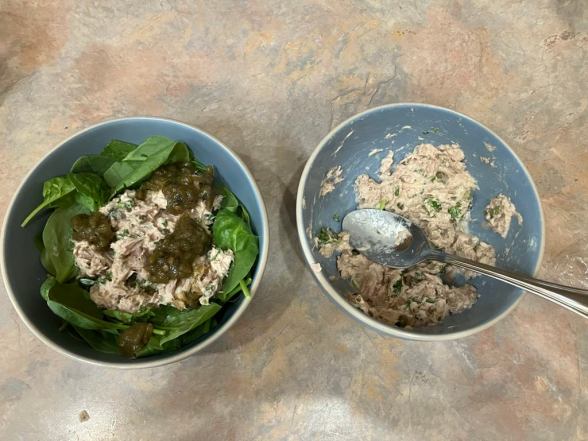
The tuna salad and spinach and green chili dish was my breakfast this am. I don’t think my stomach complained at all after it. It was distracted by packing and clearing out the refrigerator and cleaning. Sol Duc knows I am packing but is pretty sure she is going with me. I have been putting her toys in the carrier and she’s gone in and out to suss out the situation.

I hope all the people who are suffering from hunger get fed, today and tomorrow and the next day.

For the Ragtag Daily Prompt: hungry.

Hormones and rabbit holes

Medicine is confusing right now. Ok, it is always confusing because we try to base it on science and science is always changing. There are always special areas that are currently a mess. Hormones!

I speak to a patient recently who is female, premenopausal, and is getting hormone replacement therapy for hot flushes and not sleeping well from an outside source. The person wants me to order hormone tests. I do order hormone tests but not the ones she has in mind. I test a TSH, thyroid stimulating hormone, to see if she is low or high in thyroid.

She is thinking of me testing estrogen and progesterone and other related hormone levels. The party line from gynecology MDs and DOs is that these are not useful tests because women’s hormone levels are so varible. However, there are lots of naturopaths out there and functional medicine MDs and DOs who will test levels. Why is the patient asking ME to test them? Most of those naturopaths and functional medicine providers do not take insurance and charge cash. Also, insurance may not pay for them anyhow because the party line is that they aren’t useful. Why would the cash providers check levels? One reason is CASH. Another is to prescribe “bioequivalent hormone replacement”. Sounds natural, right? Well, the natural thing was for the hormones to stop at menopause and all of the hormones are either made in a laboratory from plant pre-estrogens or from pregnant mare urine, so bioequivalent seems to imply natural but it really isn’t. Pills do not grow on trees, they are made by humans in laboratories.

However, I question party lines, and off I go down the hormone rabbit hole. The current guidelines are that female hormone replacement, after menopause, should be lowest dose possible and only for a maximum of three years because of the increased risk of breast cancer. This doesn’t address my question: does premenopausal hormone replacement count as part of those three years? I may need to ask gynecology. I don’t think it counts. A woman is postmenopausal when she has had no periods for a year. Or had her ovaries removed. Or if she’s had a hysterectomy and still has her ovaries, a yearly follicle stimulating hormone and lutienizing hormone test. Both tests rise when the ovaries stop making hormones and eggs.

Also, there is another caveat. We know that when men are on opioids, the opioids can suppress their hormones and lower testosterone. Here is a paper: https://pubmed.ncbi.nlm.nih.gov/31511863/. Half the men studied in multiple studies had low testosterone when on chronic opioid therapy. 18429 subjects (patients) in 52 studies. That is a lot. Women studied? NONE. What? Yeah, none. Why? Here is part of the answer: about a decade ago I worked with the UW Telepain group and asked the head of the UW Pain clinic a question. “If opioids lower hormones in men, do they in women too?”

His reply, “I don’t know.”

“Have you ever tested a woman?”

“No.”

“Isn’t that sort of sexist?”

“Yes.”

So here I am, rechecking a decade later, and we still don’t know if giving women chronic opioids messes up their hormone levels. It would be more complicated and difficult to check women. We might have to do individual hormone baselines or something in premenopausal ones, say, 2 weeks after menses. Remember that for most of the history of medicine, clinical drug trials were only done in men, because, well, sexism. They said women could get pregnant. Yes, but then we gave the drugs to women who could get pregnant. Also, postmenopausal women can’t get pregnant. The whole thing seems stupid to me.

There is an interesting new finding here: https://neurosciencenews.com/estrogen-t-cells-pain-28548/ . Apparently in women, estrogen and progesterone work on receptors at the base of the spine to reduce pain signals using T cells, part of the immune system. The article says this doesn’t happen in men, but they were studying mice. The male mice didn’t seem to have worse pain after estrogen and progesterone were blocked. The female mice were in more pain. But wait, estrogen and progesterone are produced in men as a by product of making testosterone. Less than women, until menopause. Then the 70 year old man has more estrogen and progesterone than his postmenopausal wife. The article says that they don’t know why the receptors are in women and female mice (um, my intuitive guess would be childbirth and micebirth, right? Men don’t do that and women giving birth to a child after the first one sometimes say, “WHY did I want to do THIS again?” I think those receptors are so that women and mice can get through more than one pregnancy.) Now I need to read the article again because maybe men and male mice don’t have the receptors, even though they do have some estrogen and progesterone. Maybe they just don’t have enough estrogen and progesterone.

Maybe we can’t figure out women’s hormone because men aren’t smart enough, heh, heh. Yes, that is sexist right back at all those historical figures who didn’t study women.

At any rate, that still doesn’t answer my two questions: does premenopausal hormone replacement count towards the three year total beyond which hormone replacement increases the risk of breast cancer? And does chronic opioid treatment lower women’s hormone levels?

_________________

For the Ragtag Daily Prompt: hormone.

I took the photograph of a Port Townsend rabbit in 2011.

Alcohol myths

I am back working in Colorado and a recurring theme this month is alcohol and alcohol myths.

Myth: If I only drink on my days off, I am not an alcoholic. Nope. People can binge one day a week and still be an alcoholic. A standard “dose” of alcohol is 12 ounces of 5% beer, 5 ounces of standard wine or 1.5 ounces of liquor. But what if someone drinks 8% beer, 12 ounces? Well, that’s 1.6 standard drinks. An 8% 16 ounce beer? That is 1.6 times 1.3, so 2.08 drinks. Perhaps we should have an app that calculates this. And locks the car ignition when we are over the limit.

How much alcohol means that we are an alcoholic? The guidelines right now in the US say 7 drinks per week maximum for women, 14 for men, no more than one in 24 hours for women, no more than 2 in 24 hours for men and no saving it up for the weekend. Here: https://www.niaaa.nih.gov/health-professionals-communities/core-resource-on-alcohol/basics-defining-how-much-alcohol-too-much#pub-toc3. However, alcohol is bad for the liver, bad for the heart, bad for the brain, and increases cancer risk. There is not a “safe” amount.

What is binging or heavy drinking? For womenβ€”4 or more drinks on any day or 8 or more per week, For menβ€”5 or more drinks on any day or 15 or more per week. The rate at which people drink is also part of this.

MYTH: If I don’t throw up, I’m not an alcoholic. Now that’s an interesting one. When we drink, alcohol is absorbed into the blood and goes through the liver. The liver has enzymes which break alcohol down into aldehyde. Aldehyde is a carcinogen, causes cancer. Aldehyde is broken down by other enzymes into acetate and then to carbon dioxide and water. Some people break down the aldehyde quickly, fast metabolizers. They can drink a lot and not throw up because they break the aldehyde down fast. However, the process inflames and kills liver cells. If they keep drinking, the liver slowly dies, and this is cirrhosis. Eventually they will not be able to break down alcohol fast because the liver makes the enzymes. Then they will start throwing up.

Other people make enzymes that are slower or make less, and they get sick and have alcohol poisoning more quickly. The fast metabolizers are at higher risk for cirrhosis and the slow ones for liver cancer, but they can get either.

MYTH: “My blood pressure is fine.” I spoke to a person who stated that their blood pressure was ok during pregnancy so they did not have high blood pressure. The chart shows very high blood pressure for the last three years and I didn’t look back further. I ask, “Did you stop drinking alcohol while pregnant?” “Of course.” When NOT pregnant, this person admits to 4-5 drinks a day. Also, the history in the chart states that they had blood pressure complications in pregnancy. I did not have time to go through the chart and look at that, but this person is in denial. I think of denial as the addiction taking over and the addiction lies. It lies to me but it also lies to the person. They want to believe what they say. They want everyone else to believe what they say even if it is patently a lie and ridiculous. A woman who says a friend gave her something, she didn’t know what it was, for a headache. “How did you take it?” I asked, looking at the urine dip results. “I snorted it.” “So what things do you snort for a headache?” She was positive for cocaine and pleading ignorance was ludicrous. Another person has a positive urine drug screen for multiple things. “Can I try again?” Pause. “Sure.” I say. The first one is a false sample and I am very curious to see what the real sample will have. It has nothing. He is then surprised that I won’t fill his prescription and offer inpatient drug rehabilitation. Come now, sir, you got a urine sample from a dealer when you sold the medicine I gave you for something else. Your dealer must have been annoyed or gave you the wrong sample. When someone is really out of control, they do not have convincing lies and the only person they can convince is themselves. It is interesting to watch someone be all outraged that I do not buy the story, accusing me of discrimination or hating them or hating their race or whatever. They attempt to accuse and distract. It is harder for families because they desperately want to believe their loved one, even when the evidence shouts the opposite.

What does blood pressure have to do with alcohol? Alcohol drives blood pressure up and pulse, especially when it is wearing off. Severe alcohol withdrawal is delerium tremens and people can have such high blood pressure that they have a stroke or a heart attack or encephalopathy — a poisoned brain. They can hallucinate or have seizures and it is very dangerous. “Very dangerous” means they could die or have permanent disability. Tobacco, cocaine, methamphetamines, all raise blood pressure. The number one cause of death in the United States is the heart, but it’s not just from hypertension and weight and cholesterol and inactivity. Addictive drugs have a huge contribution.

There is nothing cheap about the cost of addiction in our country.

For the Ragtag Daily Prompt: cheap.

Listen

There is anger and blame and silence.
People talk about each other.
People talk about others.
What is truth? What is rumor?
No one wants to listen.
They want to blame.

I do not see
I do not feel
I do not hear
how to heal this, Beloved
if no one will listen.

Only love.
Anger drains away.
I send love
Into the anger
Into the blame
Into the echoing silence.

On guard

My nurse’s breath catches. “Oh, no,” she says.

I am new here. Less than a year. “What?” I say.

“We have Janna Birchfield on the schedule.”

“Who is Janna Birchfield?”

Tonna leans back in her chair at the nurse’s station, a high set desk that runs behind the front office. We have new glass barriers along it to make it more hipaa compliant. It is also more claustrophobic. She throws her pen down. “She’s one of the most hostile people here. She’s known for throwing a brick through her second doctor’s plate glass window.”

“Ah,” I say.

“She was Dr. M’s patient but apparently she and Dr. K got in a screaming fight in the hallway. She is banned from that clinic. So we are the last clinic in town.”

My nurse knows the local stories and she has seen a lot. She doesn’t have a lot of unconscious monsters. Yeah, there is some impatience and some anger there, but she’s pretty good. No real fear, nothing cringing at her feet.

“Hmm. Let me talk to Marnie.” Marnie is our office manager.

Marnie and I talk. I read the last notes from Dr. M and an account of the screaming fight with Dr. K. I call Dr. K. I don’t know of anything that scares her and she is tough. I rather enjoy envisioning her yelling back at this patient.

The day arrives and Mrs. Birchfield is put in a room. Vitals are done. I go in.

Janna Birchfield is big. She weighs about twice what I do, and it’s muscle rather than fat. She looks solid. Not like a body builder, just strong. She tops me by nearly a foot. She looks sullen and unfriendly.

And I am looking at her monsters. Three are guarding a fourth, at her feet. Fear is there, anger is the biggest and posturing, like a body builder, in front. The third is morphing back and fourth: envy and hostility. The fourth is in a stroller, guarded by the other three. Asleep? Unconscious? Well, yes, duh, but it’s not often that a monster is so undeveloped that it is still an infant. Not good.

“Hi, Miz Birchfield. I am Dr. Gen.” I hold out my hand, moving slowly and smoothly. Her monsters alert, fear flinching and anger ready to punch. I stand with my hand out. She eventually touches it, glaring.

“Hi,” sullen.

“We need to talk about the clinic rules first.” I say calmly. Anger puffs up and her shoulders rise as the monster swells and takes control, her elbows rising and hands are fists. Her eyes don’t turn red, but nearly. “I have heard about your argument with Dr. K.”

Furious voice, “She screamed at me. She’s a horrible doctor! She got me thrown out!”

I am smooth and calm, “I am not going to discuss Dr. K,” I say. Honestly, it’s even more fun to think of Dr. K taking this on and not budging an inch. Dr. K is my size, small. “In this clinic, I need you to understand that you are not allowed to yell at anyone at the front desk, in the hallways or on the phone.” Anger flees immediately, small again and she looks confused. “You may not yell at the staff, at the other patients, or at anyone on the clinic property.”

“Why would I agree to that?” she says. She is mostly confused because I am not scared or angry. I am not behaving the way she expects, the way most people behave around her.

“If you are upset, the only people you can yell at are me or the office manager and you need an appointment.”

“They are rude to me!” Basically she means everyone. “You can’t make me do that!”

“Take it or leave it.” I say. “You need to agree and keep the agreement, or we will discharge you immediately. If you say no, leave now, and I won’t charge for the visit.”

Her monsters are confused. Anger has shrunk back down and they are conferring, heads together. Confusion has shown up as well, morphing though different colors and stripes, stars and paisleys. She stares at me, frozen hostility. I just wait, sitting in front of my laptop, serene. This is going well. She isn’t yelling and she hasn’t left.

“What if they are mean?” she says.

“You will make an appointment with me or the office manager, and we will help you.”

“Ok,” she says. The monsters are still surrounding the carriage, but really, now confusion is in charge. We work through the rest of the visit, as I get to know her a little. She has had a hard, hard life.

I let the front office and the nurses know the rules. The office manager and I let them know that this is a contract with the patient and she has agreed. They feel protected. They feel protected enough that they are nice to her. She behaves and starts, infinitesimally, to relax. She is still angry and hostile in the exam room but it’s not directed at me. It is directed at the entire world, the rest of the world outside the clinic. I try to help her medically but also let the monsters have their say. The visits start with anger and hostility but tend to subside into confusion. I am not getting at the fear or whatever is in the stroller. It is one of the large old fashioned ones, heavy, navy blue, where an infant can lie flat. Clearly it does not fold up to go in a car or anywhere else convenient. There are no toys hanging from the top or across it, no stuffed animals. Only a form under the blankets, always still.

I may reach that form, or not. I do not know.

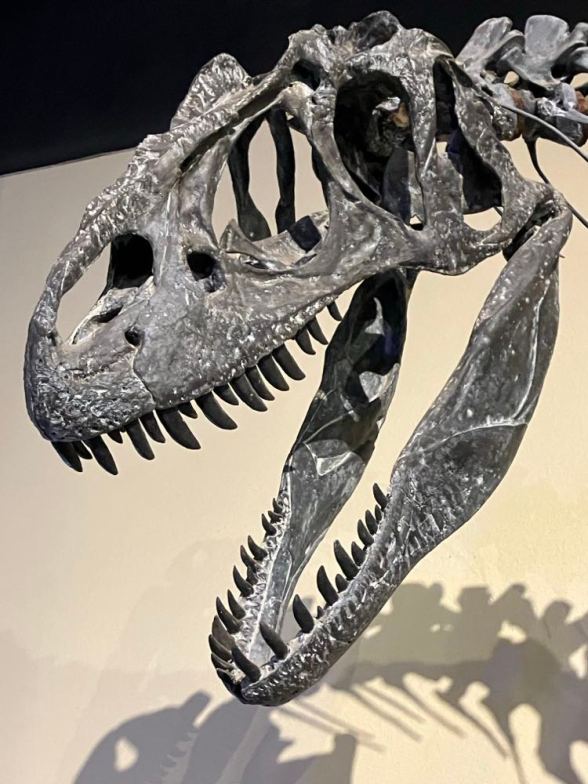
For the Ragtag Daily Prompt: paleontology.

If eggs aren’t available, why can we still buy chicken?

I note this article this week: https://apnews.com/article/usda-firings-doge-bird-flu-trump-fdd6495cbe44c96d471ae8c6cf4dd0a8. That version says that the Trump Administration is trying to rehire bird flu experts that got fired. Most of the news outlets frame it differently: https://www.nbcnews.com/politics/doge/usda-accidentally-fired-officials-bird-flu-rehire-rcna192716. Suddenly it is the USDA at fault not the Trump administration’s chainsaw fool.

Should we worry about bird flu? Oh, yes, I think so. I have been wondering why we still have chicken to eat and chicken in the stores, if millions of chickens are being wiped out to try to prevent H5N1 bird influenza from moving into humans. This article explains in unreassuring detail how factory farms, packing chickens together, and killing them at 6 weeks old for meat, puts pressure on the virus to become more deadly and kill the host. In wild birds the influenza virus wants to spread, so it’s better not to kill the host fast. That is not true on our national and international big factory farms.

Firing the people working the track the H5N1 bird influenza and trying to stop it if it starts going human to human, well. Is that injustice or arrogance or stupidity? Or all three? And who wants to work for the government now? It is being treated as a corporation, but it isn’t a corporation. Public service often pays less. Good luck hiring the best and brightest who want to serve our country and humanity.

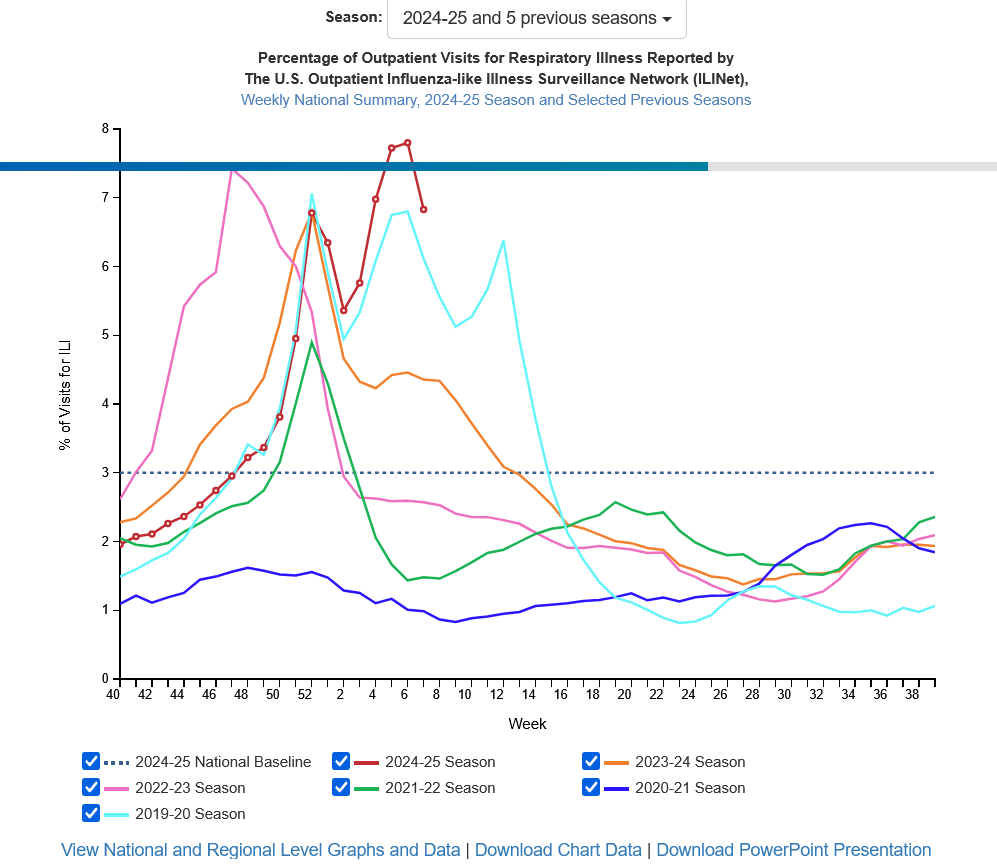
This is the worst year in the US for influenza since 2017-2018 so far. That is without the H5N1 bird influenza really getting in to people. Here is the graph for the week ending February 15th from the CDC. I keep an eye on it all through influenza season.

The article on H5N1 bird influenza is the best argument I’ve ever read for choosing not to eat meat. I like meat, but the factory farming is going to more countries. It may produce more eggs and more chickens, but if it is also the perfect breeding ground for lethal influenza, that changes my viewpoint. We cannot go on. We will have another pandemic.

Why are humans such fools?

For the Ragtag Daily Prompt: injustice.

Travel risks

The President is withdrawing the United States from the World Health Organization. https://www.whitehouse.gov/presidential-actions/2025/01/withdrawing-the-united-states-from-the-worldhealth-organization/

Here is the link to write to the President: https://www.45office.com/contact/

I am writing daily, just not for the Ragtag Daily Prompt. Here is my short note today:

Dear President Trump: I strongly disagree with withdrawing the United States from the World Health Organization. One function of that organization is travel clinics. If a person is traveling to another country, they can find out what illnesses are present there and get immunizations and advice to avoid getting ill. This also helps physicians treat people who have returned from another country. The physician can contact a state health department which is in turn connected to the World Health Organization. This is a foolish, dramatic and unscientific decision on your part. I suggest that you reverse it immediately or resign as President.

________________

The question I have, is he closing the borders to United States citizens too? Without the travel clinics, who get information about each country from the World Health Organization, aren’t even our own state department employees at higher risk for illness? My son was an exchange student to southern Thailand. At the time he went, there was Japanese encephalitis. He was there two years after the tsunami. He got vaccinated for Japanese encephalitis before he went and he also took medicine to avoid malaria. So, are we not going to send or accept any more exchange students?

I strongly disagree with the decision to leave the World Health Organization and our country is on the verge of crazy.

For the Ragtag Daily Prompt: verge.

What to check before bringing your elder home from the hospital

I get a call from the hospital (this is over a year ago). They say, “Your friend is ready for discharge. What time can you pick her up?”

I reply, “Can she walk?”

“What?”

“She has three steps up into her house. Can she walk, because otherwise I can’t get her into her home.”

“Oh, uh, we will check.”

They call me back. “She can’t walk. She’ll have to stay another day.”

I knew that she couldn’t walk before they called. She could barely walk before the surgery and after anesthesia, surgery and a night in the hospital, her walking was worse. She had been falling 1-5 times at home and the surgeon knew that. He did not take it into account. The staff would have delivered her to my car in a wheelchair and then it would have been my problem.

She was confused by that afternoon, which is not uncommon in older people after anesthesia. She stayed in the hospital for six days and then went to rehab, because she still couldn’t walk safely.

Recently I have a patient, an elder, that I send to the emergency room for possible admission. He is admitted and discharged after two and a half days. Unfortunately he can barely walk and his wife is sick as well. The medicare rules say that he needs 72 hours in the hospital before he qualifies for rehab. We scramble in clinic to get them Home Health services, with a nurse check and physical therapy and occupational therapy, and I ask for Meals on Wheels. It turns out that Meals on Wheels will be able to deliver in two months.

The wife refuses to go to the emergency room. I tell her that if she does get sicker, that they both need to check in. The husband can barely walk and is not safe home alone. If one gets hospitalized, they both need it.

If you have a frail elder, be careful when you are called about discharge. Go look at them yourself, make sure that you see that they can get out of bed, get to the bathroom, walk up and down the hall. Can they eat? Do you have steps into your house or theirs and can they go up the steps? I got away with saying please check that my friend could walk because I am a physician, because I knew she couldn’t and because there was no one else to pick her up. Do NOT ask your elder. They may want nothing more than to go home and they may well exaggerate what they can do or be firmly in denial. You want them to be safe at home, to not fall, to not break a hip and to not be bedridden.

For an already frail elder, even two and a half days in bed contributes to weakness. And being sick makes them weaker. If they are barely walking when they are admitted, it may be worse even after just 2-3 days. I used to write for physical therapy evaluation and exercise when elder patients were admitted, to help them for discharge. Once I got a polite query from physical therapy saying, “This patient is on a ventilator. Do you still want a consult?” I reply, “Yes, please do passive range of motion, thank you!”

Your elder does not have to be doing rumbustious dancing before they go home, but they need to be able to manage stairs, manage the bathroom, manage walking so that they can get stronger. Otherwise a stay in a nursing home or rehabilitation facility may be much safer for everyone.

For the Ragtag Daily Prompt: rumbustious.


Clinic comedy

Yesterday was my second day in the third clinic in this system and the day went a bit sideways. I am in seeing a person with their spouse. We are all masked because this is a sick visit. I try to wear a mask for all the visits but occasionally take it off if someone really can’t hear me. I go to wash my hands. The sink is small and turns on by a motion sensor. It is supposed to turn itself off. It goes on but then will not turn off and is loud. I send a quick message to the clinic director after flailing at it a bit. Why a message? The cabinet under the sink is locked, so I can’t turn the water off. With my patient slightly deaf and masks and loud water, I finish the visit trying to yell things. Ridiculous and embarrassing but funny. The patient and spouse are older and know that things break. They are not upset. The clinic director arrives, has her try at flailing at the sensor, unlocks the cabinet and turns the water off.

I shake hands with my patient and they and their spouse leave. We are in room three. I go in room 4 to wash my hands, since my patient was blowing their nose, and guess what? Yes, the water turns on and won’t turn off. I get the clinic manager. “I broke the second sink. How about I go home now?”

She laughs. “I will put in a ticket for maintenance.” She unlocks the room 4 sink and turns it off. Now we have two rooms out of commission!

I am covering for Dr. X. “See, this just shows that I wash my hands and Dr. X didn’t.” Not really. Dr. X has been out for a month already.

“Maybe it’s because they haven’t been used in a month,” says the medical assistant. We shut down those two rooms and I go into room 2 with some trepidation. The sink does not break.

Maintenance show up early afternoon and replaces the sink sensor batteries in room 3 and 4. They work just fine after that. It turns out that there are two other sinks not working, but there are patient visits going on, so maintenance will come back. The alcohol hand sanitizer makes my hands itch, so I prefer soap and water.

Isn’t technology great? Except when it breaks. I felt silly and helpless, since I was in a brand new place and the cabinets were locked!

I admonish all the doctors, do wash your hands! Even if the sink batteries need to be replaced more often.

For the Ragtag Daily Prompt: admonish.