Work is being a bit of a difficult place. I think that if a clinic is has two new providers with one new medical assistant, there should be some formal support in place. Not the manager of multiple offices sticking their head in the room with the three of us at computers and saying, “Everyone happy?” Um, no. This came to a head two days ago. Then yesterday I am asked to write up what I said to the manager.
No. I don’t think that is appropriate. If they have formal evaluation forms, fine. If they want a biweekly formal meeting, fine. If I ran the zoo, I would be sitting down biweekly with the job description to say, “This area is going well, this part needs some more attention. What is going well from your perspective and how can we communicate better to help each other and the patients?”
In fact, in my very first practice in 1996, I asked for a meeting with my receptionist. They had one for each pod of 2-3 providers. She was so freaked out by it that she brought the office manager, much to my surprise. I didn’t care and just said, “What is going well, what isn’t, where are the communication gaps, how do we fix them?” The receptionist looked at the office manager, said she had been scared that I was going to yell at her, but since I wasn’t, she let the office manager leave. We were fine after that. I just want a well functioning team and I am happy to help build it.
So, after thought, I am going to refuse this write up and ask what their HR process is and say that I am not satisfied with the office support and that it is quite unreasonable to leave two providers new to the clinic to guide and train a new medical assistant.
The Ragtag Daily Prompt is honey pot. That bring up this delicious and quite naughty Taj Mahal song, ooooooo. As my mother would say, you catch more flies with honey than vinegar.
Clinic has been hopping. I have been at the present site now for six weeks, so I am starting to know a few of the patients. That is, the ones that are sick and I am worrying about. It is best if your doctor’s pupils don’t dilate when they hear your name.
I have been getting helpful calls back from specialists. I have a person who has high liver tests where hepatitis and overweight and alcohol don’t seem to be the cause, so I needed an updated list of what labs to send for some of the less common liver problems. Thyroid disease, hemochromatosis, alpha one antitrypsin deficiency, smooth muscle antibodies, various other antibody disorders. The list is quite a bit longer than in the past. I warn my patient that some will come back right away and some may take a week or two. The patient is anxious and wanted to go right to the emergency room, but I ask them to wait: I get a call back from gastroenterology within 24 hours to set up the current laboratory order list.
For liver tests, we ask about alcohol intake first. Then look at weight: a high body mass index can cause fatty liver disease. Unfortunately, that can lead to cirrhosis and liver failure, so it is not trivial. We check for hepatitis A, B and C. Then we start looking for the less common causes. My person is relatively young, but that is with me taking care of age 18 and up. I tell my person not to take any supplements, I look at any prescribed medicines. No alcohol for now.
The list of tests changes quickly. If I have not worked this up recently, it’s good to check in with the specialist. The gastroenterologist may not be up to date on ankle sprains, but they are tracking the changes in their specialty. My specialty is everything, so sometimes I need a current update. Most of the specialists are just fine with this phone call.
Occasionally I do this by message. I have a new diabetic who has a cardiologist already. Diabetics are usually put on either an ace inhibitor or an angiotensin receptor blocker to protect kidney function. I message the cardiologist and get a fast answer. Start an angiotensin receptor blocker and the suggested dose. Also very helpful.
A patient tells me on the phone that I get an “A” for the day. I called them to check on them two days after changing a medicine dose and to say that the other specialist wants even MORE laboratory tests. The patient says she has not gotten a call from a doctor before. The “A” made me laugh, but it did feel good.
I am learning the local medical pathways and how to get things done in this particular medical system. The functional bits, the dysfunctional bits, and how to work around them.
I was out of clinic for two years and then very part time for a year and now not quite full time as a temp. I bargained to not quite be full time.
The electronic medical record is having a consequence, along with the pressure to see more people faster. The primary care doctors, at least the younger ones, do not seem to call their peer specialists any more. (Family Medicine is a specialty, just as Internal Medicine and Obstetrics/Gynecology are.) I called a gastroenterologist and left a message last week about a difficult and complex patient. The patient had cried three times during our visit. The gastroenterologist was very pleased I had called, was helpful, agreed with my plan of using the side effects of an antidepressant to try to help our patient, and thanked me three times for calling her. Wow. I am used to calling because during my first decade in Washington State, our rural hospital had Family Practice, General Surgery, a Urologist, Orthopedics and a Neurologist. For anything else, we called. I knew specialists on the phone for a one hundred mile radius and some knew me well enough that they’d say a cheery hi.
Now communication is by electronic medical record and email on the medical record and by (HORRORS) TEXT. Ugh. I think that there is quite a lot of handing the patient off by referring them to the Rheumatologist or Cardiologist or whatever, but the local Rheumatologist is booked out until February for new patients. That leaves the patient in a sort of despair if we don’t keep checking in on the problem. If I am worried, I call the Rheumatologist and say, “What can I do now?” I’ve had two people dropping into kidney failure and both times a call to the Nephrologist was very very helpful. I ordered the next tests that they wanted and got things rolling. One patient just got the renal ultrasound about three months after it was ordered. Sigh.
I have one patient who is booked in February for a specialist. I called that specialist too, they did not want any further tests. I told the patient, “You aren’t that sick so you won’t be seen for a while. It isn’t first come first serve: it is sickest first. We all have to save room for the emergencies and sometimes those are overwhelming.” The specialist agreed and the patient is fine with that and I think pleased to know that we do not think she’s that sick. She feels better. If things get worse, she is to come see me and might get moved up. Neither I nor the specialist think that will happen.
Is this conservation of energy, to communicate by email and text? I don’t think so. I think sometimes a phone call is much more helpful, because the other physician knows exactly what I am worrying about and they can tell me their thoughts swiftly. Sometimes they want me to start or change a medicine. Things can get lost in the overwhelming piles of data and the emails and labs and xrays and specialist notes all flowing in.
My Uncle Jim (known as AHU for Ancient Honorable Uncle Jim) used to sing part of this:
Yeah, that’s just how I call my fellow specialists.
For the Ragtag Daily Prompt: conservation. Don’t cats win at conservation of energy?
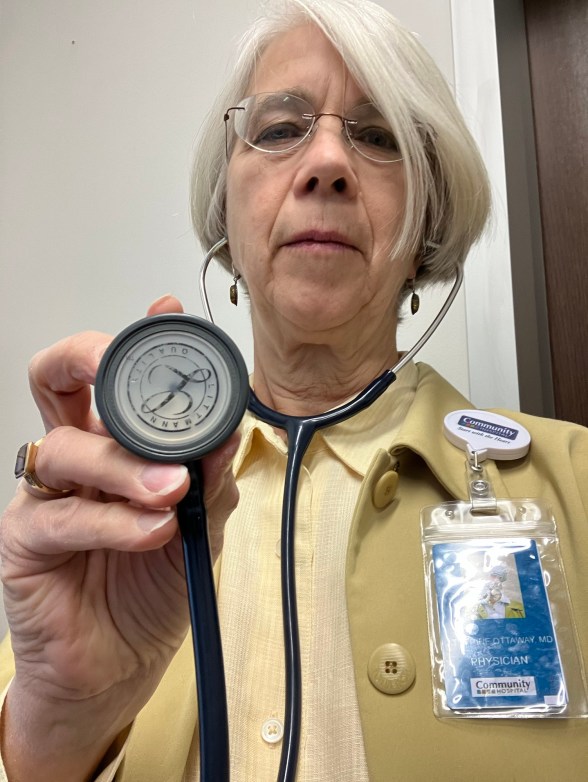
I don’t wear livery at work and anyhow that’s a uniform for men or a place to board horses though the horses can be male or female. Once I go to my daughter’s second grade for a bring your parent day and bring part of my uniform, or perhaps it is a tool or instrument, my stethoscope. The children all want to listen to my heart or at least touch this magical tool. Afterwards I receive thank you notes. I think that every one, except my daughter’s thanks me for bringing the stethoscope to their classroom. I did not know how special and magical a tool can be.
Do they really have toes? I don’t know. Probably, tiny insect toes to hold on.
I still have a daisy blooming outside in spite of weather dropping below freezing off and on for a week. We had snow flurries, but further out in the county, they got inches of snow. Port Townsend is in on the Quimper Peninsula, sticking out from the Olympic Peninsula, so all that water gives us a different microclimate.
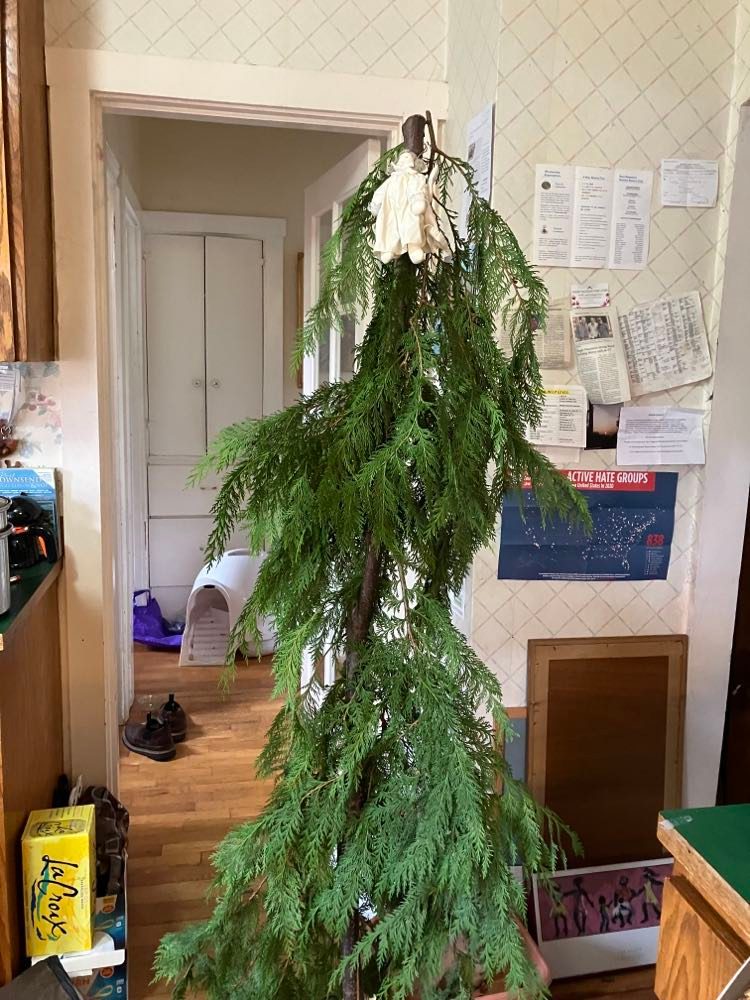
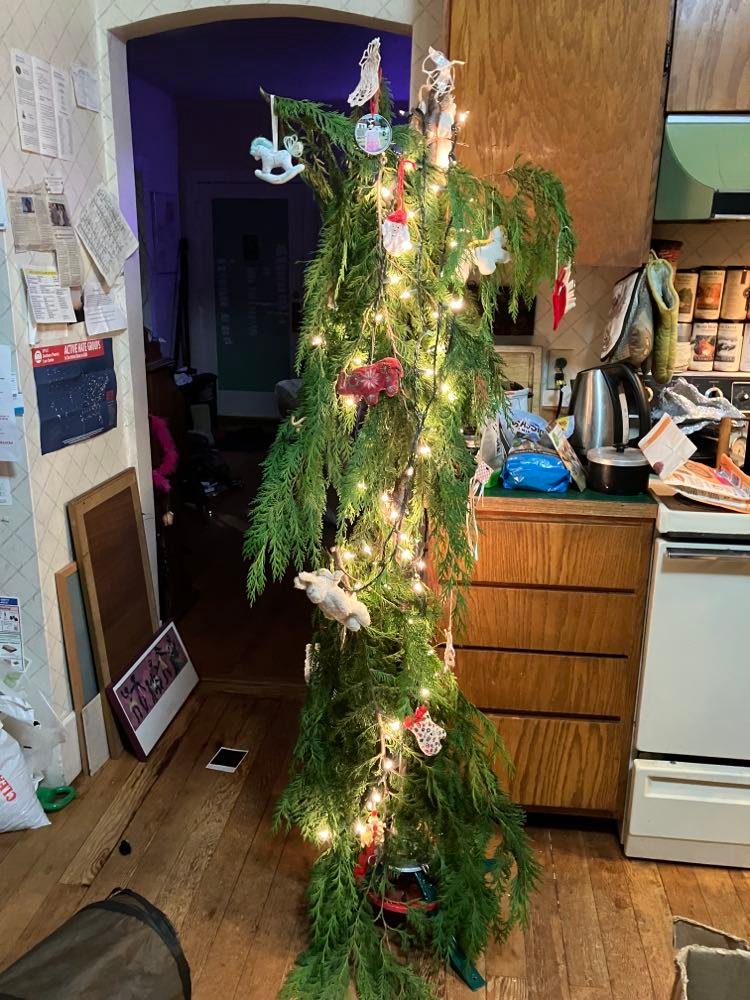
This is the second year for my “Christmas stick”. I put it up last year because I had these two kittens tearing things apart.
First I need to get the stick to stand. I had a bare stick, with the angel on top, for a week.
Then I cut four branches from the huge tree in my yard and added them to the stick.
The cats wondered, but this year they are not knocking it over so far. I put up lights and decorations yesterday. Not the glass ones: paper and soft ones. Because I’m not sure about the cats.
The cats still aren’t sure about it. We tend not to have a lot of mosquitoes even in summer, partly because the wind often howls up my street. The mosquitoes are blown inland. Too cold right now.
You needn’t worry that I will importune you. Words explode and swirl upon the page. It’s more likely that I’ll say blankly “Who?” Since I enlarge upon a fascinating stage. Approaching two years since I was taken sick, on oxygen I wrote a poem of farewell. Career ending injury: nature can be such a dick. Breathing is important. Absent it is hell. I am still healing. I hope that I can ski. I am lucky that my fatigue is relatively mild. My oxygen can go 9000 feet up where I’ll see muscle dysfunction truly makes me wild. Friends and family gather close and gather far I feel blessed beneath a lucky star.
I had cobra from my job in 2009 and the insurance company refused my bills. Not one bill. Not once. EVERY BILL EVERY TIME: 1. my healthcare 2. my son’s healthcare 3. my daughter’s healthcare 4. my daughter’s orthodontia 5. my dentist 6. my son’s dentist. I had to call EVERY TIME to get them to pay. Calling an insurance company takes 25 or 30 minutes, right? Eventually I asked for customer service who first said it was my fault because “you probably paid the bill late”. I said, “No, I was on time every month.” Then customer service wouldn’t call me back. I finally called their COUNSELING HOTLINE, since it said I would be “paid” $30 to get counseled, and said, “MY LITTLE SISTER IS DYING OF BREAST CANCER AND THE THING THAT IS MOST STRESSING ME OUT IS YOUR INSURANCE COMPANY WON’T PAY THE COBRA BILLS AND I HAVE CALLED CUSTOMER SERVICE OVER AND OVER AND THEY WON’T CALL ME BACK. HOW ABOUT YOU COUNSEL ME HOW TO DEAL WITH THAT!” And I cried. I got a call back from the head of customer service saying “Oh, it’s a computer glitch and we had you misfiled. We have fixed it.” They “misfile” people all the time, or drop patients if they get sick, or say the person didn’t pay on time. I HATE INSURANCE COMPANIES. Anyhow, be warned that insurance companies are there to earn money and will try to avoid paying you in all sorts of ways, including ways that are illegal.
We need single payer healthcare, medicare for all. If we all have healthcare, think of how many small businesses would start up. And why don’t we have single payer healthcare? I think the big corporations don’t want it.
Who is the man in the photograph? I don’t know. This is an old tintype. They came from my Great Aunt, Esther White Parr, married to Russel Parr. Perhaps they are Parrs, because my Uncle Rob did not know any of the people in the four tintypes I have. My sister and I used them for portraits in our china doll houses.I hope he is not the CEO of an insurance corporation, but then, all the white collar white men tried to dress that way then.
I wrote this in 2017, about influenza. However, I think covid-19 can do the same thing. Part of long covid is letting the lungs really heal, which means infuriating amounts of rest and learning to watch your own pulse. Watching the pulse is easier then messing around with a pulse oximeter. The very basics of pulse is that normal beats per minute is 60 to 100. If your pulse is 70 in bed and 120 after you do the dishes, you need to go back to bed or the couch and REST.
From 2017: Influenza is different from a cold virus and different from bacterial pneumonia, because it can cause lung tissue swelling.
Think of the lungs as having a certain amount of air space. Now, think of the walls between the air spaces getting swollen and inflamed: the air space can be cut in half. What is the result?
When the air space is cut down, in half or more, the heart has to work harder. The person may be ok when they are sitting at rest, but when they get up to walk, they cannot take a deeper breath. Their heart rate will rise to make up the difference, to try to get enough oxygen from the decreased lung space to give to the active muscles.
For example, I saw a person last week who had been sick for 5 days. No fever. Her heart rate at rest was 111. Normal is 60 to 100. Her oxygen level was fine at rest. Her oxygen level would start dropping as soon as she stood up. She had also dropped 9 pounds since I had seen her last and she couldn’t afford that. I sent her to the emergency room and she was admitted, with influenza A.
I have seen more people since and taken two off work. Why? Their heart rate, the number of beats in one minute, was under 100 and their oxygen level was fine. But when I had them walk up and down a short hall three times, their heart rates jumped: to 110, 120. Tachycardia. I put them off from work, to return in a week. If they rest, the lung swelling will have a chance to go down. If they return to work and activity, it’s like running a marathon all day, heart rate of 120. The lungs won’t heal and they are liable to get a bacterial infection or another viral infection and be hospitalized or die.
I had influenza in the early 2000s. My resting heart rate went from the 60s to 100. When I returned to clinic after a week, I felt like I was dying. I put the pulse ox on my finger. My heart rate standing was 130! I had seen my physician in the hospital that morning and he’d gotten a prescription pad and wrote: GO TO BED! He said I was too sick to work and he was right. I went home. It took two months for the swelling to go down and I worried for a while that it never would. I dropped 10 pounds the first week I was sick and it stayed down for six months.
Since the problem in influenza is tissue swelling, albuterol doesn’t work. Albuterol relaxes bronchospasm, lung muscle tightness. Cough medicine doesn’t work very well either: there is not fluid to cough up. The lungs are like road rash, bruised, swollen, air spaces smaller. Steroids and prednisone don’t work. Antiviral flu medicine helps if you get it within the first 72 hours!
You can check your pulse at home. Count the number of beats in one minute. That is your heart rate. Then get up and walk until you are a little short of breath (or a lot) or your heart is going fast. Then count the rate again. If your heart rate is jumping 20-30 beats faster per minute or if it’s over 100, you need to rest until it is better. Hopefully it will only be a week, and not two months like me!
Feel free to take this to your doctor. I was not taught this: I learned it on the job.
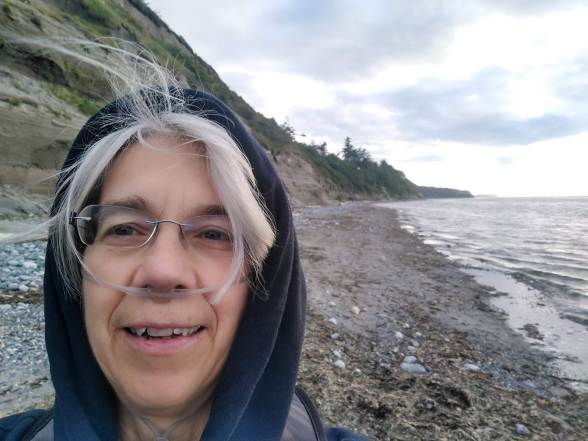
I took the photograph, a stealthie, in June 2021, when I was still on oxygen continuously.
I am thinking about the roaring twenties a lot. I think people went a little nuts, not because of the war, but because they had difficulty being emotionally honest about the influenza pandemic. I think we humans will do it again to forget the deaths, to go into denial, to refuse to grieve.
Yes, that is my prediction.
Be very quiet, I am hunting wabbits.
Be careful in our future roaring twenties. Money will flow like honey and people will go nuts. Hold fast, hunker down, don’t go out without your macintosh, wear clean underwear. Remember what your mother told you, remember what your father tells you. Because that was followed by the Depression and that is one risk.
I don’t know if it will start this spring or next spring. Ok, I AM hoping that my son and future daughter-in-law can get married in early May, since they’ve put it off for two years. But. The 1918-19 influenza was really three years, not two. It tailed off. Half the people in the world got it. In Samoa, half the adults died, or was it 70%? They had little exposure to infection but a ship brought it. They KNEW they were high risk, but a sailor didn’t know he was sick yet.
Why a roaring twenties? Because we want to forget this pandemic, as the last one was forgotten. Our history books say that the Roaring Twenties was about the end of World War I. We teach lots about that. We barely mention the influenza world pandemic. I am reading a book about the 1918-19 influenza pandemic published in 2018. The author says that it is only now, 100 years later, that we are starting to really tell the stories of that pandemic. She gathers stories from all over the world, including stores of different infection control strategies in two cities. One guessed right and one guessed wrong, and in the wrong one, way more people died.
I read about that 1918-19 pandemic after influenza nearly killed me in 2003. I was 42, healthy, a physician, a mother, an athlete. I had NO risk factors except stress. Now it looks like it was a PANS reaction, but at the time, neither my doctor nor I could figure out why I was short of breath and tachycardic walking across a room for two months. Fatigue, chest pain, tachycardia, shortness of breath. Hmmm, what does that sound like? My partners thought I was faking and I was so sick that I could barely communicate. The stresses were my mother dying of ovarian cancer in May 2000 and my marriage being pretty on the rocks and me working way too hard. My psychiatrist said I should take time off. I said, I can’t. He said, you’d better. Then I got flu. “See?” he said. The body decides, not the conscious brain. He was correct, damn him.
The book I read in 2004 looked dry and medical from the outside. It had pages and pages of footnotes. It had photographs of Los Angeles. They knew the influenza was coming towards them like a wave and they tried to get ready. Bodies under sheets were stacked five deep in the hallways of the hospitals. It hit that fast. People, usually age 20-50, turned blue and fell over dead. WHY? It was the immune response. The 20-50 year olds had a better immune response than the 50 and older and their lungs would swell until there was no airspace left. Even then, that pandemic death rate was only 1-2 % in the US. But it was so fast and spread so quickly that everything was disrupted because it was the workers that were deathly ill and at home and there was no one to work.
People wore masks in public, except for the mask refusers, but not in their homes. So entire families would get ill. I don’t think they had figured out viral loads yet. If you are the last one standing, and you are trying to take care of a spouse and six children, you were high risk from viral load and exhaustion.
The Roaring Twenties WAS a way to grieve, it’s just a dysfunctional one. The stages of grief: denial, bargaining, anger, grief and acceptance. My sister said that acting out and revenge ought to be added as stages of grief. She died of breast cancer after fighting it for 8 years. Roaring is denial and bargaining and acting out and revenge, all at once. Everyone grieves differently, remember that. There is not an order to the stages of grief and you don’t do them once. You do them over and over and over.
I am a Cheerful Charlie, right?
War is one way to forget/deny/act out. Let’s not do that. Let’s not have a civil war of forgetfulness and denial.
The good news is this: National Guard Empties Bedpans and Clips Toenails at Nursing Homes. “In Minnesota, an ambitious initiative is training hundreds of Guard members to become certified nursing assistants and relieve burned-out nursing home workers.” (1) Well, hooray, the National Guard is called out to help, because the nursing homes are out of staff and we aren’t supposed to abuse our elderly. I think this is AMAZING. And the National Guard may learn some things about work and the elderly too. Hoorah and Hooray!
The bad news is a snippet from New York State: Omicron is milder, BUT the exception may be children. (2) Child cases of Covid-19 are going up really fast and hospital admissions of children. ICU work is hard hard hard, but child and infant ICU is even harder. Blessings on the nurses who do this and the physicians too. When I did my pediatrics rotation way back in Richmond, VA, in a tertiary care hospital, I had children who were dying: one with a brain tumor, one with liver cancer, one with Wilm’s disease. Hard work. I chose Family Practice. I have still had pediatric patients die, including an 18 month old where I had taken care of mother through the pregnancy, but not terribly many. Even less in the last ten years since my average patient was about age 70. All of my kids in the last ten years were complicated: one with Down’s, another a leukemia survivor, others. Children can be very medically complicated. I had two adults who had survived infant heart surgery as well. They were set up with UW’s Adults who had Childhood Heart Surgery Clinic, though that is not the correct name. I am pretty happy to have that sort of back up only two hours away. They both had pretty awesome heart murmurs and that midline chest zipper scar. Ouch.
So, why post this on Christmas? If the cases are rising in children, maybe that will inspire some folks to get vaccinated or at least not yell at family who refuse to bring small children to an unvaccinated Christmas gathering. Judging by the posts on the doctor mom facebook group, there is quite a bit of family yelling going on. Stand down, folks, and respect other peoples’ boundaries.
The problem is, if enough children are sick, we run out of beds. And staff. “As of Thursday, there were 1,987 confirmed or suspected pediatric covid-19 patients hospitalized nationally, a 31 percent jump in 10 days, according to a Washington Post analysis.” (3)
Discover and re-discover Mexico’s cuisine, culture and history through the recipes, backyard stories and other interesting findings of an expatriate in Canada
Engaging in some lyrical athletics whilst painting pictures with words and pounding the pavement. I run; blog; write poetry; chase after my kids & drink coffee.
Refugees welcome - Flüchtlinge willkommen I am teaching German to refugees. Ich unterrichte geflüchtete Menschen in der deutschen Sprache. I am writing this blog in English and German because my friends speak English and German. Ich schreibe auf Deutsch und Englisch, weil meine Freunde Deutsch und Englisch sprechen.







 KO Rural Mad As Hell Blog
You must be logged in to post a comment.