speaking up

A friend says he does whatever he wants. He refuses to answer questions about how he makes his money. He doesn’t care if this annoys people. I suspect he may enjoy it.

I have one of those public jobs. Well, had. I have now been disabled from Family Medicine for a year. My lungs are much better than a year ago but they are not normal. And I have now seen 17 specialists and 3 primary care doctors since 2012. The consensus is “We don’t know.” Though many specialists are not willing to say that. What they say instead is, MY testing is NORMAL, go to someone else. My lungs are not normal, but I am on my fourth pulmonologist. I saw a cardiologist this year and the first thing he says is, “It’s your lungs, not your heart.” Well, yeah, I know that.

I miss my patients, but there is something freeing about not working. Ok, more money would be nice, but I am doing ok. Meanwhile, I am thinking about what to do now. I can write full time. Write, make music, travel (on a budget) and sing. And speak up.

Doctors have interesting portrayals on television. We went from Dr. Kildare to Dr. House, working our way through the shows with an emergency room and medical residents. ER drove me nuts. No one EVER dictated a chart so at the end of each show I hyperventilated at the hours of paperwork/computer/dictating they had left. House interests me because it’s always the thing that the patient is hiding or lying about that is the key. “Go search his apartment.” says House. I have figured out cases by getting permission to call family or a group home. More than once.

But a physician is a public figure. I had been here for less than a year when a woman comes up to me in the grocery store and says “What are my lab results?” I look at her blankly. I can’t remember if I really did the snappy comeback that comes to mind: “Take off your clothes and I will see if I remember.” I respond politely and she says, “Oh. I should call the office, right?” “Yes, I try to leave the work there,” I say. If a particularly difficult person was bearing down on me, I would whisper “cry” to my kids. That worked. They would act out on cue and I would be the harassed mother. The person would back off.

I am in a small town. We have three grocery stores. I see patients everywhere, now that it has been 22 years. If I remember every detail, that means they are or were really sick. And we have the layers of relationships: someone might have kids the same age or work with boats or be in chorus with me. Once I take my daughter to a party. The mom introduces me to two other mothers. “She’s my doctor,” says the introducing mom. “Well, me too.” says the second. “And me,” says the third. We all laugh.

Once I am visiting my brother outlaw’s bicycle shop. He has a customer. The customer starts talking to me too. Brother outlaw says, “Do you two know each other?” The customer eyes me. I have my neutral doc face on. “She’s seen me NAKED!” says the customer and I howl with laughter. What a great reply. And my brother outlaw gets it.

Docs have to pay attention to HIPAA. When three women say that I am their doctor, I reply, “Yeah and I left my brain at work, so I can’t remember a thing.” Those three were healthy, so I really do not remember labs or the results of a pap smear. Once I was in cut off shorts and waved at an older woman who was at the ophthalmologist’s. She sniffs and looks away. I get the giggles: I think she did not recognize me. My town is only 10,000 people, so after 22 years I have taken care of many of them. Though sometimes people thank me for taking care of their mother, and after it sounds unfamiliar I ask if they mean Dr. Parkman? Oh. Yes. People get me mixed up with two other small Caucasian woman doctors.

I started the “outfits inappropriate for work” category last year when I was still very sick and short of breath and on oxygen. I did not go out much, partly to avoid covid. My pneumonia was something other than covid and it was my fourth pneumonia and I should not need oxygen. Now I’ve had mild covid and the oxygen is only part time. I sang at my son’s wedding, off oxygen, so I can sing off oxygen for a short time. I danced off oxygen too and did get QUITE short of breath. Since I am no longer a public figure, I can speak out and speak up more. I am thinking about that, particularly with the recent Supreme Court news. I do not agree with what they seem to be planning.

Covid-19: Approach to Long Haul

Covid-19: Approach to Long Haul

This is written primarily for physicians, but is for anyone to read. This is a working theory.

I am very interested in Long Haul because I was diagnosed with PANS by an older psychiatrist who worked exclusively with physicians in 2012. That was during my third flare. The evidence is mounting that Long Haul is an autoimmune disorder like PANS. I am sharing my approach to Long Haul based on both my clinic and personal experience.

Step 1. Validate the patient. Patients are terrified, understandably, to have something “like” chronic fatigue, fibromyalgia, or are worrying that they are “crazy”. Evidence is appearing that Long Haul, chronic fatigue and fibromyalgia are all complex autoimmune disorders with multiple antibodies. We do not yet have vast antibody tests. So the first step is to say that we believe patients and also that we can help. This is a very new and evolving field. I tell patients that it will change fast over the next few years. What I tell them today may change within a year as we get new information. If this makes them anxious, remind them of the Women’s Health Initiative and how that changed hormone therapy, and that cancer treatments keep improving.

Step 2. Lower stress and antibody levels. When we are high stress, cortisol and adrenaline go up and impair the immune system. The immune system is fired up and looking for something to do. Bacteria like strep A have evolved with us and have surface proteins that “look like us”. Our bodies make antibodies to the Strep A or Covid-19 and sometimes those antibodies attack us too, because our own proteins look the same. One way of lowering the antibody level is sweating. Hot bath or shower, sauna, hot tub, exercise. Support these and explain. A second way to lower the antibody level is to quiet the sympathetic nervous system and activate the parasympathetic nervous system. The parasympathetic is the quiet, relaxed and laughing one. Where does the patient feel safe, relaxed, quiet? After my father died, leaving a complicated and messy estate with an out of date will, I did a Sudoku daily for a year. I realized that the Sudoku relaxed me because I could not solve the estate quickly, but I could nearly always solve the Sudoku. Stupid cat videos, rocking chairs, knitting, gentle walk in the neighborhood if it feels safe, a walk in a mall (without one’s purse if overspending is an issue) — how does this particular person relax? Teach the slow breathing: in for a slow count of five and out for a slow count of five. Or square breathing: in for five, hold five, out five, in five. Twenty minutes of slow breathing supposedly moves almost everyone from sympathetic to parasympathetic. It may take practice and feel unfamiliar: I have had a veteran say that it felt very very weird to relax and he was not used to it. He kept at it.

Step 3. Symptom picture. At present I am basing this on my own experience with PANS. This is my working theory. Antibodies can block receptors or “turn the key” and activate receptors. Buprenorphine does BOTH (though it is not an antibody): at lower levels it turns the key and at higher levels it blocks. I would ask specifically about five fields. You many well be able to come up with more.

a. Brain function. In my PANS, I have antibodies to dopamine that turn dopamine on very high. Other physicians assume that I am manic. I am not quite manic, but it certainly feels awful. I feel like I have been shot out of a cannon when I wake up, with the morning cortisol rise. For me, the caffeine in coffee calms me, and my assumption is that it displaces the anti-dopamine antibodies. Tea does not work. I quit coffee for seven years until the latest flare. Albuterol doesn’t work. Terbutaline does work. I don’t know about theophylline or adderall, I have not tried them. If someone has “brain fog”, I assume that they have blocker antibodies OR be sure to ask if they were different in the first 4-6 months of the illness. For me, the antibodies rise for about 2-3 months and then take 2-3 months to drop. I have a lot of fatigue when they finally leave and this time I could tell the day that the last antibodies “fell off” or dropped to my “normal” level.
For blocked people, does caffeine help? How about albuterol? Adderall, theophylline, SSRIs. Every person will have different antibodies. Treatment needs to be tailored.

b. Muscle function. My anti-tubulin antibody (I have PANS, remember?) shuts down my “fast twitch” but not my “slow twitch” muscles. Tubulin is what makes the lung cilia function, so presumably mine are paralyzed during a flare and that is why I get pneumonia. I am tachycardic, resting heart rate 100 and walking slowly or talking heart rate 135, so I get very short of breath. Both the lung dysfunction and antibodies that upregulate my dopamine receptors make me tachycardic. I think that the people who can barely get out of bed with chronic fatigue have both fast and slow twitch muscles blocked. They need validation and lower stress. With support, perhaps the antibody level can be lowered enough that they can function again. I also found that my muscles hurt when my blood sugar was up and that if I keep it low, I have minimal muscle pain. I do not know if this is true for other people.

c. Gut function. In PANS, there appears to be an antibody to lysoganglioside. I don’t understand it but when I am sick, I cut carbohydrates way back or I am horribly ill. I tolerate lactose but not fructose, sucrose or gluten. One year after getting my last flare, I can eat everything except gluten. With this round I figured out that rising blood sugar when I am sick makes me acidic. This in turn worsens lung function more, as my body automatically slows my breathing to balance the acidity. I found that taking bicarb before a meal helped tremendously. In the worst/highest antibody part of the flare, I eat fats, because anything else makes me ill. SO: what can the patient eat or not eat and support them. Food intolerances are on the rise. Ask if there are foods that they cannot eat and support them not eating them. They can go to a very restricted diet that works for them and wait three weeks. After three weeks, food antibody levels are supposed to drop. They can start adding foods back in, one every three days. I do not know if this will work in a bad flare, the antibodies may be too high.

d. Lungs: do a resting heart rate and oxygen saturation. Do a walking heart rate and sat. Then do a LOADED heart rate and sat, with the person carrying the equivalent of two bags of groceries or their toddler. If they are young, they may hold their sats, but if their heart rate jumps to 135, that is like running a continuous marathon. Try oxygen and see if the heart rate comes down. Sleep apnea testing is also highly recommended. If they are tachycardic with daily activities, of course they have fatigue! Rest. Patients can learn to check a pulse or have a pulse ox, but fingers and second hand are cheap.

d. Other. I am reading that the main complaints in Long Haul are fatigue, brain issues, tachycardia and shortness of breath. What else really bothers the person? Sound sensitivity, loss of the sense of smell. The first step in helping with this is to listen and validate.

Covid-19: long haul II

A few days ago my primary care doctor texts that she wonders if I have the autoimmune form of fibromyalgia.

Red alert. I have not heard about this.

I did a search last night and find this: https://www.sciencedaily.com/releases/2021/07/210701120703.htm.

Now, if you have been paying attention, you know that I was diagnosed with PANDAS in 2012, though Isuspect that it is really PANS. Both are autoimmune disorders. I also think that long haul covid is the same thing or something similar.

Meanwhile, they are now saying Covid-19 Long Haul may ALSO be an autoimmune disorder. Multiple sites below.

There is a paper in Nature that I don’t have access to, annoyingly enough. The fibromyalgia story in the above story is that they have spun antibodies down from human serum of affected and unaffected people and then injected them into mice. The mice get fibromyalgia symptoms from the affected antibodies but not from the unaffected ones. The symptoms in the mice go away when the antibodies fade out, in a few weeks. Aha.

The long haul story says that death from Covid-19 may be an autoimmune response, the antibodies going really nuts and making people bleed or their lungs close down. That is, swell shut. They have been drawing blood to study at different stages of Covid-19 and also checking autopsy patients. Usually autoimmune diseases are more prevalent in women then men but Covid-19 seems to be worse in men. This: “The mechanisms behind the production of such autoantibodies aren’t yet clear. Widespread and long-term inflammation during severe COVID-19 may cause the immune system to produce antibodies to pieces of the virus it wouldn’t normally recognize. Some of those pieces might resemble human proteins enough to trigger the production of autoantibodies.

Excessive inflammation could also boost production of autoantibodies that had previously only existed in the body at very low levels. Vaccination against COVID-19 is much less inflammatory than infection with the virus. In a separate study that looked at COVID vaccination, none of the healthy volunteers developed autoantibodies.” (2)(*)

Here is another fibromyalgia paper: https://www.verywellhealth.com/autoimmunity-neuroinflammation-in-fibromyalgia-5197944. That paper lists the autoantibodies that they are finding in fibromyalgia including gangliosides. The fourth antibody in PANDAS/PANS is anti-lysoganglioside. Aha! So this is sparking a serious revolution in medicine: it is looking like many of the mysterious and difficult to describe and quantify diseases may be autoantibody disorders. The anti-ganglioside antibodies were found in 71% of fibromyalgia patients. There are seven antibodies listed, including one to serotonin. In PANS, they are blaming two anti-dopamine antibodies. None of the fibromyalgia patients had ALL seven, but all of them had some of them. A different pattern in every patient, because we all make different antibodies. Fascinating.

One more: https://pubmed.ncbi.nlm.nih.gov/28339361/. People with lupus are more likely to have fibromyalgia and visa versa. “Increasing evidence indicates that N-methyl-D-aspartate receptors (NMDARs) play a major role in the induction and maintenance of central sensitisation with chronic pain. In this study, we evaluated the role of anti-NMDAR antibodies in the development of FM in patients with SLE.” Lupus and fibromyalgia share an autoantibody. Holy cats. NMDA is ALSO a neurotransmitter. Makes me wonder quite a bit about “psychiatric” disorders.

Remember that we make up all the words. So the autoimmune diseases are usually found by testing for a few antibodies. In the most common autoimmune disorder, hypothyroidism, we usually check the TSH and T4 level, so patient hormone levels rather than antibody levels. Over the last 30 years, we are able to test for more antibodies. Systemic lupus erythematosis, celiac, rheumatoid arthritis, juvenile rheumatoid arthritis. When I was in medical school in 1989, the rheumatology book was an inch and a half thick and there were loads of different patterns of disease. I am sure it is twice as thick now. Our initial test for autoimmune disease is for inflammation: an antinuclear antibody and an erythrocyte sedimentation rate. Some people have rheumatoid arthritis but their RF is negative: they have “sero-negative” rheumatiod arthritis, which is more likely “a different autoantibody that we have not tracked down” rheumatoid arthritis. In chronic fatigue and fibromyalgia, the antinuclear antibody and erythrocyte sedimentation rate are usually normal. I suspect both disorders of being “post” inflammation.

My prediction is a serious medical revolution, where we start regularly testing for autoantibodies. Whether that will be something like a pregnancy test but with hundreds of autoantibodies tested for, or whether there are some key indicator ones that we can find, is not clear. At any rate, trauma, stress and infection all increase the likelihood of getting one of these disorders and we have to figure out how to lower the load of all three.

Do you think people are instinctively quitting their jobs?

I had a phone visit with my pulmonologist yesterday. She was running about 35 minutes late, I sat on Zoom until she showed up. She looks exhausted. “We have less doctors and more patients.” she says. “I was on call for the critical care unit last week and I am on call Monday and Tuesday.” “Please take care of yourself,” I say, “We really need you.” She is smiling the whole time. She is worried about me dropping weight and I am worried about her.

Prayers and blessings all around.


1. https://www.cedars-sinai.org/newsroom/covid-19-can-trigger-self-attacking-antibodies/
2. https://www.nih.gov/news-events/nih-research-matters/autoimmune-response-found-many-covid-19
1. https://www.cedars-sinai.org/newsroom/covid-19-can-trigger-self-attacking-antibodies/
2. https://www.nih.gov/news-events/nih-research-matters/autoimmune-response-found-many-covid-19
3. https://thehill.com/policy/healthcare/591528-long-covid-study-author-explains-four-factors-that-can-predict-how-you-get
4. https://www.the-scientist.com/news-opinion/studies-identify-risk-factors-for-long-covid-69648
5. https://www.dailymail.co.uk/health/article-10436473/Is-people-sicker-Covid-19.html
*If that paragraph does not make people get the vaccine, they are living completely in a mad dream world, IMHO.
6. https://www.nih.gov/news-events/nih-research-matters/misdirected-antibodies-linked-severe-covid-19

For the Ragtag Daily Prompt: flickering. As in flickering hope.

organize

I am ready to organize my house.

I thought for years that I am NOT capable of organizing a house.

It turns out that I never had time to organize my house. I was a single mother family physician doing rural medicine including obstetrics and frequently on call, and then I opened my own business.

So organizing the house was way down the list of priorities.

I’ve been home now since March 20, 2020. I am starting to really recover from the pneumonia and muscle dysfunction. So now I am organizing once again.

I need a work room, other than the computer room. I set one up upstairs, but in this 1930s house, the upstairs room is too cold. It is great for sleeping but not for a prolonged time working on a project. So I am eyeing my spaces. I could use the front room which is currently the invasion from my clinic. However, I love having the front windows right there when I am on the computer. The cats have a chair there too and keep me company.

I am eyeing rooms in the basement. There is baseboard electric in three rooms. It means moving things around, but that is not difficult. It may take me a little while, but I will get it done.

I am ready to organize it.

____________________

For the Ragtag Daily Prompt: READY!

acoustic bicycle

Over KwanChunChrisSoliday, we discuss bicycles. We now have a plethora of electric bicycles, so we need a phrase that describes the “old” style bicycle. We came up with acoustic or analog. I like acoustic bicycle, because it sings.

My friend B-from-Arlington (BfA): “But they don’t make noise.” He didn’t approve of either idea.

“Well, we had spoke bells, and playing cards. My bikes make noise.” Sometimes it’s me making it.

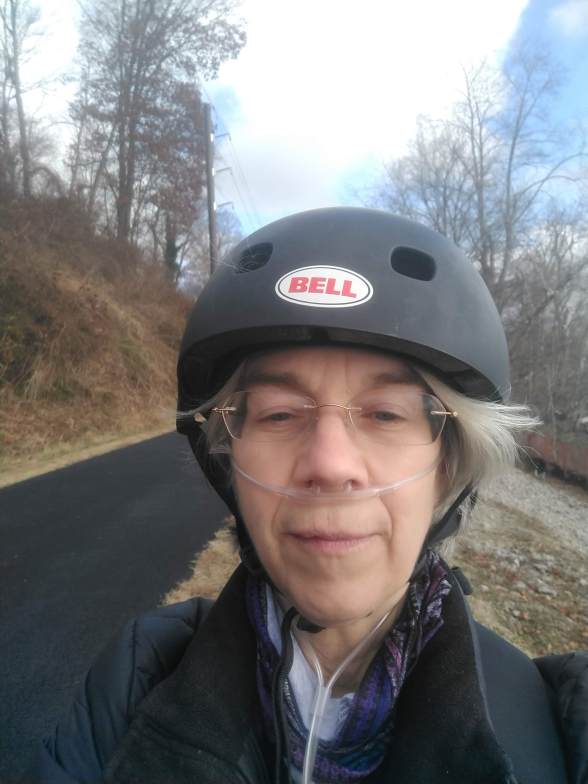
We are riding on a rails to trails path in Northern Virginia. Seven of us and me on oxygen. It’s only my second bike ride since March 2021, when my lungs fell apart. We are all on acoustic bicycles.

I feel pretty strong for most of it, 14.5 miles. It seems flat, though it is a very gentle downgrade, until the last 0.5 mile, which is gently up hill. Oh, my lungs don’t like that bit at all and by now my muscles are saying Why are we doing this? I am relieved when we get to the coffee shop destination. Three of us will stay there, while the other four will ride back and get the cars. I hang out with K-f-A, BfA’s spouse, and their son. Their son examines my phone, asks why it has four camera eyes. I have no idea, so he proceeds to figure it out. We play with the slow motion camera for a while.

We know what a penny farthing is, and safety bicycles and tricycles. The early safety bicycles did not have brakes and had wooden rims and wooden spokes. My brother outlaw has one, from the 1880 or 90s. Another friend collects penny farthings and has one that is entirely of cast iron. It would be a little bumpy and the seat is pretty hard. It is also massively heavy. So now we add acoustic bicycles to the electric ones.

Go, google, spread the word.

________________________________

Dang, others have come up with it too. Traditional bicycle sounds too fogey.
https://www.reddit.com/r/ebikes/comments/hp2l30/can_we_please_stop_calling_traditional_bicycles/
https://www.bikebiz.com/what-shall-we-call-the-non-electrified-bicycle/

Covid-19: Long Haul

https://www.bbc.com/news/av/world-us-canada-58918869 Some people with Long Haul Covid-19 are having to relearn how to walk and talk.

https://www.bbc.com/news/uk-england-leicestershire-59674203. Patients who were hospitalized are still affected at 5 months and one year after they are released from the hospital. Being female and obese are big risk factors. The article says “Long Covid has the potential to become highly prevalent as a new long-term condition.”

One more:

https://www.ncbi.nlm.nih.gov/pmc/articles/PMC8146298/ ” While the precise definition of long COVID may be lacking, the most common symptoms reported in many studies are fatigue and dyspnoea that last for months after acute COVID-19. Other persistent symptoms may include cognitive and mental impairments, chest and joint pains, palpitations, myalgia, smell and taste dysfunctions, cough, headache, and gastrointestinal and cardiac issues.”
“One puzzling feature of long COVID is that it affects survivors of COVID-19 at all disease severity. Studies have discovered that long COVID affects even mild-to-moderate cases and younger adults who did not require respiratory support or hospital or intensive care. Patients who were no longer positive for SARS-CoV-2 and discharged from the hospital, as well as outpatients, can also develop long COVID [24,30,31,41,50]. More concerningly, long COVID also targets children, including those who had asymptomatic COVID-19, resulting in symptoms such as dyspnoea, fatigue, myalgia, cognitive impairments, headache, palpitations, and chest pain that last for at least 6 months [51–53].”

And the symptoms? “The most common ongoing symptoms were fatigue, muscle pain, physically slowing down, poor sleep and breathlessness.”

Yes, the same as mine.

My initial evaluation of Long Haul Covid-19 patients will cover three areas:

1. Behavioral Health. Are they having brain fog, feeling slowed, feeling like they can’t think? Is that what happened during the Covid-19 or did the opposite happen? Were they manic/ADHD/OCD etc? What happened in the weeks leading up to getting sick? Any major worries or life trauma? Lose a job, a relationship, someone in the family die? I am looking for a dopamine antibody pattern.

2. Musculoskeletal Chronic Fatigue. What muscles work and which muscles don’t work? If they need to lie in bed for 20 hours a day, both slow and fast twitch muscles are affected. If they are short of breath, they should have pulmonary function tests, including a loaded and unloaded walk test. Are their oxygen saturations dropping? They also need a sleep study. Check for sleep apnea. Any signs of ongoing infection with anything? Teeth, sinuses, ears, throat, lungs, stomach, lower gut, urinary, skin.

3. Musculoskeletal Fibromyalgia. WHEN do their muscles hurt? Is it after eating? Do they fall asleep after they eat or does their blood pressure drop after eating? What diet changes have they made? Are there things they have identified that they can’t eat? Gluten, lactose, meat, sucrose, fructose, nightshades, whatever. I am looking for antibodies to lysogangliosides.

Treatment:

High antibody levels can be lowered somewhat just with “lifestyle changes” aka no drugs.

A. Treat infection if present. Look for strep A with an ASO, since we have an occult one that is in the lungs, not the throat. For fungal infection, even just on the skin, lower blood sugar as much as tolerated. This may mean a ketotic diet.

B. Treat behavioral health with drugs if emergent. If suicidal or really losing it (meaning job/relationships/whatever), then drugs may be needed. But not forever. Avoid benzodiazepines. Check for addictions.

C. Lower antibody levels:
a. Lower stress. Many people will resist this. Counseling highly recommended, ‘cept they are all swamped. Have the person draw the three circles: a day in the present life, their ideal life and then what their body wants. Listen to the body.

b. You can sweat antibodies out: hot baths, hot shower, steam room, sauna, exercise. Daily in the morning, because cortisol rises when we get up, and so levels should be lowered.

c. Is there a stimulant that works for this person to calm them down? Or an antidepressant if they are slowed instead of sped up. The relatives of dopamine that work for ME are coffee caffeine and terbutaline. Ones that do NOT work for me include albuterol and tea caffeine. Ones that I have not tried include theophylline, that new relative of albuterol and ADHD meds like adderall. This will be individual to the person because we all make different antibodies. We are looking for a drug that displaces the dopamine antibodies. For people who are slowed or have brain fog, the stimulants may not work. I would try the SSRI antidepressants first, like sertraline and citalopram, unless the patient tells me they don’t work or make them anxious. I would screen for PTSD. For high PTSD scores and high ACE scores, I would use the old tricyclics, mirtazapine (which is NOT a benzodiazepine), wellbutrin or trazodone. Again, avoid benzodiazepines. Also check how much alcohol and marijuana are on board, because those are definitely going to make brain fog worse. The functional medicine people are treating mystery patients with hyperbaric oxygen chambers and I suspect that this works for the people with blocker tubulin antibodies.

d. Muscle pain/fibromyalgia symptoms. Avoid opioids, they will only work temporarily and may addict. Avoid muscle relaxants, they will only work temporarily. Again, the tricyclics may help. The newer antiseizure drugs that are indicated for fibromyalgia are possibilities, though as an “old” doctor I am conservative about “new” drugs. Gabapentin, pregabalin, and if the person is sped up, antiseizure medicines that are used for mania. GENTLE exercise. The line between me having a good day today and overdoing is knife thin. On the overdoing days I go to bed at 5 pm. I went to sleep at 5 pm yesterday and 6:30 last night. I sang for church last night and even though I’d driven myself there, one of the quartet offered to drive me home. “Do I look that grey?” I asked. “Yes.” he said. I turn grey from fatigue and it can be sudden. Right now it’s after my second meal. If I am active, I will fall asleep after lunch if I can. If I go really light on lunch, I crash right after dinner. And remember, I am one of the lucky people who only have fast twitch muscles affected, not fast and slow twitch.

I am adding this to yesterday’s Ragtag Daily Prompt: hopeful.

werewolf

Time out word warning, in this poem. This poem is about discrimination. Substitute practically anything for werewolf…. disabled, bipolar, depressed, autistic, substance abuser. I am sick of discrimination. For human, substitute “normal”.

You know I’ve been a werewolf my whole life

Started in the womb
triggered by antibodies
to tuberculosis

And I am tired

of people telling me

I’m a werewolf.

Ok? I fucking know that.
I have known it since Kindergarten
where I arrived full of joy
ready to sing

and was shunned

we didn’t have a television

but I knew that wasn’t really it
I was different
I am different

and fuck you humans
different is ok.

I am a werewolf
and I am fucking proud
of all I have accomplished
in the teeth of humans hating me
and trying to shut me down
and shunning me
and reporting me
and doing everything short of shooting me
with real guns

I’ve been told to sit down
shut up
stop arguing
be nice
be good
go away
die
don’t read my writeups
don’t C! my work
don’t talk to me
stop making waves
been fired
been reported
been shunned
been alone

and fuck you humans

get ready
because I am middle aged now
for a werewolf
and I am ready

to be one all the timee

damn the torpedoes
full speed ahead
fuck you humans
for how you’ve treated me

I’ve turned the other cheek
for sixty years

and now
I
will
fight

writhe

You are sick as shit.

You go to the ER.

You finally feel safe, on a bed, they will save me, you think.

The nurse is on autopilot. He does not seem concerned. You are shaking a little as he arranges you on the bed. He puts the heart monitor stickers on and hooks you up. Blood pressure cuff, pulse ox. Blood pressure is fine, pulse is a bit fast, at 110.

You notice he is not making eye contact.

“I’m cold.” you whisper.

He doesn’t reply. He keeps messing with the wires. He puts the call button next to your hand. He leaves and returns with a warm blanket. It feels wonderful. He doesn’t say a word.

You feel better under the warmth.

The respiratory therapist wheels in the ECG machine. You smile at her but again, no eye contact. She puts more stickers on you. “Hold a deep breath.” The ECG spits out. She takes it and leaves.

The radiology tech wheels the portable xray machine in. You watch his face but don’t bother to smile. He looks everywhere but at you. It’s a bit creepy. Are they all robots? It’s 3 pm, not 3 am. “Lean forward,” says the tech, putting the radiology cartridge behind you. “Take a deep breath and hold it.” He takes the cartridge and leaves.

The nurse is back. Puts in the iv and draws 5 tubes of blood. You are shivering a little. He doesn’t seem to notice. You think about another warm blanket. The iv fluid starts and you can feel it running cold into your arm.

There is a child crying in the ER, in some other room. You start noticing the noises. Machines beeping. People typing on computer keyboards. No one is talking. The kid gives a howl of protest, rising and then is abruptly quiet.

Your hands and feet are tingling and burning. You writhe a little under the blanket. Sensation is returning to your hands and feet. It hurts but it is also good. You were at the point where all your feeling had shrunk to a tiny spark in the center of your chest. As the iv fluid runs, feeling slowly spreads out from that.

The doctor comes in. Grumpy, clearly. “Lean forward.” Listens to your chest. “Sounds clear.”

“It’s been hurting for 5 days. It hurts to breathe. Burns.” You are anxious as hell. BELIEVE ME.

The ER doc gives a little shrug. “Oxygen sats are fine.” He does a half-assed exam. He leaves.

You look at your feet, taking your socks off. Because he didn’t. There are two black spots, a couple millimeters across, old blood. Those are new.

You press the call button.

Time goes by. The nurse floats back in.

“Look. Tell the doctor to look. These are petechiae.” You point to the black spots.

If the nurse had laser vision, your feet would be burned. The nurse glares at your feet. He goes out.

The doc comes in and looks at your feet.

“They are petichiae. I have an infection.”

He gives a tiny shrug. “Your chest xray looks clear. Your labs are normal. You are not running a fever.”

“I am on azithromycin for walking pneumonia. I suddenly felt like all the fluid was running out of my arms and legs. I am worried that I am septic.”

“Blood pressure is fine. You are really really anxious.”

You are furious. It probably shows on your face. You are terrified.

“Could it be an antibiotic reaction?”

Shrug. “No rash.”

“Except the petechiae.” A sign of sepsis.

“I will change the antibiotics. Clindamycin.” He leaves.

You lie back, terrified. He doesn’t believe you. He is sending you home, septic. You will probably die.

The nurse comes in. Removes the iv and unhooks the monitor and the blood pressure cuff. You get dressed, numb and frightened and cold. The nurse goes out and returns. He recites the patient instructions in a bored voice and gives you the first dose of clindamycin.

You walk shakily to the door of the emergency room. To go home. While you are septic and they don’t believe you. You know what happens with sepsis: your blood pressure will drop and then organ damage and then IF you survive you could have heart damage or lung damage or brain damage and you might not anyhow.

You go home.