This is such a great dad pic. Climbed on and tired and putting up with it. And my daughter is having a grand time. She’s getting a bit big for that, too!
For the Ragtag Daily Prompt: moustache.
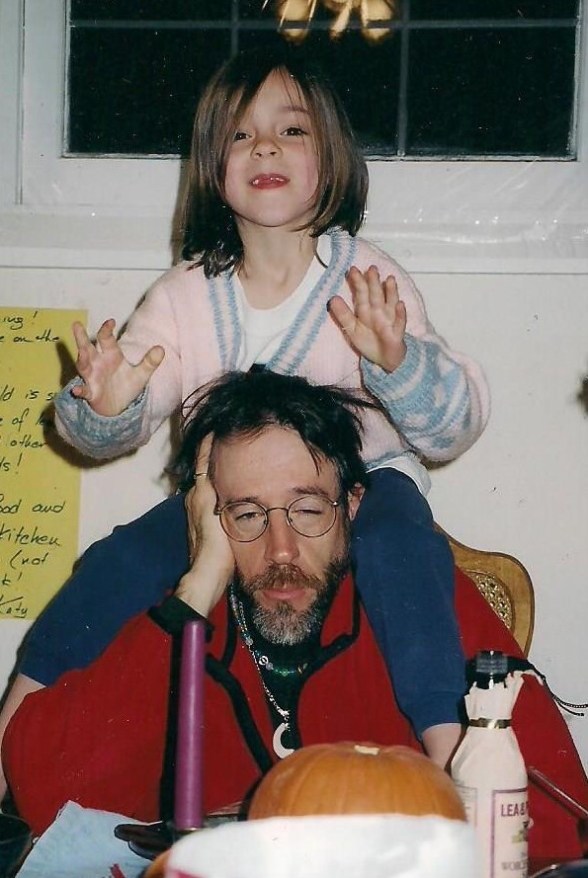
This is such a great dad pic. Climbed on and tired and putting up with it. And my daughter is having a grand time. She’s getting a bit big for that, too!
For the Ragtag Daily Prompt: moustache.

I grew up with lots of music. My father played guitar and lute and Segovia is engraved in my memory. He and my mother sang in large choruses: the Brahms Requiem, the Mozart Requiem and Bach. We had lots of classical records. I was born in the early 60s when my parents were in college, so they had tons of records. The Band, Bob Dylan, the Loving Spoonful, Joanie Mitchell, Oscar Brand and Jean Richie. I didn’t buy my first record until I was in my early teens and I bought ABBA. My father said, “This is POP!” I said, “I am a 14 year old girl. OF COURSE it’s pop and it’s really good.” He was mildly horrified.
We sang folk songs. My parents were editing them by the time I was three, because I was memorizing the words. They put the naughty folk song records away. They avoided sentimental songs. We learned “dead girl songs”, as my sister called them (Banks of the Ohio, Long Black Veil, Clementine, When I was a Bachelor, there are a lot of educational dead girl songs). We learned lots of comic songs. We also learned work and protest songs and absorbed our parents’ hatred of discrimination.
I set up a recording session for my father and sister and I after my mother died. I have a recording of us singing Long Black Veil and other songs. Here is The Band singing it.
Let’s have a band with women too, and for me that is Sweet Honey in the Rock. Acapella, with a sign language translator, and now they have been singing for ?forty years? They have amazing children’s songs and they are willing to sing about grief and protest. They have sustained me through the loss of my mother, sister and father.
And from one of the children’s albums.
The photograph is of my father at his 70th birthday in 2008. Malcolm K. Ottaway, with Andie Makie and Coke Francis. Andie is playing harmonica, my father on guitar. Malene Robinson took these photographs. The next is me and my sister at that party.
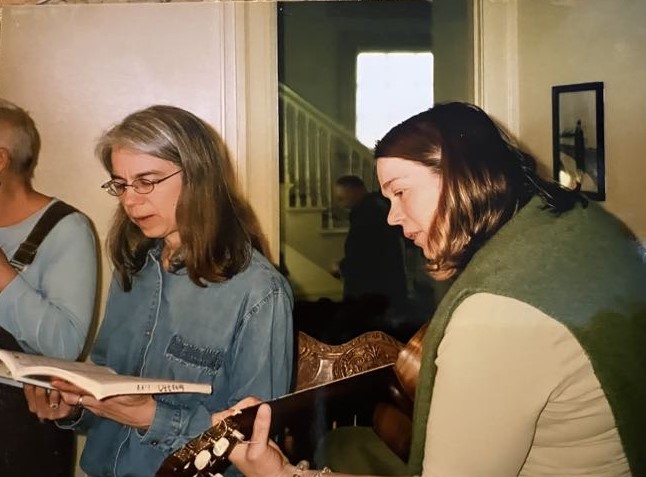
And one more of my sister, Christine Robbins Ottaway.

For the Ragtag Daily Prompt: bands. Wait, you said keep this light. Oh, well. Fail on that.

When my (now ex) husband and I were first married, we bought two gold chains. I was just starting medical school. Third year we hit the wards. This meant that I was often running around the hospital wearing scrubs, rings off. I wanted a chain to put my wedding ring on. Some people tied them to their scrub pants, but they can get lost.
I go home from Richmond, Virginia to Alexandria. We show the chains to my parents, both used ones, but gold.
My sister reports to me later. “Our mom said, why are they buying gold chains? That’s dumb. They don’t have any money!”
“Maybe they want them,” says my sister.
“Well, I think it’s a waste.”
“You bought more paper the other day.”
“Oh. Hmmm, yes I did.”
“You aren’t using that paper yet and you have an entire vault of paper.”
“Yes, but I am an artist. I need supplies.”
“Katy wants the chain for work to put her ring on. How is that different?”
“Oh, well. Maybe you’re right.”
I am very pleased that my sister defends me but it also was very funny. My mother had a stack with one by ones with thin 24 by 30 boards, on them, stacked five feet high to put paper in. Cheap shelves, though it would be totally unstable in an earthquake. She bought paper that she loved and used it too. She did watercolors, etchings, carried a sketchbook everywhere, oils, scorned acrylics, woodblocks, clay, colored pencils, chalk pastels, oil pastels and then she loved crafts as well. She was a master of paper mache. Artists need supplies, but everyone has something like that. My daughter did not get the pack rat gene and is a minimalist, but even she has some things she really likes. Real stationary, for one.
I wore that chain for more than 14 years. We were divorced at 14 years but are still good friends. My ex went on the nursing school and has been a Covid-19 hero, much to some people’s surprise.
My mother was inconsistent, as we all are. She prided herself on being frugal and not spending money, but when it came to art supplies, she wanted them. She still could be frugal but she certainly had the supplies and she would stock up when beautiful paper was on sale! And pencils and pastels and watercolors and oils. My father would quote Ralph Waldo Emerson, “A foolish consistency is the hobgoblin of little minds.” Both he and my mother would call each other out when one was being inconsistent. They could be very very funny.
The lead photograph is from winter 1991-92. Mark Warren Wilson, Helen Burling Ottaway, Christine Robbins Ottaway, me and Malcolm Kenyon Ottaway. Taken by Joel F., my sister’s first husband, with my camera. This next was taken by my father and there is Joel F. We went to Colorado and all stayed in a condo and skiied. My father found out that he really did not like heights, either driving or the ski lifts. Joel and Mark staged a pretend dramatic argument making fun of Chris and my arguments, and they were right on. We were quite embarassed and annoyed, but not instantly cured. And the skiing was delightful.

My mother, father and sister have all died. I do miss them. Hugs for all the recent losses of people.
For the Ragtag Daily Prompt: inconsistent.

Terrible photograph, right? But look for the deer. Two can be seen, and there was a third, another fawn.
First I see the buck in my yard.
Then I see him across the street with two fawns. I didn’t get a good picture of all three. But he did that deer thing where they tell the fawns to stay put. I go over to that neighbor’s house for coffee and here are the fawns.

Fawn lying under an apple tree on a lawn.
This is the second year that I have seen a buck with fawns. This time two fawns. The fawns are still spotted but about twice the size of newborns.
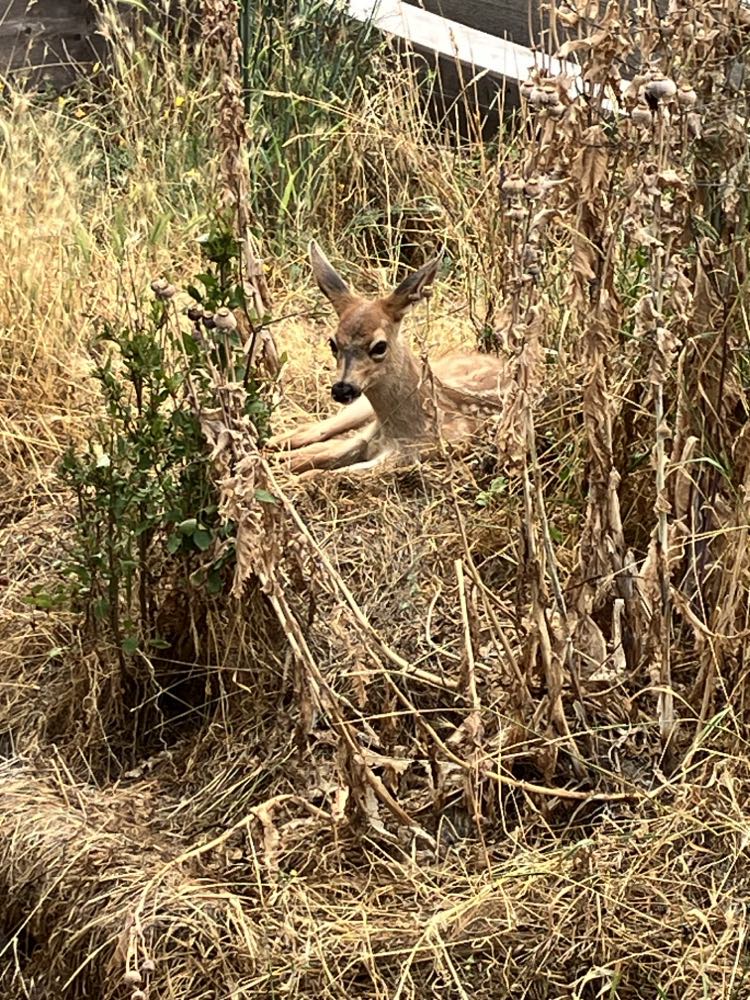
I don’t know if the buck is babysitting for the day or if something happened to mom. The fawns don’t move when I walk past and go in the house. I only see the second one because I am looking for it. This is a busy street, but the deer are pretty safe as long as they don’t get hit by a car. We have to pay attention in the early morning and twilight. The deer do teach the fawns to cross at crosswalks too, at least, the moms with fawns are. I think the big bucks have decided they can cross where ever they want.
“White-tailed deer mate in the fall (October – December). The male deer (buck) plays no role in raising fawns.” from here: https://dnr.maryland.gov/wildlife/Pages/plants_wildlife/Deer_Fawn_FAQ.aspx. That is a different species. Ok, try information on Washington deer: “Adult bucks take no part in raising fawns, and generally remain solitary or form bachelor groups throughout the summer.” from here: https://wdfw.wa.gov/species-habitats/living/species-facts/deer#. Apparently our deer have not read the manual. Or maybe those two spotted ones are males, but I can’t really tell yet.
Our deer are bucking the trend, aren’t they? Deershines instead of monkeyshines?
For the Ragtag Daily Prompt: monkeyshines.

I would tell my pregnant patients not to let anyone tell them a really difficult delivery story until after their own delivery. “Blame me,” I would say. “Tell them your doctor says you can’t listen right now.” So if you are pregnant, read this after the baby arrives.
Umbilical cords can be scary.
I delivered babies as part of Family Practice for 19 years. I was good or lucky or both. I still saw scary umbilical cords. Cords with a true knot, where the baby has managed to tie a knot moving around. More than one of those, not tightened down. Cords with two blood vessels instead of three, which can be associated with birth defects or genetic abnormalities, but not always. Cords with an abnormal insertion. I was waiting for the placenta once, with the baby in mom’s happy arms. One puts “gentle traction” on the cord to tell when the placenta is ready. I felt like the cord tore a little. I promptly call the ob-gyn. He arrives and tears the cord off. He then gives mom some “forget this” medicine and very gently gets the placenta with a ring forceps. The cord had a velamentous insertion on the placenta. This means that instead of going all the way to the placenta and diving in and spreading, the three vessels separated a few inches from the placenta. Not very well attached and I had torn one of the three vessels. Mom and baby did fine and I was glad I had called the ob-gyn. One of the scariest umbilical cords was normal but wrapped four times around that baby’s neck. Luckily I had called the ob-gyn, she agreed something was off and mom agreed to a casaerean section. Whew.
Most umbilical cords are not scary and most deliveries are wonderful. I loved holding new babies and saying hello and welcome.
The photograph is my son, about four hours old.
For the Ragtag Daily Prompt: umbilical.
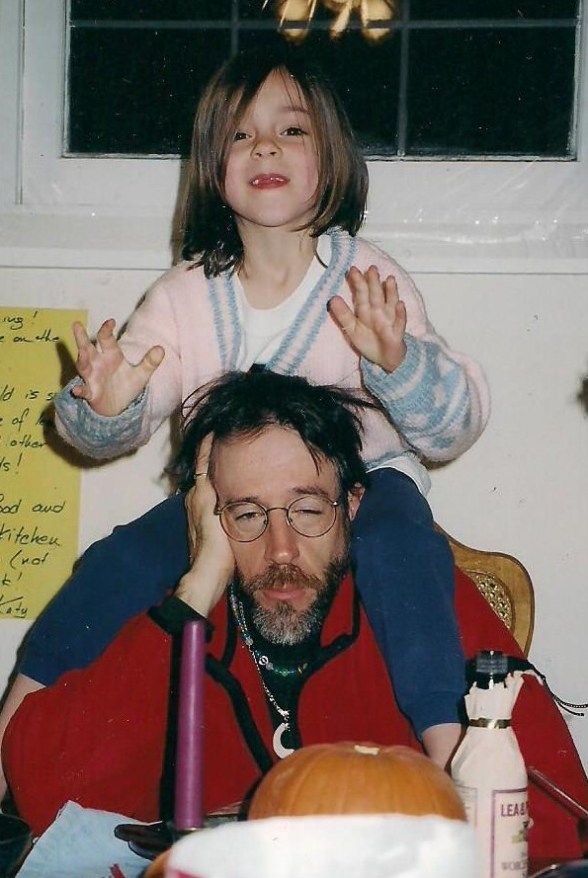
The father looks a bit more tired than the daughter, doesn’t he? Hooray for all the fathers parenting in spite of fatigue! Happy Father’s Day!
Taken in the early 2000s.
For the Ragtag Daily Prompt: thrive.

Sleep is not evil. Nor is snoring, though you might think someone is evil at 2 am if their snoring is keeping you up.
This is a small watercolor, 9 by 6 inches. Again, no date, but it is a view near my parent’s house in Chimacum. They loved that house and the views. They moved there in 1996 and my mother was diagnosed with cancer a year later. I want to end with this painting because they were so happy there, even with the cancer. They had wanted to move to the northwest for years, but waited until my grandmother died. She was in her 90s and they were afraid to move her. After she died, it took three years to find a place and sort things and move.
So let’s end with them sleeping and waking to morning and the sun coming over the mountains and the farms around them and the views.

F is also for Final. Death is frustratingly final. I can keep talking to the person, but they don’t talk back, except maybe in dreams. Even then, it’s my version of them.
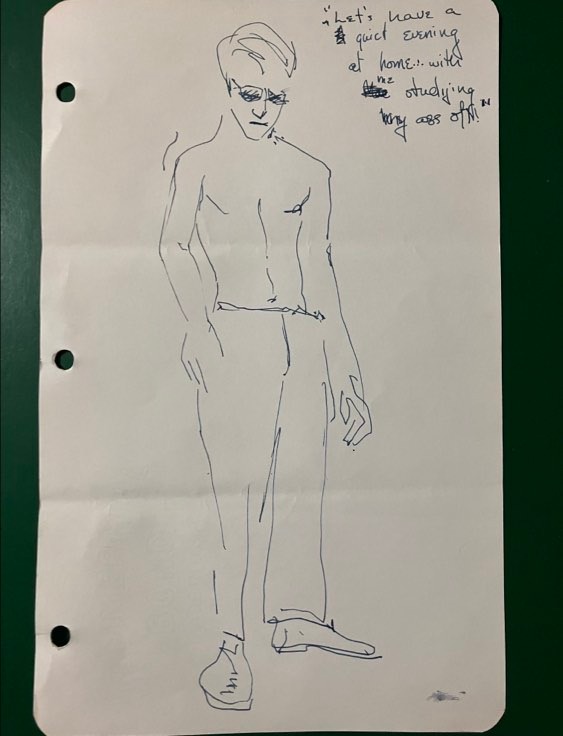
F is also for fine art and father. This is a drawing of my father in college by my mother. My mother did art all the time and carried a sketchbook around nearly all the time. Every so often she mislaid it, searched, and started a new one until the old one surfaced. I was two when she did these drawings. My impression of fine art was that it involved continuous practice. My mother thought about art most of the time, as her diaries confirm. I love the sketch books.
These two drawings are on notebook paper. My mother sent them to her mother with letters when I was two. My grandmother was in Europe.


My parents did not do karaoke. They held sings.
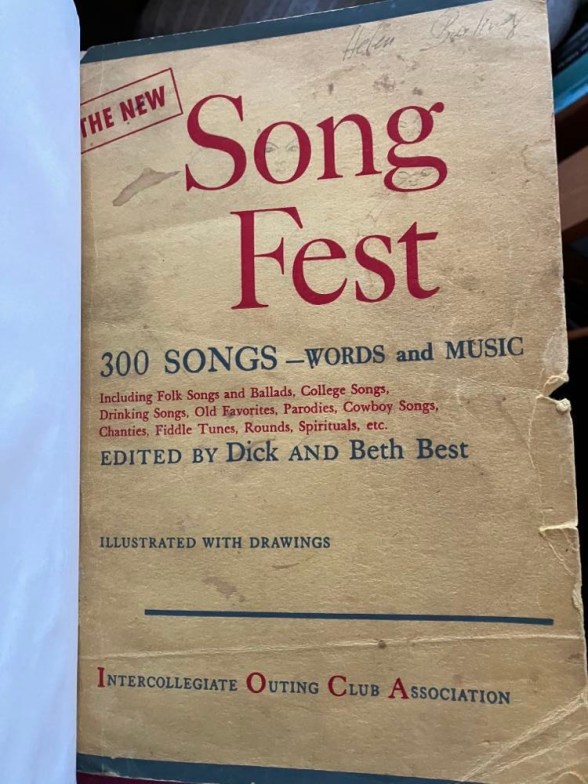
In college, late 1950s and on, they would have a sing. My father played guitar, they would invite all their friends, and sing folk songs. They used the book in the photograph, Song Fest, edited by Dick and Beth Best. Last published in 1955, I think.
I have no memory of the book itself. However, a friend of my father’s bound his copy in 2003 in leather. When I saw it, I searched on line and bought my own. It has words AND MUSIC and a chord progression. When I opened it, I know a song from about every third or fourth page.
My sister and I memorized the songs. We both had hundreds of songs memorized, many from this book, or from records. We photocopied a Beatles record insert and memorized all the words on a long car trip once.
I don’t know much about the Intercollegiate Outing Club Association, but there are still copies of Song Fest on line. My parents had to edit a number of the songs for two small children, since we were picking them up. They chose silly songs, “Dead Girl Songs” (Banks of the Ohio, Long Black Veil, My Darling Clementine, Cockles and Mussels) and work/protest songs. They rarely sang sentimental songs, except for lullabies. I loved to sing. We used to have reel to reel tape with my little sister singing a fifth off when she was three or four, but it disintegrated.
My father, Malcolm Kenyon Ottaway, was a fabulous musician. He sang in prep school, in college, in choruses on the east coast, in Rainshadow Chorale from 1997 until his death in 2013. He loved Bach and the Band and loved to encourage other people to sing. He was in our Community Chorus for years, to help new singers. People must try out for Rainshadow Chorale, but Community Chorus is for anyone who wants to join and sing. After my father died, men would say, “I would try to stand near your father in Community Chorus, to help learn the part. He was so good.”
Here is one of the lullabies from Song Fest:
At the Sings, my parents would start with a song and then go around the room, asking other people to pick songs. Sometimes people were shy, but my folks were really good at getting people to sing. Sometimes we’d have multiple guitars and other instruments. My sister and I had favorite songs too!
For the Ragtag Daily Prompt: karaoke.
If I have had PANS since birth, who would I be if I had not contracted it?
No one knows. We are still arguing about whether PANDAS and PANS exist. But, my daughter says, we make up all the words. The definitions of illnesses CHANGE over time, and what an illness MEANS. Tuberculosis was an illness of poets and people too noble for this world, until microscopes became advanced enough to see the tiny bacterium, and then it became an illness of the crowded unclean poor. Medicine and science continued to study it. Once we recognized that it is an airborne illness, tuberculosis sanatoriums were set up, to quarantine people. My mother was diagnosed with tuberculosis when she coughed blood 8 months pregnant, so I was born in a sanatorium and avoided contracting tuberculosis as a newborn.
Antibodies cross the placenta, even though the tuberculosis bacterium does not. Usually infants contract tuberculosis and die, at least when I was born. The antibodies can trigger PANS or PANDAS.
The antibodies prime the fetus’s immune system. This makes sense, right? The fetus has a sick mother and best if its’ immune system is ready to fight.
Did my younger sister have it? I do not know. Not as badly, would be my guess. My mother said that as kids, we’d both get sick, but I got sicker. We both had strep A many times. My sister got mumps, off from school for three weeks, and I did not get it. But I got everything else.
Now the estimate for children with PANS or PANDAS is 1 in 200. This is enormous. A high prevalence. Antibodies, that I suspect are adaptive and lie in readiness for a pandemic or a crisis. And now we have had another pandemic, with the last really world wide bad respiratory one 100 years ago. Is the prevalence rising because of the pandemic or are we figuring out some of the cause of behavioral health illness or is the definition of illness changing or all three? I think all of them.
My cousin’s mother had polio either during her pregnancy or very soon after. My anthropologist uncle took his family to Bangladesh, where he was doing linguistics. So does my cousin have PANS or PANDAS? I do not know.
And what of my children? My pregnancy with my older child was fourth year medical school and went well. My pregnancy with my second was very complicated. I was in my first year of work as a rural Family Practice doctor and working too hard. I ended up on bed rest for three months and on a medicine. Is labor at 23 weeks an illness? Does it affect the fetus? I was on medicine from 23 weeks to 37 weeks. What effect does it have?
Medicine is still changing and changing quickly. We don’t know. There is so much we do not know.
_______________
PANS/PANDAS: https://www.pandasppn.org/guidelines/
_______________
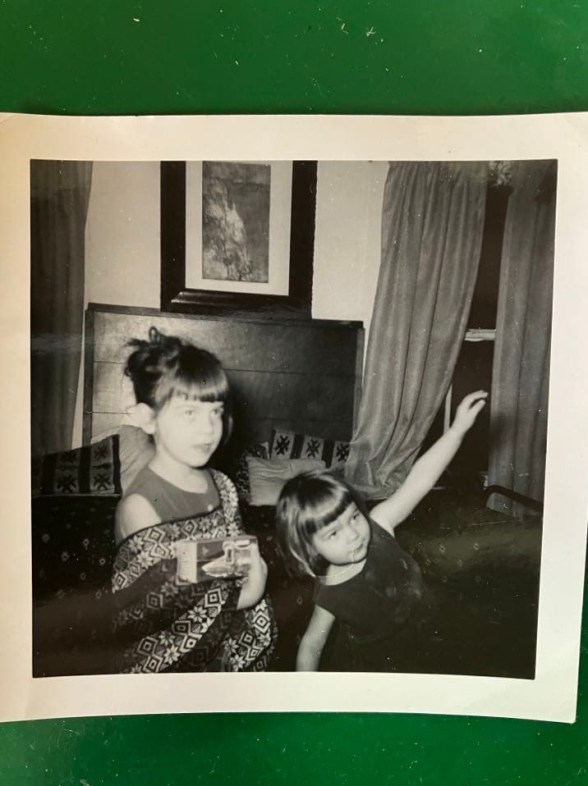
The photograph is me and my sister, in about 1967ish. I do not know who took it.
BLIND WILDERNESS
in front of the garden gate - JezzieG
Discover and re-discover Mexico’s cuisine, culture and history through the recipes, backyard stories and other interesting findings of an expatriate in Canada
Or not, depending on my mood
All those moments will be lost in time, like tears in rain!
An onion has many layers. So have I!
Exploring the great outdoors one step at a time
Some of the creative paths that escaped from my brain!
Books, reading and more ... with an Australian focus ... written on Ngunnawal Country
Engaging in some lyrical athletics whilst painting pictures with words and pounding the pavement. I run; blog; write poetry; chase after my kids & drink coffee.
Coast-to-coast US bike tour
Generative AI
Climbing, Outdoors, Life!
imperfect pictures
Refugees welcome - Flüchtlinge willkommen I am teaching German to refugees. Ich unterrichte geflüchtete Menschen in der deutschen Sprache. I am writing this blog in English and German because my friends speak English and German. Ich schreibe auf Deutsch und Englisch, weil meine Freunde Deutsch und Englisch sprechen.
En fotoblogg
Books by author Diana Coombes
NEW FLOWERY JOURNEYS
in search of a better us
Personal Blog
Art from the Earth
𝖠𝗇𝗈𝗍𝗁𝖾𝗋 𝖶𝗈𝗋𝖽𝖯𝗋𝖾𝗌𝗌.𝖼𝗈𝗆 𝗌𝗂𝗍𝖾.
Taking the camera for a walk!!!
From the Existential to the Mundane - From Poetry to Prose
1 Man and His Bloody Dog
Homepage Engaging the World, Hearing the World and speaking for the World.
Anne M Bray's art blog, and then some.
My Personal Rants, Ravings, & Ruminations
 KO Rural Mad As Hell Blog
You must be logged in to post a comment.