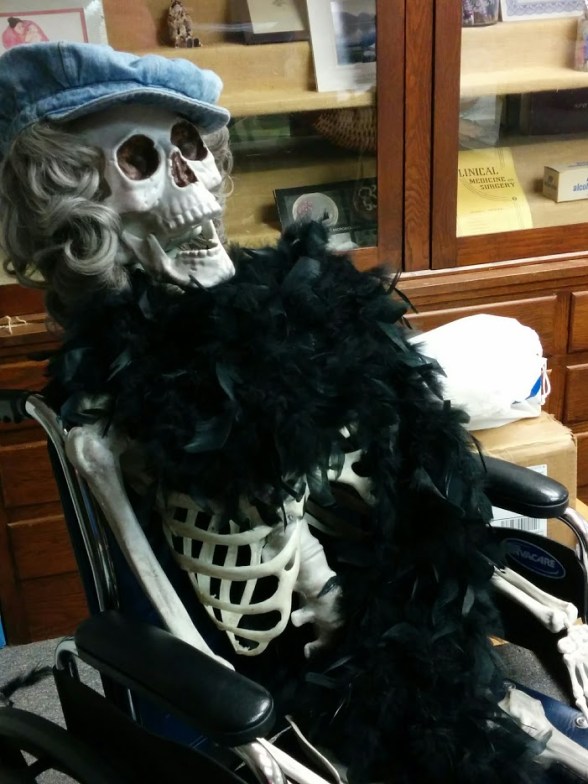
the mystic E2 dragon

We are writing a quest where we ask different people to write more about a topic. The requests are anonymous and some are for existing titles that have no write ups. This topic was given to another person and then I was asked to write about it as well. My sister was an editor on the everything2 website. She was born in the year of the dragon. She died of cancer in 2012.

_____________________

the mystic E2 dragon


“Hey.”

“Hey.”

“They want me to write about the mystic E2 dragon.”

Laughs.

“So I think of you.”

Silence… a weight. “So it’s me?”

“No, but you are a dragon, born in the Year of the Dragon.”

“Like we’re Chinese.”

“Yeah, well.”

“And you are an ox.”

“Thanks.” I wait. “Come on, show up.”

The dragon is made of a coat hanger, a rough gold cloth and black felt hand sewn to the body, thin gold cloth on the wings, gold earrings with rubies for eyes. Probably fake rubies, I’m not sure. I made it in college, tail to curl around the neck so that it can sit upright on my shoulder when I walk around. A gold fire lizard. I gave it to my sister, who said I could take it back when she lay dying.

The dragon morphs and now fills the living room, pushing on the walls and squashing me. The scales are hard and hot!

“Stop it!” I say, “Don’t destroy the house!”

The dragon is now couch size. My couch groans under it. The dragon is very alive and smoke rises from her nostrils. It manages to look like my sister, like a dragon and like the borg all at once. Metal and wires on the left side of the dragon’s face, eye socket with a metal camera that whirrs.

“Mind the couch.” I say.

She shifts a little, not shrinking. I peel myself off the fireplace, with the ache of the metal insert and the mantel on my back.

“So.” I say, “what should I tell them?”

She narrows her eyes at me and shrugs.

“What do they want to hear?”

“You tell me.”

“Keep the site alive.”

“Yeah, ok.” I wait.

She looks around. “Your dust bunnies are dying of old age.”

“That’s ok.” I say. “They are better than a guard dog.”

She snorts smoke.

“Tea?” I say. I have it made already, on a tray. The tray was painted by one cousin, the tea cloth woven by another, the teapot made by our mother, with my poem on it.

She takes the cup and saucer delicately. Five claws on each forefoot.

“What’s it like?” I say.

Shrug again, as she sips the tea.

I wait.

“I’m not telling you. And this is your active imagination, so what a stupid question.”

“But I am talking to the unconscious.”

“Yeah, whatever. And anyhow, you’ve already decided, puny human.”

“Ox.”

“Ok.”

And here a curtains drops, while I thank her and we say goodbye.


Submitted to the Daily Prompt: candid.

forgiveness 2

I am failing to forgive
I am succeeding in forgiving

The people that I have let go
I have forgiven
I do not plan to see them again
They have hurt me grievously
They have had time and time, years
to contact me and to listen
They choose not to
I let them go
I am tired of being hurt
They have no remorse nor kindness

It is the people that I hold on to
Some hope that they are loving
Some hope that they will listen
Some hope that they won’t believe the stories
They still hurt me grievously
They do not answer and make no move
Listening loving healing

I have to let them all go

And then I can forgive
Beloved, I want to forgive

And there is no reconciliation
When no one will listen


For the Daily Prompt: finally.

I shall leave you

My poems start with a problem, an idea, a worry. I never know where it will go when I start. This poem started with wanting to leave in a positive way and started with the title. So how could I leave but leave with kindness? And what would I leave?

So it is a song. And should include sign language, I think….

I shall leave you

I shall leave you with a song
I shall leave you with music
I shall leave you with a picture
I shall leave you with voice upraised

I leave you with a song
I leave you with music
I leave you with a picture
I leave you with voice upraised

I leave you a song
I leave you music
I leave you a picture
I leave you voice upraised

I leave a song
I leave music
I leave a picture
I leave voice upraised

leave a song
leave music
leave a picture
leave a voice upraised

a song
music
a picture
a voice upraised

song
music
picture
voice

song

containment in ceremony

This is for Taleweaver #147 – What brings you joy?

My minister talks about containment in ceremony.

That the ceremony can be a container for us to handle our worst selves and our best selves safely.

The Catholic mass is an example, particularly when it was in Latin. That it takes us through horror and suffering and death and then resurrection. This past weekend we performed the Mozart Requiem, from grief through joy.

My minister says that Western Civilization has lost the container for spirituality in the churches and instead holds the sacred in a love relationship. He says that the projection of one’s best self on the loved one can then flip into the projection of one’s worst, if we are not careful. We are attracted to people who have some of the aspects that we hide in our unconscious, so these are activated and projected. We magnify the talents and the beauty and wisdom of the love object. They are not real. True love is when we can slowly withdraw the projection and see the actual person who is there and then really love them.

I am taking a class where we are reading The Maiden Tsar. I am thinking of the chicken feet that Baba Yaga’s house stands on. We say that a person is chicken when they are afraid and won’t go forward, a coward. So Baba Yaga’s house on chicken feet: it is a house of fear, fear alive, terrifying. And what do we find in this most frightening place? We find that that our culture has most devalued: an old woman, not beautiful, not fertile. And she cares nothing for logic. In order to meet her challenge and not be destroyed, we must use our intuition, not our logic. No linear thinking, but a respect for magic and for humor.

I am thinking of the grandmother theory, that women have a dramatic menopause because they are the tribal memory. They have to survive the famine, raise the grandchildren, remember where there might be food, remember tricks and things forgotten. A useful man may remain fertile for the tribe, but a useful woman loses hers, because she is now a walking repository of knowledge. And western civilization has denigrated and ignored her: so she lives in the house with chicken feet.

My children are now adults but they do not have children yet. I am a practicing grandmother though. I am living alone for the first time in 28 years. I practice on other people’s children. A two year old loves my house: there is a stick dragon in the closet that roars if you press his throat. There are toys that he can’t take home. “That is mine. You may play with it while you are visiting.” I put a towel on the floor and get the espresso set out. I have never made espresso. He sits on the towel and pours water from the coffee pot until the cup overflows, the saucer overflows, the towel is soaked. He looks up at me, holding the coffee pot. “More?” I say. He hands it to me and I fill it with water again. His mother is surprised that he is wet from head to toe when she picks him up. By then the towel is cleared, the coffee set is drying, and he and I share a glance, our secrets safe. Until the next visit.

hypertension: The 2017 Clinical Guidelines

A visual guide to the new hypertension guidelines: https://www.medpagetoday.com/cardiology/hypertension/69399
In writing: http://www.acc.org/latest-in-cardiology/ten-points-to-remember/2017/11/09/11/41/2017-guideline-for-high-blood-pressure-in-adults
I don’t watch television news, so I always hear about these things from patients first. “What do you think of the new hypertension guidelines?”

“Haven’t heard about them yet, so I don’t know.” Seems pretty embarrassing really, doesn’t it? Shouldn’t I be alerted as a doctor before it hits the news?

First of all, these guidelines are NOT JNC 9.

What is JNC 9, you ask?

One of the messy complications of medicine for people in the US and in the world, is that there is not ONE set of guidelines. There are multiple sets of guidelines. Take mammograms, for example. The US Preventative Task Force* said that the evidence in their review could not differentiate between yearly and every other year mammograms. They said you could do it every other year. The American Cancer Society and the Susan Koman Foundation yapped and had different guidelines, do it yearly. So as a physician I have to not only pay attention to the guidelines but know who is putting them out. The radiologists wanted yearly mammograms too, surprise, surprise.

And do you think some of it is driven by money? Well, it’s the US.

JNC 8 is the Eighth Joint National Committee and put out guidelines in 2014. Their job is to review all of the big hypertension studies since JNC 7 and put out new guidelines. JNC 8 took over a year, was multidisciplinary, and the final document was 400+ pages.

They said that if a patient was over 60, their blood pressure should be taken standing up, and the goal was under 150/90. Under 60, sitting, goal under 140/90. Normal is 120/70 and below.

Then there are pages and pages of recommendations about which medicines to use and in special circumstances, that is: diabetes, kidney failure, heart disease, atrial fibrillation, etc, etc.

The cardiologists promptly started yelling about how JNC 8 is wrong and they put out a huge study saying that people have less heart attacks if their blood pressure is 125/80 or below.

But… the heart is not the only organ in the body. My patients are 77% over age 50 and 48% over 65. Once a person hits 80, their blood pressure may drop when they stand up. Most do. And low blood pressure, well, it’s bad for the over 80 crowd to get poor blood flow to the brain or to the kidneys or to faint and break things. That is why JNC 8 is multidisciplinary: because we need geriatrics and psychiatry and ortho and family medicine to be part of the guidelines.

So these NEW and IMPROVED guidelines. Well, who is putting them out? American Heart Association, American College of Cardiology, and a bunch of other mostly heart related organizations. And they are comparing it to JNC 7, not JNC 8. JNC 8 is being ignored. This document is a mere 192 pages, with the “short” version being 112 pages.

It says that blood pressure 130/80 to 140/90 is stage I hypertension, not prehypertension, and that we should treat it with lifestyle changes. Drugs are still to be recommended at anything over 140/90, though honestly, I start with lifestyle there too. Over 180/120 is now “hypertensive crisis”, consult your doctor immediately. 140-180/90-120 is stage II hypertension.

How will this change my practice? I am still thinking about the new guidelines and who has skin in the game. The AAFP (American Academy of Family Practice) put out a link to the guidelines and then a cautious comment to the effect of “We are studying how we should respond to this.”

Before this came out, I would tell people the JNC 8 goals. I do stand the people over 60 up, most of the time. I also tell people that the cardiologists want their blood pressure lower. And then that the cardiologists mostly ignore hypertension and cholesterol guidelines anyhow. If I follow the guidelines and then the patient sees a cardiologist, the cardiologist usually changes something. Guidelines be damned.

It comes down partly to a patient’s goal. I have people come in and say, “I don’t want to die of dementia!!” I see that as an opening. “What DO you want to die from?” People have different ideals. Some say, “I don’t want to die!” but then many do think about it. Sometimes this changes their ideas about what they want treated and what they don’t want treated.

Not everyone’s blood pressure drops in their 80s. Some people develop hypertension in their 90s. I tell them. They say, “I’m not taking a drug!”

I reply, “Let’s talk about strokes.”

They usually are not afraid of sudden death, but they don’t want the disability of a stroke. Many choose medicine after all.

One of the issues with guidelines is complexity. I could spend 20 minutes with a patient just talking about hypertension guidelines and choices of drugs and side effects and why they should be on an ace inhibitor or ARB if they have diabetes…. and there are guidelines for EVERYTHING. Sometimes conferences feel like all the specialists yelling: only half of diabetics are controlled, only one third of hypertensives are controlled, family doctors aren’t screening for urinary incontinence enough, osteoporosis, lung cancer, stop smoking! And then what my patient really needs is to talk about their adult child, in jail for addiction, and how frightened they are about overdose and the grandchild and the future…..

JNC-8 flowchart: http://www.nmhs.net/documents/27JNC8HTNGuidelinesBookBooklet.pdf
JNC-8: https://jamanetwork.com/journals/jama/fullarticle/1791497
*lots of guidelines: https://www.uspreventiveservicestaskforce.org/
teens high risk for addiction

What teens are at high risk for addiction?

Would you say inner city, poor, abused, homeless?

This study : Adolescents from upper middle class communities: Substance misuse and addiction across early adulthood. which I first saw in WebMd, says that the privileged upper middle and rich children are at higher riskย  for addiction than many of their peers.

350+ teens in New England were studied.

Drug and alcohol use was higher than across country norms, including inner city.

Rates of addiction diagnosis by age 26 were
19%-24% for girls
23%-40% for boys
These rates are two to three times the norms across the country.

Rates for addiction diagnosis by age 22 were
11%-16% for girls
19%-27% for boys
These rates are close to the same in girls, but twice as high in boys as peers across the country.

The teens were often popular high achievers who are A students. Parents tended to drink more in those cohorts than the norms.

Also: “Findings also showed the protective power of parents’ containment (anticipated stringency of repercussions for substance use) at age 18; this was inversely associated with frequency of drunkenness and marijuana and stimulant use in adulthood.” That is, parents who sent a clear message that consequences for illegal and underage substance use including alcohol and marijuana would be serious, provided protection for their teens.

A second article: Children of the Affluent: Challenges to Well-Being says this:

“Results also revealed the surprising unique significance of children’s eating dinner with at least one parent on most nights. Even after the other six parenting dimensions (including emotional closeness both to mothers and to fathers) were taken into account, this simple family routine was linked not only to children’s self-reported adjustment, but also to their performance at school. Striking, too, were the similarities of links involving family dining among families ostensibly easily able to arrange for shared leisure time and those who had to cope with the sundry exigencies of everyday life in poverty.”

Other children’s perception of parenting examined included:

felt closeness to mothers
felt closeness to fathers
parental values emphasizing integrity
regularity of eating dinner with parents
parental criticism
lack of after-school supervision
parental expectations

This aligns with my observations both in my town and with patients. I see parents “check out” sometimes when their children are in their teens. “I can’t control him/her. They are going to use drugs and alcohol.” I told my children that if they partied I would NOT be the parent who says, “Oh, he needs to play football anyhow.” I would be the parent who would be yelling “Throw the book at him/her. Bench them.” And I saw parents of teens going out to the parking lot to smoke marijuana at a church fundraiser when it was still illegal. And saying “Oh, our kids don’t know.” I thought, “Your kids are not that dumb.” They invited me along. I said, “No.” And I really lost respect for that group of parents. What example and message are they sending to their teens? Yeah, cool, do illegal things in the parking lot, nod, nod, wink, wink.

Meanwhile, my children keep me honest. “You are speeding, mom.”

“Yeah,” I say. “You are right. Sometimes I do.” And I slow down.