Every day

Every day
I am thankful for clean water
water to drink
water to wash
I am blessed
by clean water

Every day
I am thankful for food
Good food
to cook
to eat
to share
I am blessed
by good food

Every day
I am thankful that I can stand
that I can walk
that I can carry things
up and down stairs
I am blessed
that I can stand

Every day
I am thankful that I can hear
voices of friends
voices of my family
all the music
my cat and birds
I am blessed
that I can hear

Every day
I am thankful that I can see
all the faces
all the smiles
the trees, the ocean, the birds
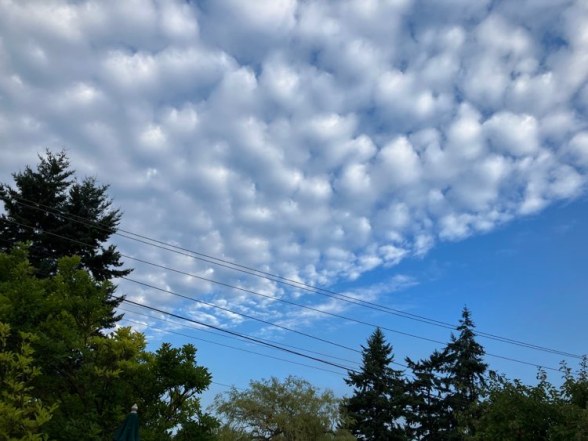
the ever changing sky
I am blessed
that I can see

Every day
I am thankful that I can touch
my cat purring
a vegetable for lunch
clothes and doors
friends to hug
I am blessed
that I can touch

Every day
I think of those
who cannot touch
who cannot see
who cannot hear
who cannot walk
who do not have food
who have no clean water
and some of them
are children

Every day
I am thankful
and grieving
at the same time

And I try to do a little
it’s not enough
yet

Some day I will be gone
or we will all have done enough

And every day I am still

thankful

________________

For the Ragtag Daily Prompt: warning.

Busy clinic

Clinic has been hopping. I have been at the present site now for six weeks, so I am starting to know a few of the patients. That is, the ones that are sick and I am worrying about. It is best if your doctor’s pupils don’t dilate when they hear your name.

I have been getting helpful calls back from specialists. I have a person who has high liver tests where hepatitis and overweight and alcohol don’t seem to be the cause, so I needed an updated list of what labs to send for some of the less common liver problems. Thyroid disease, hemochromatosis, alpha one antitrypsin deficiency, smooth muscle antibodies, various other antibody disorders. The list is quite a bit longer than in the past. I warn my patient that some will come back right away and some may take a week or two. The patient is anxious and wanted to go right to the emergency room, but I ask them to wait: I get a call back from gastroenterology within 24 hours to set up the current laboratory order list.

For liver tests, we ask about alcohol intake first. Then look at weight: a high body mass index can cause fatty liver disease. Unfortunately, that can lead to cirrhosis and liver failure, so it is not trivial. We check for hepatitis A, B and C. Then we start looking for the less common causes. My person is relatively young, but that is with me taking care of age 18 and up. I tell my person not to take any supplements, I look at any prescribed medicines. No alcohol for now.

The list of tests changes quickly. If I have not worked this up recently, it’s good to check in with the specialist. The gastroenterologist may not be up to date on ankle sprains, but they are tracking the changes in their specialty. My specialty is everything, so sometimes I need a current update. Most of the specialists are just fine with this phone call.

Occasionally I do this by message. I have a new diabetic who has a cardiologist already. Diabetics are usually put on either an ace inhibitor or an angiotensin receptor blocker to protect kidney function. I message the cardiologist and get a fast answer. Start an angiotensin receptor blocker and the suggested dose. Also very helpful.

A patient tells me on the phone that I get an “A” for the day. I called them to check on them two days after changing a medicine dose and to say that the other specialist wants even MORE laboratory tests. The patient says she has not gotten a call from a doctor before. The “A” made me laugh, but it did feel good.

I am learning the local medical pathways and how to get things done in this particular medical system. The functional bits, the dysfunctional bits, and how to work around them.

For the Ragtag Daily Prompt: functional.

Sol Duc really likes staying in her pillow fort. Sometimes I want to hide in a pillow fort too. So much for being “grown up”.

Honey and the ants again

The next two times Honey feels the ants biting from the inside feeling are also on obstetrics.

Both times it is a VBAC. Vaginal birth after cesarean. The woman has has a cesarean section in the past and is trying for a vaginal birth.

Both times, Honey gets the biting ant feeling. There doesn’t seem to be anything wrong with the woman in labor, the nurse is relaxed, the fetal heart monitor looks ok.

With the first one it is the younger male obstetrician who is on call. He is a big man. He sits and peruses the monitor strip outside the room, taking his time. “There were some decelerations back here, but the heart rate looks fine now. Do you really want me to consult?”

Honey can’t stand still, the ants feel so bad. She tries to sound professional and calm. “Yes, this is a VBAC. I would like you to go in and meet her.” She is trying not to shoo him towards the room. He shrugs and gets up, not quite slouching towards the room, Honey trying not to jump up and down in impatience behind him.

In the room, he introduces himself. Again, Honey has not told her patient. The obstetrician says, “Dr. B. asked me to stop by since you have previously had a cesarean section, but everything looks fine.” Two minutes later she and the nurse and the obstetrician all alert as the the fetal heart rate monitor chirp slows, dropping from the 120s down to 60. THERE IT IS! thinks Honey. It stays down, they have the mother roll on her side and pop oxygen on her. It comes back up, but that is that. Off to the operating room. Again, they don’t have to do a crash cesarean. This time it is not clear what was wrong, but everything comes out well.

On the third round, it is the older male obstetrician. He looks at the strip and is calm and goes right into the room. He introduces himself and everything looks fine. Honey is wanting to dance from foot to foot from the ants. Again the fetal heart rate drops, right as the obstetrician gets up to leave the room. The nurse has the woman roll to her side and adds oxygen. The calm obstetrician gives Honey a look and has the nurse get the surgical consent. The heart rate is back up and off they go.

Honey wonders. Ants? Little voices? She knows that we all pick up information from body language and information that is not conscious. That could be a scientific explanation. Information that is not quite conscious. Honey decides that she really does not care what the ants are. When those voices speak, she listens. Who cares what it is, as long as it works.

______________________

What is the word? “Fictionalized”, from fallible, friable memory.

Honey and the ants

Honey is in her second year working. She escapes clinic because she has a labor patient. In the daytime! Not on a weekend or at 2 am! Hooray!

She has to hang out, because this is baby number five, so it could come really really fast. Everything is cool. The mom has more experience than she does, nearly. Well, Honey has done more deliveries, but has only had one baby.

Honey starts to feel itchy. Agitated. It’s not skin at all. Something is bugging her. She goes in and out of the room. The nurse seems totally unperturbed, but Honey feels like ants are attacking her, from the inside. She goes out the room and studies the rhythm strip, the baby’s heartbeat. There is a printer feeding out in the central nurses station.

Screw it, thinks Honey. I make look stupid, but I don’t care. She calls the obstetrician. It’s the woman who is on. Honey is a Family Medicine physician. They are in rival clinics. “Hi,” says Honey, identifying herself, “I need a consult on this woman.” She reels off the medical details, Gravida 5, Para 4, all vaginal deliveries, no complications. “I just feel like there is something wrong. There isn’t anything really bad on the strip. But I need you to come.”

The woman obstetrician comes. She sits and studies the heartbeat strip. Honey still feels like ants are biting from inside. The OB puts the strip down. “There is nothing on this that would get you in trouble. But you’re right: something is wrong. Come on.”

Honey has not told the patient that she’s calling the obstetrician. The patient might be annoyed. They go in the room. The obstetrician introduces herself. “Dr. B called me to consult. We have a bad feeling. We want to do a cesarean section.” Honey is sure the patient will say no. She is wrong.

“Me too,” says the patient. “Do it.”

They do the paperwork and move quickly to the operating room. Not a crash cesarean, not an emergency, so spinal anesthesia, not general. Honey assists.

They are in. There it is. The umbilical cord is wrapped four times around the infant’s neck. It has not tightened down. Honey has goosebumps as they gently unwrap the cord and do the delivery. The baby is fine, no problems, apgars of 9 and 9. They complete the surgery, mom is doing fine too. Honey still feels rattled but the ants have gone away.

The mother is relieved when she wakes, glad they did it, glad to hold her fifth child. The obstetrician is in charge of post operative and Honey is managing the baby. They don’t really talk about it, everyone acts as if it’s all routine. If the cord had tightened down, everything still could have been ok, but it would be a crash cesarean section, general anesthesia, more risky for everyone. It could also have not been ok.

Honey is relieved to go home, adrenaline draining away and leaving her very very tired.

Honey decides that she will listen to those ants, that feeling, any time it shows up.

______________________

Based on a true story, at least, on memories, that are unreliable. Aren’t they?

Frail

I wrote this poem about my father at least a year before he died. He was on oxygen, on steroids, terrible emphysema from 55 years of unfiltered Camel cigarettes. He would not accept much help and became more and more of a hermit. He did continue with the Rainshadow Chorale and because of it he quit smoking three years before he died.

Frail

We are going sailing
My partner says to me
β€œInvite him if you want.”

Then I am busy for a while

I think of calling, then forget

He was not at chorus on Monday

At last I say,
β€œI haven’t called. We’ll just sail.
Just us today.”

I haven’t called
because he was not at chorus on Monday

He is frail
55 years of camels
two packs a day
as if each cigarette
destroyed one alveolus
in his lungs
one tiny air/blood interface
built to exchange oxygen
and carbon dioxide
the loss is cumulative


He is frail
he is proud that the choral director
says, β€œI need you.”
He can’t sustain
but his entrances and time
are the best
among the basses.
They need him.

Chorus
is our winter link
two introverts
we hug at the start of chorus
sing for two hours
and talk for a few minutes at the end

Occasionally we go for a beer
I invite him for dinner
but he comes less and less
he often does not feel well at night

He looks smaller at chorus
this season
this is normal in emphysema
the body sheds weight
too much tissue to oxygenate
too hard for the lungs
and the heart, working overtime
to make up the difference
he is blessed with low blood pressure
genetic, from his father,
tough English stock,
otherwise I think he’d be dead

I didn’t call
before we went sailing
because I am afraid

I’ve driven out before
when he has not answered the phone
for a day or two
wondering if I would find him dead

I didn’t call
before we went sailing
because he was not at chorus on Monday
because if he didn’t answer today
I would not go

______________________

For the Ragtag Daily Prompt: frail.

Covid 19 and the heart

This is from the University of New Mexico Roam Echo PASC (Post Acute Sequelae of Covid-19) talk on 11/9/2023 over Zoom.

Cardiovascular Outcomes in Post-COVID Conditions
Jeffrey Hsu, MD, PhD, FACC, Assistant Professor, Division of Cardiology – University of California, Los Angeles Health and Founder, COVID Cardiology Program – University of California, Los Angeles 

I am going to include the references in the order that Dr. Hsu talked about them. This is a sobering and upsetting lecture with the research showing a post Covid-19 increase in cardiovascular risk factors (cholesterol, hypertension, diabetes), and an increase in cardiovascular events in people with no previous cardiovascular diagnosis including heart attack, stroke, pulmonary embolus, blood clots and sudden death.

I don’t expect the general population to read the studies, but look at a few of them. It is very very impressive, the amount of work being done. Now let’s explore the talk and boil it down to three sentences for primary care to explain in clinic. Right. (You can always skip to the last two paragraphs if you get overwhelmed, and come back later.)

Part 1: The Research.

The first paper is about veterans without cardiovascular disease, followed for one year after Covid-19, matched with a cohort who did not have Covid-19. This is before immunization was available. They were studying the heart and cardiovascular risk. The veterans who had had Covid-19 infection were twice as likely to be diagnosed with cardiovascular risk then the veterans who had not had Covid-19. The risk was higher in the veterans with more severe Covid-19, the risk was present in all subgroups: old, young, male, female, with or without other risk factors. At two years out, the people who had been hospitalized for Covid-19 still had a persistent increased risk of death and cardiovascular incidents (heart attack, stroke, sudden death, blood clots).

To be clear, this is NOT Long Covid patients. This is just a cohort of veterans who had Covid-19. This would indicate that everyone who had Covid-19 has an increased cardiovascular risk.

Here is the first paper: 1. https://www.nature.com/articles/s41591-022-01689-3

Two more papers looked at more general populations who got Covid-19 before the vaccine was available and found the same thing. The veterans tended to be older and more male patients, but the general population studies found the same pattern in women and younger patients. Papers:

2. https://www.scientificamerican.com/article/the-risk-of-heart-disease-after-covid/, “Health modeller Sarah Wulf Hanson at the University of Washington’s Institute for Health Metrics and Evaluation in Seattle used Al-Aly’s data to estimate how many heart attacks and strokes COVID-19 has been associated with. Her unpublished work suggests that, in 2020, complications after COVID-19 caused 12,000 extra strokes and 44,000 extra heart attacks in the United States, numbers that jumped up to 18,000 strokes and 66,000 heart attacks in 2021. This means that COVID-19 could have increased the rates of heart attack by about 8% and of stroke by about 2%. β€œIt is sobering,” Wulf Hanson says.

3.https://www.nature.com/articles/s41591-023-02521-2

Non hospitalized patients had decreased risk for some cardiovascular problems but not all and still had significantly higher risk than people who had not had Covid-19. I am busily thinking UH-OH, this is really bad, in this lecture.

He stated that the data is not in yet about vaccination, whether it lowers the cardiovascular damage compared to unvaccinated.

The initial study was on veterans, mostly male and mostly white, but then was replicated in other similar studies that were not on veterans, but on a general population.

From the second and third study, 700,000 patients with a mean age 40 and more than half female, were studied for new cardiovascular disease in the year following Covid-19 and found an increased risk of death within one year, 0.34% vs 0.28% HR 1.6. That was in 2020, a nonvaccinated population. Another study showed similar results, 13,000 patients with Covid-19 and 26,000 without, average age 51. There was a similar risk increase in cardiovascular disease and an increased risk of death within one year.

4. https://www.thelancet.com/journals/eclinm/article/PIIS2589-5370(22)00349-2/fulltext

5. https://jamanetwork.com/journals/jama-health-forum/fullarticle/2802095

So do other infections do the same thing? Studies of acute risk of myocardial infarction risk after influenza, done before the pandemic, indicate an increased risk of myocardial infarction within one week after infection, but not beyond that week. So Covid-19 is really really nasty to our cardiovascular system.

6. https://www.nejm.org/doi/10.1056/NEJMoa1702090

7. https://www.nejm.org/doi/10.1056/NEJMra1808137

Pneumonia and sepsis can increase risk of cardiovascular disease, but there have not been the extensive studies as in Covid-19. More and better studies.

One to two years after diagnosis, there is increased cardiovascular and cerebrovascular risk, both:

  1. Cardiovascular risk factors, worsening after covid
  2. Thrombosis risk

8. https://www.thelancet.com/journals/landia/article/PIIS2213-8587(22)00044-4/fulltext

The risk of is up diabetes 40% in the post Covid-19 patients. That does not mean that 40% are diagnosed with diabetes, but that the risk is higher after Covid-19. For example, if in the non-Covid cohort 100 of 1000 40 year olds develop type 2 diabetes, then it’s 140 of 1000 in the post Covid-19 group.

The risk of dyslipidemia in 50,000 patients went up 24%. Dyslipidemia means increased LDL cholesterol or increased triglycerides and lower HDL or all of them.

9. https://www.thelancet.com/journals/landia/article/PIIS2213-8587(22)00355-2/fulltext

10. https://www.ahajournals.org/doi/10.1161/HYPERTENSIONAHA.123.21174

Hypertension is up too and weight gain.

11. https://www.nature.com/articles/s41577-022-00762-9

New onset hypertension is up 22% in hospitalized patients post Covid-19 and 11% in unhospitalized post Covid patients.

Myocardial infarction (heart attack) and ischemic stroke both go up. Ischemic stroke is the more common kind of stroke and is the clotting version. Bleeding strokes are less common.

Why does Covid-19 do this? What is the mechanism? The studies are pointing towards thromboembolism as the mechanism in both increased cardiovascular risk factors (dyslipidemia, hypertension, stroke, heart attack, clots). Thrombosis means clots. Remember the talk about micro-clots? (My write up here: https://drkottaway.com/2023/04/14/xeno-or-infection-phobic/). Micro-clots can lead to bigger clots. A clot in a heart artery causes a heart attack; in the brain an ischemic stroke; a clot in the leg can break into pieces and block the lung arteries. Irritation in the heart and the arteries can increase blood pressure. I’m not sure how it can increase diabetes, but it does.

Next he shows a slide about thrombosis and how complex it is. Sars covid-19 seems to promote perfect storm of events that leads to environment for thrombosis in multiple ways.

Covid-19 infects epithelial cells, causes a hyperactive immune response, orchestrates subsequent response, causes platelet hyperactivation and then hyperactive innate immune response, causes damage to glycocalyx that protects and vascular endothelial injury, decreases antithrombogenic and increases prothrombogenic activity which promotes thrombosis in the vasculature, platelet activation and coagulopathy. Got that? No? Me either, my last immune system class was in 1988 when I was working at the National Institutes of Health. It’s bad, meaning it can kill us or cause damage that is disabling.

12. https://www.thelancet.com/journals/lancet/article/PIIS0140-6736(20)30937-5/fulltext

My notes are a bit disjointed here: The endothelial cells (which line arteries) express H2 receptors that Covid-19 virus needs to enter the cells. The H2 receptors are also in glomerular capillary loops (kidneys), and immune cells and cause apoptosis of lung endothelial cells. Apoptosis is a form of programmed cell death that occurs in multicellular organisms and some eukaryotic microorganisms. So you don’t want your lung cells doing that. Lung, small bowel, and pulmonary microvasculature can all be affected.

13. https://www.thelancet.com/journals/landia/article/PIIS2213-8587(22)00355-2/fulltext

Plaque in human coronary vessels, in the immune cells, spike and Sars cov 2 identified in coronary artherosclerotic plaque.

Direct on coronary and cerebrovascular cells. (Ok, I don’t know what I meant by this note.)

Part II: Now what? What is our approach to healing this?

There is still limited data! (The clinical trials are roaring along but they take time.) Here are a bunch of studies, all using blood thinners. Blood thinners include aspirin, plavix, heparin, enoxaparin or apixaban. Do NOT start aspirin at home at this point, because when you add a blood thinner, there is a risk of bleeding, including bleeding stroke and intestinal bleeding. So far, the studies are discouraging.

Aspirin 150Mg Recovery trial: no difference in mortality: major bleeding 1.6% vs 1/0 % Lancet 2022. This is a double baby aspirin dose, 30 days in study, no benefit in acute setting.

14. https://www.thelancet.com/journals/lancet/article/PIIS0140-6736(20)30937-5/fulltext

Non critically ill hosp patients ACTIV 4A trial P2Y12 inhibitor – heparin alone or clopidigril (plavix) plus heparin, no benefit, major bleeding 2.0% vs 0.7% so worse in the both group.

15. https://www.nejm.org/doi/10.1056/NEJMoa2103417

16. https://doi.org/10.1001/jama.2021.17272

Harmed patients with severe disease.

ACTIV-4B aspirin or apixiban in outpatient, stopped early, event rate low, higher rates of minor bleeding in the 5mg apixiban group.

Feedom covid 19 trial: Non ICU Hospitalized, compared prophylactic heparin to enoxaparin or apixaban. Signal to provide benefit, lower rates of death and intubation, similar bleeding rates

17. https://www.sciencedirect.com/science/article/pii/S0735109723045278?via%3Dihub

So what does our Post Covid Cardiologist recommend to physicians and patients:

First year post covid: look for cardiovascular symptoms.

Screen for risk factors, hypertension, diabetes, hyperlipidemia, obeisity.

Optimization of risk factors, smoking cessation (and I would add that alcohol also causes damage to the heart and arteries, though tobacco is worse.

Assess candidacy for statin therapy for primary prevention.

18. https://cardiab.biomedcentral.com/articles/10.1186/s12933-021-01359-7

There is a study of triple therapy (meaning THREE blood thinners) that showed improvement but that was in older patients who already have heart disease before Covid-19. So it doesn’t apply.

He says there aren’t any good studies of blood thinners in Long Covid-19 yet and it is not clear that the Long Covid people are worse as far as the cardiovascular risk than everyone else. And remember, these studies are on unvaccinated people, so for the year following the first year of Covid-19. We don’t have the results for vaccinated people. He says that if someone is high risk or has cardiac symptoms chest pain etc put on 81 mg aspirin and a statin (and work it up, of course. Do the testing.

For now use anticoagulation (blood thinners) only if there is clear evidence of thrombus: deep venous thrombosis or pulmonary embolus. Freedom covid-19 study showed major bleed risk 0.1-0.4%.

The cardiologist speaker has not started triple therapy on any patents given unknown benefit at this time, with known significant major bleeding risk. He recommends shared decision making, meaning the patient should be presented with the risks and choices. Um, ok, boil this talk down into three sentences. Good luck. EEEEEEE!

Part III: Summary.

Whether you had Covid-19 before being vaccinated or after, or aren’t sure if you ever had it, it is worth seeing your provider to check your blood pressure, do diabetes screening, stop smoking (anything, and I include vaping in that), reduce or eliminate alcohol, keep your weight reasonable, check your cholesterol and go to your provider if there is any weirdness post Covid-19. And if you have not been vaccinated, oh, my gosh. Unless you have an immunology problem where your immunologist says “NO!”, get vaccinated.

Lastly, I’ve heard many claims that death rates were “over reported” for Covid-19. No. In a death certificate, the acute injury or infection is reported FIRST and then other related causes. Such as: Covid-19, ischemic stroke, hypertension, tobacco overuse syndrome. There were MORE strokes and heart attacks and sudden death, with Covid-19 as the final straw in many people who already had cardiovascular disease. They died sooner than they would have if not infected. That is not over reporting.

____________________________________________________________________________

A friend, Brent Butler, took the photograph, used with permission. I think it shows how I felt after this talk. Yet I still have hope, because you can’t deal with something unless you know about it.

If you want a link for the talks, message me. Anyone can tune in.

Covid-19 continues to fandangle us. There. I verbed the Ragtag Daily Prompt: fandangle.
Marijuana update

https://newsroom.heart.org/news/marijuana-use-linked-with-increased-risk-of-heart-attack-heart-failure

Marijuana is still illegal at the federal level, but some states have legalized it. I agree with legalization but I don’t think of it as benign or safe at all. It’s clear that it can be addictive. A study of teens (with parental consent and where they paid the teens to try to quit for a month) showed that the teens that smoked daily had real trouble stopping, even when quite motivated. The U of WA Pain and Addiction telemedecine said that about half of daily users have “overuse syndrome” and have trouble quitting.

I worked with two people who were trying to quit. The big issues for them in quitting were insomnia and anxiety. Marijuana can suppress both anxiety and help with sleep. However, our brains do not really like that sort of daily interference. The neurons can remove receptors from the cell walls if they are feeling overwhelmed. It is like trying to listen to music with ear plugs. You turn the music up. The drug is the ear plug: when the earplugs are gone, the music is way too loud. We can’t really “turn the music down”, so it is not much fun letting the neurons recover.

With the edibles and THC vs the other one, it’s even more confusing. I had many patients taking edibles or tinctures to sleep. Some said, “Oh, it’s CBD, so it doesn’t make me high. So it is not addictive.” We do not know it that is true. With opioids, people can have opioid overuse syndrome without ever getting high, just from being on pain medicine as directed. And marijuana does not have only CBD and THC. There are over 300 different cannabinoids in the plants, and CBD and THC are just two of them. I have no idea if the edibles and tinctures have the other 298 or more and what they do to the cannibinoid receptors in our brains alone or in combination.

I don’t want to have any overuse syndrome: alcohol, opioids, gambling, marijuana, whatever. I know I can get off caffeine in 24 hours, though it involves an awful headache. I am nearly off coffee now, because my body only likes coffee when I have pneumonia. I quit coffee from 2014 to 2021 and now am quitting again.

The two studies in the article look at people who do not smoke tobacco and who are using marijuana. They are seeing an significant increase in heart disease, heart attacks, sudden death and congestive heart failure. Congestive heart failure is pump failure, where the heart does not pump correctly. This is a major problem, as you might guess.

Be careful out there.

I took the photograph at Fort Worden last week on a day where both the wind and the tide were howling.

Car situation

What did happen in my situation?

I am worried that a car will come around the corner and hit the car partway in the street. Plus, what if there is a medical situation? A heart attack, or drugs, or alcohol, or a seizure? I want help. I call 911. The dispatcher asks for the license plate and if I can see anyone inside. I give her the plate, but the car is fogged up, so I can’t see inside. This does make it more likely that someone is alive inside, but they could still be ill.

I wait, but I am anxious. I text my neighbor and ask if he will come back me up while I bang on the car. He comes out, but the police have just arrived. We wave and go back inside. I do peek out. There is a fairly young man and a dog, who get out of the car. He can walk without difficulty. They don’t move the car. The policeman leaves, then calls me. He says that the person is having an allergic reaction and is waiting to move his car until he can see. The car will be gone by the afternoon.

“Oh, thank you!” I say. “Can I take him coffee?”

“That would be nice.”

I go out and ask if he wants coffee. He does. I take him a cup and he leaves it on my steps. The car is gone later, so I hope he is much better. It’s lucky that he is on our side street rather than the faster main one. More chance of an accident there.

I did feel like a little old lady complaining about a strange car, but I was worrying about something medical more than a stranger. And with the possibility of alcohol or methamphetamines or opioids, I want help. We had an overdose death in our hospital parking lot within the last few years and our police have nalaxone to reverse opioids. I am very glad that it was not an overdose.

________________________________

For the Ragtag Daily Prompt: situation.

The photograph is my 1986 Honda Civic, not the car in the story.

Particles

Oh, dear. My not so cheerful take on “micro” today is the tiny particles in the air from the fires. The sky held this front yesterday and the weather changed. The air was brownish by afternoon. Yesterday at 5 the Air Quality Index was 36, not too awful. This am it is 78 here, though a map of Washington State AQI shows that it is really severe in Eastern Washington. Fire season.

The screen shot is from here.

I set up my home air filter: a box fan and four filters. I had my windows open last night and woke with a headache from the air. It also makes me irritable. When I really smell the smoke, my brain keeps sounding an alarm: “Fire! fire!” I have to reassure it: yes, there is a fire, but it is not here right now. Cross your fingers. Now I’ve closed the house and have the fan running. Inelegant but very effective at filtering the tiny particles and cleaning up the air.

Consider wearing an N95 if you have to be out. We do not want those tiny micro particles in our lungs. I am holed up in the house today. We may have rain tomorrow which will quiet it down.

When the air gets really bad, the cats even refuse to go out.

Be careful out there.

For the Ragtag Daily Prompt: micro.

Filter instructions: https://encycla.com/Corsi-Rosenthal_Cube.

Humanlike? uh-oh.

Martha Kennedy’s post “Humanlike? Naturally…” almost makes me want to play with ChatGPT.

But. I worry about AI.

Why why why?

It is written by humans. Humans are trying to make it respond like a human. I don’t trust humans. Ok, I trust a very few.

My career as a physician started as a way to do science without a PhD and also to try to understand people. Understand them for writing.

I’ve been a physician for over 30 years and I still do not understand people. People do horrible things to one another. Just watch a divorce or a family lawsuit after a death or a war. People can be and often are horrible. They can be noble and loving too. Sometimes.

But, you say, ChatGPT eschews emotion.

Yes, well, I don’t believe it. It is being taught to respond as if it has emotions. Where is the line between responding as if it has emotions and actually having emotions? Oh, those are just ones and zeros, it’s a machine. Our emotions are chemical and electrical, hormones and neurotransmitters released into a complex neuron network, often to respond faster than we can think. We pull the finger out of the flame almost before we feel the pain. The response to the braking car in front of us, the deer running out, a ball followed by a child: the electrical and hormonal response is faster than conscious thought. So if ChatGPT is taught to respond to human emotions, isn’t that like our own evolution? Emotions and thought are both important to our survival with other humans. Emotions get the short end of the stick right now and the culture pretends that we can all be positive all the time. I think that is silly and insane. We should not be positive about war or child abuse or injustice or discrimination. Keep working for change, though it’s important to take time off too, because it can be exhausting.

Humans have a slow trek to emotional maturity through their lives. I wonder if ChatGPT will have a similar trek. Imagine tantrums in an AI or separation anxiety or the AI falling in love and being rejected. If humans program AI to be human, it will not be logical. It will be logical and emotional and may feel hurt when it makes mistakes. Imagine an AI sulking.

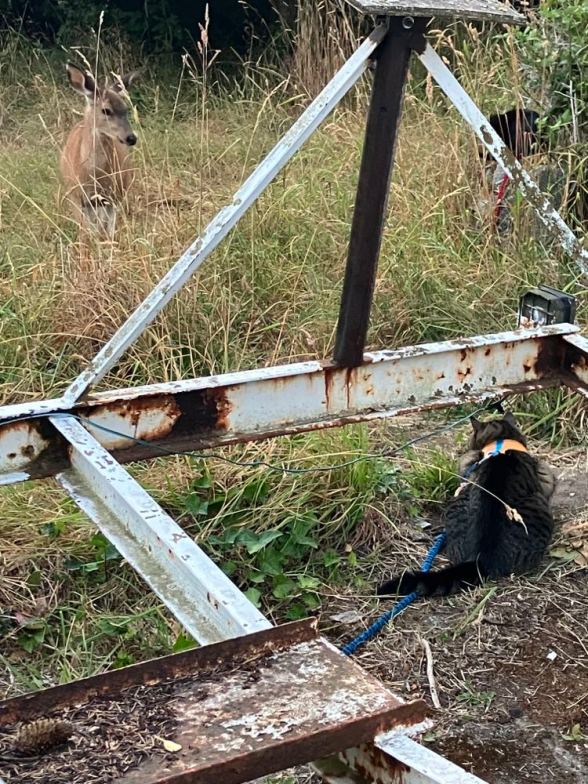
I took the cats and deer photograph yesterday.

For the Ragtag Daily Prompt: starch. They are talking about AI writing patient notes. What could go wrong? Makes my neck feel stiffer than a starched shirt!