Eating his words

After today’s international zoom on Cardiovascular Complications of Long Covid, I am thinking about one of my former partners. An ex-partner.

I got influenza in 2003. I was working full time plus all the call, had two small children, my mother had died two years before of cancer, and I was worrying about my marriage. Quite a stress load. I got influenza, running a temperature of 104 for a week and tachycardic. My heart rate was 100 at rest instead of my normal 62, and when I walked across the room slowly, it went up to the 130s or above and I got short of breath. I did not figure that out the fast heart rate immediately.

I tried to go back to work a week after I was out. By lunch time I thought, I feel like I’m dying. I stuck the pulse oximeter on my finger. My heart rate standing was 135. Oh. Normal is 60-100 and 135 is not ok. It’s exhausting. My office manager chose that moment to call me into her office and scold me for missing work. I was so freaked out by my heart rate that I did not show ANYONE in my clinic. I left and went to my physician, upstairs in the same building.

The tachycardia continued for two months.

I didn’t understand it, my Family Practice doctor didn’t understand it, and my partners accused me of malingering and were pissed. My instinct was to lie on the couch, so that’s what I did. Rest and wait. That level of tachycardia makes a person anxious, so my communication skills were challenged. After six weeks, I had an echocardiogram, which was normal EXCEPT for a fast heart rate. After two months, it went away. I staggered back to work, still frail and tired, and still down ten pounds.

One of my partners said, “I could understand you being out two months for heart disease or cancer, but not for influenza.”

At the time I didn’t say anything. That comment really, really hurt. I told myself that I should TRY to be a nice person and not wish that he would get a bad case of pneumonia with tachycardia. That took some major effort on my part.

Now with all the people with a fast heart rate after Covid-19, he can eat his words.

The path forward

Today I attended this zoom, the Schmidt Initiative for Long Covid Global Echo Webinar Series:

https://hsc.unm.edu/echo/partner-portal/echos-initiatives/long-covid-global-echo.html

Today’s topic is Cardiac Complications of Long Covid.

Whew, it’s hard to see the forest for the trees! It’s complicated! The first distinction is lungs or heart or both. The next is worsened or new measurable heart disease, which is distinguished from heart symptoms without testable heart disease.

Heart disease can include inflammatory heart disease, ischemic heart disease, cardiomyopathy, arrhythmias or clotting disorders. These are called PASC-CVD. PASC-CVD stands for Post Acute Sequelae of Covid-19 – CardioVascular Disease.

If those are ruled out, there are three major categories of PASC-CVS – CVS is CardioVascular Symptoms. One is postexertional malaise, a second is POTS (postural orthostatic tachycardia syndrome) and the third is exercise intolerance. They are all different and treated differently. The formal test for POTS is a tilt table, but for places that don’t have access, they recommended the BatemanHorne NASA 10-Minute Lean test, here. That is hugely useful! This is the international conference, in English with simultaneous translation into French, Spanish, Portuguese and Arabic. Very impressive!

I will write more about today’s lecture, but I am still trying to sort out the trees in this complex forest.

For the Ragtag Daily Prompt: forest.

I took the photograph this month hiking Mount Zion with my daughter.

Age-defying

I get lots of quasi and fringe medical emails. I subscribe to some so that I know what they are “pushing”. The current trend is online “classes” where you sign up and then they have hours of talk and interviews and stuff. The talks can be three hours or more for a week. I am offered a bargain daily to sign up to be able to access the talks over and over. Hmmm, not today, thanks. I have very low tolerance for videos and television.

Currently I’m getting notes from an “age-defying” one.

I am skeptical about “age-defying” as they are describing it. However, there is a study that I think is very convincing about how to stay healthy as you get older. It was done in England. They looked at five habits: excess alcohol (averaging more than two drinks a day), inactivity (couch potato), addictive drugs, obesity and tobacco.

They had people who had none of the five, people who had all of them and people who had one or two or more. The conclusion was that for each one added, the average lifespan dropped by about four years. That is, the people who did all five tended to die 20 years sooner on average than the ones with none of the bad habits.

Recently in the US, the news said “Gosh, it turns out that any alcohol is bad for us.” I thought, how silly, when various studies made that clear over a decade ago. There was a very nice study from Finland, with 79,000 people where they looked at alcohol and atrial fibrillation. Atrial fibrillation increases the risk of strokes. They concluded that lifetime dose of alcohol was directly related to atrial fibrillation. That is, the more you drink, the sooner your heart gets really grumpy and starts fibrillating. Alcohol is toxic to the heart, the liver, the brain. Tobacco is toxic to the lungs, the heart, the brain and everything else. The addictive drugs: well, you get the picture.

So the anti-aging prescription is pretty simple to recommend. It just is not always simple to do. That is why we still have doctors. For chronic bad habits I am part mom/cheerleader/bearleader/nag/kind helper. Here is the prescription. Feel free to send me money instead of buying that seven day set of twenty one hours of lectures:

  1. Minimal or no alcohol.
  2. No addictive drugs (that includes marijuana and THC and we have almost no studies indicating that CBD is not addictive.Remember that THC and CBD and the other 300+ cannabinoids produced by the marijuana plant were not studied because it is illegal at the federal level.)
  3. No tobacco.
  4. Exercise every day: a walk is fine.
  5. Maintain your weight, which means as you get older you either have to exercise more or eat less or both. Muscle mass decreases with age.

The last anti-aging piece is some luck. Born into a war zone? Caught in a disaster, flood, fire, tsunami? Born into a family with trauma and addiction and few resources? Huge stress in your life? Discrimination or abuse? If you have had none of these, help someone else, because you have the luck. Pass it on.

The header photograph is all family members: two are my aunts and one is a cousin of my father’s and they all play church organ! Music sustains that side of the family. I took that in 2017 in Baltimore, Maryland. We had the uncles along too!

This is my grandmother on my mother’s side. I took this in the early 1980s at Lake Matinenda.

I will try to dig up the links to the two studies.

Long Covid imaging

In the last Long Covid talk that I attended and wrote about (here: Pulmonary Manifestations of Long Covid), the pulmonologist and intensivist says that one problem with Long Covid is that we do not have imaging that can “see” it.

That is, the chest x-ray looks normal, the echocardiogram may look normal (heart ultrasound), the chest CT scan may look normal, a brain CT or MRI may look normal, but the patient may still be tachycardic, feel exhausted, feel brain fog and have multiple other symptoms.

That pulmonologist listed five of the top mechanisms that are prolonged in the immune system. Most of the scientists and physicians are framing this as “immune system dysfunction”. I am not. I am framing it as “you were really really sick and your immune system is still on high alert and trying to protect you so you can recover”. Now wait, you say, how could chronic fatigue like symptoms protect me? Well, if you are exhausted, you can’t go to work and you’ll stay quiet at home most of the time and less exposure chance. But what about brain fog? Again, this will slow your interaction with other people and force you to rest and heal. But, you say, I don’t like it. Well, yeah. Patience. We call grumpy patients that are recovering “convalescents”. It is a good sign when they are grumpy and over it and just want to be better. That doesn’t mean I can make myself or anyone else heal faster.

The pulmonologist says that the best test is the six minute walk test. This is usually done by a respiratory therapist. The person walks in a circle for six minutes wearing a pulse ox, with the respiratory therapist doing regular checks. This distinguishes between the people who have primarily a lung issue from all the other issues. If the person is tachycardic (fast heart rate) but not hypoxic (oxygen level dropping), then it’s not primarily lungs though blood clots to the lungs sometimes have to be ruled out. One of the mechanisms in the immune system is microclots and an increased risk of blood clots. That can mean heart attack, stroke, or pulmonary embolus, a clot in the lungs. The microclots are suspected of causing some of the muscle fatigue and exercise intolerance, by clogging capillaries and reducing oxygen flow to muscle cells. Muscle cells do not like this at all.

I have done my own quick walk test with patients since 2003, when I had terrible influenza. About a week after my influenza started, with the temperature of 104 and heart rate at 100 at rest and 135 walking, my temperature came down. However, the fast heart rate continued. Normal heart rate is 70-100 and 135 walking will make you feel exhausted. I lay on the couch and could barely make my kids dinner for two months. It resolved then. I read a book about influenza and thought that I had “influenza viral pneumonia” where there is lung tissue swelling, reducing the air spaces, after influenza.

My quick walk test in clinic is to check a sitting oxygen level and heart rate and then have the person walk. I would have them walk up and down a short hall three times then sit down. When they sat, I watched the pulse oximeter recovery. Some people would jump from a resting heart rate of 62 to a walking heart rate of over 100, say 120. Their oxygen level could stay normal or it could drop. If they dropped below 88, I would get home oxygen and forbid them to return to work. If their oxygen level held, then they needed to rest until their walking heart rate stayed under 100 and they were no longer exhausted by gentle or normal activity. If they return to work with a walking heart rate of 120, they will be exhausted and are more likely to get a secondary pneumonia or have other problems. The heart does not like to run at 120 all the time. You can see why a person who already has some coronary artery blockage would be more likely to have a heart attack if they get pneumonia from influenza or Covid-19.

The conferences I am attending are talking about “targets” in the immune system. That is, new drugs. I think the science is wonderful and amazing, but I also think we need to step back and say, this is a really really bad infection and some people need a lot of support and reassurance and time to heal. Reassure them that even though they have not yet returned to normal, the immune system is working hard to protect them from other infections and it is saying very very loudly that they need to rest. Rest, recuperate and trust the immune system. Some things need immediate treatment, especially blood clots, heart attacks and strokes, but once those are ruled out, we need to support people through their convalescence and healing.

______________

The photograph is from April 2021, a few days after I was put on oxygen. A selfie.

Cord stories

I would tell my pregnant patients not to let anyone tell them a really difficult delivery story until after their own delivery. “Blame me,” I would say. “Tell them your doctor says you can’t listen right now.” So if you are pregnant, read this after the baby arrives.

Umbilical cords can be scary.

I delivered babies as part of Family Practice for 19 years. I was good or lucky or both. I still saw scary umbilical cords. Cords with a true knot, where the baby has managed to tie a knot moving around. More than one of those, not tightened down. Cords with two blood vessels instead of three, which can be associated with birth defects or genetic abnormalities, but not always. Cords with an abnormal insertion. I was waiting for the placenta once, with the baby in mom’s happy arms. One puts “gentle traction” on the cord to tell when the placenta is ready. I felt like the cord tore a little. I promptly call the ob-gyn. He arrives and tears the cord off. He then gives mom some “forget this” medicine and very gently gets the placenta with a ring forceps. The cord had a velamentous insertion on the placenta. This means that instead of going all the way to the placenta and diving in and spreading, the three vessels separated a few inches from the placenta. Not very well attached and I had torn one of the three vessels. Mom and baby did fine and I was glad I had called the ob-gyn. One of the scariest umbilical cords was normal but wrapped four times around that baby’s neck. Luckily I had called the ob-gyn, she agreed something was off and mom agreed to a casaerean section. Whew.

Most umbilical cords are not scary and most deliveries are wonderful. I loved holding new babies and saying hello and welcome.

The photograph is my son, about four hours old.

For the Ragtag Daily Prompt: umbilical.

Love tale

An older couple comes to me in clinic. She is losing her memory, they explain. They are looking for a doctor who will respect her wishes. Once she goes in the nursing home, no intervention. No antibiotics, no shots, no iv, no hospital.

Yes, I say.

It is about a year before she goes in to the nursing home. I do my regular visits.

After a number of years I happen to meet her husband in the hall. “She is talking about her twenties.” he says. “She lived in an apartment and ran errands for her uncles. I am hearing all sorts of stories I never heard! I go home and type them and send them to the family.”

“That is wonderful,” I say. He visits daily.

I go on to her room. She says, “That man comes to see me. He says he’s my husband. I don’t remember, but he is such a nice man!” I think she falls in love with him again daily. He visits and is where she is in her memory.

Some time later the nursing home calls me. “She has a fever of 101 and has not eaten for two days.” I go visit and call her husband. “Should I do anything?”

“No! She’d kill me!”

“Ok. She might die.”

“I know.”

She doesn’t die. The fever comes down and she gets out of bed and is thirsty.

There is a year between my years at the hospital and setting up my private clinic. We send out postcards, trying not to send them to anyone who has died.

Her husband comes to the clinic opening. “She died last year,” he says.

“I am so sorry! We tried not to send postcards if people had died!”

“It’s ok,” he says, “I wanted to come and thank you.”

He dies about a year after she does. I hope they are together again.

For the Ragtag Daily Prompt: true love.

Volunteer

I wrote this thinking about the increasing number of homeless because of housing costs and that incomes aren’t keeping up. And even if the income has kept up, a lay-off and an illness can put people so far behind that they can end up homeless. In Denmark, they rent rooms to students in nursing homes. Part of the payment is that they have to spend time with some residents. When will we set that up here?

______________________

Volunteer

A man I know slides into kidney failure.
He’s already there when I meet him,
care for him
for a number of years.
He’s a really nice man.
Over time a bit more disheveled
unkempt
dialysis twice a week.
Even so, once on dialysis,
people die younger
than the rest of us.
Over time he is in and out of the nursing home.
loses touch with friends,
in the home so much
that even when he isn’t there
he goes there
and volunteers.
They have become his family and home.
At last he is so tired
he stops dialysis
and goes to the nursing home for the last time.
The staff call me, crying.
“He is hurting,” they say, “Do something.”
He can’t swallow.
I see him and place a fentenyl patch.
He mostly sleeps then
but is no longer in pain
He dies a few days later.
I haven’t seen this before:
The nursing home staff cry
for this man
this volunteer
this friend
and I do too.

___________

One reason that he did well at the nursing home was that they understood how frail he was and that he couldn’t do very much. They gave him very gentle volunteer jobs and enjoyed his company. Sometimes when people are very frail or ill, others avoid them or just do not understand.

Happy

Happy

May Sarton writes of happiness, in the quiet at home.

I am so happy when I dance that I smile with joy.
I wonder about the Sufis spinning
and if it is the same.
The poetry has that joy
and anyone who calls God/Dess the Beloved
has my attention.
One who was almost a friend
would laugh with me at restaurants.
Twice strangers thank us for having so much fun.
say our laughter gives them joy.
Thinking about happiness,
I think of my son’s capacity for joy
and wonder where he got it.
Surprise: from me, I think.
From me.

Pulmonary Manifestations of Long Covid

Today’s Zoom lecture was about pulmonary manifestations of Long Covid, and this is from the Schmidt Initiative for Long Covid Global ECHO Webinar Series, out of the U of New Mexico.

First of all, the talk is brilliant. The speaker is Lekshmi Santhosh, MD, MAEd, Asso Prof Med, Pulm Critical Care Med, UCSF, Intensive Care.

Two things to start with: she stressed the six minute walk test for patients, to distinguish oxygen desaturation (dropping) from the people who have terrible tachycardia (fast heart rate) only. The oxygen drop indicates that the person needs lung studies and may need oxygen, while tachycardia alone means either a heart problem, chronic fatigue/ME pattern or dysautonomia, where the heart goes fast when the person sits or stands up. Her point was that it’s a simple test and that Long Covid presents in multiple different patterns.

The second point is that there are least five main mechanisms that Long Covid can mess us up and people can have one or many. There is a review article in Nature last month (I need a copy!) and it talks about these five: immune system problems, gut microbiome problems, autoimmune responses, blood clotting/microclotting/endothelial problems and dysfunctional neurological signalling. SO: this is a MESS. She says that patient care needs to be individualized depending on which mechanism(s) are predominant and it can be more than one. This Covid-19 is a hella bad virus.

So: “The underlying biological mechanism may not be the same in each patient.” That is the understatement of the year.

She reiterates that the current diagnostic criteria, subject to change, is symptoms that last longer than 12 weeks after Covid-19 and two months past that. She states that the symptoms can wax and wane and that we need to listen to and believe patients.

In JAMA this month, there is an article that uses big data to find which symptoms are more associated with Long Covid, and lists 13 symptoms. Smell/taste tops the list but fatigue is there too. However, this is not a list for diagnosis, it’s a study list.

She also is careful to say that the treatment for the pulmonary manifestations is not the same as the people with the pattern that resembles chronic fatigue syndrome/ME. The pulmonary people can build exercise tolerance, but the CFS/ME folks need a different regimen, with pacing and energy conservation. That sounds like a subtle difference. I had both though my CFS/ME is weird. It does not put me in bed, I just can get really tired and need to sleep. It’s a bit invisible. People see me dance and would not guess that I have CFS/ME. All relative to previous function and energy, right?

For lung manifestations, she lists a pyramid, with the more rare things at the bottom. As follows:

  1. persistent dyspnea (shortness of breath)
  2. post viral reactive airways disease (asthma that can resolve from irritated pissed off lung tissue)
  3. deconditioning. She says that the isolation and quarantine with some people in very small rooms, leads to terrible deconditioning in some folks. They can build up, especially with supervised exercise with pulmonary rehabilitation and/or physical therapy. It is scary to exercise when you are short of breath and the supervision really helps, with limits on how much you should push, or encouragement to push.
  4. organizing pneumonia. This is rare and responds to steroids. Otherwise steroids are not good for the muscles in Long Covid, with the exception of inhaled steroids for the asthmatics and post viral reactive airways.
  5. post ARDS fibrosis: fibrosis is fibrous scarring that can form in the lungs. Anyone who has any terrible pneumonia and is in the ICU and intubated and on a ventilator can get this. Not everyone gets it, thankfully. ARDS is Acute Respiratory Distress Syndrome. Luckily the fibrosis is rare and it turns out that in some people it improves with time, like years. She does not recommend the pulmonary fibrosis medicines right now. There are many causes of pulmonary fibrosis besides infection.
  6. PVD: peripheral vascular disease. Covid-19 increases clotting, so we have to look for both clots and for disease in arteries, which could be lungs, brain, heart, anywhere in the body.

She says DON’T assume that chest pain is from the lungs and don’t miss cardiovascular. That is, rule out a heart attack and pulmonary embolus first.

Other lung problems have to be kept in mind that are not caused by Covid-19. This list: Reflux associated cough, pleuritic pain, neuromuscular disease, vocal cord dysfunction, tracheal stenosis, tracheomalacia. Watch for those. She says that it is very very important to look at old chest x-rays and CT scans, because those can show previous signs of emphysema/COPD/asthma/fibrosis.

Testing: She puts the 6 minute walk test first. AFTER the thorough history and making sure there are no red flags for pulmonary embolism and heart attack. Those have to ruled out if there is any suspicion. Next: pulmonary function testing. If the DLCO is low, consider a chest CT. Consider TTE -TransThoracic Echocardiogram, to look at the heart. Labs: CBC (blood count), ESR, CRP, thyroid, +/-CPK.

She has diagnosed people who are sent to her with NOT Long Covid: they have metastatic lung cancer, metastatic prostate cancer, new pregnancy, hypersensitivity pneumonitis and many other things. She says, “Don’t assume it is Long Covid. Sometimes it isn’t.”

Now, this is all a formidable list of problems and this is JUST the lungs. Long Covid can affect every system in the body and every patient is different.

She also says that she has done more disability and accommodation paperwork in the last three years than in her entire career before that. That the US disability system is a horrid mess and that she has to talk to employers and insurers OFTEN to say that the person will get better faster and have less long term problems if she treats now and they have rest and return to work may need to be very gradual.

She approaches new patients by asking which symptoms are worst. She thinks about severity of the infection, vaccination status, previous/present other medical problems and habits that can contribute or worsen things (smoking, vaping, exposures). Her clinic is for Long Covid pulmonary, but now they have opened up a neurological branch. They use multiple other specialists as well.

Last quotation: “Until we elucidate the biology and have clinical trials, treatments are largely symptomatic.” So the basic science studies working on immune system, the gut microbiome, the clotting problems, are huge in figuring out what to do in clinical trials. This is a tremendously complex illness and three years into Covid-19, we are still trying to figure out the multiple mechanisms that cause Long Covid.

This was a very hopeful lecture from my standpoint, admitting that this is complex but that we are also working to sort out the mechanisms and work on treatments. She works hard at getting patient input and feedback as well.

Two links: A free PDF from Johns Hopkins on Bouncing Back from Covid. https://www.hopkinsmedicine.org/physical_medicine_rehabilitation/coronavirus-rehabilitation/_files/impact-of-covid-patient-recovery.pdf

The American Physical Therapy Association has articles as well: https://www.apta.org/patient-care/public-health-population-care/long-covid

Also here are webinar links:

SILC Global ECHO Webinar Series Resource Links June 28, 2023

Now, how will I use the Ragtag Daily Prompt riposte for this? I think I will just say again how important it is to listen to and believe our patients!

The photograph is from Marrowstone Island, East Beach. The shape in the driftwood is sort of lung shaped.

Lungs, again

I saw the pulmonologist from Swedish Hospital last week and am still thinking about the visit.

My lung function on the pulmonary function tests did not change much from December. He gives me an inhaler, with a steroid and a long acting bronchodilator, two puffs twice a day. I use it for one day in December and promptly get Covid-19 mildly. I then ignored the inhaler until I talk to him in March. He says, “Use it for two months and we will see if your lungs improve.” I try it in March and get a cold, not Covid, within a day. I try it again in April and get a cold within two days. I then ignore the inhaler.

But at the end of March I start feeling a lot better and my fast twitch muscles start working again. I would get very tired and stiff when I use them. They are “back” but are very weak. I wanted to know if my lung testing improved too, but it didn’t. So what is going on here? I feel better but the lung studies are not better.

The pulmonologist says, “Well, the infections are probably coincidence.” Yeah, um, well, three for three. “But, if it’s not asthma, it could be bronchiectasis.” He asks when I did the methacholine test, negative, gold standard for asthma. I did it in 2014. Negative along with allergy testing.

I don’t know much about bronchiectasis. Mostly that it’s not asthma and not chronic obstructive pulmonary disease. It may be the garbage can that holds obstructive disorders that don’t fit either of those categories.

“Bronchiectasis means what?” I say. He says, “Usually there is a lot of coughing and mucous.” Nope. Well, I cough a lot with pneumonia and with colds if I don’t rest, but rarely cough anything up. “The test is a chest CT but we can’t do anything about it if you have it, so I don’t know if you want to do a CT.”

“If there’s nothing to do, then I don’t want one.” Because repeated CT scans increase cancer risk, way more so then an x-ray. I ask about work. “I still get really fatigued, and my muscles are recovering. If I am stronger at the end of the summer, I would think about work, but how would I protect my lungs?”

“Mask.” he says. “An N95 all the time would maybe help. We don’t really know.”

Ugh. We agree that I will see him in October. If my fatigue level stays where it is now, returning to work even half days is going to be too high risk, I think. I am liable to get pneumonia AGAIN and this time I might get stuck on oxygen. Or die, which I’d rather not right now.

I am reading about bronchiectasis. The Mayo Clinic doesn’t have an entry for it, though it has clinical trials and a special clinic. That would support it being a garbage can diagnosis. I am reading on Wikipedia, here, not my usual medical resource. Brochiectasis can particularly be caused by tuberculosis, mycobacterial illness. They distinguish cystic fibrosis bronchiectasis from non-cystic fibrosis bronchiectasis and other infections can cause it. Influenza, streptococcus, um, yeah, the infections I’ve had. I do not have cystic fibrosis or the alpha-1-antitrypsis disorder. And there is another disorder listed, a genetic one where the cilia don’t work right. Primary ciliary diskinesia. I don’t have that either, but my working diagnosis is PANS, with antibodies that screw up my cilia and fast twitch muscles. And that would put my lungs at risk for pneumonia.

So, says a friend, what do you need to take?

Nothing, I say. It means I have to keep stress down, be in a parasympathetic state instead of fight or flight sympathetic state, and stay the heck away from sick people. Oh, and mask on airplanes and probably avoid huge crowd things. Jazz Fest, big music festivals, riots, wars, etc. Exercise, eat right, don’t drink too much alcohol, don’t smoke anything, don’t do stupid things. Try not to get tuberculosis.

And still, I am doing well. The treatment for really bad bronchiectasis is lung transplant. I am still quite mild after four pneumonias and the kid illnesses and mononucleosis and colds and so forth. I do not cough all the time and am off oxygen. It’s looking less likely that I could return to work in person, though I don’t know about internet. It really depends on my energy level, what that does. Darn it. Uncertainty, isn’t it hella annoying? Oh, well, I am pretty used to it by now.

And that’s the lung news.

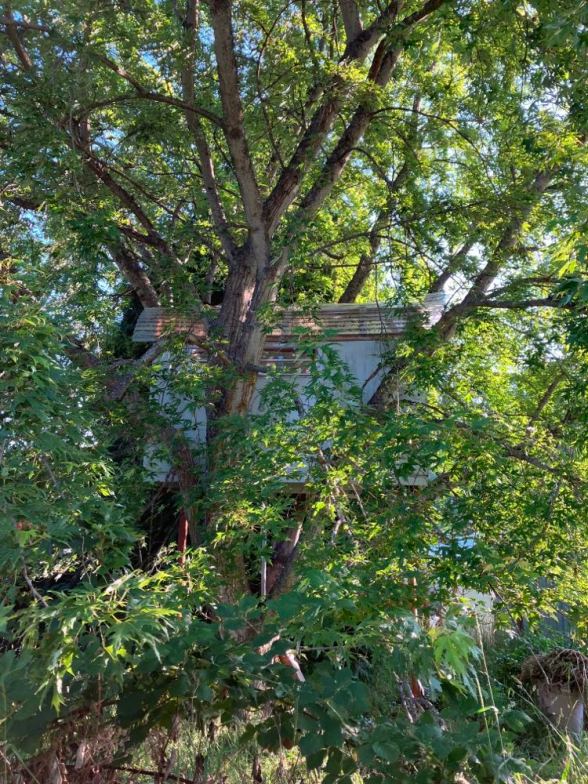
I can always hide in my tree house. But the food and water supply there is not so good.